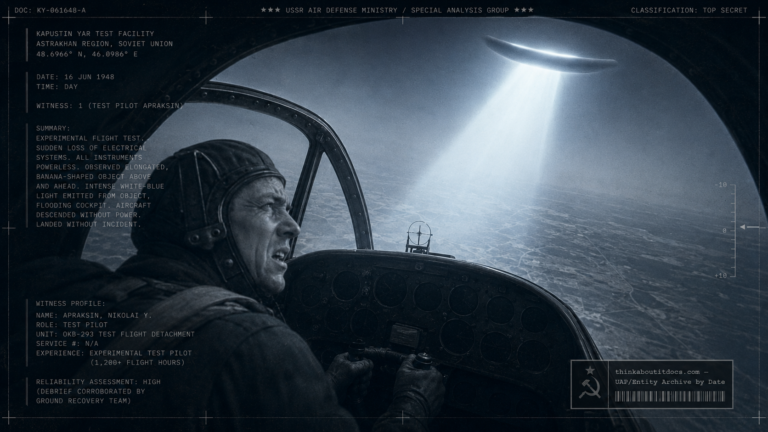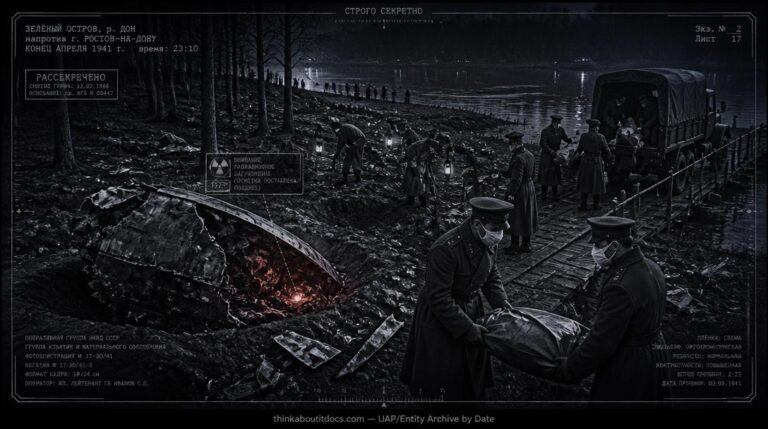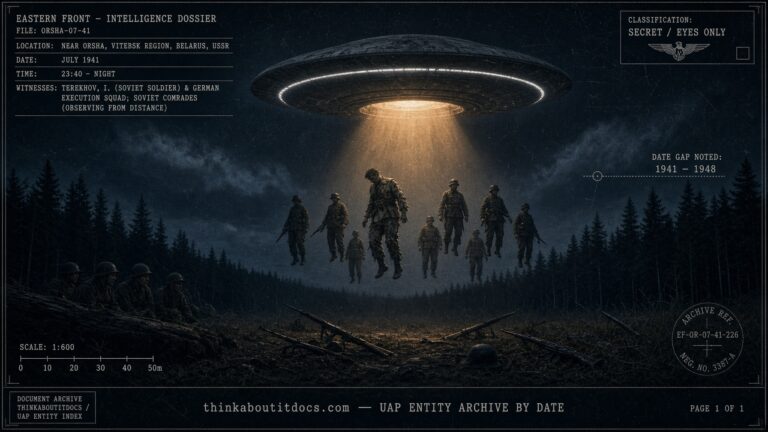
An unverified account of Capt. Peter Vusov's July 16, 1951 cannon engagement with an armed UFO near Murmansk, Russia, followed by an alleged NKVD cover-up.
THINK ABOUTIT UFO|UAP SIGHTINGS REPORT
1951: The Vusov Engagement — Near Murmansk, Russia
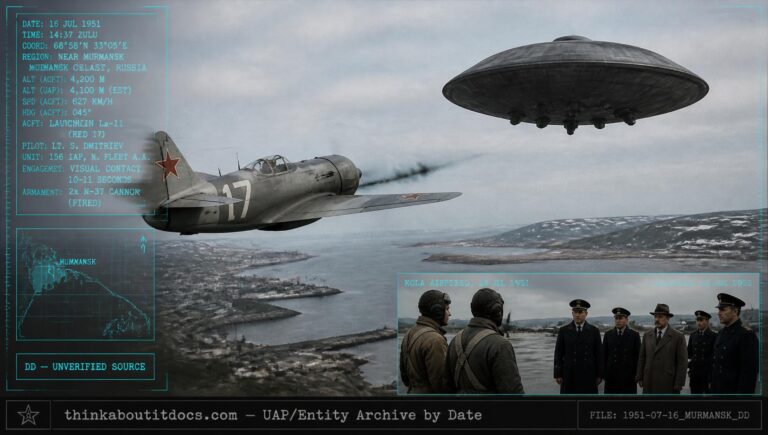
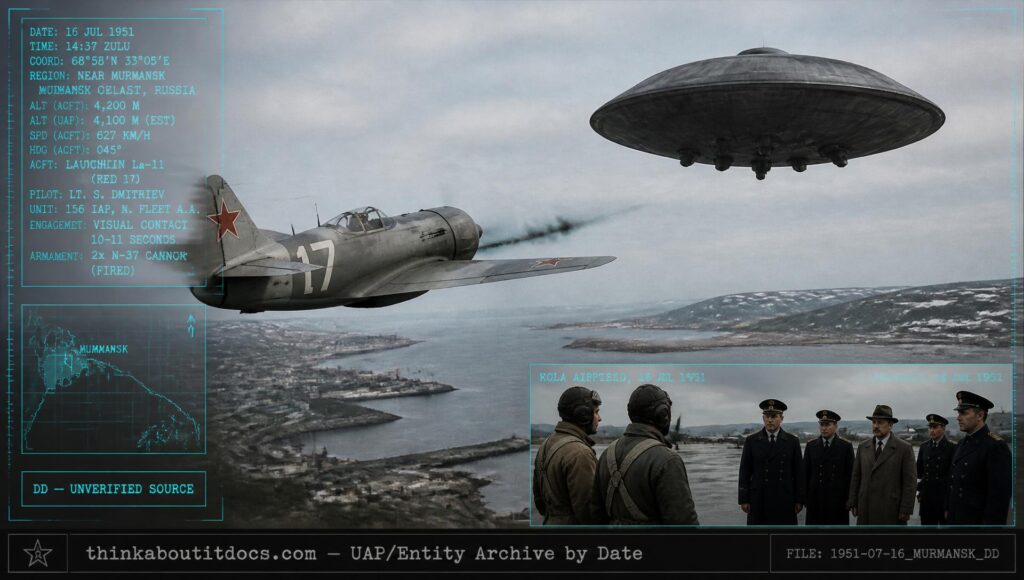
Most UFO cases from this era describe cautious pilots watching, reporting, and being told to stand down before anything escalates. This one describes a Soviet fighter pilot opening fire. According to an account circulating online since at least the early 2010s, Captain Peter Vusov, on a routine coastal patrol near Murmansk on the morning of July 16, 1951, encountered an armed, unmarked, disc-shaped craft, attacked it with cannon fire across two strafing runs, and was ordered — mid-engagement — to break off, hold radio silence, and return to base, where NKVD officers and an unidentified man in civilian clothes were waiting. It is one of the only “hostile engagement” UFO stories in this archive, and also, this report should say plainly, one of the least verifiably sourced.
Date: July 16, 1951
Sighting Time: Morning
Day/Night: Day
Location: Coastal patrol area near Murmansk, Russia, over the Barents Sea coast
Urban or Rural: Airborne, over remote coastal terrain
No. of Entity(‘s): Not applicable — no occupants seen
Entity Type: Not applicable
Hynek Classification: DD (Daylight Disc)
Duration: Not precisely recorded; the engagement itself (approach, two firing passes, order to disengage) likely unfolded over several minutes within a roughly 30-minute patrol window
No. of Object(s): 1
Description of the Object(s): A dark, unmarked, disc-shaped craft, initially mistaken for a slow-moving blimp, described as armed with what the pilot took for powerful cannons protruding from its underside
Shape of Object(s): Disc
Size of Object(s): Approximately 20 meters (roughly 65 feet) in diameter
Color of Object(s): Dark, unmarked
Distance to Object(s): Close enough for cannon engagement across two strafing runs; exact range not recorded
Height & Speed: Initially observed at roughly 4,000 meters altitude, moving at an estimated 100 km/h — slow enough that Vusov first mistook it for a blimp; the object changed course abruptly once it apparently noticed the approaching fighters
Number of Witnesses: 2 (Capt. Peter Vusov and his wingman, Lt. Ivanchenko)
Special Features/Characteristics: Appeared to be armed with visible cannon-like protrusions; showed no observable damage after being struck by 23mm cannon fire; changed course upon detecting the approaching aircraft; the incident’s aftermath — an immediate cease-fire order, enforced radio silence, and a reception by NKVD personnel and a plainclothes official upon landing — is, if accurate, as significant a detail as the aerial encounter itself. Both pilots were reportedly transferred to different, distant postings the same day and promoted, apparently as an inducement to silence.
Case Status: Insufficient Data
Source: Unattributed Russian-language source (vik.clan.su), circulating in English via various UFO forums and blogs since at least 2010-2016; no primary Soviet military record, named archival source, or serious ufological catalogue (NICAP, Vallée, Rosales) has been located to independently corroborate this account
Summary/Description: On the clear morning of July 16, 1951, according to an account of unclear original provenance, Soviet Air Force Capt. Peter Vusov and his wingman, Lt. Ivanchenko, were flying a pair of La-11 fighters on a routine coastal patrol out of Murmansk. Roughly 30 minutes into an uneventful flight, Vusov spotted a slow-moving object at about 4,000 meters altitude, initially taking it for a blimp given its estimated 100 km/h speed. Closing to investigate, he instead found a dark, unmarked, disc-shaped craft roughly 20 meters in diameter, which he described as armed with what appeared to be powerful cannons protruding from its underside. Startled, Vusov radioed his base to report the intruder. The craft’s apparent occupants seemed to notice the approaching fighters and abruptly changed course; judging the object hostile, Vusov decided to attack, firing a burst of 23mm cannon shells that reportedly had no visible effect. As he turned for a second firing pass, he received an urgent radio order to immediately cease fire, maintain complete radio silence, and return to base. Upon landing, Vusov and Ivanchenko were met by NKVD personnel and an unidentified man in civilian clothes, who firmly instructed the pilots not to discuss the encounter. That same day, Vusov was reassigned to the Pacific Fleet and Ivanchenko to Khabarovsk — postings on opposite sides of the Soviet Union — with both men reportedly receiving a promotion in rank, apparently as an inducement toward continued silence.
Related Cases: 1950-1951: The Oak Ridge/Knoxville Flap, Tennessee (comparable era, institutional secrecy pattern) | The Mantell Incident, 1948 (an earlier fatal American pilot pursuit of an unidentified object)
Detailed Report
This case has to be evaluated on two separate levels: what it claims, and how well what it claims can actually be traced back to a real, checkable source. On the level of the claim itself, the Vusov account is exceptional. Almost every military UFO encounter in this archive’s Cold War-era record describes observation, sometimes pursuit, occasionally a scramble that finds nothing — but almost never an actual weapons engagement. A fighter pilot firing live cannon rounds at an unidentified craft, and that craft apparently absorbing the hits without visible damage, would be one of the most significant physical data points in the entire post-war UFO record if it could be verified: it would represent a rare instance of a UFO’s structural resilience being tested by a known, quantifiable weapon under real combat conditions, rather than merely observed or inferred.
The aftermath described — an immediate, urgent cease-fire order transmitted mid-engagement, NKVD officers and a plainclothes handler waiting on the tarmac, and both pilots reassigned to opposite ends of the country the same day with accompanying promotions — is, if true, arguably even more significant than the aerial encounter itself. It describes a level of immediate, coordinated institutional response that would require either an extraordinarily fast decision-making chain already primed for exactly this kind of event, or a pre-existing Soviet UFO-response protocol that has never otherwise surfaced in the declassified or leaked Soviet military record this archive is aware of.
That last point is where this case runs into serious trouble. Despite extensive circulation across English-language UFO forums, blogs, and aggregator sites since at least the early 2010s, this archive has been unable to locate the story in any primary Soviet military document, any serious academic study of Cold War Soviet UFO policy, or any of the major ufological reference catalogues (NICAP, Vallée’s Magonia catalogue, Rosales’s URECAT) that have preserved comparably dramatic cases from the same era with verifiable sourcing. The earliest identifiable source for the English-language version traces to an obscure Russian-language website, itself citing an unclear original, with no named journalist, researcher, or archival document standing behind it. This does not prove the story is false — absence of evidence for a Cold War Soviet military cover-up is, almost definitionally, exactly what a successful Cold War Soviet military cover-up would look like — but it means this account currently exists as an internet-circulated story rather than a documented historical event, and it should be read accordingly.
RESEARCHER’S NOTES
The Vusov Engagement — Murmansk 1951 and the Difference Between Dramatic and Documented
- Classification issues: DD is applied for the case’s daytime, resolved-shape visual profile, though as a claimed weapons-engagement case it sits well outside the scope Hynek’s original scale was designed to categorize.
- Source chain assessment: This is among the weakest source chains for any prominent-sounding case in this archive. No primary document, named investigator, or established ufological catalogue has been located to support the account; it appears to originate from and circulate almost entirely within informal internet UFO communities. Readers should treat this case as an unverified internet-circulated story, not as documented Cold War history, until and unless a primary source surfaces.
- Pattern context: “Hostile engagement” UFO stories are rare in the broader literature specifically because they are easy to dramatize and hard to verify — a pattern this case fits closely. Genuine armed Cold War military incidents involving Soviet fighters (see the well-documented November 1951 shootdown of a U.S. Navy P2V-3W near Vladivostok by Soviet La-11s) are, by contrast, thoroughly documented in primary military records, which throws the Vusov case’s total absence from comparable records into sharper relief.
- Physical evidence and evidentiary weight: None whatsoever. No gun-camera footage, no Soviet military record, no named secondary source with any institutional standing. This case’s evidentiary weight is essentially nil by this archive’s normal standards; it is preserved for its notability within informal UFO discourse and as a documented example of how a dramatic, unsourced internet story can circulate widely without ever being traced to a verifiable origin.
- Geographic and historical context: The Murmansk coastal region was, and remains, a militarily sensitive area given its strategic Arctic naval significance, which lends the account’s setting superficial plausibility even though it does nothing to verify the specific events claimed.
The Vusov engagement is preserved here as an example of the archive’s broader commitment to honest sourcing rather than as a verified event. Taken at face value, it would be one of the most significant Cold War UFO encounters on record — an actual weapons engagement, apparently survived without damage by the object, followed by an immediate and highly organized cover-up. Taken skeptically, it is an unsourced story with no traceable origin beyond informal internet circulation, describing exactly the kind of dramatic, unfalsifiable narrative that spreads easily precisely because it cannot be checked. It is catalogued here as Insufficient Data, with the added and important note that “insufficient” here means very close to “none at all.”
“Cease fire, observe complete radio silence, and return to base.”
— Reported radio order to Capt. Peter Vusov, on the July 16, 1951 Murmansk encounter