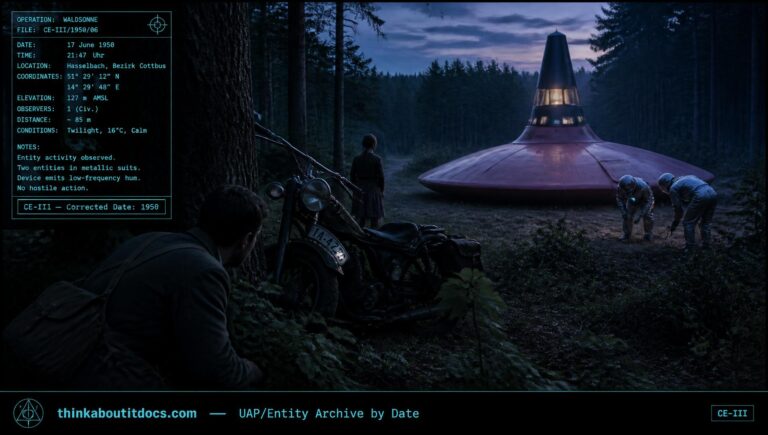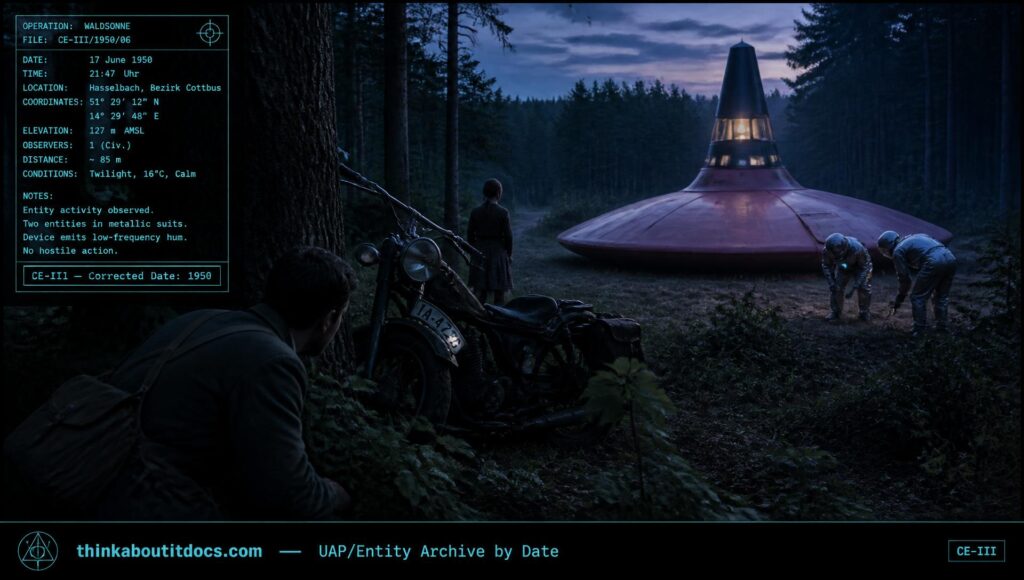
Oscar Linke's June 17, 1950 encounter near Hasselbach, East Germany — one of the earliest Cold War-era close encounters, disclosed only after his 1952 escape to the West.
THINK ABOUTIT
UFO|UAP & ENTITY ENCOUNTER REPORT
1950: The Oscar Linke Encounter — Hasselbach, East Germany
On the evening of June 17, 1950, a former mayor named Oscar Linke was walking his daughter Gabriele home after a motorcycle tire blew out near the village of Hasselbach in the Soviet-occupied zone of Germany, when the eleven-year-old pointed toward what her father first took for a young deer. It was, instead, two men in shiny metallic suits crouched beside a massive, pink, frying-pan-shaped object resting in a forest clearing. The story reached the West two years later, told under sworn oath, after Linke fled with his family to West Berlin — and it became one of the earliest and most-discussed Cold War-era close encounters, preserved in a since-declassified CIA report and investigated in detail by J. Allen Hynek.
Date: June 17, 1950 (the sighting itself; the account did not become public until Linke’s sworn statement following his 1952 escape to West Berlin)
Sighting Time: Twilight, approximately 2:30 a.m. Central European Time per some case compilations — sources disagree on whether this was an evening twilight or a pre-dawn sighting; the original sworn account describes twilight conditions consistent with evening
Day/Night: Twilight
Location: Near Hasselbach, in the Soviet-occupied zone of Germany (East Germany)
Urban or Rural: Rural — a forest clearing beside a country road
No. of Entity(‘s): 2
Entity Type: Humanoid
Entity Description: Two men-sized figures dressed in shiny, tight-fitting metallic suits, stooped over examining the ground near the object; one had a round protrusion on his chest that appeared to glow, changing from green to red
Hynek Classification: CE-III (Close Encounter of the Third Kind — occupants observed at close range)
Duration: Not precisely recorded; the observation, approach, and the craft’s departure appear to have unfolded over several minutes
No. of Object(s): 1
Description of the Object(s): A large, pink, frying-pan-shaped disc with a double row of foot-wide holes around its rim and a black, conical tower roughly 10 feet tall rising from its top
Shape of Object(s): Disc (“like a huge frying pan”), with a conical central tower
Size of Object(s): Approximately 40-50 feet (roughly 13-15 meters) in diameter; the conical tower approximately 10 feet tall
Color of Object(s): Pink
Distance to Object(s): Linke first saw the figures at roughly 140 meters (about 450 feet), then approached to within about 30-40 meters (100-130 feet) before his daughter’s shout alerted the two figures
Height & Speed: Grounded at first observation; on departure, a cylindrical support column beneath the object shifted position, the object’s color changed from green to red, it emitted a slight hum, lifted off, began spinning, and departed with an accelerating whistling sound
Number of Witnesses: 2 (Oscar Linke and his 11-year-old daughter, Gabriele)
Special Features/Characteristics: A round chest-mounted device on one figure that glowed and changed color; a retractable conical tower; a shifting cylindrical support column; a round depression left in the ground afterward, matching the shape of the support column, which Linke was able to locate and examine
Case Status: Insufficient Data
Source: Hynek, J. Allen, The UFO Report, pp. 204-206; Davis, Isabel & Bloecher, Ted, 1978; Gross, Loren E.; CIA report “‘Flying Saucers’ in East Germany” (declassified); NICAP case file 500617hasselbach
Summary/Description: On June 17, 1950, Oscar Linke, a 48-year-old former mayor of Gleimershausen, was riding his motorcycle home with his 11-year-old daughter Gabriele when a tire blew out near Hasselbach, in the Soviet-occupied zone of Germany. Walking the bike toward town in the twilight, Gabriele spotted something ahead that Linke initially mistook for a deer. Approaching alone for a closer look, he found, at a distance of roughly 140 meters, two men in shiny metallic suits crouched beside a large object resembling a huge, pink frying pan, roughly 40-50 feet across, with a double row of foot-wide holes around its rim and a black conical tower about 10 feet high rising from its center. Linke approached to within 30-40 meters before Gabriele, worried, called out to him — startling the two figures, who immediately climbed the conical tower and disappeared inside the object. The tower then retracted, a support column beneath the craft shifted position, the object’s color changed from green to red, and after a slight hum it lifted off, began spinning, and accelerated away with a rising whistling sound. Linke later found a round depression in the ground matching the support column’s shape. The account did not reach the West until 1952, when Linke and his family fled the Soviet zone; he gave sworn testimony before a West Berlin judge, and the story was carried through a Greek newspaper chain into a CIA report titled “‘Flying Saucers’ in East Germany.” Because the sighting itself is independently dated to June 17, 1950 by NICAP’s own case designation and by Hynek’s, Davis and Bloecher’s, and Gross’s period compilations — with 1952 marking only when the story became public, not when it occurred — this archive dates the case to 1950.
Related Cases: 1950: The Veghenza (Vicenza), Italy close encounter with dwarf entities, March 14 | 1950: The Lago Argentino Landing, Argentina (comparable CE-III occupant structure)
Detailed Report
The Linke case occupies an unusual position in the record for reasons that have nothing to do with the sighting’s content and everything to do with the political circumstances of its documentation. This is not a story that emerged through ordinary ufological channels — a witness contacting a local investigator, a newspaper picking it up, a research group compiling it. It surfaced because a private citizen fled a totalitarian regime, gave sworn testimony as part of establishing his credibility and circumstances to Western authorities, and that testimony happened to include an extraordinary claim from two years earlier. West Berlin intelligence officers took the account seriously enough to investigate, and it eventually reached the CIA, which filed it under a title treating it as a matter of East-West intelligence interest as much as a UFO report.
That unusual path cuts two ways for the case’s credibility. On one hand, Linke had no evident incentive to fabricate a UFO story as part of an asylum or resettlement process — if anything, an outlandish claim risked undermining his credibility on the matters that actually determined his family’s future in the West. On the other hand, the two-year gap between the claimed event and its public telling, combined with the total absence of any contemporaneous 1950 documentation from inside East Germany, means the story rests entirely on Linke’s and his daughter’s memory and honesty, tested only by a single sworn statement before a judge rather than by independent on-site investigation at the time.
The physical details Linke provided are specific enough to have shaped the case’s lasting reputation: the double row of rim holes, the retractable conical tower, the shifting support column, and above all the depression found in the ground afterward, which he was able to locate and describe. A found ground trace, even one examined only by the witness himself rather than an independent investigator, is a meaningfully different category of evidence than testimony alone, though it falls well short of a properly documented physical trace case with soil analysis or independent verification.
The entity description — human-scale figures in metallic suits, one with a glowing chest device — fits comfortably within the broader pattern of 1950-51 European humanoid reports, including this archive’s own Veghenza, Italy and other contemporaneous entries, suggesting either a genuinely shared phenomenon during this period or a shared narrative vocabulary already circulating by the time Linke’s account surfaced in 1952.
RESEARCHER’S NOTES
The Oscar Linke Encounter — East Germany 1950 and the Delayed-Disclosure Problem
- Date correction: This page previously carried the 1952 date from the CIA report’s filing, which reflects when Linke’s sworn testimony reached Western intelligence channels after his escape — not when the sighting occurred. NICAP’s own case file designation (500617hasselbach), Hynek’s UFO Report, and the Davis-Bloecher and Gross compilations all independently place the actual sighting on June 17, 1950. This page has been corrected accordingly and the case is now filed under 1950.
- Classification issues: CE-III is straightforwardly correct — two occupants were observed at close range beside their craft, with no communication or abduction involved.
- Source chain assessment: The chain runs from Linke’s own sworn statement, given under oath before a West Berlin judge shortly after his 1952 escape, through a Greek newspaper report, into a declassified CIA memorandum, and separately into the period ufological literature via Hynek, Davis and Bloecher, and Gross. This is a case where the political circumstances of disclosure are as well documented as the sighting claim itself, which is unusual and worth treating as a distinct strand of evidence about the case’s credibility.
- Physical evidence and evidentiary weight: A ground depression matching the described support column was found and examined by the witness, but not by an independent investigator at the time, and no physical sample or photograph survives. Evidentiary weight rests almost entirely on the consistency and specificity of Linke’s sworn testimony and the corroborating account of his daughter.
- Geographic and historical context: The case is inseparable from its Cold War setting — a claimed sighting inside the Soviet zone of Germany, disclosed only after a family’s escape to the West, investigated by West Berlin intelligence, and preserved through a declassified CIA file. It stands among the earliest Western-documented UFO close encounters to emerge from behind the Iron Curtain.
The Linke encounter endures as one of the earliest and most politically textured close-encounter cases on record — a story that reached the West only because its teller had already risked everything to leave a closed society, carried by channels (sworn asylum testimony, CIA intelligence filing) built for entirely different purposes than UFO research. That path lends the account a peculiar kind of sincerity while denying it the contemporaneous investigation a case of this magnitude would ideally receive. It is catalogued here, correctly dated to 1950, as Insufficient Data: a detailed, consistently told account resting on the testimony of a father and daughter, with a physical trace neither preserved nor independently examined.
“Since it was twilight, I thought that she was pointing at a young deer.”
— Oscar Linke, sworn statement, on the June 17, 1950 sighting near Hasselbach