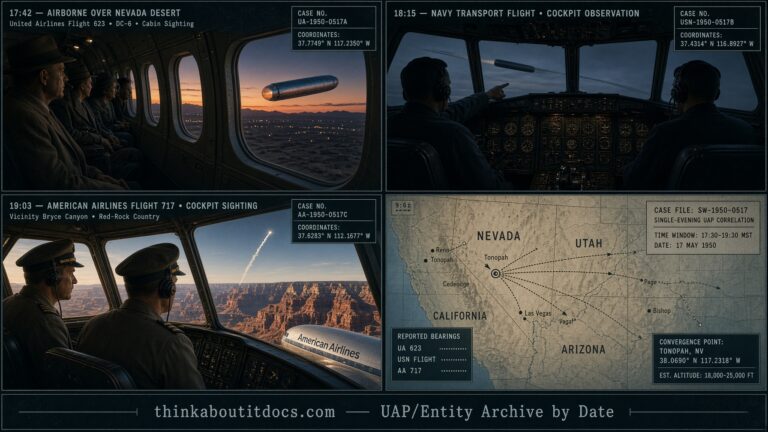
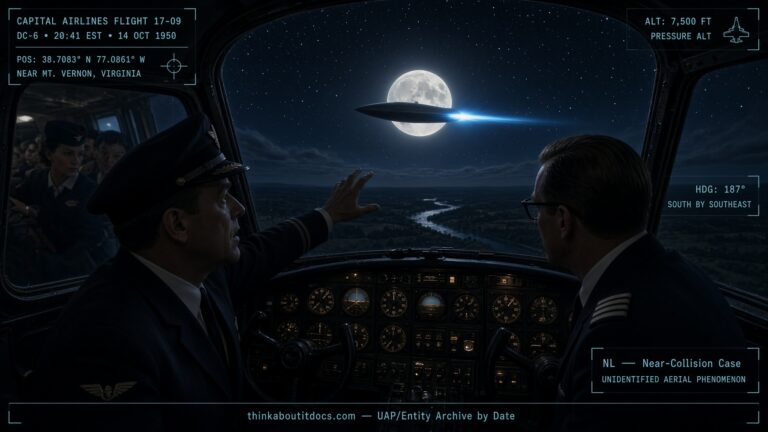
The June 24, 1950 multi-state fireball, independently reported by airline and military crews across four states within roughly an hour.
THINK ABOUTIT UFO|UAP SIGHTINGS REPORT
1950: The June 24th Multi-State Fireball
Nevada, California, Utah & Arizona
On the evening of Saturday, June 24, 1950, an extraordinarily bright object was independently reported by airline crews, military personnel, and ordinary residents across a stretch of the American Southwest spanning Nevada, California, Utah, and Arizona — hundreds of miles of territory — within roughly the same hour. A United Airlines crew and their passengers watched it pace their aircraft for twenty miles; a Navy transport crew separately tracked it changing direction; American Airlines pilots near Bryce Canyon and in northern Arizona reported it minutes later; and residents of Ely, Nevada and the surrounding region spent the following days puzzling over a persistent, glowing vapor trail. Airline officials who compared the pilots’ bearings afterward calculated the object was likely somewhere over Tonopah, Nevada — at an altitude high enough, by most estimates, to be visible across an enormous radius at once.
Date: June 24, 1950
Sighting Time: Approximately 8:08 p.m. to 9:13 p.m. PDT (20:08–21:13)
Day/Night: Night (dusk into darkness)
Location: Spanning Nevada (Daggett-Silver Lake corridor, Lovelock, Ely, Pioche, Bristol Silver Mine), southern California (near Daggett), southwestern Utah (near Bryce Canyon National Park), and northern Arizona (near Williams and Winslow) — airline officials calculated the object’s likely position as over Tonopah, Nevada
Urban or Rural: Both — airborne over remote desert terrain, with corroborating reports from small towns and airport personnel
No. of Entity(‘s): Not applicable
Entity Type: Not applicable
Hynek Classification: NL (Nocturnal Light) — though the case is better understood as a multi-witness, multi-location wave event than a single localized sighting
Duration: Individual sightings lasted roughly three to five minutes each; the vapor trail persisted and was visible for approximately 20 minutes to half an hour after the object itself faded
No. of Object(s): 1 (as reconstructed by airline officials from the combined bearings), though multiple independent witness groups each describe it somewhat differently
Description of the Object(s): Described by the United Airlines crew as a brilliant, bluish-centered, cylindrical or dirigible-shaped object with an orange tint; described separately by the Navy transport crew as a dark gray or gunmetal, cigar-shaped object with a faint radiant exhaust, roughly 1/8 the angular size of the full moon; described by American Airlines pilots near Bryce Canyon and in Arizona simply as an “exceedingly bright object” leaving a vapor trail. None of the pilot witnesses described it as a “flying saucer” in the classic disc sense.
Shape of Object(s): Cylindrical / cigar-shaped / dirigible-like, according to the two aircrews who reported a resolved shape rather than a point of light
Size of Object(s): Not fixed — witnesses candidly acknowledged that size, distance, and altitude could not be judged accurately without an independent reference; estimates of altitude ranged from roughly 20,000 feet to 100,000 feet depending on the assumed distance
Color of Object(s): Bluish-centered with an orange tint (United Airlines account); dark gray/gunmetal with faint radiant exhaust (Navy account)
Distance to Object(s): The United Airlines crew estimated 20-30 miles; using the reported elevation angle, this would place the object between roughly 28,000 and 42,000 feet, though most pilot altitude estimates ran considerably higher, implying a correspondingly greater distance
Height & Speed: The United Airlines aircraft was cruising at 14,000 feet and 290 mph; the object paced it on a parallel course for approximately twenty miles over three to five minutes before fading. The Navy crew’s object was estimated at 1,000-1,500 mph, traveling north before turning west and disappearing over roughly three minutes.
Number of Witnesses: Extensive — a United Airlines captain, first officer, and observing captain, plus approximately 25 to 50 passengers; a separate Navy transport crew (pilot, copilot, navigator); roughly 30 pilots and ground personnel at Lovelock, Nevada’s airport; four additional pilots on the ground at Silver Lake; CAA personnel at Las Vegas and Daggett; three American Airlines flight crews near Bryce Canyon, Williams, and Winslow; and numerous named and unnamed residents across Nevada, Utah, and Arizona who reported the vapor trail over the following days
Special Features/Characteristics: An unusually bright, glowing bluish-white vapor or smoke trail persisted for 20 minutes to half an hour after the object itself faded from view, described by some Nevada witnesses as forming a distinctive “3” shape in the sky. The event was independently corroborated across a geographic span of several hundred miles within roughly an hour.
Case Status: Insufficient Data
Source: Jan Aldrich; David Rudiak; Weinstein, Dominique; The UFO Evidence (Richard Hall, ed., 1964); Ely Daily Times, June 26, 1950; Reno Evening Gazette, June 28, 1950; NICAP (case certified by Paul Cerny, Bay Area NICAP Subcommittee)
Summary/Description: Beginning around 8:08 p.m. PDT on June 24, 1950, a United Airlines crew — Captain E. L. Remlin, First Officer David Stewart, and observing Captain Sam B. Wiper — along with roughly 25 to 50 passengers, watched a brilliant, bluish-centered, cylindrical object with an orange tint pace their aircraft on a parallel course for about twenty miles before it faded. The United crew alerted a nearby Navy transport pilot, whose copilot independently spotted a dark, cigar-shaped object with a faint exhaust; it traveled north for about three minutes before turning west and vanishing. Both crews discussed the sighting with CAA ground stations at Daggett and Silver Lake, California. Roughly five minutes later, at approximately 9:13 p.m. PDT, three separate American Airlines flight crews near Bryce Canyon National Park in Utah and near Williams and Winslow in northern Arizona — locations separated by well over a hundred miles from the original sighting and from each other — independently reported an exceedingly bright object trailing a vapor trail, with the Winslow-area pilot describing it as extremely high, apparently burning out around 18,000 feet. Airline officials, comparing the various bearings afterward, calculated the object’s likely position as over Tonopah, Nevada, a location roughly consistent with all the reports if the object were at extreme altitude and therefore visible across a very wide radius. Separately, residents throughout central and eastern Nevada — including Ely, Pioche, and the Bristol Silver Mine area — reported a bright, glowing vapor or smoke trail that persisted in the sky for twenty minutes to half an hour, which local newspapers covered over the following days as a distinct but related phenomenon.
Related Cases: 1950: The TWA Flight 117 Pursuit, Indiana | 1950: The Mt. Vernon, Virginia DC-6 Near-Collision | 1950: The Farmington Armada, New Mexico (comparable multi-witness wave structure)
Detailed Report
What makes the June 24 event unusual is not any single sighting’s strangeness but its geographic and professional breadth. Airline pilots, a military aircrew, CAA ground controllers, and ordinary townspeople across four states independently reported some version of the same phenomenon within roughly an hour of each other — a pattern of corroboration that is difficult to produce by coincidence, yet also consistent with a natural but rare high-altitude event visible across an enormous area, such as an unusually bright meteor, a high-altitude balloon breakup, or re-entering debris. The individual witness accounts do not agree perfectly with one another: the United Airlines crew described a bluish, orange-tinted cylinder; the Navy crew, a dark gunmetal cigar; the Utah and Arizona pilots, simply an “exceedingly bright object” with a vapor trail. That kind of variation is exactly what one would expect from multiple observers viewing the same object from very different angles, distances, and lighting conditions — or, alternatively, from several distinct phenomena mistakenly conflated into one event during the frenzy of contemporary press coverage.
The United Airlines case, documented separately as a Blue Book Unknown, carries the most operational detail: two named airline captains, a first officer, and dozens of passengers over a multi-minute pacing observation, followed immediately by cross-referral to a second aircrew and to two separate CAA ground stations. Captain Wiper’s willingness to call the object a “flying saucer” despite the Air Force’s official denial that such things existed, paired with his and Stewart’s professional caution about specific altitude and distance figures, reads as a credible, methodologically honest account rather than an embellished one.
The Bryce Canyon and Arizona sightings, arriving from three separate American Airlines crews within minutes of the Nevada/California reports, are the detail that turns this from a single strong sighting into a genuine regional event. Airline officials’ own reconstruction — triangulating the various bearings to a probable position over Tonopah, Nevada — is a serious, methodologically sound piece of period analysis, and it points toward an object at very high altitude, which would explain how it could be seen, at slightly different times and from different angles, across such a wide territory. High altitude is also consistent with the mundane candidate explanations most likely to be raised for this kind of event: a bright meteor fireball, a high-altitude balloon, or (less commonly proposed for 1950) descending space debris, none of which this archive can confirm or rule out from the available record.
The persistent vapor trail reported across central Nevada in the following days adds a secondary, semi-independent line of evidence — though vapor or condensation trails from conventional high-altitude phenomena, including bright meteors and some aircraft contrails under certain atmospheric conditions, are also known to persist visibly for extended periods, so this detail alone does not resolve the case’s origin.
RESEARCHER’S NOTES
The June 24th Multi-State Fireball — 1950 and the Value of Independent Triangulation
- Classification issues: NL is applied loosely here — this is fundamentally a multi-location wave event rather than a single classifiable sighting, and readers should treat the Hynek tag as describing the individual component sightings rather than the event as a whole, consistent with how this archive treats other multi-incident wave pages such as the Farmington Armada.
- Source chain assessment: This case benefits from unusually strong contemporaneous newspaper documentation (the Ely Daily Times and Reno Evening Gazette both covered it within days) alongside a signed, NICAP-certified witness report from the United Airlines crew. The convergence of independent newspaper, airline-official, and NICAP-certified witness sourcing gives this case a stronger documentary foundation than most single-witness reports from the same year.
- Pattern context: The event’s structure — a single high-altitude phenomenon visible across a wide geographic radius, triggering independent reports that were only later recognized as describing the same object — is a documented pattern in ufology, and investigators should weigh a conventional high-altitude explanation (bright meteor, balloon, re-entering debris) seriously alongside a genuinely anomalous one before treating the geographic spread itself as evidence of something extraordinary.
- Physical evidence and evidentiary weight: No photograph or film survives, but the number, professional caliber, and geographic independence of the witnesses — commercial and military aircrews, CAA ground controllers, and townspeople across four states — gives this case unusually broad evidentiary weight for a 1950-era sighting, even without physical corroboration.
- Geographic and historical context: The event occurred across the same general Nevada-Utah-Arizona-California test and transit corridor that produced a disproportionate share of the era’s best-documented military and airline sightings, reflecting the region’s dense concentration of commercial air routes, military aviation activity, and, later, nuclear and missile testing infrastructure.
The June 24, 1950 event stands as one of the broadest single-night UFO waves in this archive’s early record — independently reported by professional aircrews and ordinary residents across four states within about an hour, with airline officials themselves undertaking a serious, if informal, triangulation effort. Whether it represents one extraordinary object, a natural high-altitude phenomenon visible across an enormous area, or several distinct events loosely stitched together by contemporary press coverage cannot be resolved from the surviving record. It is catalogued here as Insufficient Data: a wave event too broadly and credibly witnessed to dismiss, but never conclusively explained in either direction.
“I’ve never seen anything in the skies that remotely resembled what I saw Saturday night.”
— First Officer David Stewart, United Airlines, on the June 24, 1950 sighting