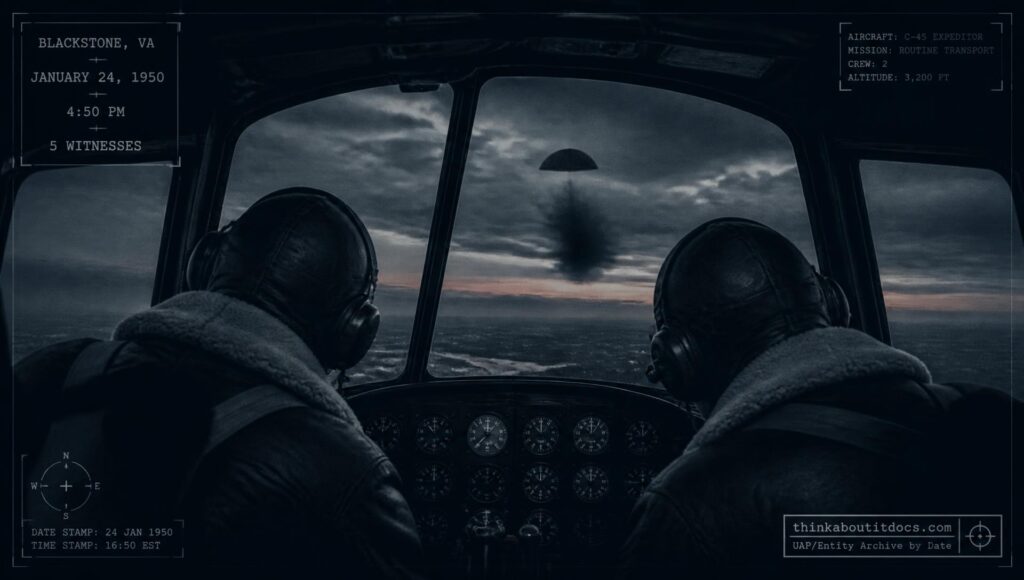
January 24, 1950 — Pentagon officials and two USAF pilots track a maneuvering object near Blackstone, Virginia for over 15 minutes.
THINK ABOUTIT UFO|UAP SIGHTINGS REPORT
1950: The Blackstone, Virginia Encounter
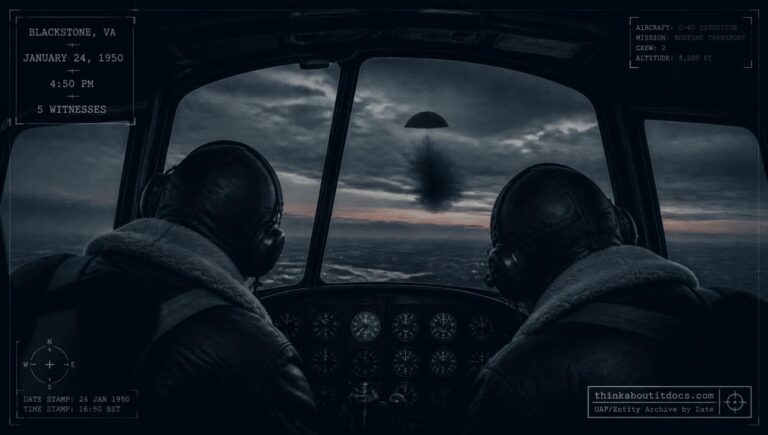
Three Pentagon officials and two combat-experienced Air Force pilots watched a dark, 200-250-foot hemispherical object shadow their transport plane for over 15 minutes near Blackstone, Virginia — moving with no turn radius at all, vanishing at what may have been thousands of miles per hour, then reappearing miles away to “wiggle” in place before disappearing for good.
Date: January 24, 1950, BBU
Sighting Time: 4:50-5:05 p.m. (EST)
Day/Night: Day (dusk)
Location: Near Blackstone, Virginia, aboard a USAF C-45 transport aircraft
Urban or Rural: Rural (aerial)
No. of Entity(‘s): Not Applicable
Entity Type: Not Applicable
Entity Description: Not Applicable
Hynek Classification: DD (Daylight Disc)
Duration: Over 15 minutes total, across two separate observation phases
No. of Object(s): 1
Description of the Object(s): A dark, hemispherical, parachute-shaped or flying-wing-shaped object, darker than the surrounding 50% cloud cover and clearly distinguishable from any cloud; a large black smoke-like region below it, roughly three times the object’s diameter, possibly obscuring the lower portion of what might have actually been a full sphere
Shape of Object(s): Hemispherical/parachute-shaped, resembling a flying-wing aircraft profile
Size of Object(s): Approximately 200-250 ft in diameter
Color of Object(s): Dark, with an associated black, smoke-like region beneath it
Distance to Object(s): Approximately 5-10 miles
Height & Speed: About 7,000 ft altitude; moved horizontally at an estimated 300+ mph with no noticeable turn radius, and later receded at extreme speed (possibly as much as 6,000 mph based on its rate of disappearance), covering an estimated 200+ miles in about 1.5 minutes
Number of Witnesses: 5 (three Pentagon officials, pilot Capt. G. B. Edwards, copilot Capt. Theron C. Fehrevach; a sixth witness, 1st Lt. John H. Van Santen, also observed the second phase)
Special Features/Characteristics: Multiple High-Level Government/Military Witnesses, Zero Turn-Radius Maneuvering, Extreme Estimated Departure Speed, Two-Phase Sighting With a Gap, Stationary “Wiggling” Behavior, Pilot Actively Maneuvered Toward the Object
Case Status: Unexplained
Source: Sparks Database of Bluebook Unknowns, Version 1.7, Dec. 31, 2003
Summary/Description: Three Pentagon officials and two USAF combat flying officers — pilot Capt. G. B. Edwards and copilot Capt. Theron C. Fehrevach — were flying a C-45 transport plane on a heading of 26° at 5,000 ft when they saw a dark, hemispherical or flying-wing-shaped object, about 200-250 ft in diameter, at roughly 20° azimuth and 7,000 ft altitude, 5-10 miles away, with a large black smoke-like region beneath it about three times its own diameter. The object was distinctly darker than the 50% cloud cover and easily distinguished as not being a cloud. It moved smoothly to the right to about 32° azimuth at over 300 mph, then back again, with no noticeable turn radius at either end. Edwards climbed the C-45 to 7,000 ft to match its altitude and turned toward it. Army Courier Service passenger 1st Lt. John H. Van Santen, alerted by Fehrevach, also saw the object move right and then left by about 12° again — before it receded away at extremely high speed and disappeared, possibly covering over 200 miles in about 1.5 minutes based on how it shrank from view. About 1.5 minutes later, the object reappeared 30-45° to the right of the aircraft’s heading, at the same altitude but a greater distance, now stationary and “wiggling” or oscillating horizontally within a distance of about 1-1.5 times its own width. It then moved horizontally back to dead ahead of the aircraft and disappeared again, receding into the distance at high speed.
Detailed Report
Few 1950 cases in this archive combine this many corroborating factors at once: multiple witnesses, several with professional flight or military intelligence backgrounds, a pilot who actively changed course and altitude to close the distance rather than simply watching from afar, and a described maneuver profile precise enough to include specific azimuth changes and a near-total absence of turn radius at the extremes of its lateral movement.
The zero-turn-radius direction reversal is the detail most difficult to reconcile with a conventional aircraft or natural phenomenon of the era — a solid object of the estimated 200-250 ft size reversing direction with no arc is not a maneuver 1950-era aviation technology could replicate. The object’s apparent “wiggling” in place during its second appearance, combined with its extreme estimated departure speed on both ends of the encounter, together with the two-phase structure (departure, gap, reappearance, final departure) makes this one of the more behaviorally complex single-witness-group sightings in this archive’s 1950 record.
No radar confirmation, photograph, or independent ground observation is documented alongside the aerial account. The witnesses’ identities and professional roles (Pentagon officials, combat pilots, an Army courier officer) are specifically named in the source record, which is unusual for a case of this era and lends the account a level of named accountability not present in most anonymous or initials-only reports in this archive.
RESEARCHER’S NOTES
The Blackstone Encounter — Virginia 1950 and the Weight of a Named Chase
- Classification issues/corrections: Filed as DD given the daytime/dusk timing and the object’s disc/hemisphere-adjacent shape; no entity or landing is claimed, and the encounter remained purely aerial and visual throughout.
- Source chain assessment: The case is preserved in Brad Sparks’s Comprehensive Database of Blue Book Unknowns, a rigorously compiled secondary source drawing on original case files; the named witnesses (Edwards, Fehrevach, Van Santen) and their stated roles (Pentagon officials, USAF combat pilots, Army Courier Service) suggest derivation from an original incident report rather than a later, less-attributed retelling.
- Pattern context/comparative cases: The active pursuit behavior — the pilot deliberately climbing and turning to close on the object — sets this case apart from the majority of passive sighting reports in this archive, aligning it more closely with a small number of other pilot-pursuit cases from the same era, though no direct connection to any specific one is documented.
- Physical evidence/evidentiary weight: No photograph, radar record, or ground corroboration exists. The case’s evidentiary weight rests on the number and stated professional background of its witnesses and the internal consistency of a fairly complex, two-phase account — a strong witness case without physical confirmation.
- Geographic/historical context: Blackstone, Virginia sits near Fort Pickett (then an active Army training installation) and within the broader Washington, D.C. defense corridor; no source consulted for this report connects the sighting to any specific installation or program in the area.
A pilot who turns toward an unknown object rather than away from it, and a passenger list that includes named Pentagon officials rather than anonymous civilians, gives this case a level of accountability rare in this archive’s record. Whatever the object was, the account of how it moved — the reversals with no turning arc, the vanishing act, the stationary wiggle — remains unexplained by any conventional aircraft of 1950.
“Easy to distinguish as not being a cloud.”
Sparks Database of Bluebook Unknowns, describing the January 24, 1950 Blackstone, Virginia sighting.