Near Simferopol, Crimea, 1931 — Yakov Tabunshikov's account of a transparent globe with a red-bearded, red-clothed occupant, now traced to contemporary New York Times coverage.
THINK ABOUTIT UFO|UAP | ENTITY ENCOUNTER REPORT
1931: Simferopol Crimea: The Transparent Globe UFO
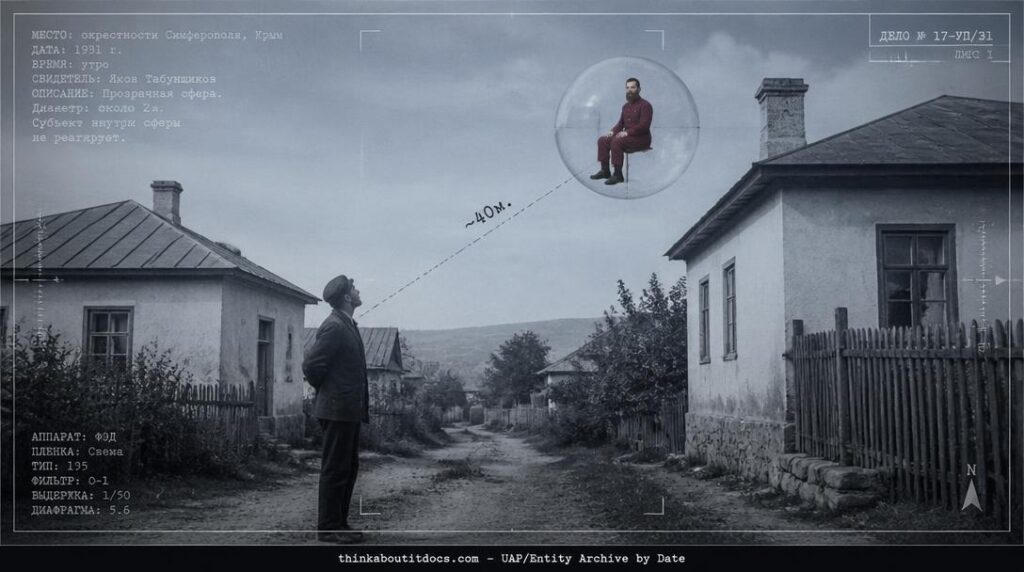
On a morning in 1931, near Simferopol in Soviet Crimea, a man named Yakov Tabunshikov looked up to see a completely transparent globe, no more than two meters across, drifting silently between his house and a neighbor’s roughly forty meters away — and inside it, seated as though on an invisible chair, a red-bearded, red-haired man in red clothing, staring fixedly ahead with an expression of total, emotionless indifference to the human watching from below. The case reached this archive for years through a thin catalogue citation; it is in fact traceable to contemporary New York Times coverage from August 1931, making it one of the better-documented occupied-craft sightings anywhere in the pre-1947 Soviet record.
Date: 1931 (specific day undocumented; press coverage dated August 22 and 27, 1931)
Sighting Time: Morning
Day/Night: Day
Location: Near Simferopol, Crimea (then Ukrainian SSR, USSR)
Urban or Rural: Residential/suburban — between two houses
No. of Entity(‘s): 1
Entity Type: Human-appearing occupant, unidentified origin
Entity Description: Fully human in appearance; red clothing, no helmet; light red beard and thick, longish red hair; wrinkled face; seated in a fixed posture with no visible chair or support; fixed, emotionless expression, entirely unresponsive to the witness
Hynek Classification: CE-III (Close Encounter of the Third Kind — craft and occupant both observed at close range, no interaction)
Duration: Undocumented; sufficient for the witness to register full detail of the occupant’s clothing, hair, beard, and posture before the globe drifted away
No. of Object(s): 1
Description of the Object(s): A completely transparent spherical globe with no visible engine, propulsion system, or structural framework
Shape of Object(s): Sphere/globe
Size of Object(s): No more than 2 meters in diameter
Color of Object(s): Fully transparent
Distance to Object(s): Approximately 40 meters
Height & Speed: Hovering/floating at roof height; drifted away at an undocumented, apparently unhurried pace
Number of Witnesses: 1 (Yakov Tabunshikov)
Special Features/Characteristics: Complete transparency of the craft with no visible propulsion; occupant seated on no visible support structure (“as if on an invisible chair”); occupant’s total behavioral indifference to being observed, distinct from more interactive pre-modern entity accounts
Case Status: Unexplained.
Source: Primary: John Keel, Flying Saucer Review Vol. 16 #4, p.10, citing the New York Times, August 22 and 27, 1931. A separate, parallel investigation citation via Albert S. Rosales’s catalogue attributes research to Mikhail Gershtein and Anton Anfalov; Anfalov is this archive’s standing flagged source for Soviet/CIS-territory cases, and this secondary chain is noted with that caveat rather than relied upon as primary.
Summary/Description: In 1931, near Simferopol in Soviet Crimea, Yakov Tabunshikov observed a completely transparent spherical globe, no more than two meters in diameter, hovering roughly forty meters away between his home and a neighbor’s. Inside, a fully human-appearing man in red clothing, with a red beard and long red hair and a wrinkled face, sat as though on an invisible chair, staring fixedly ahead with a blank, emotionless expression, apparently entirely unaware of or indifferent to the witness below. The globe and its occupant drifted away and vanished from sight without further incident. The case was covered contemporaneously by the New York Times in August 1931.
Related Cases: 1931: UFO|UAP & Entity Sightings Archive
Detailed Report
The Simferopol case’s source chain is unusual among this archive’s pre-1947 Soviet-territory entries in that it does not rest solely on later catalogue compilation. John Keel, writing in Flying Saucer Review volume 16, issue 4, cites the New York Times itself — coverage from August 22 and 27, 1931 — as the origin of the report. A contemporary Western newspaper carrying a Soviet-territory sighting during this period is itself notable: it means the case reached international attention within the same year it allegedly occurred, rather than surfacing decades later through retrospective compilation, which is the far more common pattern for Soviet pre-1947 material available to Western researchers. That contemporaneity is the case’s single strongest evidentiary asset.
A second citation chain exists in parallel, running through Albert S. Rosales’s Humanoid Encounters catalogue to an investigation credited to Mikhail Gershtein and Anton Anfalov. Anfalov’s involvement is flagged here as a matter of this archive’s standing editorial policy on Soviet and CIS-territory cases, where his sourcing has proven unreliable in prior entries. This does not necessarily mean the Gershtein/Anfalov investigation contradicts or undermines the Keel/NYT chain — the two may simply represent independent later research converging on the same original press report — but this archive treats the New York Times-sourced chain as primary and the Gershtein/Anfalov chain as a secondary, caveat-bearing addition rather than co-equal corroboration.
RESEARCHER’S NOTES
The Simferopol Globe — 1931 and the Indifferent Occupant Pattern
- Source Chain Correction: This entry’s sourcing has been corrected from a vague bundle of general catalogue names to its actual traceable origin: John Keel’s citation of contemporary New York Times coverage. This is a meaningfully stronger source than the catalogue-only citations typical of pre-1947 Soviet-territory cases in this archive, and the correction should be treated as raising this case’s evidentiary standing accordingly.
- Classification Rationale: CE-III is assigned on the strength of a clearly observed craft and a clearly observed occupant at moderate range. The case does not rise to CE-IV or any interactive tier because no communication, pursuit, or physical interaction occurred — the occupant’s defining feature is precisely the absence of any acknowledgment of the witness.
- Pattern Context: The “indifferent occupant” — an entity plainly visible to and observable by a witness, yet displaying no awareness of or response to being watched — is a distinct behavioral category within this archive’s pre-1947 CE-III record, separable from cases where occupants gesture toward, point at, or otherwise register witnesses (e.g., Burns, Oregon, 1929) or appear startled or responsive to being watched (e.g., Greensboro, North Carolina, 1930). This archive flags the pattern as worth tracking across future years rather than treating each instance as isolated.
- Evidentiary Weight: Single witness, but with contemporary press coverage rather than decades-later retrospective compilation — a meaningfully different evidentiary category from most of this archive’s pre-1947 entries. No physical trace, photograph, or second witness exists. The case is logged as Unexplained on the strength of the contemporary sourcing and the specificity of the description.
The Simferopol transparent globe stands, after this session’s source correction, as one of the better-documented Soviet-territory pre-1947 occupied-craft cases in the archive — not because of overwhelming physical evidence, but because it was reported and printed within the same year it occurred, by a source this archive can independently trace rather than merely inherit through later compilation.
“He was amazed to see a man seating inside the globe, as if seating on an invisible chair. The man was dressed in red clothing without a helmet. He had a light red beard and a thick red longish hair on his head. His faced appeared wrinkled. He stared ahead of him in a fixed glance, emotionless, completely ignoring the witness.”
Case summary describing Yakov Tabunshikov’s 1931 Simferopol, Crimea sighting