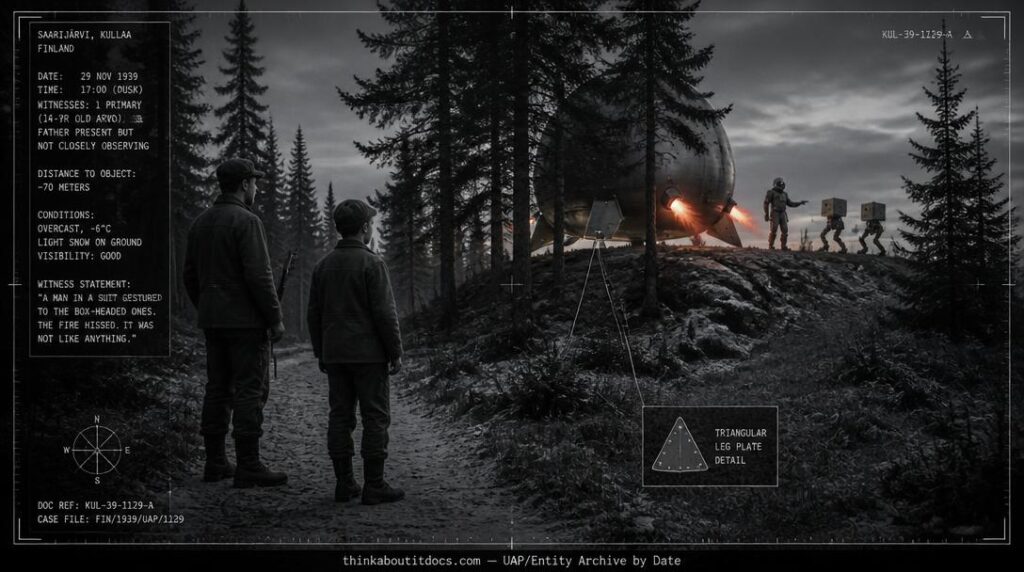
Saarijarvi, Finland, November 29, 1939 — one day before the Winter War, fourteen-year-old Arvo watched a suited operator direct articulated robot-like units beside a landed kettle-shaped craft.
THINK ABOUTIT UFO|UAP | ENTITY ENCOUNTER REPORT
1939: Saarijarvi Finland – The Robot Crew Before the Winter War
At five in the evening on November 29, 1939 — one day before the Soviet invasion of Finland launched the Winter War — fourteen-year-old Arvo was walking home through the forest near Saarijarvi with his father when he spotted, on a small rocky hillock seventy meters off the path, a strange kettle-shaped device on triangular landing legs, flame vents angled from its sides, and a suited figure directing two or three articulated robot-like beings. His father pulled him away before he could get closer. The next morning, with his country now at war, Arvo went back alone against his father’s wishes and found a triangular leg-mark pressed into the ground and a strong, unpleasant smell lingering in the clearing. This is one of the most technically precise craft-and-crew descriptions in this archive’s entire pre-modern record.
Date: November 29, 1939 (observation); November 30, 1939 (trace investigation, the day the Winter War began)
Sighting Time: 17:00, twilight
Day/Night: Dusk/twilight
Location: Saarijarvi, Kullaa, Finland
Urban or Rural: Rural — forest path, small rocky hillock
No. of Entity(‘s): 3 to 4 (1 suited operator, 2–3 robot-like units)
Entity Type: One human-scale suited operator; two or three smaller robot-like units
Entity Description: Operator — approximately 160 cm tall, wearing an astronaut-like suit with a round helmet featuring an oval opening, carrying a box-like device apparently used to direct the smaller units. Robot units — box-shaped heads, articulated rod-like legs lifted unusually high while walking, ending in flat plates at ground contact.
Hynek Classification: CE-III (Close Encounter of the Third Kind — craft and differentiated crew observed at close range) with CE-II physical trace elements (triangular leg-mark, persistent unpleasant odor)
Duration: Not precisely recorded; sufficient for detailed observation of the craft’s structure, exhaust behavior, and crew activity from a distance of 70 meters before the witness was drawn away by his father
No. of Object(s): 1
Description of the Object(s): 3–4 meters in diameter, narrowing toward the top (obscured by dense fir trees); round, kettle-shaped lower section approximately 2.5 meters in height; supported on what appeared to be three landing legs, each composed of 2–3 rods ending in triangular plates; a dull, inverted-candle-flame-like glow approximately 1.5 meters long hung from the underside; five or six distinct colored flames, each roughly a meter long, shot outward from the lower sides at a 45-degree downward angle, producing a sound like escaping gas
Shape of Object(s): Kettle-shaped lower body, narrowing upper section
Size of Object(s): 3–4 meters in diameter; approximately 2.5 meters in height at the visible lower section
Color of Object(s): Not specified beyond the described flame colors emanating from its sides and underside
Distance to Object(s): Approximately 70 meters
Height & Speed: Grounded on landing legs throughout the observation; no departure witnessed by Arvo, who was led away by his father before any liftoff
Number of Witnesses: 1 primary (Arvo, age 14); his father was present but reportedly did not look closely and actively discouraged approach
Special Features/Characteristics: Multi-colored angled exhaust flames with an escaping-gas sound; a differentiated crew — one suited operator using a hand-held device to direct multiple smaller articulated units; robot units’ distinctively high leg-lift gait; triangular landing-leg ground impression discovered the following morning; strong unpleasant odor persisting at the site; observation occurring on the eve of, and trace investigation occurring on the first day of, the Winter War
Case Status: Unexplained.
Source: Mervi Virtanen, Finland.
Summary/Description: On the evening of November 29, 1939, fourteen-year-old Arvo, walking home through the forest near Saarijarvi with his father, spotted an unusual kettle-shaped device on a small rocky hillock about seventy meters from the path. The craft, 3–4 meters in diameter, rested on triangular landing legs and emitted colored angled exhaust flames with a gas-like hiss. A 160cm suited figure with a round, oval-visored helmet stood outside directing two or three smaller robot-like units with box-shaped heads and high-stepping articulated legs, using a hand-held box device. His father discouraged him from approaching and they continued home. The following day, as the Soviet invasion of Finland began, Arvo returned to the site alone against his father’s wishes and found a triangular leg-shaped impression in the ground along with a strong, unpleasant smell.
Related Cases: 1939: UFO|UAP & Entity Sightings Archive | Zahara de los Atunes, Spain, July 1, 1939 (same year, structured landing with occupants) | Pentelikon Mountain, Greece, May 1939 (same year, repeat-visitation entity contact)
Detailed Report
The Saarijarvi case, sourced through Finnish researcher Mervi Virtanen, is distinguished from most of this archive’s pre-modern entries by the sheer engineering specificity of the witness’s description. Arvo did not simply see “a craft” — he described a structural hierarchy: a narrowing upper section obscured by trees, a distinct kettle-shaped lower body of measurable height, landing legs built from multiple rod segments terminating in triangular ground plates, and an exhaust system producing both a continuous underside glow and discrete angled side-vents in multiple colors. This level of structural differentiation, offered by a fourteen-year-old with presumably no technical background, is either a remarkable feat of naive observation and recall or evidence that Virtanen’s compiled account reflects careful, repeated interview work to extract precise detail from the witness.
The crew description is equally structured. Rather than a uniform group, Arvo described a clear operational hierarchy: one suited, human-scale figure using a hand-held device to direct multiple smaller, differently-configured units. The robot-like units’ distinctive gait — legs lifted unusually high, ending in flat articulated plates — is a specific enough kinematic detail that it reads as genuine observation of an unfamiliar locomotion pattern rather than a generic “robot” description drawn from period science fiction, which in 1939 had not yet developed anything resembling this specific description in mainstream circulation.
The historical framing of the case is its most emotionally significant element. Arvo’s sighting occurred at 5 PM on November 29, 1939 — hours before the Soviet Union’s invasion of Finland began in the early morning of November 30, launching the Winter War. Arvo returned to the landing site the following morning specifically defying his father, who by that point had far more urgent concerns than an unusual object in the forest and refused to accompany him or continue gathering firewood. That a fourteen-year-old chose, on the first morning of a war that would kill tens of thousands of his countrymen over the following months, to walk back into the forest alone to verify a landing site, speaks to how genuinely anomalous and compelling the previous evening’s sighting must have been to him.
RESEARCHER’S NOTES
Saarijarvi — 1939 and the Threshold of War
- Source Chain Assessment: Mervi Virtanen’s Finnish-language research compilation is the sole traceable source for this case as it reaches this archive; this archive has not located an independent primary account or an earlier publication predating Virtanen’s compilation. The case’s internal structural consistency and the specificity of technical detail argue for a genuine, carefully-recorded witness interview rather than casual retelling, though this cannot substitute for independent corroboration.
- Classification Rationale: CE-III is the primary classification given the close-range, detailed observation of both craft and a differentiated crew. The physical trace (triangular leg mark, persistent odor), discovered independently the following day, adds a CE-II evidentiary layer distinct from the observational CE-III elements.
- Pattern Context: The differentiated operator/worker-unit crew structure — one directing figure, multiple subordinate articulated units — recurs across a small number of this archive’s pre-modern cases and stands in useful contrast to the far more common single-entity-type crew description found in most other 1930s reports. The triangular landing-leg trace also recurs at Nipawin, Saskatchewan (1933, 1935), suggesting either a genuinely shared craft-design element across independently sourced cases or a narrative motif that had begun circulating in some form of ufological cross-pollination by the time these various compilers recorded their respective accounts.
- Evidentiary Weight: Single primary witness (a minor at the time), a secondary witness (his father) who did not closely observe, no photograph, and a physical trace investigated only by the primary witness himself without independent corroboration. The case’s evidentiary strength rests almost entirely on the internal structural coherence and technical specificity of Arvo’s account as recorded by Virtanen, which this archive finds analytically compelling without treating it as proof.
Arvo watched a suited figure direct box-headed workers beside a kettle-shaped craft on a Finnish hillside on the last ordinary evening his country would know for years. He went back the next morning, alone, against his father’s wishes, with the war already begun, because he needed to know that what he’d seen had actually been there. It had left a triangular mark in the ground and a smell that would not leave the clearing. This archive has few cases with that particular combination of technical precision and historical weight.
“Standing outside the object was a 160cm tall human like creature, which was clad in an astronaut-like suit with a round helmet, which had an oval opening. It was carrying a box, which he was apparently using to ‘direct’ 2 or 3 robot-like creatures, which had box-like heads.”
Mervi Virtanen, Finland, reporting the November 29, 1939 Saarijarvi, Kullaa, Finland encounter — one day before the Winter War