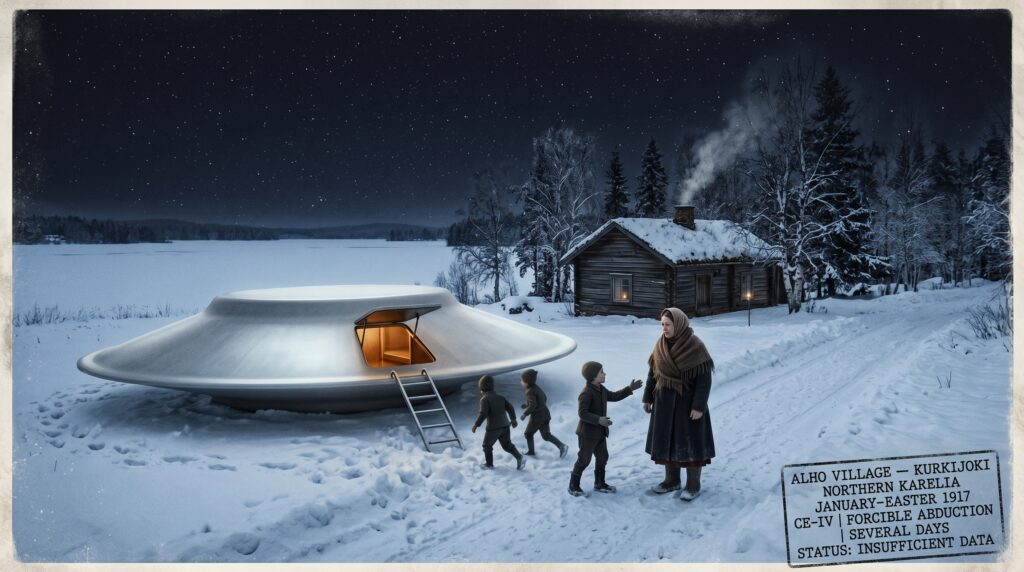
Alho village, Kurkijoki, Northern Karelia, Finland, between January and Easter 1917 — Anni Lattu was taken by force aboard a large washbasin-shaped silent craft by many small men. She spent several days traveling over the world and between the stars, was asked to stay, and was returned to the road outside her house. She told the story until her death in 1930. Source: Heikki Virtanen; Kurki Jokelainen No. 23, 1978; UFO Research Finland / Mauritz Hietamäki. Case status: Insufficient Data.
THINK ABOUTIT ABDUCTION REPORT
1917: First Known Abduction Case in Finland?
Between January and Easter of 1917, in a small house on the eastern shore of Kankaanlampi Lake in the village of Alho, six kilometres west of Kurkijoki in Northern Karelia, a woman named Anni Lattu disappeared for several days. Her neighbours assumed she had gone to visit her daughter. When she came back she had a different account entirely. A large machine shaped like a washbasin had landed beside her house. Small men came down a ladder. She could understand a little of their language. She did not want to go. They took her anyway. Inside the craft it was warm and the seats were comfortable and there was a leader she communicated with — possibly without words — and they flew her over the world and between the stars and asked her to stay. She said no. They brought her back to the road outside her house, the same spot they had taken her from. Anni Lattu told this story many times for the rest of her life, to anyone who would listen, and was not believed by a single person. She died in 1930. In 1978 someone who remembered her wrote it down in a Finnish newspaper. A researcher followed the trail and confirmed, through vital records, details about Anni’s life that the village itself had gotten wrong. The archive holds what he found.
Date: Between January and Easter, 1917 — exact date unknown
Sighting Time: Daytime — Anni was doing her everyday work when the machine landed; duration of the abduction itself spanned several days
Day/Night: Day — initial encounter during daily activities; duration of abduction spanned several days
Location: Jyrinvaara, Alho village, eastern shore of Kankaanlampi Lake — approximately 6 km west of Kurkijoki church, Northern Karelia, Finland (now Russian territory, formerly Finnish Karelia)
Urban or Rural: Rural — isolated lakeside farmstead in Northern Karelia, winter conditions
No. of Entity(s): Many — described as a number of small men inside the craft, with one identified as a leader
Entity Type: Small humanoid — described by Anni as small men; called “devils” by the religiously-minded village community, a term Anni herself adopted for lack of any better available vocabulary; their actual nature was not understood by the witness or her community
Entity Description: Small in stature, moving quickly inside the craft; a number of occupants, no clothing description recorded across any retelling — Anni appears to have had no framework for describing what they wore. One functioned as a leader with whom Anni communicated, possibly by telepathy according to the secondary witness’s understanding of Anni’s account. Anni reported understanding a little of their language. They asked her to stay with them. They were not reported as violent beyond the initial forcible boarding.
Hynek Classification: CE-IV (Close Encounter IV) — forcible abduction of the witness; transport aboard the craft over several days; world and interstellar travel described; invitation to remain extended; return to the exact point of departure
Duration: Several days — villagers noted her absence for several days before her return
No. of Object(s): 1
Description of the Object(s): A large machine described by Anni as shaped like a washbasin — a wide, flat, soup-plate-shaped vessel in 1917 rural Finnish usage, suggesting a wide disc or saucer-like profile with low sides. Equipped with a ladder by which the entities descended and by which Anni was taken aboard. The interior was self-luminous (“shining”), silent in operation (“made no noise like a train”), warm, and furnished with comfortable seating.
Shape of Object(s): Washbasin-shaped — wide, flat, disc-like with a raised rim; consistent with a disc or saucer profile
Size of Object(s): Large — sufficient to contain many small occupants with comfortable seating and room to move about; described as a “machine” large enough to land beside a house
Color of Object(s): Insufficient Data — not recorded in available source
Distance to Object(s): Landed beside Anni’s house — immediate proximity; entities descended by ladder directly to her location
Height & Speed: Landed on the ground at the time of the encounter; traveled very fast during the abduction — Anni described being shown “everything in the world” and traveling between the stars; returned her to the exact road outside her house
Number of Witnesses: Primary — Anni Lattu (1873–1930), named and confirmed by vital records. Secondary — Mrs. N.N. (born 1910), a childhood neighbour who heard Anni recount the experience multiple times; formally interviewed by researcher Mauritz Hietamäki of UFO Research Finland
Special Features/Characteristics: Forcible boarding — Anni was unwilling but was taken aboard against her will; partial language comprehension — Anni could understand a little of the entities’ language, suggesting either a partially shared linguistic root or a telepathic bridging effect; multiple retellings over 13 years, establishing a broad secondary-witness network within the Kurkijoki community; an invitation to remain, which Anni declined; an exact return to the departure point; universal community dismissal — every listener attributed the account to fever from a cold winter house, an explanation Anni consistently and firmly rejected; the case was first published in the community newspaper Kurkijokelainen in 1978, 48 years after Anni’s death, under the signature “Latomäen Aino”; researcher Mauritz Hietamäki subsequently traced and formally interviewed a surviving childhood neighbour who independently corroborated the account’s details. Vital-records research also established that Anni was not, in fact, a widow, as the village had generally assumed — her husband Juho survived her by eleven years, though she appears to have lived and traveled largely alone, which is likely why neighbors took her for a widow.
Case Status: Insufficient Data — named witness with confirmed vital records; corroborated by a formal researcher interview of a secondary witness; no physical evidence; no contemporaneous written account; community dismissal documented; internally consistent across multiple retellings over 13 years
Source: Latomäen Aino (contributor signature), Kurkijokelainen newspaper, No. 23, June 9, 1978; UFO Research Finland / Mauritz Hietamäki
Summary/Description: Between January and Easter 1917, Anni Lattu — a woman living largely alone on the shores of Kankaanlampi Lake near Kurkijoki, Northern Karelia, Finland — was taken aboard a large, washbasin-shaped, silent craft by a number of small men who descended by ladder. Taken against her will, she spent several days aboard as the craft traveled over the world and between the stars. The interior was warm, lit, and comfortable. She communicated with a leader, possibly by telepathy, and was asked to stay. She declined and was returned to the road outside her house. She retold the account many times until her death in 1930. It was first written down in a community newspaper in 1978, and a formal researcher interview of a surviving childhood neighbour corroborated the account’s consistent details — while also correcting the village’s own assumption that Anni had been a widow.
Related Cases: 1914: Alien Abduction in Cochabamba, Bolivia | 1912: Contact Near Vancouver, British Columbia | 1957: Antonio Villas Boas, Brazil | European Abduction Cases Archive | Finland Sightings Archive
DETAILED REPORT
Anni Lattu’s Machine — Alho Village, Northern Karelia, Finland, 1917
The case first surfaced in the community newspaper Kurkijokelainen — a publication primarily read by people who had formerly lived in the small community of Kurkijoki in Northern Karelia, territory that was Finnish before the war and Soviet territory thereafter. In issue No. 23, dated June 9, 1978, a contributor writing under the signature “Latomäen Aino” published a short article recounting a memory from 1917. The article prompted a formal investigation.
Anni Lattu — whose full name, birth year of 1873, and death year of 1930 were subsequently confirmed through vital records — lived in a small house on the eastern shore of Kankaanlampi Lake, in Jyrinvaara within the village of Alho, approximately six kilometres west of the Kurkijoki church. She was doing her everyday work when a large machine, shaped like a washbasin, landed beside her house. Small creatures descended by ladder. Anni later called them devils — not as a literal theological designation, but as the only available vocabulary in a religious rural Finnish community for something entirely outside normal experience.
She was not willing to go with them. She was taken aboard by force.
Inside the craft it was conveniently warm. The seats were comfortable. A number of small men moved about quickly. The machine was self-luminous inside and made no noise like a train — it was silent. They traveled very fast; Anni described being shown a great deal of the world, and they flew between the stars.
There was a leader. Mrs. N.N., a childhood neighbour interviewed by researcher Mauritz Hietamäki of UFO Research Finland, gathered from Anni’s repeated retellings that Anni had communicated with this leader — perhaps by telepathy. Anni had been able to understand a little of the entities’ language.
She was asked to stay. She did not want to.
She was brought back to the same place she had been taken from — the road outside her house.
She told her story many times, in many houses, in the years that followed. Every person who heard it said she had a fever, that her house was cold in winter, that she had hallucinated or dreamed. Anni never accepted this. She could not understand who the small men were, and she could not stop telling people about them. She died in 1930, still telling the story.
Forty-eight years later, “Latomäen Aino” published the account in Kurkijokelainen. Mauritz Hietamäki traced Mrs. N.N. and conducted a formal interview. The details Anni had told as a child — the washbasin shape, the ladder, the many small men, the warmth, the silence, the stars, the leader, the invitation to stay, the return to the road — all of them were there, preserved in a neighbour’s memory across sixty years. Hietamäki’s research also went further than the original newspaper account: it established, through vital records, that Anni had not actually been a widow, correcting a detail the village itself had simply assumed because she was so often seen alone. Her husband Juho, it turned out, outlived her by eleven years.
RESEARCHER’S NOTES
Anni Lattu’s Machine — Kurkijoki 1917 and the Pre-Modern Nordic Abduction Case as Archive Evidence
- Named Witness With Confirmed Vital Records — Unusual Evidentiary Strength: Anni Lattu is not an anonymous witness. Her full name, birth year, and death year were confirmed by the formal investigation — and researcher Hietamäki’s vital-records work went further still, correcting the village’s own assumption that she was a widow. In the context of a 1917 rural Finnish account reaching the research record through a 1978 community newspaper, this level of independently-verified biographical detail is an exceptional evidentiary anchor. The account is not attributed to a nameless figure or a composite village memory. It is attributed to a specific woman whose documented life — including details the community itself had wrong — is on record.
- The Secondary Witness Interview as Corroboration Mechanism: Mauritz Hietamäki’s formal interview of Mrs. N.N. — a woman born in 1910 who as a child had heard Anni recount the experience multiple times in her home — is the structural corroboration that elevates this case above single-witness testimony. Mrs. N.N. was not reporting what she herself had seen; she was reporting what she had heard, repeatedly, from a named adult witness during her childhood, with enough detail retained across sixty years to confirm the washbasin shape, the ladder, the many small men, the leader, the silence, the warmth, the travel between stars, and the invitation to stay.
- The Invitation to Stay — A Recurring Abduction Signature: The entities’ request that Anni remain with them is a detail that recurs across multiple abduction cases in this archive — the 1914 Cochabamba, Bolivia case and several later 20th-century North American and Nordic cases among them. In each instance the witness declines and is returned. The archive notes this pattern without asserting its meaning, but the detail is worth flagging: it runs counter to the expected narrative shape of a frightening abduction, and adds a complexity that fabricated accounts don’t typically include.
- Community Dismissal as Preservation Paradox: Every person Anni told attributed her account to fever, a cold house, a hard winter. Yet Anni told the story anyway — repeatedly, consistently, for thirteen years until her death — and never accepted the fever explanation. The community’s dismissal did not silence her; it preserved her, because she kept telling it. Because she was not believed, she kept insisting, and that insistence is what preserved the account long enough to reach print in 1978.
Anni Lattu was taken from the road outside her house in the winter of 1917 and spent several days between the stars in a warm, silent machine with a number of small men and a leader she could almost understand. She came back and told everyone, and no one believed her, and she kept telling them anyway until she died. In 1978 someone remembered. In the years that followed, a researcher confirmed what there was to confirm — down to correcting a detail about her own life that the village itself had gotten wrong. The archive holds the rest, not as proof of where she went, but as the record of a woman who went somewhere and could not pretend she hadn’t.
“A large object, like a large washbasin, landed next to her house, and she went down the stairs to the small creatures, which Anni later called devils. Somehow she could understand a little of their language.”
— From the account first published in Kurkijokelainen, No. 23, June 9, 1978, under the signature “Latomäen Aino”