Porlier Pass, off the east coast of Vancouver Island, BC, 1937 or 1938 — teenage commercial fisherman George observes a whitish-blue sphere 6–7 feet in diameter hovering over dead calm misty water in the tidal channel between Galiano and Valdez Islands. The sphere appears to follow his 16-foot boat, closing to within 100 feet. Clearly defined edge. Multiple blue tones. Watched for over 5 minutes before dissipation. Seen 3–4 times in the same area previously. St. Elmo's Fire ruled out by witness after reviewing that phenomenon's characteristics. Source: Martin Jasek, UFO*BC Yukon Representative. Case Status: Unexplained. NOTE: Page miscategorized under Yukon Territory Sightings — should be British Columbia Sightings. thinkaboutitdocs.com.
THINK ABOUTIT UFO | UAP | SIGHTING REPORT
1937 or 1938: Spherical UFO over the Sea off Vancouver Island
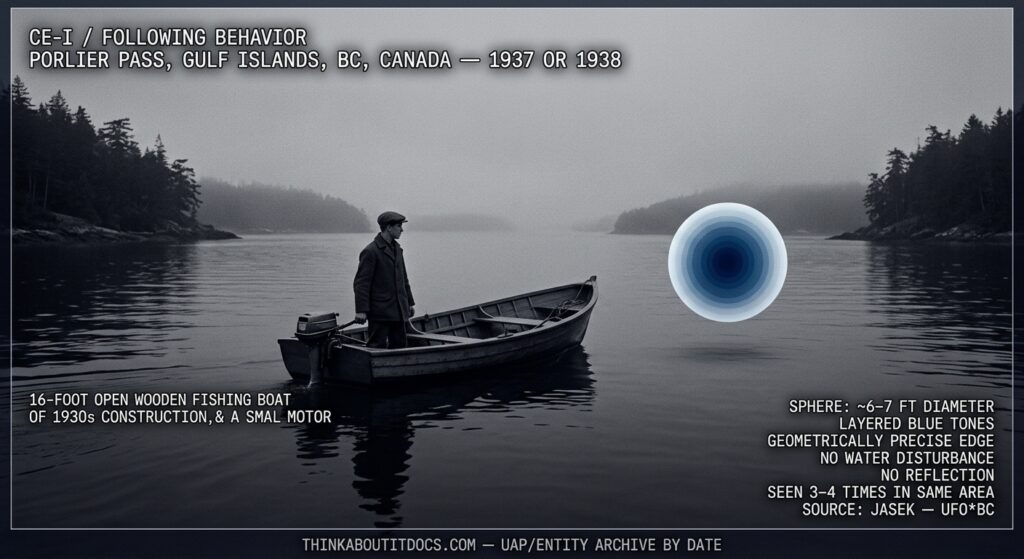
In 1937 or 1938, a teenage commercial fisherman working Porlier Pass off the east coast of Vancouver Island, British Columbia in a 16-foot open boat watched a whitish-bluish sphere, roughly six to seven feet across, hovering low over dead-calm water. It closed to within a hundred feet, held a clearly defined edge and a shifting range of blue tones for over five minutes, and then simply dissipated. He had seen it in the same general area three or four times before. He assumed for decades it was St. Elmo’s Fire — until the actual physical requirements of that phenomenon were laid out for him, at which point he agreed it could not have been that, and settled instead on some other unnamed natural explanation.
Date: 1937 or 1938
Sighting Time: Daylight
Day/Night: Day
Location: Porlier Pass, off the east coast of Vancouver Island, British Columbia, Canada (between Galiano and Valdez Islands, approximately 17 km east-northeast of Ladysmith)
Urban or Rural: Open sea/marine passage
No. of Entity(‘s): None reported
Entity Type: N/A
Entity Description: N/A
Hynek Classification: CE-I (Close Encounter of the First Kind) — observation of an object in close proximity to the witness (within 500 feet), no physical trace and no interaction beyond apparent following behavior
Duration: Over 5 minutes
No. of Object(s): 1
Description of the Object(s): A whitish-bluish sphere with a clearly defined edge, composed of a variety of blue tones, hovering over the water and appearing to follow the witness’s boat
Shape of Object(s): Sphere
Size of Object(s): 6 to 7 feet in diameter
Color of Object(s): Whitish-bluish, with a variety of blue tones visible across its surface
Distance to Object(s): Initially three to four hundred yards; closed to within approximately one hundred feet at closest approach
Height & Speed: Hovering low over the water surface; no rapid movement described other than appearing to follow the boat
Number of Witnesses: 1 (referred to as “George” in the source report)
Special Features/Characteristics: Clearly defined edge (distinguishing it from a diffuse glow); apparent following behavior relative to the witness’s boat; observed in the same general area on three or four separate occasions, this being the closest approach; weather at time of sighting was dead calm, cloudy, and misty — notably not stormy, which is significant given the witness’s initial explanation
Case Status: Unexplained. The witness’s own proposed explanation (St. Elmo’s Fire) does not fit the conditions or the object’s properties.
Source: Martin Jasek, UFO*BC Yukon Representative, reporting the account as related directly by the witness (“George”), who at time of report resided in Whitehorse, Yukon
Summary/Description: In 1937 or 1938, a teenage commercial fisherman working Porlier Pass, off the east coast of Vancouver Island, British Columbia, in a 16-foot open boat under dead calm, cloudy, misty daylight conditions spotted a whitish-bluish sphere approximately 6 to 7 feet in diameter hovering over the water three to four hundred yards away. The object appeared to follow his boat, closing to within about a hundred feet at its nearest. He observed a clearly defined edge and a range of blue tones across its surface for over five minutes before it dissipated. He had seen the same or a similar object in the same general area three or four previous times, but this was his closest encounter with it. He initially attributed the sighting to St. Elmo’s Fire, but on learning the specific physical requirements of that phenomenon, agreed his observation did not match it.
Related Cases: 1937 or 1938 Confederation Park, Burnaby, BC (HBCC UFO Research — same year, same region, two fireballs) | 1937 Vancouver BC disc photograph (provenance unknown — same year, same region)
DETAILED REPORT
The Porlier Pass case reaches this archive by an unusual route: it was not the witness’s primary contribution to UFO research. George, by the time of the report a resident of Whitehorse, Yukon, was already known to UFO*BC investigator Martin Jasek as the owner of a photographic slide showing seven glowing orb-like UFOs taken over Tagish Lake, Yukon — a separate, better-documented case. It was during discussion of that photograph that George volunteered his own much earlier story, from his youth on Vancouver Island, unprompted and evidently not something he had previously sought to publicize.
The sighting itself has several evidentiary strengths despite being a single-witness account. George was a working commercial fisherman in a 16-foot open boat, a setting that placed him in direct, unobstructed, close-range contact with the object rather than viewing it from a distance across intervening structures or terrain. The weather — dead calm, cloudy, misty — is recorded with a specificity that suggests genuine recollection rather than embellishment; a fabricated account seeking dramatic effect would more plausibly invoke stormy conditions, which is precisely the setting in which the witness’s own proposed explanation, St. Elmo’s Fire, would actually apply.
That explanation is worth examining directly because the witness himself, once informed of the phenomenon’s actual requirements, rejected it. St. Elmo’s Fire is a continuous electrical discharge from a grounded metal point — typically a ship’s mast or a lightning rod — into a highly charged atmosphere, producing a faint blue-violet or greenish glow that requires darkness to be visible and requires physical attachment to a conductive object; it does not exist as a free-floating, well-defined sphere with a discrete edge, and it does not occur in daylight, calm conditions. George’s sighting was in daylight, the object had a “clearly defined edge” — inconsistent with the faint, diffuse nature of a corona discharge — and nothing in his account describes any metal object, mast, or rigging from which the glow could have originated. When Jasek presented him with the actual physical description of St. Elmo’s Fire, George recognized immediately that his sighting did not match it, though he continued to assume some other undetermined natural explanation was more likely than not.
The apparent following behavior is the case’s most analytically interesting detail. An object that closes distance with a moving boat over a period exceeding five minutes, in calm conditions with no wind to explain drift, suggests either active movement on the object’s part or, at minimum, a persistent proximity that a static natural phenomenon would be unlikely to maintain. Combined with George’s report of three or four prior sightings of the same or a similar object in the same general area, the case describes not an isolated anomaly but a recurring localized phenomenon at Porlier Pass across an unspecified span of time in the late 1930s.
RESEARCHER’S NOTES
The Sphere at Porlier Pass — 1937/38 and the St. Elmo’s Fire Elimination
- Source Chain Assessment: Martin Jasek, as UFO*BC’s Yukon representative, is a credentialed regional investigator, and the case reaches the record through his direct interview of the witness rather than through an anonymous submission. The witness’s own credibility is bolstered by his unrelated, independently verifiable connection to the Tagish Lake photographic case — he was not a stranger seeking attention for a UFO story, but an established contact whose own sighting emerged secondarily.
- The St. Elmo’s Fire Elimination as Credibility Marker: The witness’s willingness to abandon his own long-held explanation once presented with contrary physical facts, rather than defending it, is a meaningful indicator of honest engagement with the material rather than motivated reasoning toward a predetermined UFO conclusion. He did not leap to an extraordinary explanation; if anything, he resisted one for decades.
- Classification Rationale: CE-I is appropriate given the close range (within 100 feet at closest approach, well under the 500-foot threshold) without any interaction beyond the object’s apparent tracking of the boat, and without physical trace evidence.
- Categorization Note: This case is currently filed on the live site under “Yukon Territory Sightings,” which is incorrect — the sighting itself occurred at Porlier Pass, Vancouver Island, British Columbia; only the witness’s later residence, and his unrelated Tagish Lake photograph, connect the case to the Yukon. This entry should be recategorized under British Columbia Sightings.
A teenage fisherman in a small open boat on a calm, misty day at Porlier Pass watched a defined, blue-toned sphere close to within a hundred feet of him and hold there for over five minutes before it dissipated — one of several times he’d seen it in that stretch of water. He spent decades assuming it was a known phenomenon, and let that assumption go the moment the facts didn’t support it. That is, in its way, the case’s strongest credential.