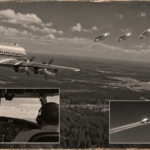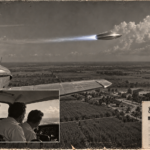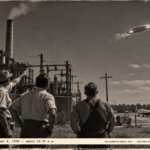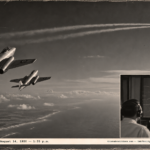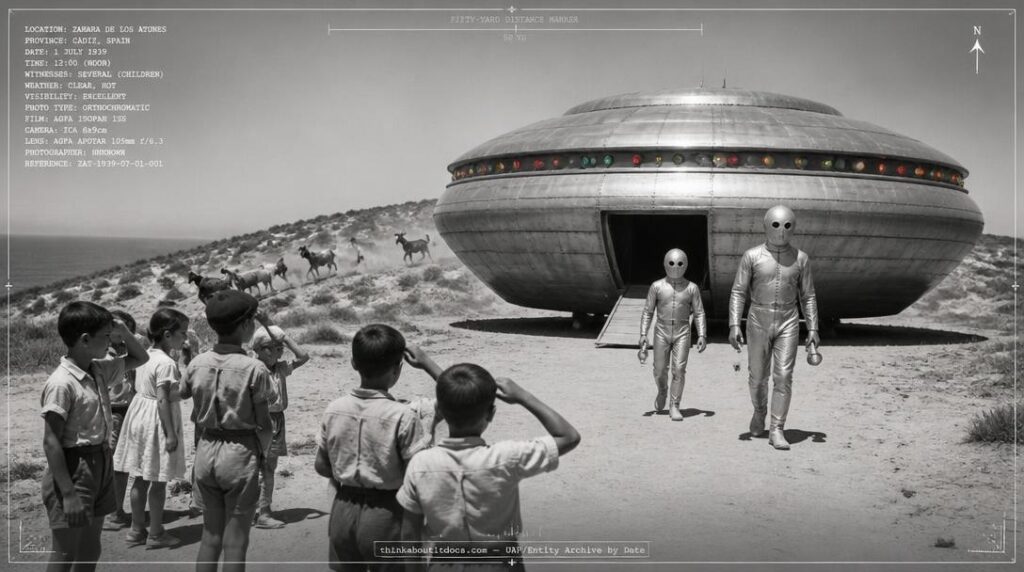
Zahara de los Atunes, Cádiz Province, Spain, July 1, 1939 — children watched two stiff-moving, silver-suited figures with blank black eye-holes emerge from a landed metallic disc.
THINK ABOUTIT UFO|UAP | ENTITY ENCOUNTER REPORT
1939: Zahara de los Atunes Spain – The Silver-Suited Occupants
At noon on July 1, 1939, several children resting in the shade near Zahara de los Atunes, in Cádiz Province, Spain, watched nearby goats stampede down a hillside moments before a huge metallic disc, ringed with red, yellow, and green lights, flew low overhead emitting a wave of intense heat. It landed in a nearby clearing amid a great cloud of dust, whistling as it touched down. A door opened; a tall figure in a silver metallic suit and headgear emerged, followed by a shorter, identically dressed companion. Both moved with stiff, mechanical stride, their faces covered entirely by their suits except for two black holes where eyes should have been. Each carried out a flashlight-like object and walked fifty yards from the craft before returning and departing at tremendous speed. Ground traces were reportedly still visible at the site four decades later, in 1980.
Date: July 1, 1939
Sighting Time: Noon
Day/Night: Day
Location: Zahara de los Atunes, Cádiz Province, Spain
Urban or Rural: Rural — hillside and clearing near the coast
No. of Entity(‘s): 2
Entity Type: Humanoid, one tall, one shorter
Entity Description: Both figures wore full silvery metallic outfits including headgear and a wide belt, covering their faces entirely except for two black holes where eyes should have been; both moved with distinctly stiff, mechanical-appearing movements; one figure was notably taller than the other
Hynek Classification: CE-III (Close Encounter of the Third Kind — craft and occupants observed at close range, direct if brief activity observed)
Duration: Not precisely recorded; sufficient for the craft’s approach, landing, occupant emergence, a fifty-yard walk from and return to the craft, and departure
No. of Object(s): 1
Description of the Object(s): A huge metallic disc-shaped craft, encircled with a band of red, yellow, and green lights; emitted a strong heat wave during its low-altitude approach; produced a loud whistling sound on touchdown; kicked up a great cloud of dust on landing
Shape of Object(s): Disc
Size of Object(s): Described as “huge”; no specific dimension given
Color of Object(s): Metallic, with a red-yellow-green light band around its perimeter
Distance to Object(s): Close range — flew low overhead, then landed in a clearing near the children’s position; occupants walked to within observable distance and back
Height & Speed: Flew low enough to be felt as a heat wave by the witnesses on approach; departed at “tremendous speed”
Number of Witnesses: Several (unspecified number of children)
Special Features/Characteristics: Pre-sighting animal disturbance (goats stampeding before the craft became visible to the children); intense heat emission during low-altitude flight; tri-color perimeter lighting; loud whistle on landing; dust cloud on touchdown; occupants’ stiff, mechanical gait; blank black eye-holes in otherwise fully covered faces; occupants carried flashlight-like handheld objects and walked a measured fifty yards from the craft before returning; ground traces reportedly persisted for at least 41 years, still visible as of 1980
Case Status: Unexplained.
Source: Vicente-Juan Ballester Olmos & Fernández Peri, Enciclopedia de Los Encuentros Cercanos con Ovnis. Ballester Olmos is among the most credentialed and long-established researchers in Spanish ufology.
Summary/Description: At noon on July 1, 1939, several children resting in the shade near Zahara de los Atunes, Cádiz Province, Spain, watched nearby goats become agitated and stampede down a hill just before a huge metallic disc, ringed with red, yellow, and green lights, flew low overhead, radiating intense heat. The craft descended and landed in a nearby clearing amid a large dust cloud, emitting a loud whistling sound. A door opened and a tall figure in a full silver metallic suit, headgear, and wide belt emerged, followed by a shorter, similarly dressed companion. Both walked with a distinctly stiff gait; their suits fully covered their faces except for two black holes where eyes should have been. Each held out a flashlight-like object and walked fifty yards from the craft before both returned and re-entered it, which then ascended at tremendous speed. Ground traces were reportedly still visible at the site as of 1980, forty-one years after the event.
Related Cases: 1939: UFO|UAP & Entity Sightings Archive | Saarijarvi, Finland, November 29, 1939 (same year, structured craft with landing trace) | Muñico, Spain, Summer 1938 (same country, prior year, silver-suited occupants)
Detailed Report
The Zahara de los Atunes case is documented through the Enciclopedia de Los Encuentros Cercanos con Ovnis, compiled by Vicente-Juan Ballester Olmos with Fernández Peri. Ballester Olmos is one of the most credentialed and long-serving researchers in Spanish ufology, with a career spanning from the 1970s to the present, and this archive treats his sourcing with correspondingly higher confidence than less-established compilers, consistent with the treatment given his other 1938 Guadalajara case elsewhere in this archive.
The animal-disturbance precursor — goats stampeding down the hillside moments before the craft became visible to the children — is a recurring pattern element across this archive’s pre-modern record, appearing in cases as geographically and temporally distant as the 1930s Glenwood, Washington ranchers’ horses and the Nipawin, Saskatchewan encounters. Animals reacting to an approaching anomalous phenomenon before human witnesses perceive it directly is either evidence of a genuine, non-visual precursor effect (infrasound, electromagnetic disturbance, or similar) common to multiple independently reported cases, or a narrative element that circulated within the broader UFO-reporting culture and was retrospectively incorporated into witness accounts. This archive does not resolve which explanation applies here.
The occupants’ description — fully suited, faces entirely covered except for blank black eye-holes, stiff mechanical movement — produces an ambiguous impression: are these described as biological beings in protective suits, or as something closer to automatons? The account does not resolve this, and the witnesses’ description of the beings’ “very stiff movements” specifically invites the automaton reading without confirming it. The fifty-yard walk each occupant took from the craft, holding a flashlight-like object, before returning, suggests some kind of survey or sampling activity, though its specific purpose is not described.
The persistence of ground traces reportedly visible as of 1980 — forty-one years after the alleged 1939 event — is a claim this archive cannot independently verify, but it is notable that Ballester Olmos’s documentation apparently tracked the site’s physical condition across four decades, which speaks to a degree of longitudinal investigative rigor uncommon in pre-modern casework.
RESEARCHER’S NOTES
Zahara de los Atunes — 1939 and the Animal-Precursor Pattern
- Source Chain Assessment: Ballester Olmos and Fernández Peri’s Enciclopedia is a credentialed, long-standing Spanish reference work. This archive’s exec summary for the 1939 record independently rates this case as “among the strongest in the entire Spanish pre-modern corpus,” a characterization this standalone treatment finds well-supported by the source’s investigative reputation.
- Classification Rationale: CE-III applies given the close-range, sustained observation of both craft and occupants engaged in observable activity (the fifty-yard walk with a handheld device), distinguishing this from a simple flyover or brief occupant glimpse.
- Pattern Context: The pre-sighting animal disturbance and the stiff, mechanically-described occupant gait are both recurring elements in this archive’s broader pre-1947 record, appearing in cases with no plausible cross-contamination given their differing countries, decades, and source chains, which strengthens the case that these represent genuine (if unexplained) recurring phenomenological patterns rather than isolated narrative flourishes.
- Evidentiary Weight: Multiple child witnesses, a credentialed long-term investigative source, and a claimed persistent physical trace observed across decades together place this among the stronger 1939 cases, though the witnesses’ status as children at the time of a dramatic, frightening event, and the 40-year gap before the trace’s last reported observation, are limitations this archive notes without dismissing the case.
A handful of children resting in the shade near a Spanish fishing village watched their goats bolt down a hillside, and then watched something huge, metallic, and ringed in colored light descend into a clearing and disgorge two stiff-moving, blank-eyed figures who walked out fifty yards, turned around, and left. Whatever it was, Ballester Olmos’s research suggests it left a mark on the ground that outlasted a world war and four decades of Spanish history.
“A door opened and a tall figure clad in a silvery metallic outfit, with headgear and a wide belt emerged, quickly followed by a shorter similarly dressed figure. They both walked in very stiff movements. Their silvery suit covered their faces and both had two black holes where the eyes should have been.”
Case summary describing the July 1, 1939 Zahara de los Atunes, Cádiz Province, Spain encounter, sourced via Vicente-Juan Ballester Olmos & Fernández Peri, Enciclopedia de Los Encuentros Cercanos con Ovnis