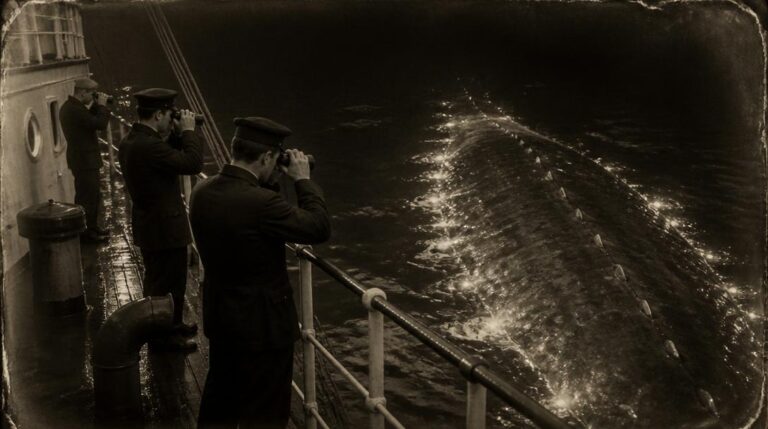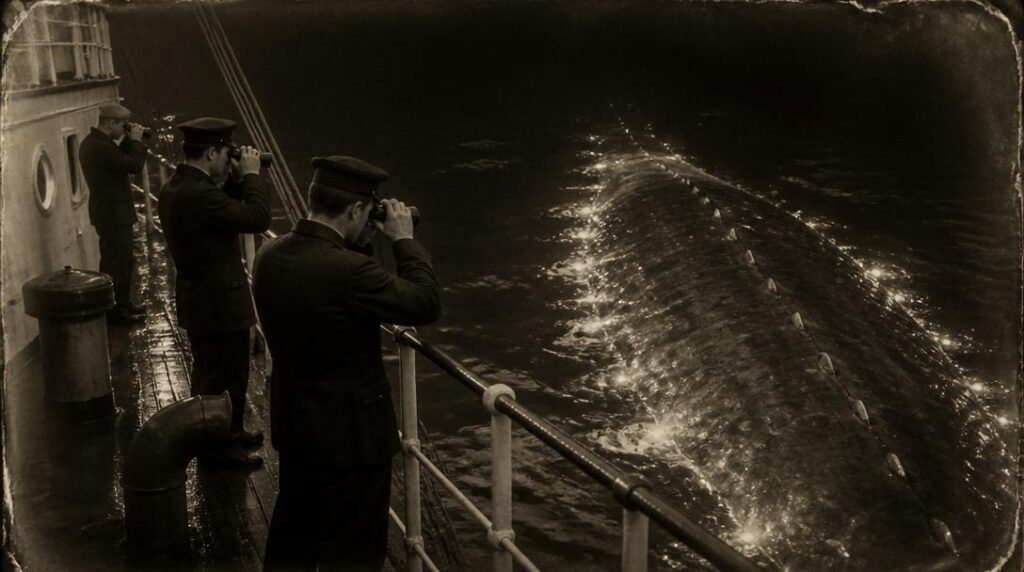
The October 28, 1902 Fort Salisbury encounter — Second Officer A. H. Raymer and two crewmen watched a 500-to-600-foot scaled creature pass alongside their ship in the South Atlantic, its back dotted with phosphorescent light.
THINK ABOUTIT SEA SERPENT ENCOUNTER REPORT
The Fort Salisbury Sea Serpent
1902 Gulf of Guinea Encounter, Corrected and Explained
At 3:05 in the morning of October 28, 1902, three men aboard a steamship in the South Atlantic watched something roughly the length of two football fields slide slowly beneath the surface ahead of them — close enough that they could see individual scales, smell the low-tide odor rising off its back, and hear the water swirl as unseen fins moved beneath it. The ship’s second officer wrote it up in the log himself, under his own heading: “the passing of the Sea Serpent.” This page corrects an earlier version of this site’s coverage, which filed the case as an Unidentified Submerged Object. Read in full, the primary source describes something else entirely — and that’s the more interesting story.
Date: October 28, 1902
Sighting Time: 03:05 AM
Day/Night: Night
Location: South Atlantic Ocean, off West Africa, near the Gulf of Guinea (Lat. 5°31’S, Long. 4°42’W)
Urban or Rural: N/A (open ocean)
No. of Entity(s): 1 (biological creature; not classified as an entity in the ufological sense)
Entity Type: N/A — cryptid/unidentified marine animal, not a UFO occupant
Entity Description: N/A
Hynek Classification: N/A — not applicable; this is a cryptid encounter, not a standard UFO/UAP sighting
Duration: Undocumented (single sustained observation as the ship passed)
No. of Object(s): 1 (the creature itself; not a craft or object)
Description of the Object(s): A scaled, barnacle-encrusted creature with a wet, shiny back dotted with phosphorescent light
Shape of Object(s): Elongated, serpentine; tapering from roughly 80 feet wide near the head to about 5 feet at the visible tail end
Size of Object(s): Approximately 500 to 600 feet in length
Color of Object(s): Undocumented; back described as wet and shiny, encircled by a band of white phosphorescent sea
Distance to Object(s): Approximately 40 to 50 yards off the ship’s port side at closest approach
Height & Speed: N/A (surface-swimming marine creature; no altitude or flight speed applicable)
Number of Witnesses: 3, named by role (Second Officer A. H. Raymer, the ship’s helmsman, and the lookout)
Special Features/Characteristics: Barnacle-encrusted scales roughly 1 foot in diameter, audible swirl from its movement, a strong low-tide odor, visible fin movement below the surface, and twinkling phosphorescent lights along its back
Case Status: Insufficient Data — the creature’s identity was never established
Source: Raymer, A. H., ship’s log, quoted in full in The Zoologist, January 1903; Fort, Charles, Lo!; Vallée, Jacques, Anatomy of a Phenomenon, case 20
Summary/Description: Three named-role witnesses aboard the S.S. Fort Salisbury watched a roughly 500-to-600-foot scaled creature, its back dotted with phosphorescent light, pass close alongside the ship before submerging. The ship’s second officer titled his own log entry “the passing of the Sea Serpent.”
Classification: Cryptid / unidentified marine animal encounter — not a UFO, UAP, or USO sighting
Related Cases: Corrected from this site’s earlier 1902 archive listing, which had filed this case as a “USO”; see Researcher’s Notes below for the full correction
DETAILED REPORT
The primary source for this case is Second Officer A. H. Raymer’s own log entry, written the morning of the sighting and later quoted in full in The Zoologist, January 1903. It is worth reading close to verbatim, because every dramatic detail in this case comes directly from it rather than from later retelling:
“Dark object, with long, luminous trailing wake, thrown in relief by a phosphorescent sea, seen ahead, a little on starboard bow. Look-out reported two masthead lights ahead. These two lights, almost as bright as a steamer’s lights, appeared to shine from two points in line on the upper surface of the dark mass. Concluded dark mass was a whale, and lights phosphorescent. On drawing nearer, dark mass and lights sank below the surface.”
This opening is important: the crew’s first conclusion was the ordinary one — a whale, its wake catching phosphorescent plankton, and the “lights” simply bioluminescent glow. That identification held until the ship drew close enough to actually see the thing clearly.
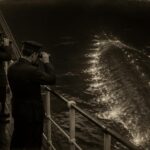
“Prepared to examine the wake in passing with binoculars. Passed about forty to fifty yards on port side of wake, and discovered it was the scaled back of some huge monster slowly disappearing below the surface. Darkness of the night prevented determining its exact nature, but scales of apparently 1 ft. diameter, and dotted in places with barnacle growth, were plainly discernible. The breadth of the body showing above water tapered from about 80 ft. close abaft, where the dark mass had appeared, to about 5 ft. at the extreme end visible. Length roughly about 500 ft. to 600 ft.”
Raymer concluded that what the crew had first seen — the “dark mass” with the two lights — was the creature’s head, and that what they were now passing was its body, tapering away behind it. The scale is worth sitting with: 500 to 600 feet is longer than most ocean liners of the era, and far beyond any known animal, living or extinct. No blue whale, the largest animal ever documented, exceeds about 100 feet.
“The swirl caused by the monster’s progress could be distinctly heard, and a strong odour like that of a low-tide beach on a summer day pervaded the air. Twice along its length the disturbance of the water and a broadening of the surrounding belt of phosphorus indicated the presence of huge fins in motion below the surface. The wet, shiny back of the monster was dotted with twinkling phosphorescent lights, and was encircled with a band of white phosphorescent sea.”
This closing detail matters for correcting this site’s earlier presentation of the case: the “lights” described throughout are consistently phosphorescent — bioluminescent glow disturbed by the animal’s movement through plankton-rich water — not mechanical running lights of the kind a craft would carry. Raymer titled his own entry plainly: “Such are the bare facts of the passing of the Sea Serpent in latitude 5 deg. 31 min. S., longitude 4 deg. 42 min. W., as seen by myself, being officer of the watch, and by the helmsman and look-out man.” The ship’s master added his own endorsement: “I can only say that he is very earnest on the subject, and certainly has, together with look-out and helmsman, seen something in the water of a huge nature as specified.”
Charles Fort later found the account while reading back issues of The Zoologist and included it in his book Lo! as an example of the kind of high-strangeness report that resists tidy explanation — not as a claim that it involved a craft or technology of any kind. Jacques Vallée’s citation of the case in Anatomy of a Phenomenon likewise treats it as an anomaly worth cataloging, not as evidence of a specific USO. Both writers were doing what they generally did: collecting reports that didn’t fit standard categories, regardless of whether the underlying phenomenon was ufological, cryptozoological, or something else.
RESEARCHER’S NOTES
The Fort Salisbury Case — Reading the Primary Source Instead of the Secondary Label
- This is not a USO case, and calling it one overstates the source: This site’s earlier 1902 archive entry filed Fort Salisbury as an “Unidentified Submerged Object,” in the ufological sense of implying a possible craft. Raymer’s own log entry never suggests this — he identifies it as a sea serpent, describes scales, barnacles, fins, and an organic odor, and the ship’s master’s endorsement speaks of “something in the water of a huge nature,” not a vehicle. The USO framing came from this site’s own prior drafting, not from Fort, Vallée, or the primary source.
- The “second object” in the earlier entry does not exist in the source: The prior draft described “a second object observed to port for approximately two minutes before disappearing.” This appears to be a misreading of Raymer’s navigational detail — the ship itself passing “forty to fifty yards on port side of wake” — as though it described a second creature. It does not. There is one animal in this account, not two.
- The lights are bioluminescent, not mechanical: Every mention of “lights” in the primary source is explicitly phosphorescent — first mistaken for masthead lights, then understood as glowing plankton disturbed by the animal’s movement. The earlier draft’s description of “red lights visible at each end above the water surface” is not supported by the log and has been dropped.
- What the case actually is: a strong, multi-witness, contemporaneously logged sighting of an unidentified marine animal of implausible scale. Three named-role witnesses, a same-day log entry, a corroborating captain’s endorsement, and publication in a respected zoological journal within months of the event — this is a genuinely well-documented cryptid report. It belongs in that category, filed and searchable as such, rather than folded into a UFO archive under a label the source doesn’t support.
- Recommendation: This case is a strong candidate for cross-listing on subterraneanbases.com or a future cryptid/sea-monster section of think-aboutit.com, where its actual content — an unexplained giant marine animal, not an unidentified craft — would be accurately represented. It remains on thinkaboutitdocs.com here only as a corrected, honestly-labeled entry, not as evidence for the site’s core UFO/UAP subject matter.
The Fort Salisbury case is a genuinely remarkable piece of maritime testimony — three witnesses, a contemporaneous ship’s log, a corroborating captain, and a description precise enough to include barnacle-encrusted scale measurements. It just isn’t a UFO case. Reading Raymer’s own words instead of a decades-removed “USO” label reveals a stronger, stranger, and more honest story: something enormous, unidentified, and biological passed close alongside a steamship in the dark, and the men who saw it never doubted for a moment that it was alive.
“The wet, shiny back of the monster was dotted with twinkling phosphorescent lights, and was encircled with a band of white phosphorescent sea. Such are the bare facts of the passing of the Sea Serpent.”
— Second Officer A. H. Raymer, S.S. Fort Salisbury, log entry of October 28, 1902, as quoted in The Zoologist, January 1903