A disputed legend at the Republic's darkest hour — Valley Forge, winter 1777–1778
THINK ABOUTIT ENTITY ENCOUNTER REPORT
1777–1778: The Valley Forge Vision | George Washington’s Disputed Legend
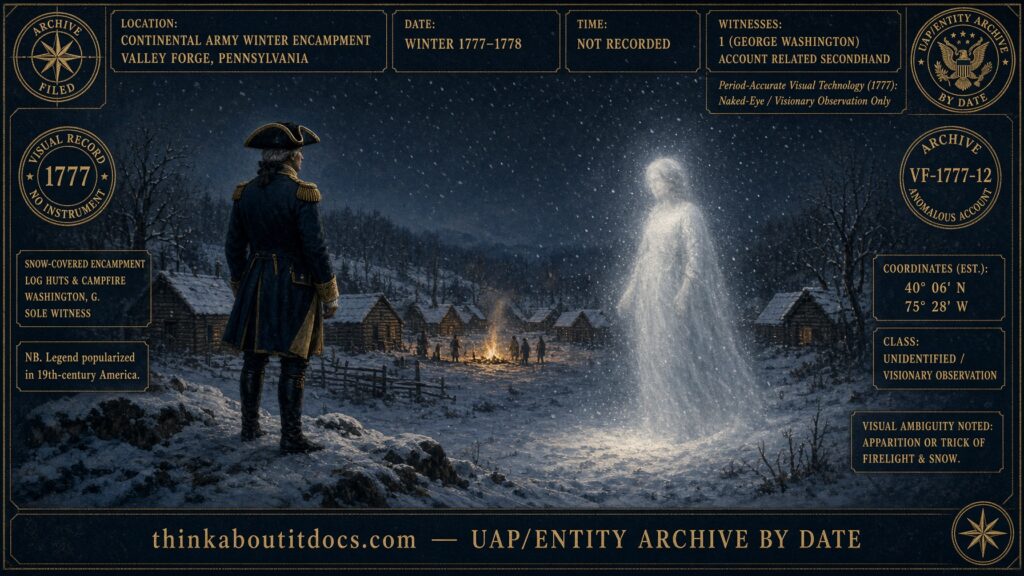
At the lowest point of the Revolutionary War, in a freezing winter encampment where his army was starving, freezing, and dying by the hundreds, George Washington reportedly told a fellow soldier that a luminous female figure had appeared to him and shown him three great trials the young Republic would face. The account did not surface in print until 1859 — eight decades later, from a single named source, describing a private conversation with a man who was, by then, dead and unable to confirm or deny it.
Date: Winter 1777–1778
Sighting Time: Not recorded
Day/Night: Not recorded
Location: Valley Forge, Pennsylvania
Urban or Rural: Rural — military winter encampment
No. of Entity(‘s): One
Entity Type: A luminous female figure, described in the account as an entity showing prophetic visions
Entity Description: Not physically described in detail beyond her luminous appearance; her role in the account is defined by the prophetic visions she reportedly presented rather than by physical characteristics
Hynek Classification: Not Applicable — no craft described; classified as an entity/visionary encounter outside the standard Hynek scale
Duration: Not recorded
No. of Object(s): Not Applicable
Description of the Object(s): Not Applicable
Shape of Object(s): Not Applicable
Size of Object(s): Not Applicable
Color of Object(s): Not Applicable
Distance to Object(s): Not Applicable
Height & Speed: Not Applicable
Number of Witnesses: One (George Washington), with the account itself relayed secondhand by Anthony Sherman, who reported Washington described the experience to him
Special Features/Characteristics: The entity is described as having shown Washington three great trials the American Republic would face; the account is doubly secondhand — Sherman’s retelling of Washington’s own retelling — and was not published until 1859, roughly eight decades after the events described and after both Washington and, by most accounts, Sherman himself were no longer available to confirm the story firsthand; the account’s authenticity has been extensively debated by historians
Case Status: Insufficient Data
Source: The National Tribune, December 1880 (reprinting an account first published in 1859); Anthony Sherman account
Summary/Description: George Washington reportedly described to Anthony Sherman a visionary encounter with a luminous female entity at Valley Forge during the darkest period of the American Revolutionary War, when his army faced starvation, exposure, and mass desertion. The entity allegedly showed him three great trials the Republic would face in its future. The account was first documented in print in The National Tribune in 1859, based on Sherman’s own retelling of what Washington had told him decades earlier. The story’s authenticity has been extensively debated by historians, but it has remained in continuous circulation since the Civil War era, appearing in patriotic and popular literature into the 20th century.
Related Cases: Not Applicable
Detailed Report
The “Valley Forge Vision” is one of the most persistently circulated legends in American popular history, but its sourcing is genuinely weak by the standards this archive applies elsewhere. The story rests entirely on Anthony Sherman’s account, first published in 1859 — roughly eighty years after the events it describes, and decades after George Washington’s own death in 1799, meaning Washington himself never confirmed the story in any independently verifiable written source. Sherman’s own historical existence and exact identity have themselves been subjects of dispute among historians researching the legend’s origins, and no contemporary 1777–1778 document, letter, or diary entry from Washington or any other Valley Forge witness corroborates any element of the vision.
The historical context in which the story is set is entirely real and well documented: the winter of 1777–1778 at Valley Forge was genuinely catastrophic for the Continental Army, with roughly a quarter of Washington’s soldiers dying from disease, exposure, and malnutrition during the encampment. This genuine historical desperation likely accounts for much of the story’s enduring emotional and patriotic resonance — a vision of ultimate national triumph delivered at the exact moment triumph seemed least likely — regardless of whether the specific visionary encounter itself has any basis in an actual reported experience.
RESEARCHER’S NOTES
The Valley Forge Vision — Pennsylvania 1777–1778 and a Legend Published Eight Decades Later
- Source chain assessment: This is among the weakest-sourced entries in this archive’s 18th-century record: a doubly secondhand account (Sherman relaying Washington’s own retelling) first published roughly eighty years after the fact, with no contemporary corroborating document from Washington or any other Valley Forge source.
- Classification issues / corrections: Given the sourcing weaknesses, this archive classifies the case as Insufficient Data rather than Unexplained — the available evidence does not support confident classification in either direction, and the story’s authenticity remains genuinely contested among historians rather than merely unresolved.
- Pattern context / comparative cases: The story follows a recognizable genre pattern of retrospectively attributed prophetic visions granted to founding national figures at their moment of greatest crisis, a narrative type found across many nations’ founding mythologies, which should inform how much independent weight the account’s specific details are given.
- Geographic or historical context: The genuine historical severity of the Valley Forge winter — with roughly a quarter of the Continental Army dying during the encampment — provides real historical context for why such a story would have powerful emotional resonance and long-term circulation, independent of whether the vision itself occurred as described.
The Valley Forge Vision endures as one of American history’s most persistent legends precisely because of what it offers rather than what it proves — a luminous promise of ultimate triumph delivered to the nation’s founding commander at the exact moment his cause seemed most likely to fail, sourced no more solidly than one man’s account of what another man once told him.
Washington reportedly described a luminous female entity who showed him three great trials the Republic would face.