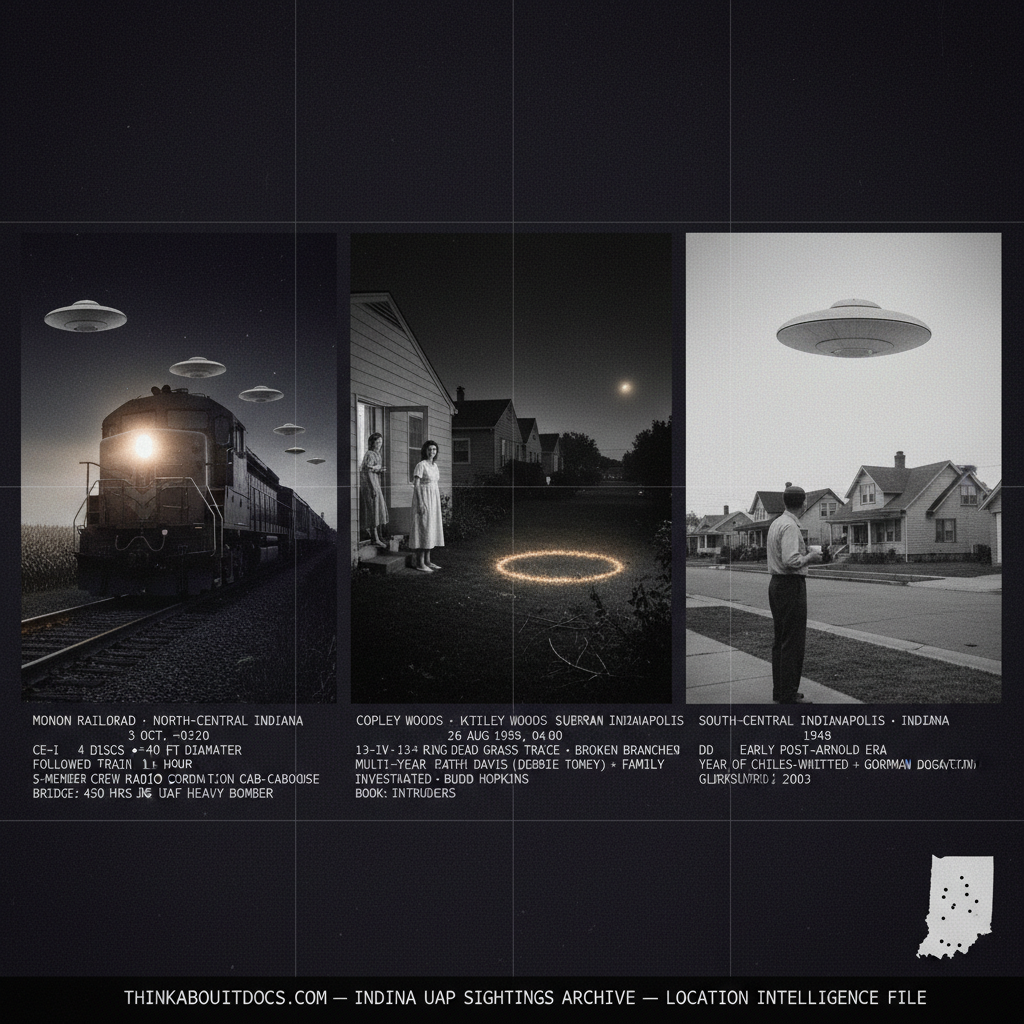
Indiana UAP archive: Monon Railroad October 1958 five-crew encounter with four discs pacing the train for over an hour with radio-coordinated observations (NICAP investigated), Copley Woods suburban Indianapolis August 1983 physical trace ring and extended multi-year CE-IV abduction series investigated by Budd Hopkins (Intruders), and south-central Indianapolis 1948 domed disc early post-Arnold era observation. 12 documented cases 1948–2005.
Indiana UFO|UAP & Alien Sightings Archive
Indiana’s twelve-case UAP archive is anchored by two events from different decades that together represent the state’s strongest institutional observer documentation. The first is the Monon Railroad incident of October 3, 1958 — five professional railroad crew members aboard freight train No. 91 on the southbound run from Monon to Indianapolis who observed multiple discs approximately 40 feet in diameter and 10 feet thick follow their train for over an hour through north-central Indiana. The crew included a former Air Force heavy bomber pilot with 450 hours of flight time who served as fireman. The objects made multiple passes — crossing the tracks ahead, departing east, returning, maintaining parallel track with the train — for the duration of the observation. The crew used onboard radio to coordinate between locomotive cab and caboose, producing a documented real-time multi-station observation record. The Monon case was investigated by NICAP and has remained in the research literature as one of the strongest extended train-pacing encounters in the American record. The second anchor is the Copley Woods / Kitley Woods encounter cluster of 1983 — an extended multi-year abduction series investigated by Budd Hopkins that produced his book Intruders and gave the national research community the most thoroughly documented multiple-witness, multiple-event abduction case in the Indianapolis suburban record. The central figure, Kathie Davis (pseudonym for Debbie Tomey), reported events spanning from 1978 to the mid-1980s, corroborated by family members and a physical ground trace — a 13-foot ring of dead grass with broken branches — discovered in August 1983.
The state’s 1948 domed disc sighting over south-central Indianapolis — one of the earliest post-Arnold structured craft observations in the record — places Indiana in the first wave. The 1963 Homer, Indiana landing case adds physical trace evidence. The 1967 Connersville entity encounter and the 1994 case in which a witness identified a specific military installation from within a craft during an abduction add CE-III and CE-IV dimensions respectively. Indiana’s geographic position — flat agricultural interior, crossroads of the American Midwest — produces a case distribution that spans from the Indianapolis metro to the rural north-central railroad corridor to the southern river valleys, covering the full breadth of the state’s terrain.
- 1948: Domed Disc Seen over South Central Indianapolis
- 1957: Object beamed out an eerie, penetrating light: Merom Indiana UFO
- 1958: The Monon Railroad UFO Incident
- 1963: Homer Indiana Landing
- 1967: Milan, Indiana UFO Encounter
- 1973: CE1 in Princeton, Indiana
- 1977: UFO in Anderson, Indiana
- 1983: Copely Woods Encounter
- 1984: Clarksburg, Indiana Sighting
- 1994: Witness names military installation from UFO encounter
- 2003: Three Huntington Police Officers See Circular Flying Object
- 2005: Woman is Sickened by Two Encounters
- 1891: Crawfordsville, Indiana — The Headless Aerial Creature
- 1950: The TWA Flight 117 Pursuit — Goshen, Indiana
- 1954: The Brubaker Photographs — Richmond, Indiana
- 1954: The Floyd’s Knob, Indiana Abduction Account
- 1955: Fort Wayne, Indiana: American Airlines Flight 266’s Star-Like Formation
Executive Summary
The Monon Train and Copley Woods — Indiana’s Sustained Observation Records
Indiana’s UAP archive is defined by two cases that share a structural characteristic rare in the national record: extended duration. The Monon Railroad encounter lasted over an hour, with five witnesses coordinating observations by radio between the locomotive cab and the caboose. The Copley Woods encounter cluster lasted years, with multiple family members as witnesses and a documented physical trace at the central landing site. Both cases resist the standard debunking approaches — brief observation, single witness, no corroboration — because they are precisely the opposite: sustained, multi-witness, systematically documented by named investigators. The Monon case produced NICAP documentation from interviews with all five crew members within days of the event. The Copley Woods cluster produced Budd Hopkins’s most extensive research work, including hypnotic regression sessions, family member corroboration, and the physical trace evidence that gives the 1983 events an evidentiary anchor beyond pure testimony. Indiana’s remaining cases — the 1948 Indianapolis domed disc, the 1957 beam object, the 1963 Homer landing, the 1994 military installation abduction — fill out a state record that consistently produces multi-witness or physically evidenced events across seven decades.