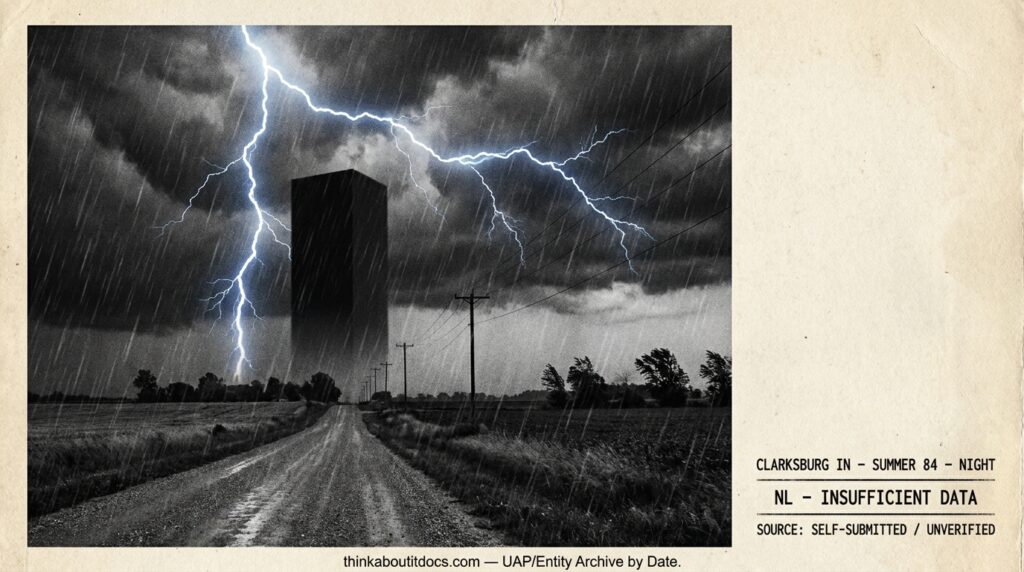
Clarksburg, Indiana, early summer 1984 — A lightning flash reveals a dark rectangular prism-shaped object with industrial piping and panel texture moving silently above the power lines during a thunderstorm. Self-submitted, unverified.
THINK ABOUTIT UFO|UAP SIGHTING REPORT
On a stormy night in early summer 1984, a lone witness in Clarksburg, Indiana — a crossroads community in Fugit Township, Decatur County — saw something in the sky that was only visible when the lightning flashed. It was dark, enormous, silent, and shaped like nothing that belonged in the air: a rectangular prism, roughly the size of one to three railroad boxcars joined together, with an exterior texture of piping and panels. No lights. No sound. It moved slowly and steadily through the storm until it disappeared into the rain and low clouds. That is the entire record. No name. No investigation. No corroboration. An email to a website, a description that reads like an industrial structure drifting through a thunderstorm, and nothing more.
⚠ SELF-SUBMITTED REPORT — UNCORROBORATED: This account was submitted directly to Think About It via email. The witness is anonymous. No external investigation was conducted. No NUFORC, MUFON, or other organizational filing has been identified. No corroborating witnesses have come forward. Readers should weigh the account accordingly.
Date: Early summer 1984 — exact date not recorded
Sighting Time: Not recorded — nighttime during a thunderstorm
Day/Night: Night — stormy, with lightning providing the only illumination of the object
Location: Clarksburg, Fugit Township, Decatur County, Indiana
Urban or Rural: Rural — small crossroads community in southeastern Indiana
No. of Entity(‘s): None observed
Entity Type: N/A
Entity Description: N/A
Hynek Classification: NL (Nocturnal Light) — object observed at night, visible only during lightning flashes. NL is retained as a conservative classification; the object itself was dark and unlighted, but it was observed under nocturnal conditions with lightning as the only illumination source.
Duration: Not recorded — observed across multiple lightning flashes until it moved out of view
No. of Object(s): 1 (possibly 1–3 joined together, moving as a single unit)
Description of the Object(s): Rectangular prism — dark, massive, silent, with an exterior texture of piping and panels. Witness compared it to 1–3 railroad boxcars attached together moving as one unit. Not as elaborate as a “Borg” ship (witness’s own pop-culture comparison), but industrial and structured. No lights. No sound. No emissions.
Shape of Object(s): Rectangular prism — boxcar-shaped, angular, non-aerodynamic
Size of Object(s): Approximately the size of 1–3 railroad boxcars (roughly 40–150 feet in length, 10–15 feet in width and height per car). Witness stated the object “seemed to take up the space of a boxcar if I was 5 feet away” — indicating significant apparent angular size.
Color of Object(s): Dark brown to black
Distance to Object(s): Estimated approximately 400 feet — the witness was unsure of altitude above power lines, making distance and size estimates uncertain
Height & Speed: Above the power lines — exact altitude uncertain. Moving slowly and steadily in a consistent direction.
Number of Witnesses: 1
Special Features/Characteristics: The object carried no lights and produced no sound — it was visible only during lightning flashes, rendering it effectively invisible between strikes. The surface texture of piping and panels suggests a structured, manufactured object rather than an atmospheric phenomenon. The slow, steady movement through a thunderstorm — without being affected by wind — parallels the 1973 Princeton sighting’s observation of storm-immune motion.
Case Status: Insufficient Data
Source: Self-submitted via email to Think About It (email address on file). No organizational filing. No investigation.
Summary/Description: A single anonymous witness in Clarksburg, Decatur County, Indiana observed a large, dark, rectangular prism-shaped object during a thunderstorm in early summer 1984. The object was visible only during lightning flashes and had an exterior texture of piping and panels. It carried no lights, produced no sound, and moved slowly and steadily until disappearing into rain and low clouds. No investigation was conducted.
Related Cases: 1973 Princeton Indiana CE-I (storm-immune motion, same state) | 1994 Newport Chemical Depot Triangle (large structured craft, Indiana)
Detailed Report
The Clarksburg sighting is one of the thinnest reports in the Indiana archive — a single anonymous email submission with no name, no date beyond “early summer 1984,” no investigation, and no corroborating witnesses. What it does have is a physical description that is specific, internally consistent, and unusually difficult to explain conventionally.
The witness was in Clarksburg, a small crossroads community in Fugit Township, Decatur County, during a nighttime thunderstorm. The sky was dark. The object carried no lights. It was visible only when lightning flashed, freezing its silhouette against the illuminated sky for fractions of a second at a time. What the witness saw was a rectangular prism — angular, dark, massive — with an exterior surface described as textured with piping and panels. The witness compared it to one to three railroad boxcars attached together, moving as a single unit. It was dark brown or black, produced no sound, and moved slowly and steadily in a consistent direction until it passed out of view in the rain and low clouds.
The witness explicitly acknowledged the difficulty of estimating scale, noting uncertainty about the object’s altitude above the power lines. The pop-culture comparison — “not nearly as elaborate as a Borg ship” — is an unusual but illuminating detail: the witness is describing an industrial, utilitarian object, not a sleek or futuristic craft. The piping-and-panel surface texture reinforces this impression.
No one else has reported seeing this object. No investigation was ever conducted. The case exists as a single data point — an anomalous description from an anonymous source — and can be evaluated only on the internal consistency of its content.
Researcher’s Notes
The Clarksburg Boxcar — Decatur County 1984 and the Lightning-Flash Object
Source Chain Assessment: This is the minimum viable source chain — an anonymous email to a website, with no name, no organizational filing, and no investigation. The email address is on file but the witness has not been contacted or interviewed. The report cannot be verified by any independent means. It is retained in the archive solely on the specificity of its physical description.
Classification Rationale: NL is technically correct but poorly fitting. The object itself was dark and unlighted — it was the lightning that made it visible, not any luminosity from the object. Under strict Hynek criteria, NL refers to “point or extended luminous source observed at night,” and this object was neither luminous nor a point source. A more precise classification might be “Nocturnal Structured Object,” but this category does not exist in the standard Hynek taxonomy. NL is retained as the closest available classification with the caveat that the object was illuminated externally, not self-luminous.
Rectangular Prism Morphology: Rectangular or boxcar-shaped UFOs are uncommon but not unprecedented in the literature. They resist easy conflation with conventional aircraft (which are aerodynamically shaped) and with balloons or atmospheric phenomena (which are irregular or spherical). A dark, angular, piping-and-panel-surfaced rectangular prism moving silently through a thunderstorm at low altitude does not match any known conventional aircraft configuration. The description is either an accurate observation of an anomalous object or a fabrication — and the specificity of the piping-and-panel surface texture, the honest acknowledgment of estimation difficulties, and the absence of sensational embellishment argue weakly against fabrication.
Storm-Immune Motion Pattern: The object’s slow, steady movement through an active thunderstorm — without being deflected by wind — parallels the 1973 Princeton CE-I witness’s observation that his saucer moved “so smooth and determined in its movements” and “wasn’t being affected by the storm any.” Both observations describe objects that appear to be decoupled from atmospheric conditions. Whether this constitutes a pattern or a coincidence across two anonymous/low-investigation Indiana storm sightings cannot be determined.
A boxcar in the sky, visible only when the lightning shows it to you, moving through a storm as if the storm does not exist. The Clarksburg report is too thin to build a case on and too specific to dismiss. The archive holds it as submitted.