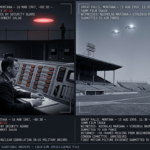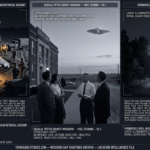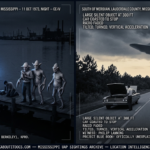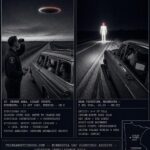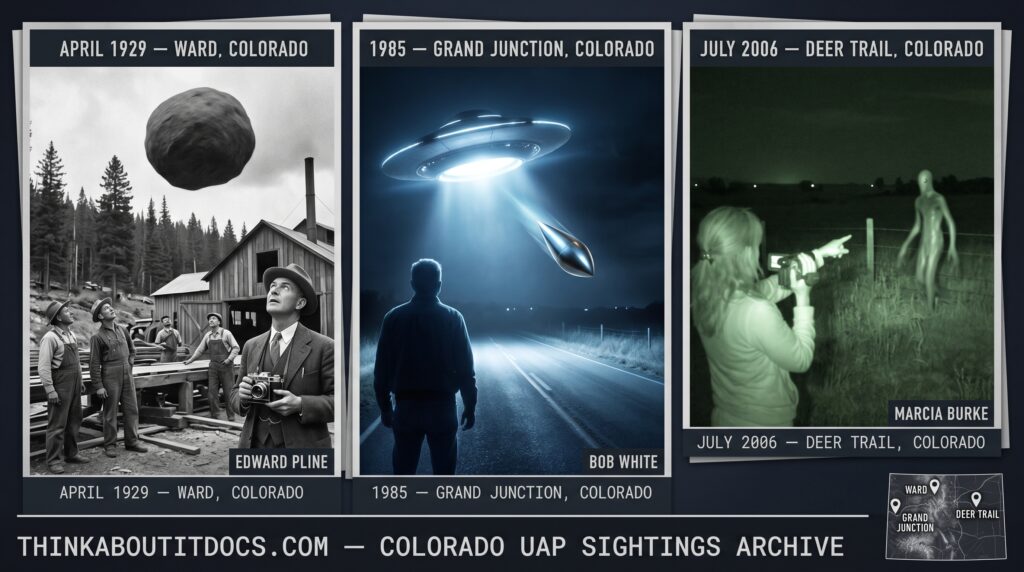
Colorado UAP archive: 1929 Ward sawmill pre-1947 photograph by Edward Pline (corroborated by Hetty Pline letter), 1985 Bob White near Grand Junction disc encounter producing a recovered artifact with anomalous isotopic ratios at laboratory analysis, and 2006 Marcia Burke Deer Trail entity video. 9 documented cases 1929–2013 spanning Front Range foothills, eastern plains, Western Slope, and San Luis Valley.
Colorado UFO|UAP & Alien Sightings Archive
Colorado’s anomalous record spans terrain that is as varied as any state in the continental United States — the 14,000-foot peaks of the Front Range and San Juan Mountains, the high-desert floor of the San Luis Valley, the eastern shortgrass plains stretching toward Kansas, and the canyon country of the Western Slope above Grand Junction. That geographic range is reflected in the case record. The state’s earliest documented photographic case comes from Ward, in Boulder County at 9,253 feet elevation, where in April 1929 sawmill operator Edward Pline captured an unidentified round object on film — described in his daughter Hetty’s corroborating letter as roughly the size of a boulder, passing at low altitude with sufficient sound and ground vibration to freeze the mill workers in place. The photograph predates the modern UFO era by eighteen years and represents one of the handful of genuinely pre-contamination photographic records in the archive. Forty-three years later, in July 1952, a child in Evergreen in the foothills above Denver experienced a CE-IV encounter with a tall, large-headed humanoid entity that has been independently classified as among the most detailed pre-Hill abduction accounts in the Colorado record. The Evergreen case and the 1978 Cullen abduction near Yuma on the eastern plains give Colorado two CE-IV events in its nine-case archive — a density of abduction-classification reports that is notable for a state this size.
The physical artifact dimension is Colorado’s most analytically distinctive contribution to the national UAP record. In 1985, near Grand Junction on the Western Slope, Bob White and a companion encountered a large craft at close range on a remote road in the early morning hours. As the craft departed at speed, an object was ejected from its underside — a metallic teardrop-shaped artifact, still hot when White retrieved it, eventually subjected to laboratory analysis at multiple institutions including Los Alamos. The metallurgical results showed an anomalous isotopic composition inconsistent with known natural or manufactured terrestrial materials — a finding that places the Bob White artifact in a small category of physically recovered UAP-associated materials with documented laboratory chain of custody. The 2006 Marcia Burke encounter at Deer Trail on the eastern plains adds a video record of possible entity activity to the state’s modern file. Colorado’s nine documented cases span eight decades, three distinct geographic zones — Front Range foothills, eastern plains, and Western Slope — and four classification types: NL, CE-I, CE-IV, and physical trace/artifact.
- 1929: Possible UFO In Old Photo
- 1952: Child Abduction in Evergreen, Colorado
- 1956: UFOs Reported over Jasper, Colorado
- 1978: Cullen Abduction
- 1985: Bob White Alien Artifact
- 2001: Buena Vista, Colorado Sighting
- 2004: Large, disk-shaped, domed top, craft with lights
- 2006: The Marcia Burke Encounter
- 2013: UFO Sighting in Colorado – Video
EXECUTIVE SUMMARY
The Artifact State — Colorado’s Physical Evidence Record
Colorado’s UAP case record is defined by two analytical threads that run independent of each other through eight decades: the abduction cluster and the physical evidence record. The abduction cluster — Evergreen 1952, Cullen/Yuma 1978 — produces two of the most detailed pre-and-post-Hill CE-IV accounts in the Rocky Mountain region. The Evergreen child abduction, occurring in July 1952 in the same month as the national wave that produced the Washington D.C. radar/visual cases and dozens of Project Blue Book entries, places Colorado in the thick of the decade’s most active UAP period with a case that carries the morphological hallmarks — tall humanoid, large head, minimal facial features, examination context — that will define the abduction archetype in subsequent decades. The Yuma/Cullen case adds an eastern-plains rural abduction to the record with the isolation and witness credibility profile typical of the strongest CE-IV cases nationally.
The Bob White artifact case is Colorado’s most significant individual contribution to the physical evidence record. The chain of custody is documented: White retrieved the object at the scene, retained it, submitted it to laboratory analysis, and the results — anomalous isotopic ratios inconsistent with known terrestrial manufacturing — have never been satisfactorily explained by the institutions that examined it. This places it alongside a small number of physically recovered materials in the UAP literature that cannot be dismissed as misidentification or fabrication without directly addressing the laboratory data. The 1929 Ward sawmill photograph anchors the state’s pre-modern record with a photographic document and a corroborating witness letter that give it a two-source evidentiary foundation rare for 1929. Colorado’s nine cases do not represent the largest state archive in the database, but by physical evidence density — one pre-1947 photograph, one recovered artifact with anomalous metallurgy, one entity video — it ranks among the most materially evidenced.