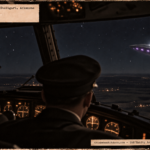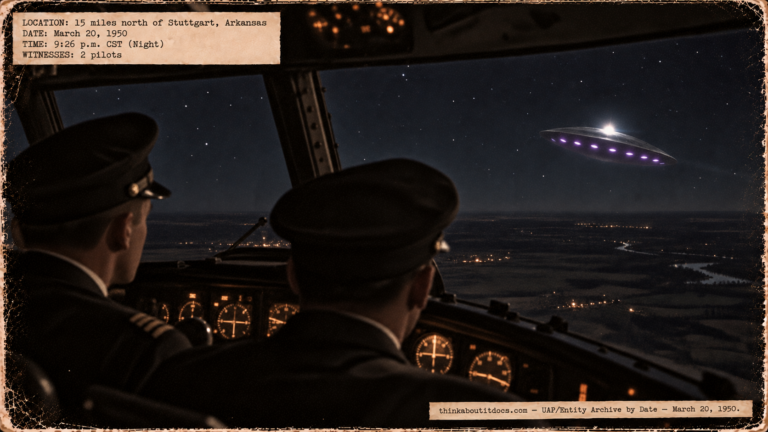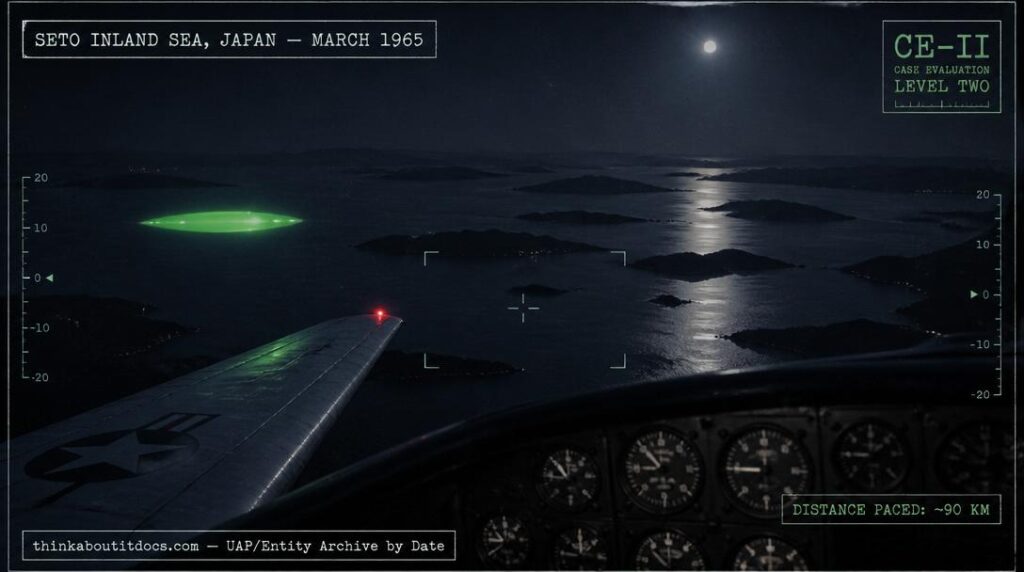
Dossier reconstruction of the object reported pacing a TOA Airlines Convair-240 over Japan's Seto Inland Sea, March 18, 1965.
THINK ABOUTIT UFO|UAP ENCOUNTER REPORT
1965: Seto Inland Sea, Japan UFO | Two-Pilot CE-II Case Archive
Just after 7 PM on the night of Thursday, March 18, 1965, TOA Airlines captain Inaba, twenty years and 8,600 flying hours into his career, was crossing the Seto Inland Sea near the Ieshima Islands when a greenish, elliptical light fell in beside his Convair-240’s left wing. It paced him for roughly 90 kilometers, all the way to Matsuyama on Shikoku — pausing at one point for about three minutes — while violently jamming his automatic direction finder and radio. Within minutes of the same encounter, a second pilot, Negishi, flying a Piper Apache nearby, reported the identical object near the same spot. A team of American “flying saucer experts,” from the Defense Department, the FAA, and the Palomar Observatory, flew to Japan specifically to interview them both.
The two period news accounts behind this case — a UPI wire report and a Mainichi Daily News follow-up — don’t fully agree with each other on some details, and this page’s own date field turns out to have recorded a newspaper’s publication date rather than the sighting itself. Both are corrected and flagged plainly below.
Date: March 18, 1965 (Thursday) — corrected from “March 21, 1965,” which is the publication date of the UPI wire report, not the sighting date. See Researcher’s Notes.
Sighting Time: 7:06 PM (per the Mainichi Daily News account); the initial UPI account gives “shortly after 7 p.m.”
Day/Night: Night
Location: A multi-location encounter beginning over Himeji, near Osaka, continuing over the Ieshima Islands in the Seto Inland Sea, and extending roughly 90 km across the Inland Sea to Matsuyama, Shikoku Island, Japan
Urban or Rural: Not applicable — an aerial encounter involving commercial aircraft in flight
Hynek Classification: CE-II (Close Encounter II) — corrected from NL. The lead pilot reported the object “violently affected” his automatic direction finder and radio, a documented electrical/instrument interference effect that defines Hynek’s CE-II category. See Researcher’s Notes.
Duration: The object reportedly paused alongside the aircraft for about three minutes at one point; the full encounter, spanning roughly 90 km, likely lasted longer overall. See Researcher’s Notes.
No. of Object(s): 1 (reported independently by both aircraft)
Description of the Object(s): An oblong, luminescent, greenish object that paced the Convair-240 alongside its left wing for approximately 90 km before disappearing near Matsuyama; interfered severely with the aircraft’s automatic direction finder and radio
Shape of Object(s): Oblong/elliptical
Size of Object(s): Undocumented
Color of Object(s): Greenish luminescent light
Distance to Object(s): Flew alongside the aircraft’s left wing at close formation-flying distance for roughly 90 km
Height & Speed: Aircraft was cruising at approximately 2,000 meters altitude when the object first appeared; the object matched the aircraft’s own speed while pacing alongside it
Number of Witnesses: At least 3 named pilots across 2 separate aircraft — Captain Inaba and his co-pilot (TOA Airlines Convair-240), and pilot Negishi (Tokyo Airlines Piper Apache), who independently reported the same object near the same spot within minutes; an unspecified number of the Convair-240’s 28–40 passengers (count varies between sources) were also aboard, though their own observations are not detailed
Special Features/Characteristics: Captain Inaba, a 20-year veteran with over 8,600 flying hours, said it was the first time in his career he had seen anything like it; the sky was clear with an almost-full moon; a test conducted by the airline on a later night under similar conditions specifically ruled out the possibility that the pilots had seen a reflection of light from their own aircraft; a team of American “flying saucer experts” from the Defense Department, the Federal Aviation Agency, and the Palomar Astronomical Observatory reportedly traveled to Japan specifically to interview the pilots involved
Case Status: Unexplained
Source: Tokyo Japan Times, March 21, 1965 (UPI wire release originating from Hiroshima); Mainichi Daily News (Tokyo), March 22, 1965
Summary/Description: On the night of Thursday, March 18, 1965, a greenish, elliptical, luminous object paced a TOA Airlines Convair-240 alongside its left wing for roughly 90 km across Japan’s Seto Inland Sea, interfering severely with the aircraft’s radio and direction finder before disappearing near Matsuyama. A second aircraft, a Tokyo Airlines Piper Apache, independently reported the same object near the same location within minutes. A team of American aviation, astronomical, and defense experts subsequently traveled to Japan to interview the pilots involved.
Related Cases: Not to be confused with the later, more widely known 1986 Japan Air Lines Flight 1628 “Alaska UFO” incident, an entirely separate case involving different aircraft, crew, and location. Not separately indexed in this archive.
Detailed Report
Shortly after 7 PM on the night of Thursday, March 18, 1965, Captain Inaba of TOA Airlines was flying a scheduled Convair-240 service from Osaka toward Hiroshima, having just passed over Himeji, when a mysterious elliptical, luminous object appeared near his aircraft. Cruising at roughly 2,000 meters, Inaba watched the object approach; fearing a collision, he turned the plane 60 degrees to the right, but the object matched the maneuver and settled in alongside his left wing. It stayed with the aircraft across the Ieshima Islands and the Seto Inland Sea, at one point holding its position for about three minutes, continuing for a total distance of roughly 90 kilometers before finally disappearing as the flight reached Matsuyama, on Shikoku Island.
The object glowed a greenish color throughout, and Inaba reported that it interfered violently with his automatic direction finder and radio equipment — badly enough that he was unable to reach the Osaka communications tower to report what he was seeing in real time. His co-pilot instead tried to raise the tower at Matsuyama once they arrived, and while attempting to do so, picked up frantic radio calls from another aircraft entirely: a Tokyo Airlines Piper Apache, piloted by Joji Negishi, whose pilot reported being chased by a similar mysterious luminous object along the northern edge of Matsuyama city — apparently the same object, sighted independently within minutes of the Convair-240’s own encounter.
Inaba, a veteran with twenty years and more than 8,600 flying hours, said it was the first time in his career he had witnessed anything like it. Period reporting on the case took pains to note that the night was clear with an almost-full moon, arguing this made a simple weather-related misidentification unlikely, and that a test conducted by the airline on a subsequent night, under similar conditions, specifically ruled out the possibility that the pilots had merely seen a reflection of light from their own aircraft.
The case drew serious outside attention. According to a follow-up report in the Mainichi Daily News, a team of American “flying saucer experts” — drawn from the Defense Department, the Federal Aviation Agency, and the Palomar Astronomical Observatory — traveled to Japan specifically to interview both Inaba and Negishi about their respective encounters. No outcome or conclusion from that investigation is documented in the material available to this archive.
RESEARCHER’S NOTES
The Inland Sea Pursuit — Japan 1965 and Two Aircraft, One Object
- Date Correction: The structured date field lists March 21, 1965, but this is the publication date of the UPI wire report in the Tokyo Japan Times, not the date of the sighting itself. Cross-referencing the source’s own internal details — the sighting is repeatedly described as having occurred “Thursday,” with press reports following “Friday night” — the actual encounter took place on Thursday, March 18, 1965. This entry corrects the date accordingly.
- Classification Correction: NL does not capture the reported electrical interference — Captain Inaba stated the object “violently affected” his automatic direction finder and radio, preventing him from contacting the Osaka communications tower. This kind of documented electrical/instrument effect is specifically what defines Hynek’s CE-II category, and this entry reclassifies the case accordingly.
- Source Discrepancies, Preserved: The two contemporaneous news accounts disagree on several specific details — the lead pilot’s first name (Yoshiaka vs. Yoshiharu Inaba), the co-pilot’s surname (Umashima vs. Majima), and the number of passengers aboard the Convair-240 (40 vs. 28). These are genuine inconsistencies between the two period wire sources themselves, not something introduced by this archive, and are preserved here rather than silently resolved in favor of one account.
- Two Independent Aircraft: This case involves not one but two separate aircraft — Inaba’s TOA Airlines Convair-240 and Negishi’s Tokyo Airlines Piper Apache — reporting what was described as the same object near the same location within minutes of each other. This kind of near-simultaneous, independent multi-aircraft corroboration is relatively uncommon and adds meaningful weight to the case.
- Duration Nuance: The “about three minutes” figure appears to describe a specific phase of the encounter — most likely a period during which the object paused or held formation — rather than the full sighting, which spanned roughly 90 kilometers across the Inland Sea and would likely have taken considerably longer than three minutes to cover at typical cruising speeds. This entry presents the figure with that caveat rather than as a total encounter duration.
- Institutional Response: The source reports that a team of American “flying saucer experts” from the Defense Department, the Federal Aviation Agency, and the Palomar Astronomical Observatory traveled to Japan specifically to interview the pilots — a notable degree of institutional engagement, though no outcome or conclusion from that investigation is documented in the material available to this archive.
Two aircraft, two independent crews, the same object, minutes apart, over ninety kilometers of open sea — and a veteran pilot’s own instruments jammed the whole way. That’s a hard case to wave off with a single mundane explanation, and period investigators seem to have thought so too, given how far some of them traveled to ask about it. It remains filed as Unexplained, with this entry’s corrected date and classification giving the record a firmer footing than it had before.
“A mysterious elliptical luminous object appeared just after I had passed Himeji.”