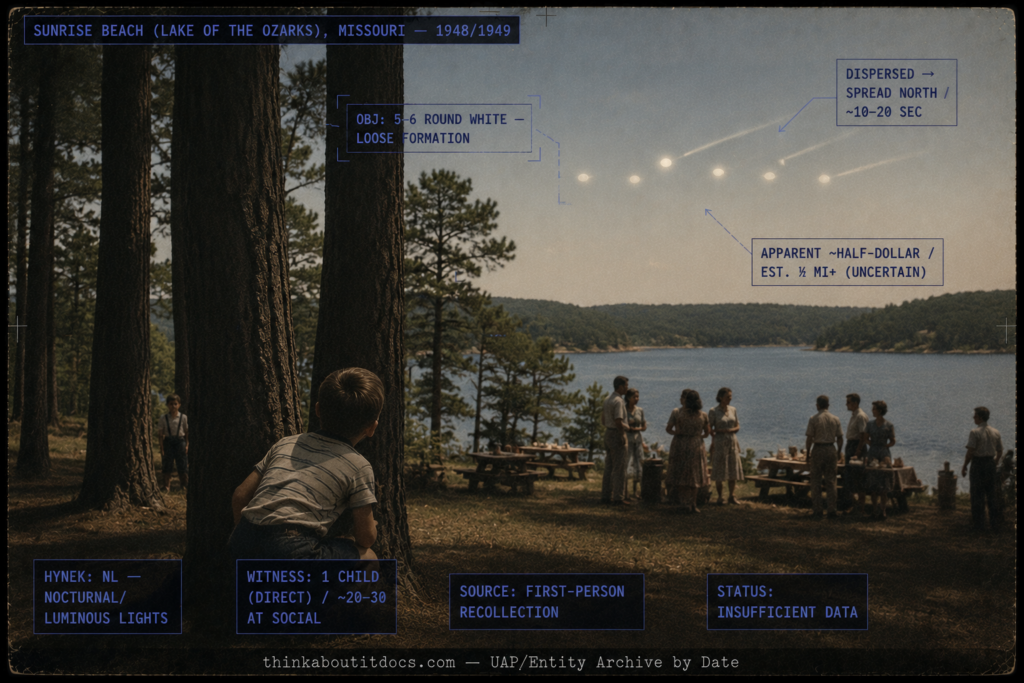
A child at a lakeside social glimpses five or six white objects in loose formation over the Ozarks, 1948–49 — a brief sighting that scattered and drifted north.
THINK ABOUTIT UFO | UAP SIGHTING REPORT
1948 / 1949: Sunrise Beach, Missouri Sighting
A child crouched behind a stand of pine trees at the Lake of the Ozarks, hiding in a game of hide-and-seek while the grown-ups held a parent/teacher social nearby, happened to tip his head back and look up. Strung loosely across the sky, left to right, were five or six bright, nearly round white objects — about the apparent size of half-dollars held at arm’s length. He watched only a few seconds. Then the group broke apart, the objects spreading out and drifting off toward the north until they were gone. It is a small, fleeting glimpse, remembered across a lifetime and set down for the record: no fanfare, no craft detail, just a handful of white lights over the Missouri woods at the close of the 1940s.
Date: 1948 or 1949 (year uncertain)
Sighting Time: Unknown
Day/Night: Unknown (light conditions not specified; objects seen as bright white)
Location: Sunrise Beach, in the Hurricane Deck State Park area, Lake of the Ozarks, Missouri
Urban or Rural: Rural (undeveloped area, miles from towns or developments)
No. of Entity(‘s): None reported
Entity Type: Not applicable — no occupants or entities observed
Entity Description: Not applicable
Hynek Classification: NL (Nocturnal/luminous Lights) — bright luminous objects observed as points/discs of light
Duration: 10–20 seconds
No. of Object(s): 5–6
Description of the Object(s): Five or six bright, nearly round white objects, seen in a loose left-to-right grouping. After a few seconds the group dispersed, the objects breaking apart and spreading out as they moved off toward the north.
Shape of Object(s): Round
Size of Object(s): Apparent size of a half-dollar or quarter held at arm’s length; estimated (very roughly) 50 to 300 ft in actual size
Color of Object(s): White (bright)
Distance to Object(s): Roughly half a mile or more (estimated, uncertain)
Height & Speed: Estimated low — perhaps 50 to 300 ft up; movement steady, dispersing northward; no speed estimate
Number of Witnesses: 1 direct (the child witness, hiding with a friend); approximately 20–30 adults and others present at the social nearby, though it is not established that any of them observed the objects
Special Features/Characteristics: Loose left-to-right grouping that dispersed and spread out as it departed northward; bright white round objects; brief duration; observed by a child during a game while a parent/teacher social was underway nearby; remote, undeveloped setting
Case Status: Insufficient Data
Source: First-person witness recollection submitted to Think About It Docs
Summary/Description: The witness recalls that, as a child playing hide-and-seek and hiding with a friend behind some pine trees at a parent/teacher social held at Sunrise Beach in the Hurricane Deck area of the Lake of the Ozarks, Missouri, in 1948 or 1949, he looked up and saw five or six bright, nearly round white objects — about the apparent size of half-dollars — loosely grouped from left to right. After a few seconds the objects dispersed, breaking from the group and spreading out as they moved off toward the north. The total observation lasted only 10 to 20 seconds.
Related Cases: 1947 Saranac Lake, New York (serial/grouped white objects, child witness) | 1947 Mission, B.C. (grouped objects shifting formation) | broader late-1940s Missouri and Midwest NL reports
DETAILED REPORT
This is a brief, first-person recollection of a childhood sighting at the Lake of the Ozarks in Missouri, set down by the witness for the record. By the account, the witness was a child at the time, in 1948 or 1949, attending a parent/teacher social with the adults at Sunrise Beach in the Hurricane Deck State Park area — described as an undeveloped stretch miles from any town or development. While playing a game of hide-and-seek, the witness was concealed with a friend behind a group of pine trees when he happened to look up.
What he saw was a loose grouping of five or six bright, nearly round white objects arranged from left to right across the sky. He estimated their apparent size, at the time, as comparable to a half-dollar or quarter held at arm’s length, and offered a tentative actual-size range of anywhere from 50 to 300 feet, with an equally tentative distance of about half a mile or more and a low altitude — all of which he flags as rough guesses. The objects held their loose formation only briefly; after a few seconds they dispersed, breaking from the group and spreading out as they moved off toward the north. The entire observation lasted only 10 to 20 seconds.
As evidence, the case is modest by its own framing. It is a single direct witness — a child at the time — recalling the event much later; while roughly 20 to 30 adults and others were present at the nearby social, the account does not establish that any of them saw the objects, so the practical corroboration is limited. The year is uncertain (1948 or 1949), no time of day or source is recorded, and the size, distance, and altitude figures are explicitly hedged. What the account does have in its favor is its modesty and internal consistency: a short, plainly described glimpse of bright white objects in loose formation that dispersed and left — no craft structure, no exotic claims, no embellishment. It reads as a sincere recollection of something briefly and genuinely seen, set down precisely because the witness wanted it on the record, with the uncertainties left honestly in place.
RESEARCHER’S NOTES
The Pines at Sunrise Beach — Lake of the Ozarks, 1948–49, and a Child’s Brief Glimpse of Lights in Formation
- Classification Basis: NL (Nocturnal/luminous Lights) is the appropriate category. The objects were perceived essentially as bright luminous points or discs in loose formation, with no resolved structure, no occupants, and no close approach. The “round” descriptor reflects the appearance of bright light sources at distance rather than a structured-craft observation, which keeps the case in the NL category rather than DD.
- Source and Evidentiary Assessment: This is a single-witness first-person submission with no external source, recalled from childhood, which places it among the more modest entries of the period. The witness’s own estimates — apparent size, distance (half a mile “or more”), altitude (50–300 ft) — are explicitly tentative, and the year itself is given as 1948 or 1949. The presence of 20–30 people at the nearby social is noted, but the account does not claim any of them shared the sighting, so there is effectively no corroboration. None of this points toward fabrication; the candor of the hedging and the absence of any dramatic elaboration are credibility markers. It simply means the data are too thin to carry the case beyond a sincere, uncorroborated recollection.
- Pattern Context: The configuration — several bright white objects in a loose group that disperses and spreads out while departing in a single general direction — is a common late-1940s report type and resembles other grouped-light accounts of the era, such as the 1947 Saranac Lake procession and the Mission, B.C. formation. A loose group of bright objects that breaks apart and moves off has, as with those cases, a range of possible explanations spanning the genuinely anomalous to the conventional (high-altitude aircraft formations catching light, balloons, or birds), none of which can be confirmed or excluded from a 10-to-20-second childhood glimpse. The value of the entry is as a regional Missouri data point within that broader pattern.
- Physical Evidence and Weight: There is no physical evidence — no photograph, no instrument record, no second confirmed witness. The weight rests entirely on a brief, honestly-hedged recollection. With an uncertain year, no time, no source, and self-flagged estimates, the case cannot be elevated to Unexplained, but its sincerity and lack of red flags equally argue against dismissing it. Insufficient Data is the accurate standing — a genuine-seeming brief sighting that the record cannot independently verify or resolve.
The Sunrise Beach sighting is a small, honest fragment from the close of the 1940s: a child behind the pines at a lakeside social, a few seconds’ glimpse of five or six bright white objects in loose formation that scattered and drifted north, and a lifetime later a careful effort to put it on the record with the uncertainties intact. It is single-witness, undated to the year, sourceless, and brief, with size and distance figures the witness himself marks as guesses — too thin to call Unexplained, too sincere and unembellished to wave away. The record’s standing is NL, Case Status Insufficient Data: a genuine-seeming brief observation preserved as a regional Missouri data point within the broader late-1940s pattern of grouped lights, and held honestly at the limit of what a short childhood memory can support.