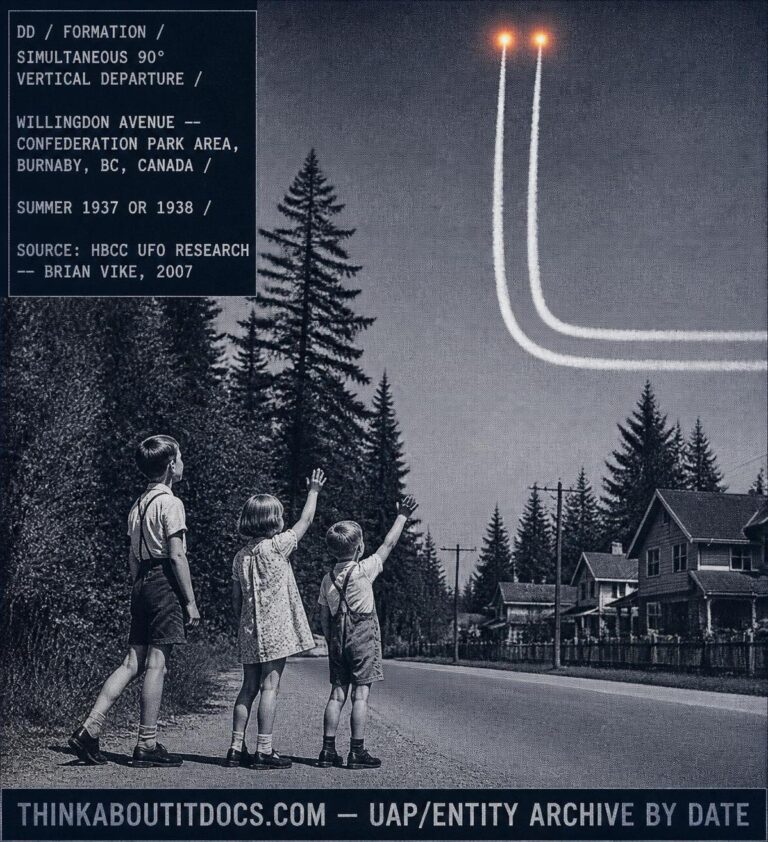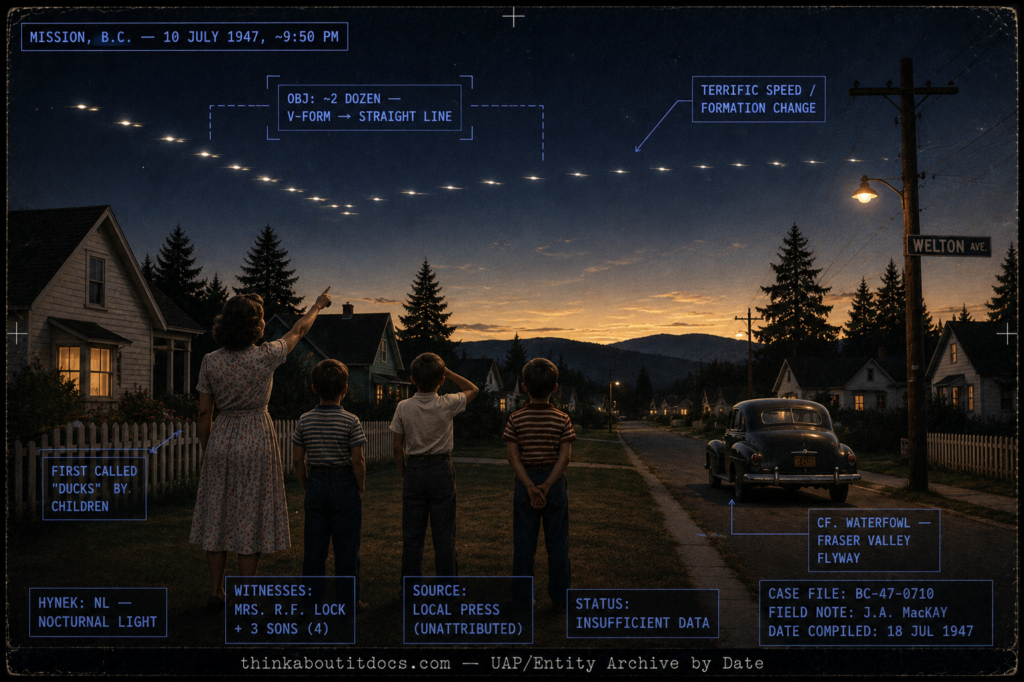
A mother and three boys watch two dozen objects shift from a V into a line over Mission, B.C., July 10, 1947 — the children first called them ducks.
THINK ABOUTIT UFO | UAP SIGHTING REPORT
1947: Mission, British Columbia, Canada Saucer Sightings
“Look, look at the ducks.” That was how Mrs. R.F. Lock’s three sons brought it to her attention on the evening of July 10, 1947, in Mission, British Columbia — and when she looked up at about 9:50, what she saw was no flock she recognized. Roughly two dozen objects crossed the sky, first in a V-formation and then snapping into a straight line, moving at what she described as a terrific speed before they vanished. No one else on the street reported seeing them. It is one of the countless small civilian reports that rippled out of the Pacific Northwest in the days after Kenneth Arnold and Roswell — brief, local, and unresolved, the kind of entry that, multiplied across a continent, made the summer of 1947 the moment the sky started to feel unfamiliar.
Date: July 10, 1947
Sighting Time: ~9:50 PM (Tuesday evening)
Day/Night: Night (late dusk/evening)
Location: Mission, British Columbia, Canada (Welton Avenue)
Urban or Rural: Urban (residential)
No. of Entity(‘s): None reported
Entity Type: Not applicable — no occupants or entities observed
Entity Description: Not applicable
Hynek Classification: NL (Nocturnal Light) — luminous/indistinct objects observed at night in formation
Duration: Brief (objects observed in formation before disappearing at high speed; exact time not specified)
No. of Object(s): Approximately two dozen
Description of the Object(s): About two dozen objects observed crossing the night sky, first arranged in a V-formation, then reforming into a straight line, moving at a “terrific speed” before disappearing. No shape, color, or size detail recorded. Initially mistaken by the children for ducks.
Shape of Object(s): Not specified
Size of Object(s): Not specified
Color of Object(s): Not specified
Distance to Object(s): Not specified
Height & Speed: Described as moving at “terrific speed”; altitude not specified
Number of Witnesses: 4 — Mrs. R.F. Lock and her three sons; no other persons reported observing the objects
Special Features/Characteristics: Large count (~two dozen); formation behavior — a V-formation reforming into a straight line; high speed; children’s initial identification as “ducks”; no other neighborhood witnesses; occurred at the height of the July 1947 wave
Case Status: Insufficient Data
Source: Local newspaper report (text not preserved on the live page; the account reads as a contemporaneous Mission/Fraser Valley press item). Source field currently blank — needs attribution.
Summary/Description: On the evening of July 10, 1947, at about 9:50 PM in Mission, British Columbia, Mrs. R.F. Lock of Welton Avenue and her three sons reported seeing “mysterious flying saucers.” The boys first drew their mother’s attention by exclaiming “Look, look at the ducks.” Mrs. Lock observed approximately two dozen objects fly first in a V-formation, then reform into a straight line, moving at a terrific speed before disappearing. No other persons were reported to have witnessed the phenomenon.
Related Cases: 1947 Kenneth Arnold sighting | 1947 United Air Lines Flight 105 (Idaho, formation discs) | broader July 1947 nationwide/Canadian disc wave | other 1947 British Columbia reports
DETAILED REPORT
This is a short, contemporaneous-style local report from the height of the July 1947 wave, set in the town of Mission in British Columbia’s Fraser Valley. The witnesses were Mrs. R.F. Lock of Welton Avenue and her three sons. By the account, it was the boys who first noticed something in the sky at about 9:50 on a Tuesday evening, calling out “Look, look at the ducks” — a detail that is both charming and analytically important, since it records the witnesses’ own first, instinctive interpretation. When Mrs. Lock looked, she reported seeing approximately two dozen objects that did not behave like a flock she could identify: they flew first in a V-formation and then reformed into a straight line, moving at what she called a terrific speed before disappearing from view.
The report’s notable features are the object count and the formation behavior. Two dozen objects is a large number, and the transition from a V into a straight line is a specific, structured maneuver. Against that, the account is thin on the details that would allow discrimination: no shape, color, size, altitude, or duration is recorded, and the only described motion characteristics are “terrific speed” and the formation change. The report explicitly notes that no other persons observed the phenomenon, which means the case rests on a single family group of four, with the mother as the principal adult witness.
The honest analytical tension here is that the witnesses’ own first reaction — “ducks” — points squarely at the most common prosaic explanation for a couple-dozen objects shifting from a V into a line at dusk: a flock of birds. Waterfowl and other birds routinely fly in V-formations, reconfigure into lines, and can appear to move quickly and catch or lose the light against an evening sky, and Mission sits in the Fraser Valley, a major migratory and waterfowl corridor. That does not establish that birds are what they saw — Mrs. Lock evidently concluded they were not ducks, the term “terrific speed” is not typical of how observers describe flocks, and the case entered the record as a “flying saucer” report during the wave — but the proximity of a strong conventional explanation, volunteered by the witnesses themselves, is the defining feature of this entry and cannot be set aside. With no corroborating witnesses, no preserved source text, and no further detail, the report cannot be pushed beyond a thin, single-group account.
RESEARCHER’S NOTES
Look at the Ducks — Mission, B.C. 1947 and the Limits of a Thin Wave-Era Report
- Classification Assessment: NL (Nocturnal Light) is the appropriate classification given the evening timing and the absence of any resolved shape, color, or structure — the objects were indistinct forms in formation against a night sky. No Close Encounter category applies. It is worth noting the case sits near the NL/DD boundary only in that it occurred at ~9:50 PM in July at a northern latitude, where residual dusk light is possible; absent any shape detail, NL is correct.
- Source Chain Assessment: The Source field on the live page is blank and must be populated. The account’s phrasing (“Mrs. R.F. Lock, Welton Avenue, observed the particular objects around 9:50 Tuesday evening”) reads as a lift from a contemporaneous local newspaper — almost certainly a Mission or Fraser Valley paper of July 1947 (e.g., the Fraser Valley Record). If that original item can be located, it would anchor the case as a genuine contemporaneous press report and is the obvious upgrade path. As held, the source is unattributed, which caps the entry’s standing. (Note also the live page’s tags include “J. Edgar Hoover” and “New Mexico,” which appear to be erroneous carryovers and should be removed.)
- Pattern Context: The report is a textbook minor entry of the July 1947 wave, which produced hundreds of brief local “flying saucer” items across North America in the days after the Arnold sighting and the Roswell press release. Large-count formation reports were common in this period, and the V-to-line maneuver echoes the formation behavior in better-documented cases like the United Air Lines Flight 105 sighting six days earlier. Its value to the archive is as a regional Canadian data point within the wave rather than as a strong standalone case. The Fraser Valley setting is also a known waterfowl flyway, which is directly relevant to the competing explanation.
- Physical Evidence and Evidentiary Weight: There is no physical evidence and minimal descriptive detail. The case rests on a single family group of four, with no independent corroboration (“no other persons observed the phenomena”), no preserved source, and a strong, witness-volunteered conventional candidate (birds). This combination — thin detail, single group, plausible prosaic explanation — is precisely what the Insufficient Data status exists to capture: not dismissed as explained, since Mrs. Lock rejected the duck interpretation and the detail is too sparse to confirm birds, but not elevated to Unexplained, since the evidence cannot rule the conventional explanation out. Recovery of the original newspaper item is the only realistic path to firming it up.
The Mission report is a small, honest fragment of the 1947 wave: a mother and three boys, a couple-dozen objects shifting from a V into a line at terrific speed over a Fraser Valley street, and a first reaction — “ducks” — that names the very explanation the case can neither confirm nor dismiss. It is too thin to elevate and too pointedly unresolved to wave away: no corroborating witnesses, no preserved source, no shape or color, and a strong conventional candidate volunteered by the observers themselves. The archive keeps the NL classification, flags the blank source and the erroneous tags for cleanup, and assigns Case Status: Insufficient Data. It stands as a representative regional Canadian entry from the height of the wave and a candidate for upgrade only if the original July 1947 newspaper report can be recovered.