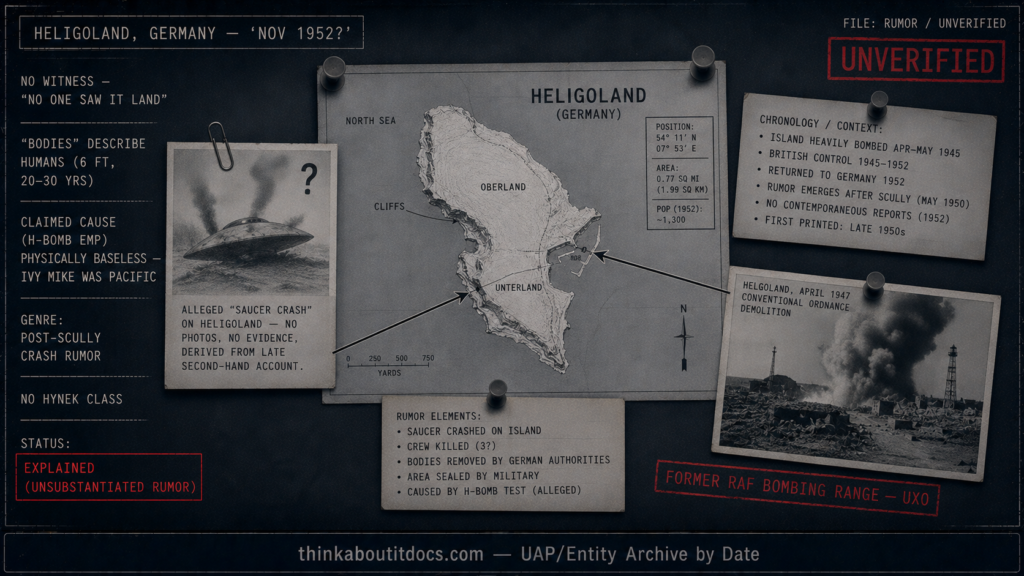
The 1952 Heligoland "saucer crash" — no witness, no documentation, "bodies" that describe humans, and a former British bombing range for a setting. Logged Explained (unsubstantiated crash-retrieval rumor). (thinkaboutitdocs.com — UAP/Entity Archive by Date)
THINK ABOUTIT UFO|UAP|ENTITY SIGHTINGS REPORT
1952: The Heligoland, Germany “Crash” (Unsubstantiated Crash-Retrieval Rumor)
UNSUBSTANTIATED CRASH-RETRIEVAL RUMOR
— no witness, no date precision, no documentation, and a description of the “bodies” that fits human beings.
No Hynek classification applies.
Case Status: Explained (unsubstantiated rumor; likely mundane).
The story is striking and almost weightless: somewhere on the tiny North Sea island of Heligoland, around November 1952, a saucer supposedly came down — though, the account concedes, no one actually saw it land — its instruments mysteriously intact, with the badly burned bodies of seven men scattered on the ground outside. It is preserved in Kevin Randle’s catalogue of crash claims, but it has no named witness, no unit, no document, and no chain of evidence of any kind. And its most quoted detail quietly dismantles it: seven well-built men, roughly six feet tall and twenty to thirty years old, is a description of human beings, not of an alien crew. Heligoland in 1952 had just been handed back to Germany after years as a British live-bombing range littered with unexploded ordnance — a setting that supplies far more ordinary explanations for burned bodies and wrecked metal than a downed spacecraft. The archive keeps the entry as a documented example of the post-Scully crash-rumor genre and labels it plainly for what it is.
Date: Reported as November 1952 (no specific date; unverified)
Sighting Time: Unknown (no one reportedly witnessed the event)
Day/Night: Unknown
Location: Heligoland (Helgoland), a small German archipelago in the North Sea
Urban or Rural: Rural (small island)
No. of Entity(‘s): 7 claimed (described as human-appearing male bodies)
Entity Type: Described as the bodies of seven men — a description consistent with humans, not non-human entities
Entity Description: The bodies of seven men, all badly burned; one report put them at about 20 to 30 years old and roughly six feet tall
Hynek Classification: None — this is an unwitnessed, unsubstantiated crash-retrieval rumor, not an observed encounter; no Hynek classification applies (the prior “CE-III” has been removed)
Duration: Not applicable
No. of Object(s): 1 claimed (a “saucer” that no one is said to have seen land)
Description of the Object(s): Claimed to be a saucer whose internal instruments were found in good condition despite the crash; no witness, photograph, or physical evidence supports the description
Shape of Object(s): Claimed saucer
Size of Object(s): Unknown
Color of Object(s): Unknown
Distance to Object(s): Not applicable (no witness)
Height & Speed: Not applicable
Number of Witnesses: None identified — the account itself states no one saw the object land
Special Features/Characteristics: No named witness, date, unit, or documentation; the “bodies” are described as human-appearing men; the claimed cause (a hydrogen-bomb test downing the craft) is physically baseless; the location was a former British live-bombing range strewn with unexploded ordnance; the account belongs to the post-Scully crash-retrieval rumor genre
Case Status: Explained (unsubstantiated crash-retrieval rumor; likely mundane)
Source: Kevin D. Randle, “A History of UFO Crashes” — a catalogue and critical history of crash claims; inclusion records the rumor, not an endorsement of it
Summary/Description: An unsubstantiated rumor, recorded in Kevin Randle’s history of crash claims, holds that around November 1952 a saucer crashed on the North Sea island of Heligoland — though no one is said to have seen it land — with its instruments intact and the badly burned bodies of seven roughly six-foot men nearby, supposedly downed by atmospheric effects of hydrogen-bomb testing. There is no named witness, date, unit, or documentation; the “bodies” describe humans; the claimed cause is physically baseless; and the island was a former British live-bombing range. The account is logged as Explained (unsubstantiated crash-retrieval rumor; likely mundane).
Related Cases: 1948 & 1950: The Aztec, New Mexico Crash Hoax (Frank Scully) | 1946 & 1952: The Legends of UFO Crashes at Spitzbergen, Norway | the broader corpus of unsubstantiated 1950s “crashed saucer” rumors
DETAILED REPORT
The entire account, as carried in Kevin Randle’s history of crash claims, amounts to a few sentences. Around November 1952, a flying saucer is said to have come down on Heligoland, a small German island in the North Sea. No one, the report admits, actually saw it land; it was supposedly downed by atmospheric disturbances created by hydrogen-bomb testing. The craft and its internal instruments were said to be in good condition, but scattered on the ground outside were the badly burned bodies of seven men, one report describing them as about twenty to thirty years old and roughly six feet tall. That is the whole of it: no named witness, no specific date, no military or police unit, no recovered object, no photograph, no document.
An honest entry begins by naming the genre. This is a crash-retrieval rumor of the kind that proliferated in the early 1950s in the wake of Frank Scully’s 1950 best-seller “Behind the Flying Saucers,” which promoted the Aztec, New Mexico “crashed saucer with little bodies” story — a tale that a “True” magazine exposé soon traced to two known confidence men running a swindle. After Scully, free-floating accounts of downed discs and recovered crews circulated widely, and serious investigators of the day dismissed most of them as, in the phrase of the era, “little men in pickle jars.” The Heligoland story has every hallmark of that genre: a dramatic recovery, no witness, no paperwork, and a convenient official silence to explain the absence of evidence.
The detail meant to make it eerie is the detail that undoes it. Seven well-developed male bodies, six feet tall and of ordinary adult age, are a description of human beings. Genuine “alien body” lore of the period tends toward the small and the strange; this account instead describes exactly what one would expect if real human remains lay behind the rumor. And the location is unusually suggestive on that point. Heligoland was returned to German civilian control only in 1952, after years in which the British military had used the uninhabited island as a bombing range. In 1947 the British had detonated there one of the largest conventional explosions in history to destroy the island’s wartime fortifications, and the island remained littered with unexploded ordnance for years. A small North Sea island, recently a live bombing target and still strewn with explosives, is a place where burned bodies and twisted metal could plausibly be found and, in the retelling, transformed into a crashed saucer with an intact instrument panel.
The prior page compounded the rumor with an entire invented analysis. It asserted that the craft was downed by the “electromagnetic pulses or atmospheric ionizing radiation” of the first thermonuclear test, Operation Ivy Mike, and reasoned that the intact instruments proved “an external failure of its propulsion systems rather than a typical mechanical malfunction.” This is pseudo-physics built on a sourceless story, and it is wrong on the facts as well as the logic. Ivy Mike was detonated on November 1, 1952, at Enewetak Atoll in the Pacific Ocean — roughly seven thousand miles from the North Sea — and a thermonuclear test does not emit pulses capable of reaching across the globe to disable machinery over Germany. The reasoning also inverts ordinary inference: deducing the cause of a crash from the imagined condition of a craft that no documented person ever examined. The entire “Atomic Connection” section, including its closing block quotation, has been removed as fabricated analysis.
One cultural note is worth keeping, because it recurs across the 1952 files. The reflex to attach the atom to a saucer story — here as the cause of a crash, elsewhere as the message the “Space Brothers” deliver about humanity’s bombs — reflects how thoroughly thermonuclear anxiety saturated 1952, the year of both the first H-bomb and a massive UFO wave. That anxiety pulled saucer lore into its orbit. It is context for why such stories took the shape they did; it is not evidence that any of them happened.
None of this can be a forensic disproof, because there is nothing to autopsy: no witness to interview, no body to examine, no wreckage to test, no document to check. But that is precisely the point. A dramatic physical event — a crashed craft and seven dead — that left no witness, no record, and no evidence, and whose only concrete detail describes human beings on a former bombing range, is not a documented anomaly. The weight of the matter points decisively away from a real spacecraft, and the entry is filed accordingly.
RESEARCHER’S NOTES
The Heligoland “Crash” — Germany 1952 and a Rumor That Undoes Itself
- Classification, why none applies: The prior page filed this CE-III, but a close encounter of the third kind requires a witness to observe animate beings associated with a craft. Here there is no witness to anything — the account states no one saw the object land — and the “entities” are described as already-dead human-appearing bodies. An unwitnessed, unsubstantiated crash rumor is not a close encounter of any kind and carries no Hynek classification. The field is set to none, consistent with how the archive treats hoaxes and free-floating rumors.
- Source handled honestly: Kevin Randle’s “A History of UFO Crashes” is a catalogue and largely critical history of crash claims, not a register of verified events. Citing it establishes that the Heligoland rumor exists in the literature; it does not establish that the event occurred or that Randle endorsed it. For a story with no witness and no documentation, the catalogue entry is the beginning of inquiry, not its conclusion — and the inquiry finds nothing underneath it.
- The two findings that settle it: First, the “bodies.” Seven six-foot men of ordinary adult age are humans; the most economical reading of any real remains behind this story is human remains, not an alien crew. Second, the place. Heligoland in 1952 was a former British live-bombing range, just returned to German control, still strewn with unexploded ordnance after the 1947 demolition of its fortifications — a setting that readily supplies burned bodies and wrecked metal. Together these move the case out of the “mysterious” column: the rumor’s own details point toward the mundane.
- Why Explained rather than Insufficient Data: The archive reserves “Insufficient Data” for accounts that are thin but not self-defeating. This one defeats itself: it admits to no witness, describes humans as its “aliens,” offers a physically impossible cause, and sits on a former bombing range, all within the discredited post-Scully crash-retrieval genre. That is enough to call it Explained — an unsubstantiated rumor with a likely mundane basis — while acknowledging that, with no evidence to examine, the specific mundane events behind it cannot be reconstructed. Naming it plainly is what keeps a sourceless crash yarn from lending false weight to the genuinely documented cases elsewhere in the archive.
The Heligoland crash is a textbook specimen of the 1950s crashed-saucer rumor: vivid, quotable, and empty. It has no witness, no date, no document, and no object; its dead are described as men; its proposed cause is a bomb test on the far side of the planet; and its setting is an island the British had spent years bombing. Stripped of the invented “atomic” analysis the prior page built on it, reclassified out of CE-III, and read for what its own details say, it stands as Explained — an unsubstantiated crash-retrieval rumor, almost certainly mundane in origin, kept in the record so that it is documented and defused rather than repeated.