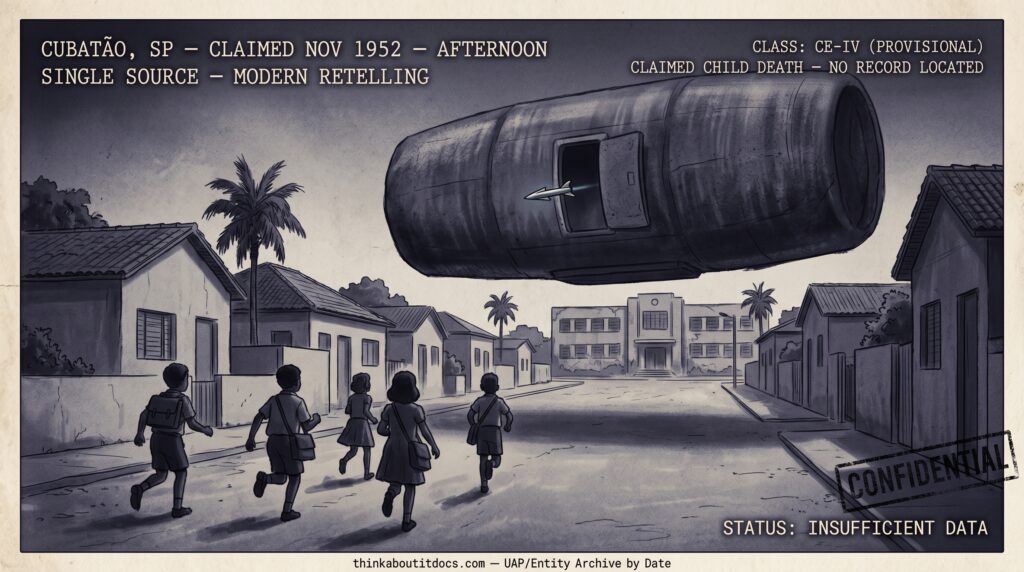
The 1952 Cubatão "missing boy" abduction — a single uncorroborated modern account whose claimed child death has no located documentation, logged as Insufficient Data. (thinkaboutitdocs.com — UAP/Entity Archive by Date)
THINK ABOUTIT UFO|UAP|ENTITY SIGHTINGS REPORT
1952: Cubatão, Brazil Abduction
It is among the most disturbing entries in the South American files — a daytime street in Cubatão, a bus-sized craft, a group of children scattering, and a small boy who vanishes and is found hours later in another town, confused, feverish, and dead soon after. If even roughly true it would be one of the most serious UFO-associated events on record. But a death like that, in a public place, before many witnesses, with a police report and a body, leaves documentation — a death record, a newspaper notice, a medical account. None exists in the searchable record. The case rests entirely on a single modern retelling attributed to one researcher, sourced to a witness recalling her own childhood and described as a repeat experiencer. The archive keeps the entry, but tells the truth about it: a grave claim with no corroboration of the one fact that would matter most.
Date: Given as November 1952 (no firm date documented)
Sighting Time: Afternoon (as stated)
Day/Night: Day
Location: Cubatão, São Paulo state, Brazil
Urban or Rural: Urban (residential, near a school)
No. of Entity(‘s): None described — no occupants reported, only the craft and a small metallic object
Entity Type: Not applicable — no beings described
Entity Description: Not applicable
Hynek Classification: CE-IV (abduction / direct contact) — provisional, as the account is a single uncorroborated modern retelling
Duration: Not recorded
No. of Object(s): 1
Description of the Object(s): A craft roughly the size of a bus that approached the children amid a sudden strong wind; an “elevator-like” door opened, from which a small metallic “arrow”-like object, said to be about 30 cm across, emerged
Shape of Object(s): Not clearly described (“strange object”)
Size of Object(s): About the size of a bus
Color of Object(s): Not recorded
Distance to Object(s): Close (approached the group)
Height & Speed: Not recorded
Number of Witnesses: Several children present; the narrator is the only identified witness, and her testimony is the sole source
Special Features/Characteristics: A sudden localized wind; an “elevator-like” door; a small metallic “arrow”-like object emerging; a young boy reported missing, found hours later in a neighboring town in a state of shock with no memory, then reported ill with skin rashes and fever and said to have died shortly after
Case Status: Insufficient Data
Source: Single attribution — Analigia Santos Francisco / UFOVIA (Brazil); a modern retelling from a witness recalling childhood. No contemporaneous documentation or independent corroboration located
Summary/Description: By a single modern account, a girl of about nine was playing with her younger brother and other children in Cubatão, Brazil, when a sudden wind rose and a bus-sized craft approached; a door opened and a small metallic “arrow”-like object emerged, and the children fled to a nearby school. The girl’s younger brother was found to be missing; hours later a boy matching him was reportedly found in a neighboring town in a state of shock with no memory, and was said to have fallen ill with rashes and fever and died soon after. The account is uncorroborated, the claimed death is undocumented in any located record, and it is logged here as Insufficient Data.
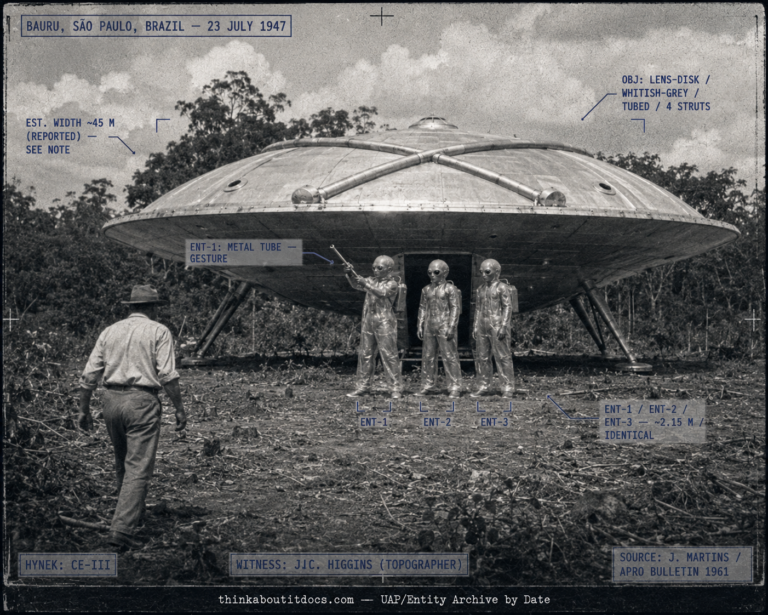
Related Cases: 1947: 7 ft Aliens Spotted in Brazil (Bauru / Higgins) | 1952: Contact in the Angatuba Mountains (Dino Kraspedon) | the broader South American “harmful-effects” abduction claims
DETAILED REPORT
As the single source tells it, a girl of about nine was outside in Cubatão with her younger brother and other children, playing a chasing game, when a strong wind rose abruptly out of still air. A craft roughly the size of a bus then approached the group; it stopped, an “elevator-like” door opened, and a small metallic object likened to an arrow, said to be around 30 centimeters across, came out of it. The frightened children scattered and took shelter at a nearby school. Only afterward did the girl realize her younger brother was no longer with them. The family and neighbors searched without finding him; hours later, the account says, police in a neighboring town reported a boy found wandering in shock, and the family identified him as the missing brother. He is said to have had no memory of what happened, to have developed skin rashes and a high fever that doctors could not treat, and to have died soon after.
If documented, this would be extraordinary — a fatal close encounter with many child witnesses, a missing-person search, a police report from another town, and a medical death. Precisely because the claim is so grave, the absence of any supporting record is the heart of the matter. A child’s death in 1952 Cubatão would have generated a death certificate; a public daytime panic and a cross-town recovery would likely have reached a local newspaper; a baffling fatal illness would have left a medical trail. No such documentation appears in the searchable Brazilian UFO record, which is not thin for this period — the era’s Brazilian cases (Bauru 1947, the Barra da Tijuca photographs of May 1952, later government OVNI files) are catalogued and cross-referenced. This case is not among them. The only carriers of the story are the present archive entry and the single source it credits.
That source is a modern one. The account is attributed to Analigia Santos Francisco via the Brazilian group UFOVIA, and the narrator is described as recalling the event from her own childhood and as having been “involved in other encounters” — a self-identified repeat experiencer relating a decades-old memory. None of that is disqualifying on its face, but it places the case firmly in the category of uncorroborated personal testimony recorded long after the fact, not contemporaneous documentation. The “afternoon, November 1952” specifics should be read as features of the retelling rather than established record.
The prior version of this page closed by asserting that the boy “obviously” suffered “some kind of radiation sickness.” That is the page diagnosing an undocumented death from a single second-hand description, and it has been removed. Rashes and fever are consistent with a great many ordinary illnesses; attaching a radiation interpretation to them lends false specificity to an event that cannot even be confirmed to have occurred. Where the record allows, the honest statement is narrow: a single witness has described, decades later, the loss of her brother in association with a craft. What actually befell any real child behind this account — if there was one — cannot be established from what exists.
RESEARCHER’S NOTES
The Cubatão Missing Boy — Brazil 1952 and a Grave Claim Without a Record
- Classification, held but provisional: CE-IV describes the type of claim — an abduction, here of the narrator’s brother — and so it stands as the report-type label. But there are no entities described, no craft details beyond size, and no corroboration, so the class marks a category, not a vouched-for event. It sits beside an Insufficient Data status that reflects how little can be confirmed. Note too that the prior page’s framing wavered between the girl and the boy as the central figure; cleanly stated, the girl is the narrator and her younger brother is the one said to have been taken.
- Source-chain assessment: The case has one source — a modern retelling attributed to Analigia Santos Francisco and the group UFOVIA — and no independent confirmation in the Brazilian record. For a 1952 event with a claimed child fatality, that is a severe deficiency. The story did not enter the literature through contemporaneous investigation; it surfaced through later personal testimony from a witness who identifies as a repeat experiencer. Naming that chain plainly is the correction the prior page most needed.
- The missing documentation, and why it is decisive: The single most important analytical point is what is absent. A real death of a child under these circumstances would almost certainly have produced a death certificate, contemporaneous press coverage, and a medical record, and a multi-town search and police involvement would have left their own traces. None has been located. This is not a case where evidence is merely thin; it is a case where the one event that would make it historically significant — a child’s death — has no documentary footprint at all. That absence does not prove nothing happened, but it forbids treating the death as established.
- Evidentiary weight and why Insufficient Data: Against the account: a single uncorroborated modern source, an undocumented death, no named witnesses beyond the narrator, and no contemporaneous record. For it: only the internal consistency of one person’s testimony. There is likewise no positive evidence of deliberate hoax. That balance is Insufficient Data exactly — neither a documented anomaly to call “Unexplained” nor a demonstrated fabrication or mundane cause to call “Explained.” The archive’s duty with a claim this serious is restraint: record it, strip the invented diagnosis, name the single source, and decline to present an undocumented child’s death as fact.
The Cubatão case asks the archive to log the death of a child on the strength of one person’s decades-later memory, with nothing else behind it. The proper response is neither to amplify it into a confirmed tragedy nor to erase it, but to keep it and tell it straight: a grave, affecting claim from a single uncorroborated source, its central fact undocumented, its old radiation-sickness verdict removed as unfounded. It stands as Insufficient Data — a story held in the record with the honesty its seriousness demands, and none of the certainty it has not earned.