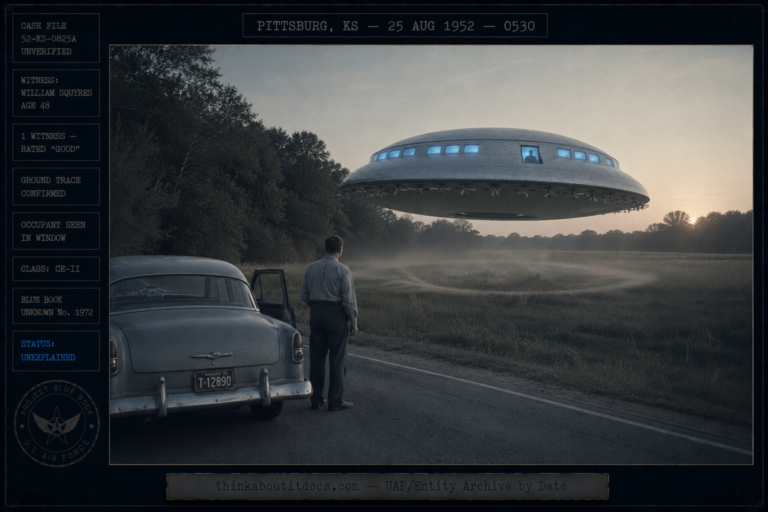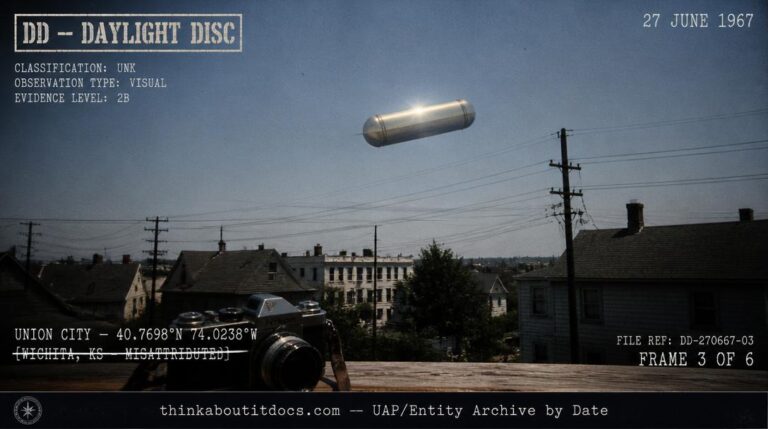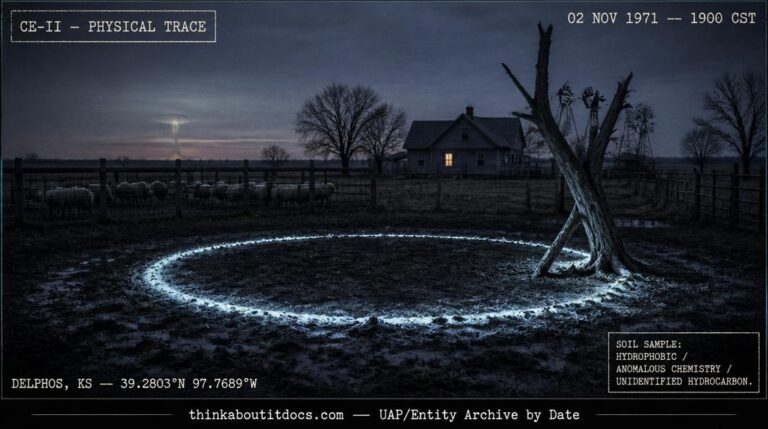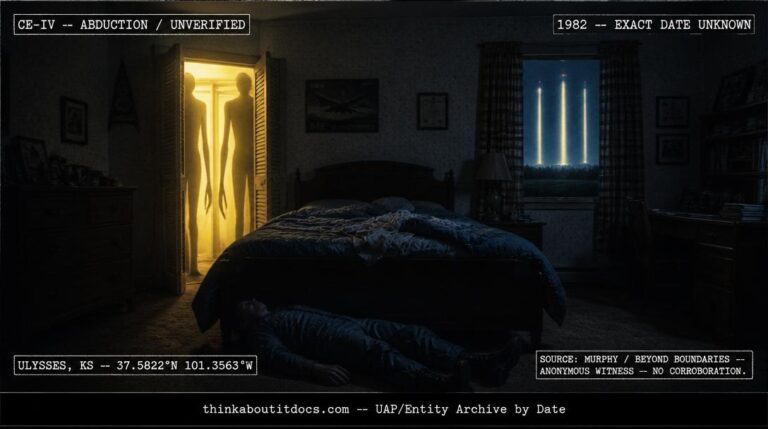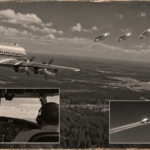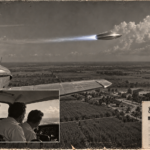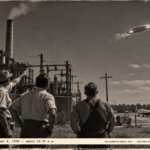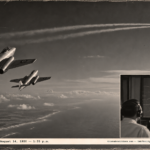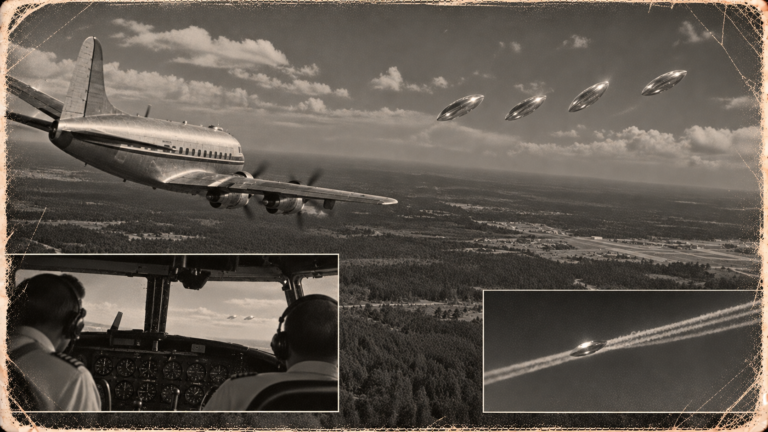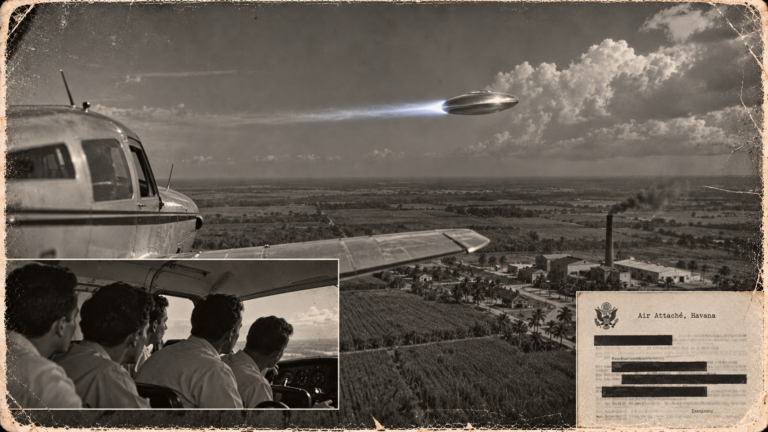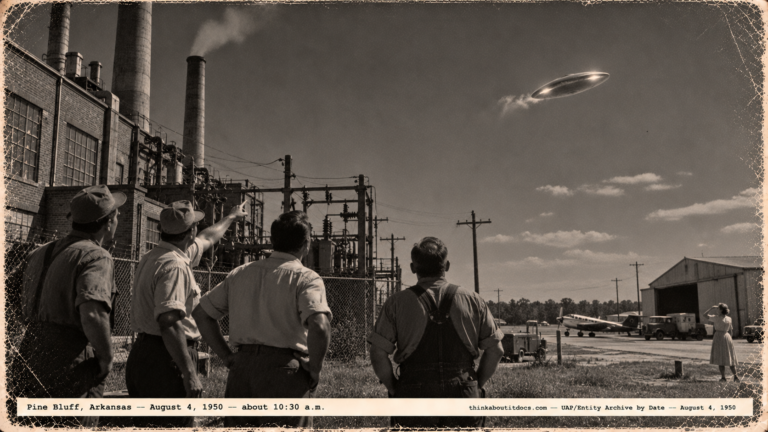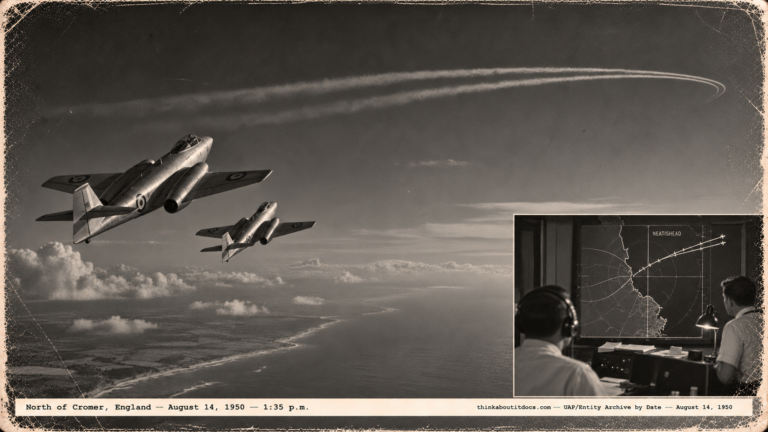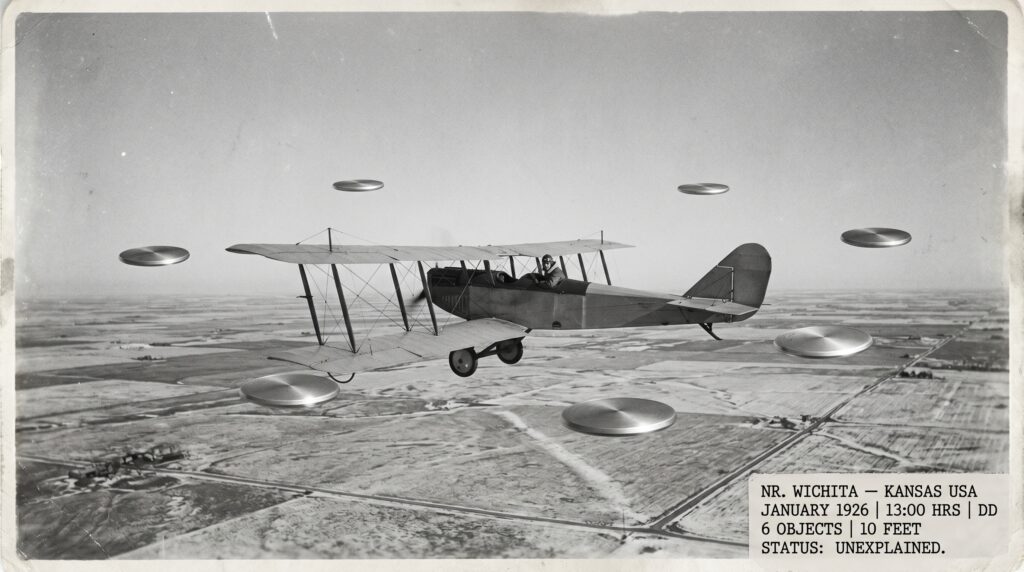
Near Wichita, Kansas, January 1926, 1:00 PM — celebrated stunt pilot Bert Acosta was surrounded by six shiny circular objects approximately 3 to 4 feet in diameter that circled his aircraft at 10 feet before speeding away. Duration: two minutes. Source: Richard Hall, 2000, p.13; Frank Edwards. Case status: Unexplained.
THINK ABOUTIT UFO|UAP SIGHTING REPORT
1926: Several Circular Objects Surrounded Plane
In January 1926 at one o’clock in the afternoon, Bert Acosta — one of the most celebrated stunt pilots in America, a man who would later co-pilot the America on its transatlantic crossing in 1927 — was flying from Wichita, Kansas toward Colorado Springs when six shiny circular objects the size of flying manhole covers surrounded his aircraft and closed to within ten feet. They circled. Then they sped away. The entire encounter lasted two minutes. A trained aerobatic pilot with thousands of hours in the air, flying in clear daylight, who knew every aircraft type in existence in 1926, described six disc-shaped objects performing maneuvers no aircraft of his era could match at a distance of ten feet from his wingtip. Frank Edwards documented it. Richard Hall catalogued it. The archive holds it here as one of the earliest and most credibly sourced pilot UAP encounters in the American record.
Date: January 1926 — exact date not recorded
Sighting Time: 1:00 PM
Day/Night: Day
Location: Airspace near Wichita, Kansas, en route to Colorado Springs, Colorado — altitude not recorded
Urban or Rural: Air — in-flight encounter over Kansas plains
No. of Entity(‘s): None observed
Entity Type: None
Entity Description: None
Hynek Classification: DD (Daylight Disc) — multiple shiny disc-shaped objects observed in full daylight from aircraft at extremely close range; formation behavior and coordinated departure documented
Duration: Two minutes
No. of Object(s): 6
Description of the Object(s): Six circular objects described by Frank Edwards as flying manhole covers — flat, disc-shaped, shiny metallic surfaces, approximately 3 to 4 feet in diameter. The objects circled Acosta’s aircraft before speeding away. No propulsion, exhaust, or control surfaces visible. Their shiny surfaces were noted specifically — consistent with metallic disc appearance in full daylight conditions.
Shape of Object(s): Disc — circular, flat
Size of Object(s): 3 to 4 feet in diameter
Color of Object(s): Shiny — metallic reflective surface
Distance to Object(s): Approximately 10 feet — the objects approached to within 10 feet of Acosta’s aircraft; an extraordinarily close approach for any aerial object
Height & Speed: Cruising altitude of a 1926 aircraft on a cross-country flight — approximately 3,000 to 6,000 feet; objects initially circled at close range then sped away at speed exceeding Acosta’s aircraft; exact departure speed not recorded
Number of Witnesses: 1 — Bert Acosta, noted stunt pilot and record-holding aviator; one of the most experienced and celebrated pilots in America at the time of the encounter
Special Features/Characteristics: Formation behavior — six objects circled the aircraft in coordinated fashion before departing together; extremely close approach to within 10 feet — well within the pilot’s unobstructed visual field for detailed observation; shiny metallic disc profile observed in full daylight at close range by a professional aviator; coordinated simultaneous departure — all six sped away together; Bert Acosta’s credibility as a witness is exceptional — as a stunt pilot he was professionally required to identify and avoid all aerial objects and had intimate familiarity with every known aircraft type of the era; the encounter occurred in January 1926, twenty-one years before the modern UFO era began with the 1947 Kenneth Arnold sighting, establishing this as a significant pre-modern pilot disc encounter
Case Status: Unexplained
Source: Hall, 2000, p.13; Frank Edwards (description cited in Hall)
Summary/Description: In January 1926 at 1:00 PM, noted stunt pilot Bert Acosta was flying near Wichita, Kansas en route to Colorado Springs when six shiny circular objects approximately 3 to 4 feet in diameter surrounded his aircraft and approached to within 10 feet. The objects circled his plane for approximately two minutes before speeding away. Documented by Frank Edwards and catalogued by Richard Hall in 2000. Case status: Unexplained.
Related Cases: 1904: USS Supply — Three Circular UFOs in Echelon Formation | 1916: Lt. Morgan, Royal Flying Corps, Rochford Essex | 1926: Maitland Ontario — Nocturnal Lights | Early Pilot UAP Encounter Archive
Detailed Report
Flying Manhole Covers Over Kansas — Bert Acosta, January 1926
In January 1926, Bert Acosta — one of the most accomplished and celebrated aviators in America — was making a cross-country flight from Wichita, Kansas to Colorado Springs, Colorado. At one o’clock in the afternoon, in full daylight over the Kansas plains, six circular objects surrounded his aircraft.
According to Frank Edwards’s account documented by Richard Hall, the objects were shiny and disc-shaped, approximately 3 to 4 feet in diameter — described as flying manhole covers. They approached to within 10 feet of Acosta’s aircraft and circled it. After approximately two minutes they sped away.
Bert Acosta was not a casual observer. By 1926 he was one of the most experienced stunt pilots in America, holder of multiple aviation records, and would go on the following year to co-pilot the trimotor Fokker America on one of the first transatlantic crossings in June 1927. He flew with Charles Levine on the Columbia on a record-breaking Atlantic flight the same year. His professional competence, aerial experience, and familiarity with every known aircraft type of the era make him one of the most credible pilot witnesses in the pre-war UAP record.
What surrounded his aircraft over Kansas at 1:00 PM in January 1926 was not any known aircraft of the period. Six shiny circular objects three to four feet in diameter do not correspond to any 1926 technology. They circled a moving aircraft and sped away. That is what happened. The rest is the archive’s to hold.
RESEARCHER’S NOTES
Flying Manhole Covers Over Kansas — Bert Acosta 1926 and the Pre-War Pilot Disc Encounter
- Bert Acosta as Witness — Exceptional Aeronautical Credibility: Bert Acosta’s status as a witness places this case in the highest credibility tier available for a pre-war pilot encounter. By January 1926 he had logged thousands of hours in aircraft ranging from training biplanes to high-performance racing planes. His career required intimate knowledge of every aircraft type in production and experimental development in America. A stunt pilot’s professional survival depends on the accurate identification and avoidance of aerial objects at close range — exactly the skill set that makes his description of six shiny circular discs at ten feet analytically reliable. He had no framework for what he saw and no incentive to embellish an account that placed his professional credibility at risk in 1926. He reported what he observed.
- Ten Feet — The Proximity Factor: The ten-foot approach distance is the single most analytically significant detail in the Acosta case. Ten feet from an aircraft in flight is not a sighting at distance. It is an observation at arm’s-length range by a trained professional observer in full daylight. At ten feet a 1926 pilot could determine shape, surface finish, the presence or absence of propulsion structures, the presence or absence of control surfaces, and whether the object had any characteristics consistent with known technology. Acosta’s description — shiny, circular, disc-shaped, manhole-cover sized — is the description of an object he could examine in detail. There is no ambiguity at ten feet in a clear January Kansas sky.
- Formation Behavior and Coordinated Departure: Six objects circling an aircraft in coordinated formation and then speeding away together is not a natural phenomenon, not a meteorological event, and not a misidentification of known 1926 aircraft. Formation maintenance around a moving target at close range requires relative velocity control, positional awareness, and coordinated behavior. A coordinated simultaneous departure at speed exceeding the host aircraft adds a propulsion capability to that behavioral profile. The combination — formation maintenance, close approach, encirclement, and coordinated high-speed departure — describes a controlled operational interaction with Acosta’s aircraft. What the operation’s purpose was the archive does not assert. That it was controlled is what the behavioral data supports.
- Pre-Arnold Disc Encounter — Archive Significance: The Acosta encounter predates Kenneth Arnold’s June 24th, 1947 sighting — the event that launched the modern UFO era and introduced the flying saucer terminology — by twenty-one years. It predates the USAF’s official interest in disc-shaped objects by more than two decades. In January 1926 there was no cultural framework for disc-shaped aerial objects, no flying saucer vocabulary, and no incentive for a professional aviator to describe six shiny circular objects as such unless that is what he observed. The archive notes this pre-modern timestamp as significant: disc-shaped objects surrounding aircraft in formation were documented twenty-one years before the world had a name for them.
Six shiny discs the size of manhole covers came within ten feet of Bert Acosta’s aircraft over Kansas at one in the afternoon in January 1926 and circled it for two minutes and left. He was one of the finest pilots in America and he knew what aircraft looked like and these were not aircraft. Frank Edwards wrote it down. Richard Hall catalogued it. The archive holds it here — twenty-one years before anyone had a word for what Acosta saw.