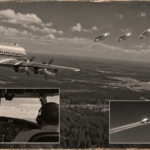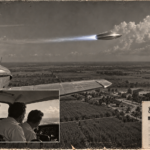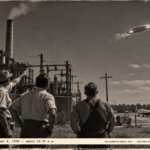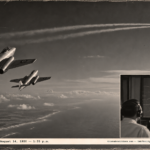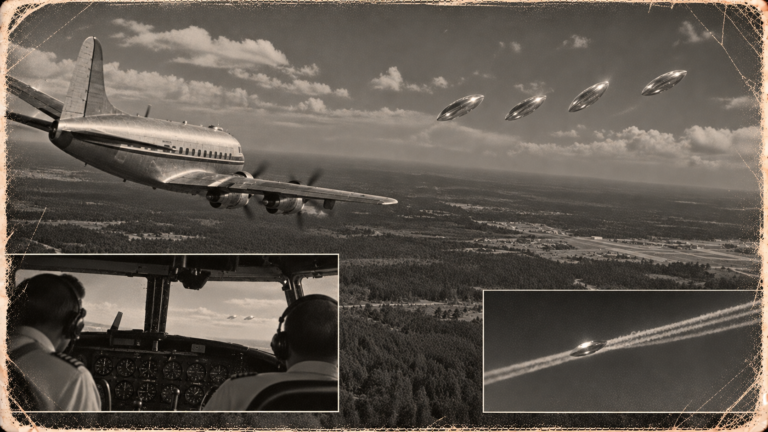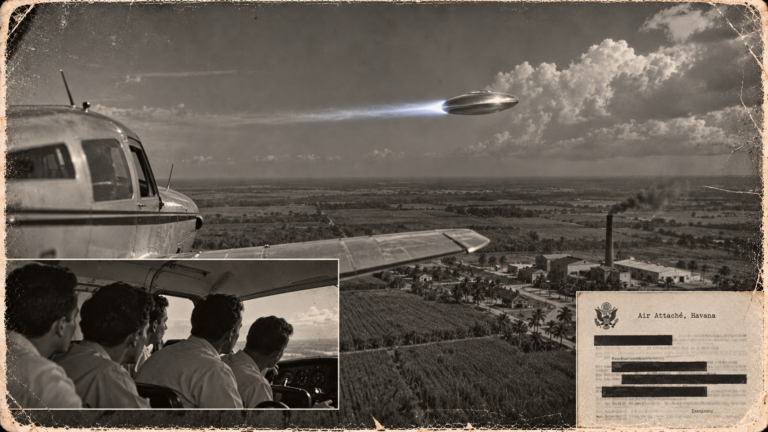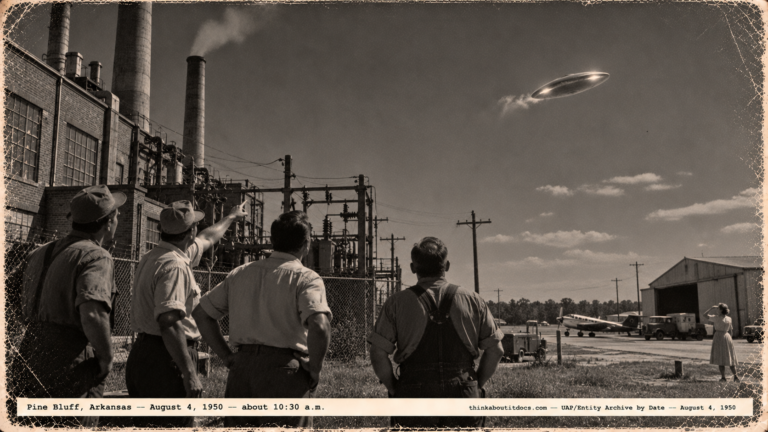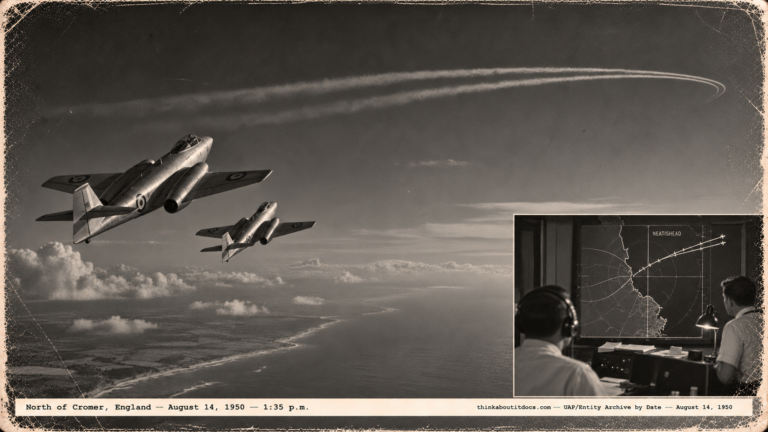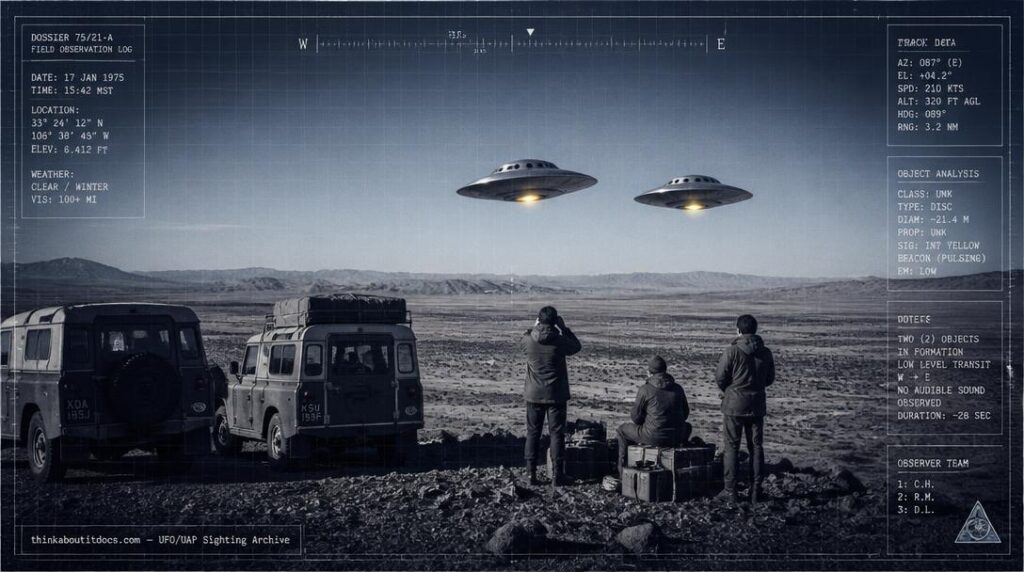
Three mineral exploration scientists near Mongrel Downs Station, Tanami Desert watched two identical silver disc-shaped craft pass at close range, mid-August 1970.
THINK ABOUTIT UFO SIGHTING REPORT
1970 Tanami Desert UFO Sighting: Three Scientists See Twin Silver Discs
On a clear winter afternoon in mid-August 1970, three scientists — a geophysicist and two geologists, working deep in the Northern Territory’s Tanami Desert — watched two identical, silver, disc-shaped craft cruise past them at close range and low altitude, each pulsing a yellow flame-like light from its underside roughly once per second. One witness later became a member of the Western Australian parliament. Decades later, the account remains detailed, technically specific, and — in the witnesses’ own telling — met with an official explanation that didn’t actually fit what they’d seen.
Date: Mid-August 1970
Sighting Time: Approximately 3:00 p.m.
Day/Night: Day — corrected from the source material’s original “Night,” which contradicts the account’s explicit description of a 3 p.m. daylight sighting
Location: Near Three Officers Hill, Mongrel Downs Station, Tanami Desert, Northern Territory, Australia, close to the Western Australian border (near the Granites and Rabbit Flat landmarks)
Urban or Rural: Rural — remote desert station country
No. of Entity(‘s): None documented
Entity Type: None documented
Entity Description: None documented
Hynek Classification: DD (Daylight Disc) — retained per the source material; a clear daylight sighting of a metallic disc-shaped object at a distance of roughly 300 yards, which is beyond the close-range threshold generally used for CE-I
Duration: Approximately 1 to 2 minutes to cross the witnesses’ field of view
No. of Object(s): 2
Description of the Object(s): Circular, disc-shaped craft with a raised cabin on top featuring visible portholes; a pulsing yellow flame-like light flashed from the underside of each object at roughly one-second intervals; both objects were identical in design and size, silent, with no exhaust smoke apart from the flashing underside light; traveled one behind the other, with the leading object appearing to vibrate slightly at the front while the trailing object moved smoothly, possibly in its slipstream
Shape of Object(s): Circular/disc-shaped
Size of Object(s): Approximately 30 feet in diameter, per the estimate of the witness identified as a geophysicist
Color of Object(s): Silver
Distance to Object(s): Approximately 300 yards
Height & Speed: Several hundred feet above ground level, traveling at an estimated 50 miles per hour, maintaining this altitude and speed for at least 500 yards as observed
Number of Witnesses: 3 — a geophysicist and two geologists employed by a mining company conducting mineral exploration and mapping out of Tennant Creek; one of the three later became a member of the Western Australian Parliament (identified in the source only by role, not by name)
Special Features/Characteristics: The objects traveled from west to east at low altitude with the witnesses’ position offering an unobstructed “dress circle” view; conditions were clear, with roughly 20 miles of visibility and no cloud cover; the property owners at Mongrel Downs Station separately reported unusual lights observed in the same general area several months prior to this sighting, on a different, nighttime occasion; the matter was reported to the Department of Civil Aviation in Darwin and to RAAF officers, who offered an explanation involving surveyors working in the area — an explanation the witnesses rejected outright, noting that surveyors of that era did not work at night, and that property access protocols would have made any unauthorized personnel in that remote area known to the station owners
Case Status: Unexplained — three professionally credentialed witnesses gave a detailed, technically specific, mutually consistent account; the official explanation offered does not clearly address the daylight sighting actually described (see Researcher’s Notes)
Source: Witness account, submitted directly; witnesses identified by professional role rather than name
Summary/Description: Three mineral exploration scientists working in the Tanami Desert, Northern Territory watched two identical silver disc-shaped craft with raised, portholed cabins pass at close range and low altitude in clear daylight in mid-August 1970, each pulsing a yellow light from its underside at roughly one-second intervals. An official RAAF explanation involving surveyors was rejected by the witnesses as implausible for the circumstances described.
Related Cases: None documented
Detailed Report
In mid-August 1970, three scientists — a geophysicist and two geologists employed by a mining company conducting mineral exploration and mapping out of Tennant Creek — were working in the Northern Territory’s Tanami Desert, close to the Western Australian border. The group had stopped their two Land Rovers at a location known as Three Officers Hill, near landmarks called the Granites and Rabbit Flat, on a property called Mongrel Downs Station. The surrounding landscape was flat for hundreds of miles in every direction, apart from the hill itself, which rose several hundred feet.
At approximately 3:00 p.m., under a clear Northern Territory winter sky with roughly 20 miles of visibility and the sun behind them, the group saw two identical, silver, disc-shaped craft traveling from west to east at low altitude — several hundred feet above ground level — and at an estimated speed of around 50 miles per hour. The objects passed within about 300 yards of the group’s position, at roughly eye level relative to their vantage point on the hill, giving them what one witness described as a “dress circle” view.
Each craft featured a raised cabin on top with visible portholes, and a pulsing, yellow, flame-like light flashed from the underside of each object at intervals of roughly one second. The geophysicist among the group estimated each object at approximately 30 feet in diameter. The craft were silent, producing no exhaust smoke apart from the flashing underside light, and traveled one behind the other — the leading object appeared to vibrate slightly at its front, while the trailing object moved smoothly, which one witness speculated might indicate it was traveling in the leading object’s slipstream. The objects maintained their altitude and speed for at least 500 yards of observed travel, taking roughly one to two minutes to cross the group’s field of view before disappearing over the horizon.
Several days later, upon returning from their remote fieldwork, the group stopped at Mongrel Downs Station and informed the property owners of what they had seen. The owners told them that several months earlier, they themselves had observed strange lights in the same general area late one evening. The matter was reported to the Department of Civil Aviation in Darwin, and the group subsequently sought details from RAAF officers, who informed them that surveyors had been working in the area at the time. The witnesses rejected this explanation, noting that surveying work of that era was not conducted at night, and that the remoteness of the property meant any authorized personnel present would have been known to, and cleared by, the station’s owners.
The reporting witness noted that shortly after the sighting, he purchased a book by Bruce Cathie on his “Harmonic” theory, which included illustrations he considered strikingly similar to what the group had observed. He also offered his own speculation — explicitly presented as personal conjecture rather than established fact — that a line drawn between the U.S. naval communication facility near Exmouth, Western Australia, and the Pine Gap facility near Alice Springs might approximate the flight path the objects appeared to be following.
Researcher’s Notes
The Tanami Desert Sighting — 1970 and an Explanation That Answers the Wrong Question
- The official “surveyors” explanation appears to address a different incident entirely. The witnesses’ own account describes two separate events: their daylight sighting in mid-August, and a nighttime light the station owners had observed “several months earlier.” The RAAF’s surveyor explanation, and the witnesses’ rebuttal that surveyors didn’t work at night, only makes sense as a response to the nighttime lights — not to the clear, 3 p.m. sighting that is the actual subject of this report. If that’s what happened, the official explanation on record doesn’t actually address the event being documented here at all, which is a more significant gap than a simply unconvincing explanation.
- Three professionally credentialed witnesses, observing together, is a genuinely strong evidentiary feature. A geophysicist and two geologists, all engaged in technical field work requiring careful observation as part of their profession, describing a mutually consistent, detailed account — including a specific size estimate and a precise description of the flashing interval — is a stronger evidentiary base than many single-witness cases in this archive.
- The Bruce Cathie reference should be read as the witness’s own interpretation, not independent corroboration. Cathie’s “Harmonic” theories are a fringe framework linking UFO sightings to a proposed global geometric energy grid, not a scientifically validated body of work. The witness’s sense that Cathie’s illustrations matched what he saw is a genuine and understandable reaction, but it functions here as a personal interpretive framework rather than external verification of the sighting itself.
- The Exmouth–Pine Gap flight-line speculation is explicitly the witness’s own conjecture. The witness frames this himself as speculation (“one could maybe construed”), and this page treats it accordingly — an interesting personal observation about the objects’ heading, not a claimed fact about their origin or purpose.
- The physical description is unusually mechanical and specific for a moving-object sighting. A precise flash interval, a specific diameter estimate, and a described difference in the two objects’ motion (one “vibrating,” one smooth, possibly in slipstream) suggest careful, attentive observation rather than a vague impression — consistent with the witnesses’ stated professional background in careful field observation.
The Tanami Desert sighting stands out for its combination of three technically trained witnesses, a highly specific physical description, and an official explanation that — on the timeline the witnesses themselves describe — appears to answer a different, earlier incident rather than the daylight sighting actually being reported.
“It appeared as if they were on a Sunday afternoon cruise.”
— witness account, Tanami Desert, mid-August 1970