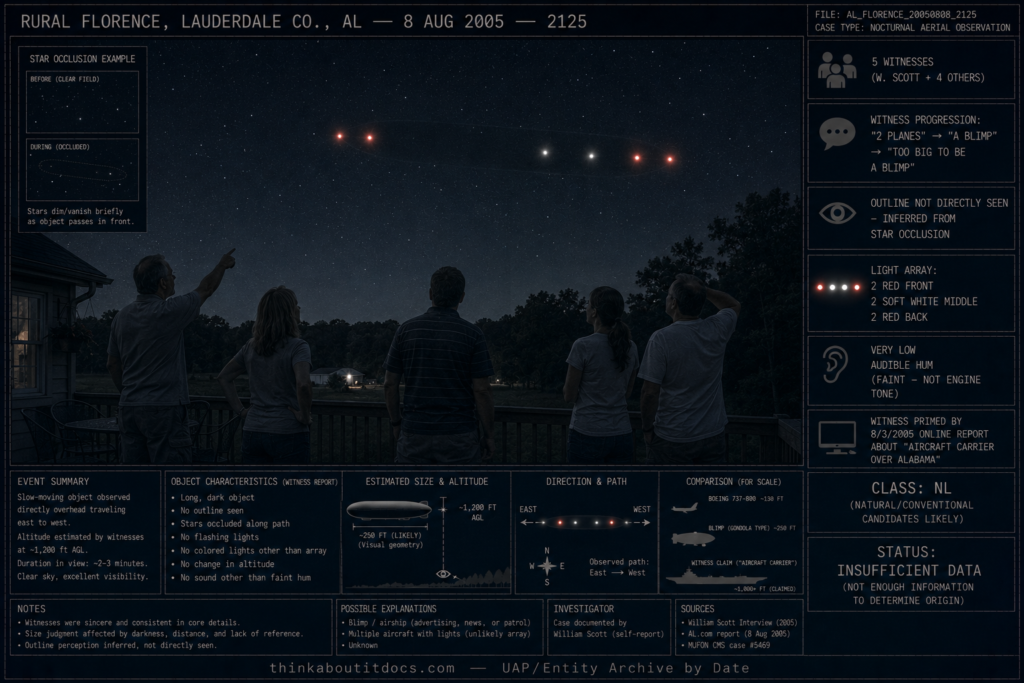
The August 8, 2005 Florence, Alabama long-craft encounter — William Scott and four others watched a long dark slow-moving object pass east-to-west for 2 minutes. They thought it was two planes, then a blimp, then revised only on size — but the size was estimated by star occlusion, not direct observation. Likely a real airship dramatically over-sized. Logged Insufficient Data. (thinkaboutitdocs.com — UAP/Entity Archive by Date)
THINK ABOUTIT UFO|UAP SIGHTINGS REPORT
2005: Long Craft over Florence, Alabama
— Five Witnesses Who Almost Identified Their Own Sighting
On the evening of August 8, 2005, around 9:25 p.m., William Scott and four other witnesses at his home near Florence in northwest Alabama watched a long, dark, slow-moving object pass overhead from east to west for approximately two minutes. The witnesses’ own progression of identification is the most useful part of the report: they thought it was two airplanes flying in formation, then they thought it was a blimp, and then they rejected the blimp identification only because the object seemed too large. They could not actually see its outline — they inferred its size and shape from watching the stars disappear behind it as it passed between the lights they could see, and they estimated the resulting silhouette to be “as long as an aircraft carrier” (~1,000 feet). The light arrangement was two red lights front, two red lights rear, with two soft white lights between the rear pair. A “very low hum” was audible. With five sincere witnesses, a brief but sustained observation, a clean east-to-west trajectory, and the witnesses’ own initial blimp identification before they revised it on size grounds, this is a real observation that almost certainly involved a real low-altitude airship — with the size estimate dramatically inflated, in the same pattern as the Mount Olive case two months earlier. The archive logs the report as Insufficient Data with the airship candidate the witnesses themselves first reached for, named plainly.
Date: August 8, 2005
Sighting Time: 9:25 p.m. local time
Day/Night: Night (after sunset; late summer evening in northwest Alabama)
Location: A home near Florence, Alabama, in northwest Alabama near the Tennessee state line (Lauderdale County)
Urban or Rural: Rural (correct as filed; Florence is a small city but the witness’s home is in the rural area)
No. of Entity(‘s): None reported
Entity Type: Not applicable
Entity Description: Not applicable
Hynek Classification: NL (Nocturnal Light) — luminous points observed at night with the body of the craft inferred from star occlusion rather than directly observed; the page’s NL is retained
Duration: About 2 minutes
No. of Object(s): 1
Description of the Object(s): A long, dark, slow-moving object whose body the witnesses could not directly observe — they inferred its size and shape by watching the stars disappear as it passed between the lights mounted on it. The lighting arrangement: two red lights at the front, two red lights at the back, and two large white lights with a “soft glow” between the rear red pair. A very low audible hum accompanied the passage. The witnesses initially identified the object as two planes flying in formation, then revised to a blimp, then revised again to an unknown craft on the basis of size only
Shape of Object(s): “Long Triangular Rectangle shape” (per the page); the actual described shape is elongated and dark, with the lights distributed front, back, and middle — consistent with the gondola and running-light arrangement of an airship or with the formation lights of a slow-moving conventional aircraft viewed from below
Size of Object(s): Page lists 200-300 feet; witness text says “as long as an aircraft carrier” (~1,000 feet) — the witness’s own larger estimate is the case’s primary structural weakness (see Researcher’s Notes); a modern Goodyear blimp is approximately 192 feet, a Zeppelin NT approximately 246 feet
Color of Object(s): Dark / unlit body (inferred from star occlusion), with red running lights front and back and soft white lights between the rear pair
Distance to Object(s): Approximately 1,200 feet overhead (witness estimate)
Height & Speed: About 1,200 feet altitude; very slow (“slowly gliding”); moving from east to west during the entire 2-minute observation
Number of Witnesses: 5 (the narrator William Scott and four others at his home)
Special Features/Characteristics: Witnesses’ own initial identification was “two planes in formation,” revised to “a blimp,” revised again only on size grounds; outline of the craft was not directly observed but inferred from star occlusion; light arrangement of red-front / red-back / soft-white-middle is unusual for standard aircraft running lights (which use red port / green starboard / white tail) but consistent with airship running lights or with low-altitude military aircraft formations using non-standard lighting; very low audible hum; clean east-to-west trajectory; witness references a recent (8/3/2005) similar sighting posted by another submitter — confirming the witness was already primed to interpret his sighting through the lens of a recent online report
Case Status: Insufficient Data
Source: First-person submission to UFOEvidence.org by William Scott, with reference to a sighting by witness “Joe Nunnally” (a real period UFO illustrator who did witness sketches for many sightings); the report was published on UFOEvidence.org and reposted to Think AboutIt Docs
Summary/Description: At about 9:25 p.m. on August 8, 2005, William Scott and four others at his home near Florence in northwest Alabama observed a long, dark, slow-moving object pass overhead from east to west for about 2 minutes at an estimated altitude of 1,200 feet. The witnesses initially identified the object as two planes in formation, then as a blimp, then rejected the blimp identification only on the basis of size — estimating the object as “as long as an aircraft carrier” (~1,000 feet). They could not directly observe the body of the craft; they inferred its shape from watching stars disappear as it passed between the lights they could see (two red lights front, two red lights back, two soft white lights between the rear pair). A very low hum was audible. The witnesses’ own identification progression — and their reference to a similar sighting posted just five days earlier — is the report’s most useful diagnostic feature. The case fits the profile of a real low-altitude airship or unusual military aircraft formation with the size estimate dramatically inflated. The case is logged as Insufficient Data.
Related Cases: 2005: Daylight Setting near Mount Olive Alabama (Powered Paraglider Pilot) — another 2005 Alabama “1,000-foot cigar-shaped craft” sighting two months earlier with the same size-overestimation pattern | the broader corpus of 2000s southeastern US airship/dirigible misidentifications
DETAILED REPORT
The testimony comes from William Scott, who reported the sighting to UFOEvidence.org (a real and active mid-2000s UFO submission aggregator) within hours of the event. He writes that he and four others — his wife, family members, or neighbors are not specifically identified — were at his home near Florence, in northwest Alabama close to the Tennessee state line, at about 9:25 p.m. on the evening of August 8, 2005. The Lauderdale County area is rural farmland and pine woods, with Florence itself being a small city.
The witnesses’ own initial reaction to the object is the most diagnostic feature of the report, and it deserves to be preserved in their own progression. They first interpreted what they were seeing as “two planes flying one in front of the other” — a perfectly ordinary identification for an unusual light pattern in the sky. As the object approached, they noticed it had no wings. They then revised their identification to “a blimp,” which is the natural second-best ordinary identification for a long, slow, wingless, lighted object at low altitude. The blimp identification stood until the object was “just north of us and noticed it’s size” — only then did the witnesses reject the blimp hypothesis, on the grounds that the object seemed too large to be a blimp. They estimated it as “as long as an aircraft carrier” (modern US aircraft carriers are about 1,000 feet long), and noted that they could not directly see the body of the craft. They inferred its size and shape by watching the stars in the night sky disappear behind it as it passed between the lights mounted on the craft.
The light arrangement: two red lights at the front, two red lights at the back, and two large white lights with a “soft glow” between the rear pair. The witnesses heard a “very low hum” throughout the passage. The object moved very slowly from east to west, requiring approximately 2 minutes to pass out of sight from their vantage point.
The honest analysis has to take both the strengths and the structural problems seriously.
The strengths: five witnesses simultaneously, a sustained 2-minute observation, a clean directional trajectory (east-to-west), a specific altitude estimate (1,200 feet), a low audible hum, and — most importantly — a witness whose initial impressions were honest and prosaic. William Scott did not start with “I saw a UFO.” He started with “we thought it was two planes,” then “we thought it was a blimp,” then revised only on size grounds. This progression of identification, from ordinary to ordinary to anomalous, is the structure of a sincere witness trying to make sense of what he is seeing. It is the opposite of the structure of a confabulated or expectation-driven sighting, where the anomalous interpretation usually comes first.
The structural problems: the size estimate, the inference method, and the priming context.
The “aircraft carrier” size estimate (~1,000 feet) is the same size estimate the Mount Olive paraglider pilot offered two months earlier, and it fails the same comparison: no airship in service in 2005 approached that length, the Goodyear blimp was 192 feet, the largest civilian airship was 246 feet, and the LZ 129 Hindenburg at 803 feet was the largest airship ever built. A 1,000-foot craft passing slowly overhead at 1,200 feet altitude would be a structure substantially larger than the airspace it was occupying could reasonably accommodate at that height. The size estimate is dramatically wrong.
The inference method explains how the wrong size estimate was generated. The witnesses say explicitly that they could not see the body of the craft — they inferred its size and shape by watching the stars disappear as it passed between the visible lights. This is a real observational technique (counting star occlusions to estimate the angular size of a dark object) but it depends critically on knowing the actual altitude of the object. If the object was at 1,200 feet, then the angular size of (say) a 250-foot blimp passing overhead at that altitude would be substantial — large enough to occlude many stars across a wide swath of sky over the course of a 2-minute pass. The witnesses would have seen exactly what they describe: many stars disappearing and reappearing as the object passed. Their interpretation of this — that the object must be “as long as an aircraft carrier” — would follow if they overestimated either the altitude or the angular sweep. The most likely error: a real 200-300 foot airship at lower-than-estimated altitude (say, 800 feet rather than 1,200), passing slowly enough to occlude stars for 2 minutes, producing the impression of an object 3-4 times its actual size.
The priming context is the William Scott’s own reference at the start of the report: “The object posted 8/3/2005 of an object over high — so. cal, the United States is almost exactly what we saw about 2 and a half hours ago. The way he describes it fits our sighting, with a few exceptions.” This is the witness directly disclosing that he had recently read another UFO report on the same submission site, and that he was already framing his own sighting in comparison to that prior report. This is not dishonest — it is a sincere and useful piece of context — but it is the structure of expectation-shaped interpretation. A witness who has just read about another long-craft sighting and then sees a long object in his own sky is going to interpret it through that frame.
The light arrangement (two red front, two red back, two soft white middle) is worth specific comment because it does not exactly match either standard aircraft running lights or standard airship lights. Conventional aircraft use red on the port wingtip, green on the starboard wingtip, and white at the tail or fuselage center — a left/right/center pattern, not a front/back/middle pattern. Airships and dirigibles often have running lights distributed along the length of the envelope, which can produce the “lights in a line” appearance. Military aircraft formations sometimes use non-standard lighting for tactical reasons. The exact configuration the witness describes does not point cleanly to any single conventional source, but it also does not point cleanly to anything anomalous. The most likely candidate remains a real airship with a non-standard running-light arrangement.
The “very low hum” is consistent with a propeller aircraft, a turboprop, or an airship engine at the stated altitude. Pure-electric airships were rare in 2005; a combustion-engine airship would produce a low hum at 1,200 feet that would be audible from the ground.
The most economical reading: a real low-altitude airship or unusual military aircraft passed slowly over the witnesses’ home on August 8, 2005, on an east-to-west trajectory. The witnesses’ initial blimp identification was probably correct. Their revision to “as long as an aircraft carrier” was driven by size-misperception against a featureless night sky, compounded by altitude estimation error and the recent priming of having read about a similar sighting. The case is therefore likely a real airship encounter dramatically reframed through size error and recent UFO-reading context.
This is not provable, however. Without a 2005 airship-tracking record for the Florence area on August 8 of that year, the specific candidate cannot be confirmed. The witnesses’ sincerity is not in doubt; their interpretation is.
RESEARCHER’S NOTES
The Florence Long Craft — When Witnesses Almost Identify Their Own Sighting
- The witness identification progression is the central feature: The most useful single piece of information in this report is William Scott’s own progression: “two planes” → “a blimp” → “couldn’t be a blimp because of size.” A sincere witness whose first interpretations are ordinary, whose final interpretation is anomalous, and whose only basis for the final interpretation is a size estimate, has effectively told the analyst what the case probably is. The first two identifications (planes, blimp) are the witness’s untainted perceptions. The third identification (anomaly) is the witness’s interpretation of his own perceptions through a size-estimate that, by the standard of all known airships, does not survive comparison. Honest analysis follows the witness back to the blimp identification.
This is a very different report from the 1983 Pat Norris case, where the witness reports impossible perceptual detail consistent with an internal experience. And it is different from the 1996 Valley case, where the photographic chain of evidence has been fatally compromised by anonymity and methodological failures. The Florence witnesses are sincere observers who almost correctly identified what they were seeing.
- Star-occlusion inference is real but altitude-dependent: The witnesses’ method of inferring the craft’s size — watching stars disappear behind it — is a legitimate observational technique, but its accuracy depends critically on accurately knowing the altitude. The witnesses’ altitude estimate of 1,200 feet is itself a perceptual estimate, not a measurement. If the actual altitude was lower (say, 800 feet), the same star-occlusion pattern would imply a much smaller object. If the altitude was higher, a much larger one. The “1,000-foot” size estimate therefore depends on the 1,200-foot altitude estimate being accurate, which there is no independent reason to believe.
- The 8/3/2005 priming reference is the second key feature: William Scott explicitly references a recent sighting “posted 8/3/2005 of an object over high — so. cal” on the same UFO submission site, and notes that his own sighting “is almost exactly what we saw.” This is the witness disclosing that his interpretation framework was shaped by a recent online report. Sincere witnesses who have just read about a phenomenon and then see something resembling it tend to interpret what they see through the recent reading. This is well-documented in the broader eyewitness literature. It does not make the underlying observation false; it does make the interpretation of that observation susceptible to bias.
- The light arrangement does not cleanly identify the source: Two red front, two red rear, two soft white in the rear middle is not a standard aircraft running-light configuration (which is red port / green starboard / white tail/fuselage). It is also not a precise match to any specific airship configuration the analyst is aware of. The configuration is consistent with several mundane candidates — an airship with non-standard running lights, a slow-moving military aircraft with operational lighting, a research dirigible — but it does not point cleanly to any single one of them. The mismatch with standard conventional-aircraft running lights is the part of the report that least supports the airship/aircraft mundane reading.
- The 5-witness count is the case’s structural strength: Multi-witness reports are stronger than single-witness reports because they constrain the explanation space — whatever caused the sighting had to be visible to multiple people simultaneously from the same location. Five witnesses at the same home seeing the same object pass overhead is a meaningful corroboration. It does not, however, rule out an ordinary cause (multiple people can witness the same airship pass overhead as easily as one person can). It rules out individual hallucination or fabrication by a single observer.
- Comparison to the Mount Olive 2005 case: Two months earlier, the powered-paraglider pilot near Mount Olive reported a “1,000 feet long or more” cigar-shaped craft hovering over old strip-mined land. The same size-estimate failure appears here. The same general region (north Alabama) and the same general time frame (summer 2005) raise the possibility that there was a real airship or surveillance platform operating in north Alabama airspace that summer that was witnessed by multiple unrelated observers. The archive cannot identify the specific platform, but the consistency of the witness reports is worth recording as a pattern.
- Why Insufficient Data: The witnesses are sincere, the observation is real, and the witnesses’ own initial identification (a blimp) is probably the correct identification. The size estimate is dramatically wrong by the standard of all known airships. The interpretation framework was influenced by recent online priming. No physical evidence (photographs, recordings) supports either reading. The case is therefore Insufficient Data, with the airship-with-size-error reading named openly as the leading mundane candidate the witnesses themselves first reached for before revising on questionable grounds.

The Florence long-craft case is a useful counterpoint to the more visionary and methodologically failed cases elsewhere in the Alabama archive.
Five sincere witnesses, a clean east-to-west trajectory, a sustained 2-minute observation, and a witness identification progression that almost correctly identified a real airship — only revised because of a size estimate that does not survive comparison.
Credited honestly, with the airship candidate named, it stands as Insufficient Data.