The "Tomato Man" photos sold as a 1948 alien crash south of Laredo — taken apart by investigators as a hoax built around an incinerated human body.
THINK ABOUTIT CRASH REPORT
1948: ‘Tomato Man’ Photographs and Laredo, Texas UFO Crash
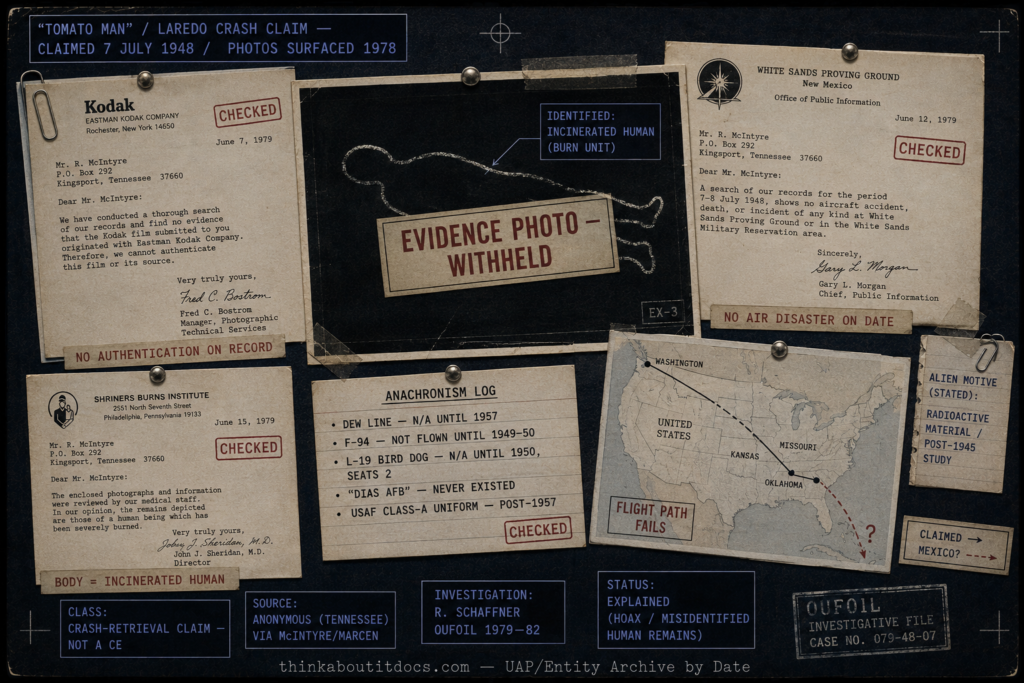
In 1978 an anonymous man in Tennessee began mailing photographs of a charred head and torso to a UFO researcher, with a story to match: that as a young Navy photographer in 1948 he had been flown to a site south of Laredo to document a crashed ninety-foot flying saucer and its dead, large-headed, four-clawed pilot. The images were dramatic enough to earn the burned figure a grim nickname — “Tomato Man” — and to circulate for decades as possible proof of a recovered alien. But when the Ohio UFO Investigators League actually checked the story, it fell apart at nearly every seam: a radar system that wouldn’t exist for years, fighter jets that hadn’t flown yet, an air base that was never called that, a tiny spotter plane that couldn’t have carried the team and didn’t exist in 1948, and a uniform in the photograph that the Air Force didn’t issue until 1957. A burn surgeon who examined the prints saw no alien at all — only an incinerated human being. The case survives not as evidence, but as one of ufology’s cleanest lessons in how to take a story apart.
Date: Claimed July 7, 1948 (photographs surfaced 1978)
Sighting Time: Not applicable (claimed crash-retrieval; no live sighting)
Day/Night: Not applicable
Location: Claimed ~38 miles south of Laredo, Texas, into Mexico
Urban or Rural: Rural (as claimed)
No. of Entity(‘s): Claimed 1 (a single dead “pilot” — confirmed by a burn specialist to be an incinerated human body)
Entity Type: None established; the photographed remains were identified as a burned human
Entity Description: As claimed: about 4 ft 6 in long, with an outsized head, missing eyes, no visible ears/nose/lips (only a slit), arms longer than human, and four claw-like fingers. A burn-unit chief of staff identified these features as consistent with an incinerated human body, the head swelling caused by extreme heat flash.
Hynek Classification: None. This is a crash-retrieval photo claim, not a Close Encounter; there is no living witness to an object in proximity. Logged as a crash-retrieval claim, debunked.
Duration: Not applicable
No. of Object(s): Claimed 1 (a saucer); no craft ever shown or recovered for examination
Description of the Object(s): As claimed: a 90-foot disc, still smoldering on a vegetated hillside, made of extremely hard honeycombed/crystalline (possibly silicon-based) metal bound by bolts that resisted conventional tools, with foil-like fragments strewn across the area. None of this was ever produced; investigators noted ordinary man-made hardware (hex nut, tubing, welds, two-conductor cable, eyeglass frames) visible in the photographs.
Shape of Object(s): Saucer (as claimed)
Size of Object(s): 90-foot diameter (as claimed)
Color of Object(s): Not specified
Distance to Object(s): Not applicable
Height & Speed: As claimed: tracked at 2,000+ mph with right-angle turns (radar narrative; see below — physically and historically untenable)
Number of Witnesses: None verifiable; a single anonymous claimant who surfaced 30 years later via an intermediary
Special Features/Characteristics: Anonymous, decades-delayed source; “Tomato Man” nickname (coined by Robert Easley); chain of demonstrable anachronisms (DEW Line, F-94, L-19 Bird Dog, “Dias AFB,” post-1957 uniform); Kodak’s denial of any authentication; burn-surgeon identification of incinerated human remains; flight-path math that points to Oklahoma/Kansas, not Mexico; strong resemblance to prior crash-retrieval tales (Scully/Aztec, Roswell)
Case Status: Explained (hoax / misidentified incinerated human remains)
Source: Ron Schaffner, Ohio UFO Investigators League (OUFOIL), “Tomato Man Revisited: The Alleged Alien Body Photographs” (investigation conducted 1979–1982); story relayed via Willard McIntyre (MARCEN) from an anonymous Tennessee correspondent
Summary/Description: In December 1978 an anonymous man in Tennessee sent UFO investigator Willard McIntyre an 8×10 print of a charred head and torso, claiming it was an extraterrestrial photographed on July 7, 1948, after he, as a young Navy photographer, was flown to a crash site about 38 miles south of Laredo to document a downed 90-foot saucer and its dead pilot. The detailed narrative — radar tracking, fighter intercepts, a remote night airlift, hard “honeycombed” metal, an autopsy finding no reproductive organs — circulated for years, the body nicknamed “Tomato Man.” The Ohio UFO Investigators League’s investigation (Ron Schaffner) dismantled it: the DEW Line, the F-94 jets, the L-19 aircraft, and “Dias AFB” did not exist or could not function as described in 1948; the photographed uniform postdated 1957; Kodak denied authenticating the negatives; a Shriners burn-unit chief of staff identified the remains as an incinerated human; and the stated flight path could not reach Mexico. The case is a hoax built from recycled crash-retrieval lore around photographs of a burned human body.
Related Cases: 1948 Aztec, New Mexico crash (Scully hoax, explicitly cited) | 1947 Roswell incident (template) | 1950 Crash Near Del Rio, Mexico | broader crash-retrieval hoax lineage
DETAILED REPORT
The “Tomato Man” affair is a crash-retrieval photo claim that, unusually for the genre, comes to the archive with its own thorough debunking attached. The story entered circulation in December 1978, when an anonymous correspondent in Tennessee mailed an 8×10 glossy of a charred head and torso to Willard McIntyre, who was associated with a group called MARCEN. McIntyre’s first instinct was sound — he wrote back that the image looked like a burned pilot from a light-aircraft crash. In early 1979 the source replied with an elaborate narrative, followed over the next year by original negatives, and the claim was on its way into the literature, the burned figure soon nicknamed “Tomato Man” (a coinage credited to Robert Easley).
The source’s account was a full crash-retrieval set piece. He claimed to have been a young Navy photographer assigned to White Sands in 1948, with prior work photographing atomic-test aftereffects. On July 7, 1948, he said, early-warning radar tracked an object exceeding 2,000 mph over Washington State; fighters scrambled, the object made a right-angle turn toward Texas, wobbled, and vanished from radar, with triangulation placing the crash about 30 miles south of Laredo. A photographic team was flown in by night, circled a still-smoldering disc on a vegetated hill, and photographed a single dead occupant — about 4 ft 6 in, with an enormous head, missing eyes, no ears/nose/lips, long arms, and four claw-like fingers. He described extraordinarily hard “honeycombed,” possibly silicon-based metal, foil-like fragments, bolts that resisted conventional tools, and an Army-doctor examination finding no reproductive organs and no muscle fiber. The body was flown out by C-47; the wreckage trucked toward Laredo; the photographer returned to White Sands to work the images under Marine guard, later quietly duplicating forty negatives.
The Ohio UFO Investigators League, with Ron Schaffner as Investigations Director, applied the correct method: eliminate prosaic explanations first, and verify every checkable claim. The results were comprehensive. Eastman Kodak, which McIntyre had said authenticated the negatives as decades old and un-hoaxed, told OUFOIL it had no record of any such analysis and would not perform authenticity testing of the kind described. The Shriners Burns Institute chief of staff in Cincinnati examined the prints and concluded they showed an incinerated human body, the swollen head a product of extreme heat flash. White Sands had no record of any air disaster on the dates given and stated it had no photographic teams assigned. A mailing to regional newspapers turned up no record of any such crash.
Most damning was the cascade of technical and historical impossibilities in the source’s own narrative. The DEW Line radar he cited did not begin construction until 1955 and became operational in 1957 — it did not exist in 1948. The F-94 fighters he described as intercepting the object did not fly even as prototypes until 1949 and did not enter Air Force service until 1950. The “Dias Air Base” he named was never an operational base; the location had been Abilene Army Airfield, deactivated in 1945 and reactivated only in 1956 as Dyess AFB. The L-19 “Bird Dog” that supposedly airlifted the five-member team did not exist in 1948 (first contracted 1950), seats only two, and has no cargo space. In the photographs themselves, investigators identified ordinary man-made hardware — a hex nut, tubular piping, angle iron, standard welds, two-conductor cable, and what appeared to be the frames of flight glasses near the body — and a uniform on a figure behind the body featuring the black-striped Class-A trousers the Air Force did not adopt until 1957. Finally, the stated flight path, worked through, would have put any crash in Oklahoma or Kansas, not Mexico; McIntyre privately conceded the path was wrong.
Schaffner’s conclusion was measured and is worth preserving as written: that an extraordinary claim requires undisputable proof, that the simpler explanation clearly favored a hoax, and that the photographs depicted a light-aircraft crash and its dead human pilot. He framed the report explicitly as a teaching tool — a demonstration of how a hoax can be assembled from well-publicized cases (he opens with Frank Scully’s Aztec debacle) and how disciplined investigation takes it apart. The body, by the burn specialist’s judgment, was a human being who died in a fire; the alien narrative was constructed around the photographs after the fact.
RESEARCHER’S NOTES
Tomato Man — Laredo 1948 and the Anatomy of a Debunked Crash-Retrieval Hoax
- Classification Basis: A Hynek Close Encounter category does not apply, and the CE-II label sometimes attached to this case is a category error: there is no living witness observing an object in proximity with physical effects. This is a crash-retrieval photo claim, and on the evidence a debunked one. It is logged as a crash-retrieval claim with Case Status Explained (hoax / misidentified human remains).
- Source Chain Assessment: The chain is the weakest possible and the debunk the strongest part of the record. The originating claimant is anonymous, surfaced thirty years after the alleged event, and reached the public only through an intermediary (McIntyre/MARCEN) whose own authentication claims (the Kodak analysis) were directly contradicted by Kodak. Under the archive’s hierarchy this is squarely problematic at origin. By contrast, the OUFOIL investigation — primary correspondence with Kodak, White Sands, Lockheed, the USAF Historical Division, and the Shriners Burns Institute — is a model secondary source and is what gives the entry its lasting value.
- Why It Stays in the Archive: This case earns retention not as evidence but as method. Schaffner’s report is one of the clearest worked examples in the literature of eliminating prosaic explanations first and checking every verifiable detail: the anachronism stack (DEW Line, F-94, L-19, “Dias AFB,” the 1957 uniform), the expert identification of the remains, and the flight-path math. It also documents how crash-retrieval hoaxes are built — recycled from Roswell, Aztec, and the Scully con — with “honeycombed metal,” the oversized head, and the bolts-that-won’t-unscrew appearing as genre furniture rather than independent observation.
- Physical Evidence and Evidentiary Weight: The only physical artifacts are the photographs, and they actively disconfirm the claim: a burn surgeon identified an incinerated human, and man-made hardware and a post-1957 uniform are visible in the frames. No craft, no body, and no contemporaneous record were ever produced; the supporting institutions (White Sands, regional newspapers) have no matching record; Kodak disavowed the authentication. The weight of evidence points entirely to a hoax assembled around photographs of human remains, which is why this is one of the rare entries that can be classed Explained with confidence. (Ground Saucer Watch’s separate guess — a lab monkey from a V-2 failure — is noted historically but was not adopted by OUFOIL and is not needed; the burn-surgeon identification of a human is the operative finding.)
“Tomato Man” is a crash-retrieval hoax with an exemplary autopsy. An anonymous source, thirty years after the fact, wrapped a set of grim photographs in a Roswell-flavored narrative of radar chases, secret airlifts, and honeycombed alien metal — and the Ohio UFO Investigators League took it apart claim by claim: a radar net that didn’t yet exist, jets that hadn’t flown, an aircraft that couldn’t have carried the team, a base by the wrong name, a uniform from the wrong decade, a flight path that missed Mexico by a thousand miles, a Kodak authentication that never happened, and a burn surgeon who saw an incinerated human, not an alien. The record’s standing is a crash-retrieval claim, Case Status Explained (hoax). It is kept not as proof of anything beyond Earth, but as one of the field’s best teaching cases — a clean demonstration that the discipline of checking the checkable is what separates the record from the wishful, then as now.
Full Report

TOMATO MAN REVISITED: The Alleged Alien Body Photographs
by Ron Schaffner
INTRODUCTION
Generally, the history of UFO reportage is not a good one. All too often, researchers are far too eager to latch onto a good story, to attach themselves to a “major” case, that important details are not assessed and evidentiary credibility is not addressed. Perhaps the best example of this is Frank Scully’s Behind the Flying Saucers. Intrigued by the story of a crashed saucer, Scully neglected to check his sources, a mistake that came back to haunt him. J.P. Cahn of the San Francisco Chronicle did check into Scully’s sources and found them to be con men. Scully was the victim of a hoax.
Consequently, crashed UFO stories are recycled down to succeeding generations of Ufologists. Many of these alleged tales are nothing more than “spin-offs” of previous accounts. When one considers the amount of disinformation spread over the years, it becomes difficult to separate fact from fiction.
Stories, such as Roswell and Aztec have graced the world with accounts of aliens and conspiracies within the United States government. It is not this writer’s intent to prove nor disprove these particular stories. Rather, it is to show the reader that with a little imagination a hoax can be perpetrated using information from well publicized cases and.
The following report is well known within the circle of senior Ufologists. Therefore, it is recommended to the freshman Ufologist who may desire to seek the truth in a sometimes not-so-truthful subject.
BACKGROUND
The following information was relayed to the former Ohio UFO Investigators League (OUFOIL) by Willard McIntyre who was involved with a group calling itself the Mutual Anomaly Research Center and Evaluation Network (MARCEN). At that time, this author was the Investigations Director for OUFOIL. This information exchange occurred during the years of 1979 and 1981.
Mr. McIntyre claimed to have corresponded with a gentleman in Tennessee in December, 1978. This unnamed source sent him an 8X10 glossy print of the charred remains of a head and torso, which he claimed were extraterrestrial. McIntyre wrote back saying that he thought the photo represented a light aircraft crash and its burned pilot.
In early January, 1979, this alleged source wrote back and explained in detail a story of a clandestine operation executed on July 7, 1948, to document the crash of a UFO and its dead occupant . By November of 1979, the original negative was mailed to McIntyre. Another negative was shipped the following May showing a burned body lying in vegetation on a hillside.
The source was concerned for possible prosecution of the government, so it was agreed that he would receive full confidentiality. Allegedly, McIntyre checked out his credentials and everything appeared in order.
McIntyre advised us that he sent the original negatives to Eastman Kodak for analysis:
“The conclusion of Eastman Kodak, which we initially felt was of dubious value because of the methodology used, pointed to a negative processed at least thirty years previously. Micro densitometer traces of the negative showed us that no deliberated hoaxing had been done, at least photographically, in the production of the negative.”
Negatives were also mailed to William Spaulding of Ground Saucer Watch (GSW). This organization speculate that the pictures represented the remains of a dead monkey used in the V-2 rocket experiments of the 1940s and ‘50s. (1)
ORIGINIAL CLAIMS
The source said that as a young Naval photographer in 1948, he was flown to Mexico to document the crash of 90-foot diameter “flying saucer” and its dead pilot. The photographer claimed he was assigned to White Sands, New Mexico. Prior to the incident, he visited atomic test sites and photographed the after affects of the blasts.
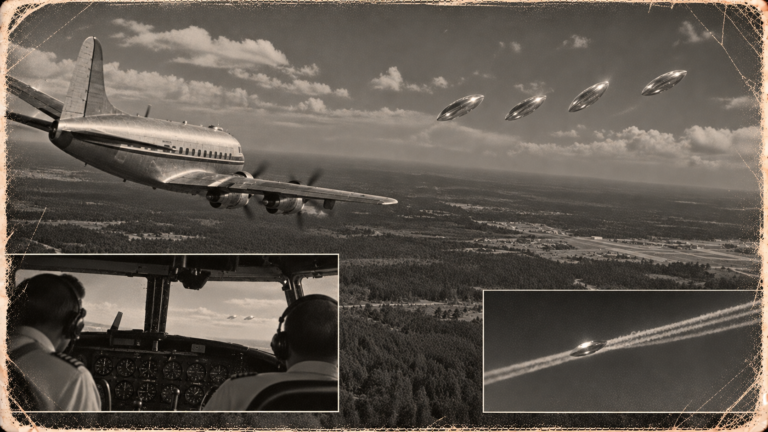
Meanwhile, on July 7 at approximately 1322 hours, the Distant Early Warning [DEW] line early warning radar was tracking an object moving at speeds in excess of 2,000 mph when it flew over Washington state heading southeast. Upon hearing about the bogey’s flight path, two fighter pilots out of Dias Air Base in Texas path cruised into position over Albuquerque to identify or intercept the object.
As the two F-94’s approached the UFO, it made a 90 degree angle turn towards eastern Texas without apparently decreasing in speed. At 1410 hours, other pilots in pursuit said the object was slowing down and was wobbling in flight. By 1429 hours, the object disappeared from all radar screens. Using triangulation from all the radar installations, it was determined that the object must have went down in Mexico approximately 30 miles south of Laredo, Texas.
After notifying the Mexican authorities, Army and Air Force units were rushed to the crash site, arriving at 1830 hours. The commander phoned Washington and was told that a photographic team would be airlifted to the site. McIntyre’s source claimed to be one of those photographers. They were told that they would be going to a top secret airplane crash.
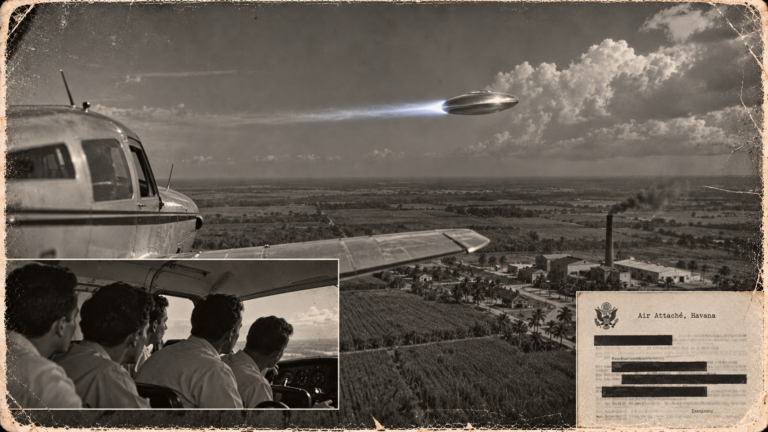
The team was picked up by an Army L-19 Bird Dog at 2130 hours. The source explained that it was quite uncomfortable with five team members and their equipment in such a small plane. They arrived at the designated site at 0215 hours. The plane circled the area and observed a disc shaped craft still smoldering on a heavily vegetated hill.
There was one body found within the craft. The photographers managed to get a series of pictures even though there was intense heat. When the object cooled down, the body was removed to a hill side and another series of pictures were taken.
The body was said to be 4 feet 6 inches long with a head extremely large compared to the rest of the torso. The eyes were gone and there were no visible ears, nose or lips with just a slit without were teeth and a tongue would be. The arms appeared much longer than a human and the hands had four claw-like appendages.
The source went on to explain that the craft appeared as unusual, but the debris looked as if it was “earthly” in origin. There was an absence of any wiring, rubber, glass, plastic, wood, or paper. The structures were bound by normal looking bolts, but could not be unscrewed with conventional tools. Eventually, they were chiseled off. The metal was very hard. Diamond drills and saws were used for disassembly. Another metal was discovered which seemed to be a lighter grade and cutting torches were used.
Army doctors arrived on July 8 and preformed an examination of the body. They could not find any reproductive organs. They compared the gray skin to the texture of a human female breast. The bone structure was more complicated than a human and no muscle fiber was discovered within the torso.
We are also told that a metallurgist was brought in to determine the alloy of the object. He believed this alloy had a honey combed crystalline structure unlike anything know in “earthy” technology. He thought that it could be silicon based.
The entire hill side and valley below were littered with foil fragment; very much like cigarette packages, only harder. The material could not be bent. All the fragments were confiscated by the military.
At 1300 hours, the following day, a C-47 arrived and the body was shipped to an origin unknown to the source. The remaining wreckage was loaded on US and Mexican trucks which headed in the direction of Laredo, Texas. The source explained that he was not told the destination.
The source returned to White Sands and began work on the photographic evidence with a team of other experts. Allegedly, they were constantly watched by Marine security. The mysterious Commander returned to Washington never to be seen again.
A few years later, the source removed 40 negatives from the file and made duplicates and placed the originals back.
OUFOIL’s INVESTIGATION
In 1981, McIntyre and Dennis Pilichis (The UFO Information Network ; UFOIN) wrote a booklet entitled: “Alien Body Photos: An Updated Report”. Although OUFOIL’s name was represented, we had no contribution what so ever to its production. Some of our members believed the photos to be authentic, However the majority, like myself had more questions and became skeptical of the entire story. After all, we could only take McIntyre’s story at face value. When we questioned him about certain aspects of the story, he stalled and would not forward us any documentation that he claimed to have. It was at this point where we decided to begin our own independent investigation into the matter.
We attacked this problem by using the correct investigative methodology: Eliminating all possible prosaic explanations first.
We asked ourselves, “Was McIntyre correct when he stated that he originally believed the photos were of a crashed plane and its pilot?” We began with this premise.
Our first procedure was to verify that Kodak actually did the photo analysis that Mr. McIntrye claimed. A letter was sent to Eastman Kodak along with a copy of the prints. We asked for documentation regarding the quality of the print, time frames and the person’s name and title who supposedly did the analysis.
We were not surprised when the response came back that Kodak was not aware of any photo work done on the pictures enclosed. Furthermore, their representative said that Kodak would not preform any type of testing that we desired for authenticity. (2)
The second step in our investigations led us to the Burns Institute ( Shriners Hospital for Crippled Children, Cincinnati, Ohio) This hospital is world known for its work with burned patients. We interviewed the Chief of Staff and allowed him to study the photographs. It was his expert opinion that the photos represented an incinerated body of a human. The swelling of the head would be caused by extreme heat flash. (3)
It became apparent to us that these photographs did not depict an extraterrestrial. We decided to probe a little deeper into the story. After all, if the pictures were a deception, then the scenario surrounding them would also have suspicions.
Consider the following:
White Sands Proving Grounds, New Mexico informed us that after a search for information, they had no knowledge of any air disaster on the dates forwarded. In addition, they said that they did not investigate such incidents and there are no photographic teams assigned to the base.(4)
We conducted a mailing to all newspapers in the region to find out if they had any records of an air disaster within a three month time span. All that replied said they had no records of any such event occurring.
The source said that the object was tracked by the DEW radar system. The Distant Early Warning (DEW) is a series of radar installations to provide a warning of enemy attack by air. The project began its planning stages in 1946. Construction did not begin until 1955 and it finally became operational in 1957. If the alleged source was in the military as described, the he would have known that this was erroneous. Is it is possible that the person behind this hoaxed failed to research the DEW Line radar systems?(5)
We are told that two F-94 fighter pilots were scrambled out of Dias Air Base to intercept the object. This is quite an achievement considering that the F-94 didn’t fly until 1949 as prototypes. The Air Force didn’t fly them until 1950. (6)
Furthermore, there wasn’t an operational Dias Air Base in 1948. That location would have been Abilene Army Airfield and it was deactivated in 1945. When reactivated in 1956, the base was called Dyess AFB; not Dias. (7)
The source stated that his team was picked up by a U.S. Army L-19 “Bird Dog” and flown to the site. He described his trip as being uncomfortable with five people and equipment being cramped into this small plane. Unfortunately, the story does not match up to historical fact.
This plane was developed for the U.S. Army as a light reconnaissance aircraft. The first contract for these planes were in 1950. Production was completed on October 7, 1954 and these planes are still in use. They cannot accommodate more than two individuals and there is no room for cargo space. (8)
With regard to the absence of wire and the metals, consider the following points:
1. Upon closer examination of photo #1, what appears to be two conductor cable, probably “earthly” in origin, can be seen..
2. Near the right shoulder we find the frames of some type of eyeglasses. It was our opinion that this was the remains of flight glasses used by pilots.
3. Close scrutiny of the structural remains look man-made. You can see a six-sided hex nut, tubular piping, angle iron and many welded areas. The welds conform to all standard procedures indicative of that time.
Photograph #2 was cropped to reserve web space. The original picture we have on file shows what appears to be three individuals standing behind the body. The legs of the person you are seeing is definitely military since his fatigues are bloused above his field boots. The others seem to be wearing raincoats. If one of these persons is an Officer, he is wearing low quarters and a class “A” uniform (Greens). According to the Air Force, the class “A” uniform with the black stripe down the side of the pants did not come into use until 1957. This uniform is only worn during the winter months. (9)
We have no way to prove nor disprove the allegations made about the physical make up of the “aliens” and their craft. However, it should be noted that the basic scenario is very similar to other crashed saucer stories. The so-called field examinations of the craft and body bear similarities to Roswell, Aztec, and countless other retrieval stories. For instance, this is not the first time that Ufology was told of “honeycombed” material. The large head is also consistent with the stories we all have heard up to present time.
The flight path of the craft is probably the largest gaff in the entire scenario. If one takes all the information given and does some simple calculations, the object should have crashed in Oklahoma or Kansas. In order to reach Mexico, our ‘spaceship’ would have had to make another 90 degree turn and fly south by southwest. Mr. McIntyre told other researchers that he knew the flight path was off. Why wasn’t this mentioned in the previous investigations? (10)
CONCLUSIONS
You have been presented with an extraordinary claim. In order to quantify such statements, there needs to be undisputable proof that such an event took place. This applies to both the true believer and debunker. It is far better to be cautious with such claims before any endorsement. Simply put, it’s a correct procedure to fully investigate a report to its logical conclusion before writing any report.
The above case comes down to just two possibilities. Either the claim is valid as an extraordinary event, or it is a hoax. The simpler explanation clearly favors this to be a hoax.
One could argue that ET uses some of the same hardware as “Earthlings.” Maybe you are thinking, “Why go through all this trouble with a hoax?” or, perhaps, “The source was confused on some of the finer details.” I could also interject that maybe there is a clandestine movement within the United States to cover-up this episode. Perhaps this is disinformation, a ruse to hide facts regarding another covert operation. As I previously stated, I cannot prove nor disprove these statements.
What we will say is that the above incident could not have happened with the information given. Our investigations indicate this to my satisfaction. This was a photograph of a light aircraft crash and its dead pilot. Whether it was military or not is still an issue open for debate.
This report is meant to be more of an educational tool for researchers. In the future, you may be presented with a similar account. As an objective investigator, you should pursue every avenue at your disposal, much like we did. Bear in mind, that not all the crash saucer stories have this many errors. It may take time to weed out all the evidence, pro or con. After all, the first step to defining Ufology as a worthy study is to collect all the trash and dump it from the database.
END
Note: Robert Easley is credited with coining the term “Tomato Man”.
References:
1. GSW stated in their report that they felt the photographs represented a misinterpretation of a laboratory monkey from a V-2 rocket test failure. Their hypothesis does have merit for other UFO crashes, but we felt it was not applicable to the instant case. OUFOIL Investigative Report; 1982; Charles Wilhelm, Editor.
2. Letter from Eastman Kodak to Ron Schaffner dated January 26, 1981.
3. Letter from Shriners Hospital for Crippled Children to Earl Jones dated April 6, 1981
4. Letters from White Sands to Charles Wilhelm dated February 2 and 17, 1981
5. History of the DEW Line 1946-1964; K4112 AFSHRC/HD, Maxwell AFB.
6. Letter and information packet sent to Charles Wilhelm from Lockheed Corporation dated April 6, 1981.
7. USAF Historical Division, Maxwell AFB, AL. 36112
8. Department of the Army; The Center of Military History and Cessna Aircraft Corporation.
9. USAF Historical Division, Maxwell AFB
10. Letter from Willard McIntyre to Lee Graham dated June 3, 1981