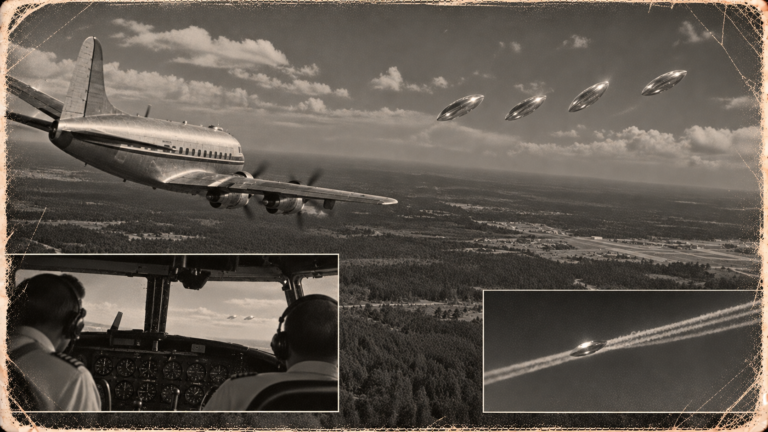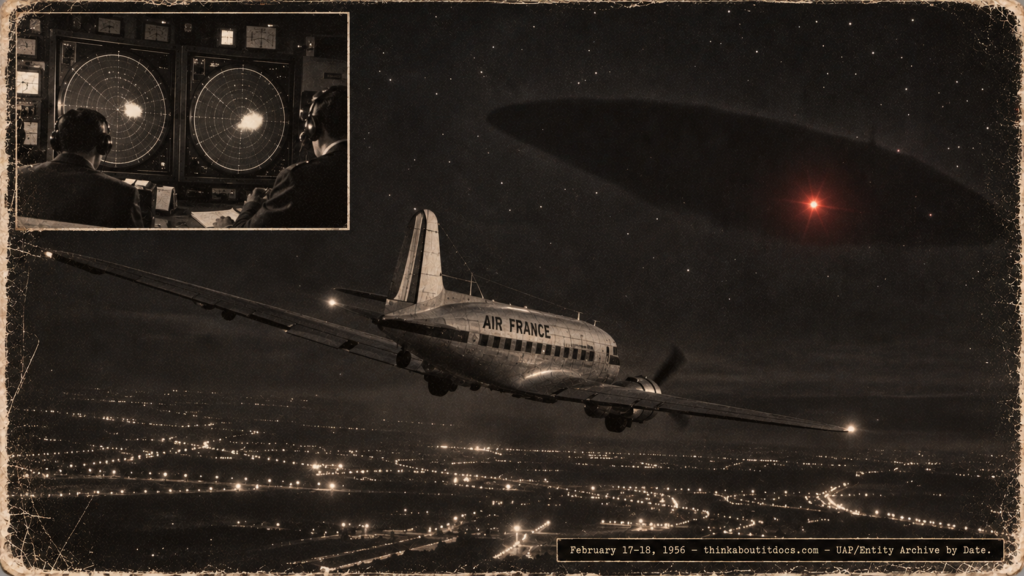
Orly, France, February 17-18, 1956: radar showed an echo twice the size of an airliner, and an Air France pilot swerved to avoid its red light.
THINK ABOUTIT UFO|UAP SIGHTINGS REPORT
1956: Orly Airport, France: The Radar Ghost That Stalked Paris Air Traffic
For about three hours on the night of February 17-18, 1956, something over Paris showed up on the radar at Orly International Airport and would not behave like an aircraft. The echo was roughly twice the size of the largest airliners in service. It hung motionless, then accelerated to speeds reported at 1,500 miles per hour or more, and it repeatedly moved toward planes taking off and landing. When the Orly tower warned an outbound Air France DC-3, the pilot, Michel Desavoye, saw a flashing red light where the radar placed the target and changed course to avoid it.
The Orly radar-visual case made the front pages in Paris and was carried by the New York Times. It remains one of the most discussed French UFO cases of the 1950s. Orly’s radar staff were reportedly questioned by the French military, and the Paris Observatory’s weather-balloon explanation never fit what the radar showed. The “ghost of Orly” was never identified.
Date: Night of February 17-18, 1956 (Friday night into Saturday)
Sighting Time: First radar contact about 10:50 to 11:00 p.m.; the Air France DC-3 took off at 11:55 p.m.
Day/Night: Night
Location: Paris-Orly Airport and the Paris region, France, including Les Mureaux, Orgeval (given as “Orgival”) and Le Bourget
Urban or Rural: Urban (the Paris metropolitan airspace)
No. of Entity(‘s): Not Applicable
Entity Type: Not Applicable
Entity Description: Not Applicable
Hynek Classification: RV (Radar-Visual)
Duration: About three hours of radar activity; some later accounts say four
No. of Object(s): 1
Description of the Object(s): On radar, an echo about twice the size of the largest airliners. It alternated between hovering and very high speed, and it repeatedly approached aircraft. Visually, it was a flashing or twinkling red light, larger than normal aircraft position lights. Later accounts add a huge dark shape seen against the night sky.
Shape/Size/Color of Object(s): Shape unknown; the radar return was twice the size of a large airliner; a red flashing light, with a dark mass reported in later accounts
Distance to Object(s): Unknown. The DC-3 crew saw the light a little to their right at about their own altitude, close enough that the pilot took evasive action.
Height & Speed: Around 5,000 feet according to the New York Times; the DC-3 was at about 1,500 meters when the crew saw it. Speeds ran from stationary to about 1,500 mph (2,400 km/h), and one account gives bursts up to 3,600 km/h.
Number of Witnesses: Multiple: Orly radar staff (reported as ten technicians, including radar chief Deveaux and technician Baruc); Air France Captain Michel Desavoye and radio operator Baupetuy, with the flight mechanic also named in later accounts; and crews of other aircraft that night, according to civil aviation investigators
Special Features/Characteristics: The object appeared on two radar screens at once and was also reported by a radio beacon station southwest of Paris. It repeatedly approached departing and arriving aircraft, and the DC-3 took evasive action. Later accounts add apparent radar jamming that followed frequency changes, and a delayed fighter scramble from Tours.
Case Status: Unexplained (listed as a Project Blue Book unknown)
Source: New York Times, February 20, 1956; Le Méridional, February 19 and 21, 1956; Le Figaro, February 21, 1956; Quick (Munich), No. 11, March 1956; Sunday Mirror, March 11, 1956; Aimé Michel, “Oui, il y a un problème soucoupes volantes!”, Planète No. 10, May-June 1963; Patrick Gross, “UFOs at close sight: Orly airport case, France, February 1956”; Project 1947; FUFOR Index; BBU Files (BBU)
Summary/Description: Orly radar tracked a huge unidentified echo for about three hours as it hovered, sped up to around 1,500 mph and moved toward airliners. Air France DC-3 Captain Michel Desavoye saw a flashing red light at the radar’s reported position and swerved to avoid it. The case was never explained.
Related Cases: 1956: February UFO|UAP & Entity Sightings Archive; 1956: Choisy-le-Roi, France Alien Encounter (mid-February 1956, a few miles from Orly); Montélimar, France C-119 sighting (February 18, 1956)
Detailed Report
February 1956 was one of the coldest months France had seen, and on the night of the 17th the sky over Paris was clear. At about 10:50 to 11:00 p.m., an echo appeared on the radar at Orly International Airport where no aircraft was scheduled. It was about twice the size of the largest airliners then flying. The operators at first simply watched it. At times it sat completely still, and then it moved at speeds they later put at around 1,500 miles per hour. The New York Times, reporting from Paris two days later, described a blip about twice the size of an average airliner, at roughly 5,000 feet, that appeared to follow aircraft taking off and landing. A radio beacon station southwest of Paris also reported the object.
Air France Captain Michel Desavoye, 36, had been flying a daily DC-3 freight service between Orly and London for a month. He told the press he took off at 11:55 p.m. A few minutes later the Orly tower warned him that radar showed an unidentified craft heading toward Le Bourget, across his flight path. He and his radio operator, Mr. Baupetuy, then saw a flashing red light slightly to their right and at about their own height. They were at about 1,500 meters near Orgival. Desavoye changed course to avoid it, and the light suddenly vanished. After he resumed his heading, radar told him the object was now above him, but he saw nothing more.
Desavoye said he could not explain what he had seen. He was certain it was not an aircraft, because he would have seen its position lights, and the red light looked about twice as large as normal position lights. He rejected the weather-balloon suggestion outright. Back in Paris at 5:00 a.m., he was questioned by Orly’s radar technicians and an Air Force colonel, and he confirmed his account in a written report.
French researcher Aimé Michel interviewed personnel involved and published a fuller account in 1963. It places the DC-3 encounter near Les Mureaux and says that after the tower relocated the target toward Le Bourget, the crew saw not only the red light but the object itself, a huge dark shape against the sky. Michel reported that the pursuit went on for three hours. He said investigators told him that pilots landing at Orly that night were badly shaken after the light, and sometimes the object, maneuvered around them. His technical sources also described two unusual behaviors. The first was that the object jumped between radio beacons at very high speed. The second was that when Orly tried to check its detection with Le Bourget, the Orly radar was hit by strong jamming that followed each change of frequency. Le Bourget’s own radar was not working that night.
The Munich magazine Quick reported in March 1956 that Orly’s radar chief, Deveaux, and his ten staff were questioned by the French General Staff. It said the object crossed the path of the departing DC-3 F-BAXI, followed an inbound Swissair flight from London for about 40 seconds, and was gone by the time fighters from the air base at Tours, about 200 kilometers away, were finally in a position to pursue. Quick also said the General Staff was looking into why that scramble had been so slow.
The only official scientific comment came from a Paris Observatory spokesman. He suggested the object might have been an American weather balloon launched in Germany and carried west by the jet stream. Neither the Observatory nor Le Bourget reported radar contact. Years later a newspaper dismissed the whole affair as a radar echo off the Seine.
RESEARCHER’S NOTES
A Solid Core, Layered With Later Detail
- What is documented in 1956: Contemporary press establishes the core. There was a large, anomalous Orly radar return that hovered and moved at high speed, and a named Air France pilot saw a flashing red light at the radar-reported position and changed course. The pilot was debriefed by radar staff and an Air Force colonel and filed a written report. A radio beacon station also reported the object.
- The pilot’s own account is narrower: Desavoye’s February 21, 1956 statement describes only the red light, seen by himself and his radio operator, and says he saw nothing when radar later placed the object above him. The “enormous black” shape, the half-minute observation and the three-hour cat-and-mouse account come from Aimé Michel’s 1963 retelling and later sources. They may reflect other aircrews or later interviews, but they go beyond what Desavoye told the press at the time.
- “De Vaux” vs. Deveaux: The Blue Book index names the pilot “De Vaux.” Quick names Orly’s radar chief as Deveaux. The Blue Book spelling may merge the radar chief’s name with the pilot’s role. Desavoye, sometimes spelled Désavoi, is the pilot named in the French press.
- Contradictions to note: Some retellings have the DC-3 arriving from London, but Desavoye himself says he was outbound. Accounts of the duration range from three to four hours. Charles M.’s claim, recalled 17 years later, that “thousands” of people saw the object is not supported by 1956 press reports.
- The balloon and Seine explanations: A drifting weather balloon cannot account for a target that hovered, then moved at around 1,500 mph and changed direction toward specific aircraft. A radar echo off the river would not produce a visual red light at the matching position. Neither explanation covers the radar-visual correlation.
- The jamming claim: Aimé Michel’s account of jamming that followed Orly’s frequency changes is the most extraordinary detail in the case. It rests on technicians’ statements relayed secondhand, and it should be treated as unconfirmed.
Strip Orly down to its 1956 core and it is still one of the strongest European radar-visual cases of the decade. A professional pilot saw a light he could not identify at the exact position where radar showed an unknown target, he took evasive action, and he stood by his written report. The later layers, including the black mass, the beacon-hopping and the jamming, add drama but rest on thinner ground. The case has been unexplained since 1956.
“It was certainly not a weather balloon.”
Air France Captain Michel Desavoye, to the press, Paris, February 1956 (Le Méridional, February 21, 1956) index line.