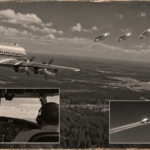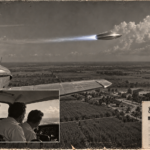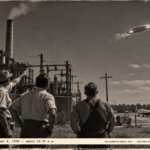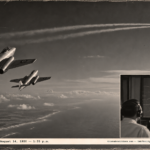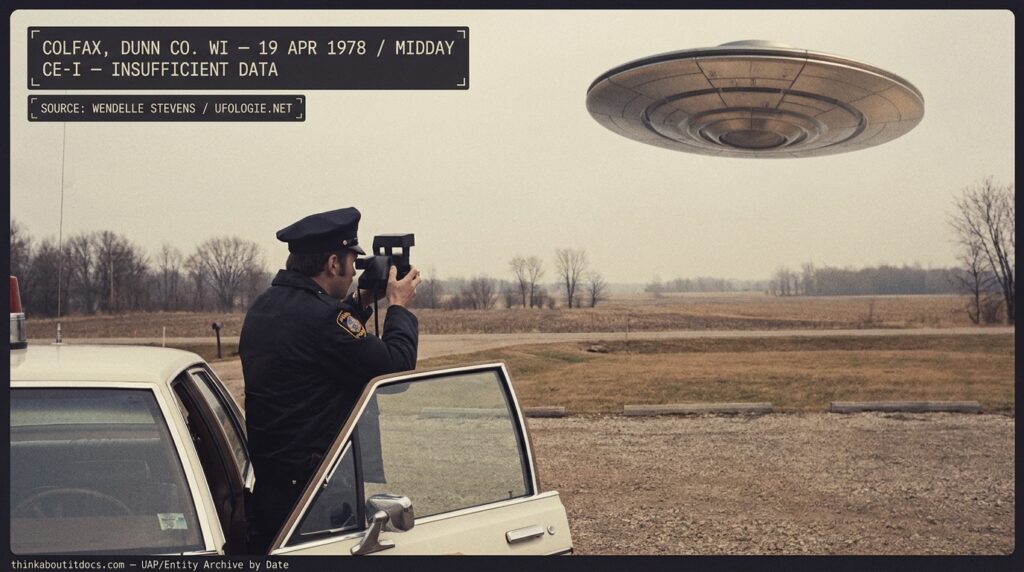
Near Colfax, Dunn County, Wisconsin, April 19, 1978 — Police officer Mark Coltrane photographs a metallic disc at close range with a Polaroid camera during a midday lunch break. One image captured structural detail of the craft's lower surface. Coltrane sat in his patrol car for two hours before reporting the encounter. Source: Wendelle Stevens / ufologie.net.
THINK ABOUTIT UFO|UAP SIGHTING REPORT
1978: Police officer photographs disc in Colfax, Wisconsin
On April 19, 1978, police officer Mark Coltrane was eating lunch in his patrol car in an isolated area near Colfax, Wisconsin when he noticed his radio emitting crackles. He then saw a metallic disc rising from a short distance away, moving toward him. Coltrane grabbed his Polaroid camera, stepped out of the car, and snapped photographs as the object passed — one image close enough to capture details of the craft’s lower surface. The object accelerated and disappeared in the distance. Coltrane sat in stunned silence for two hours before reporting the encounter, afraid of being ridiculed by his superiors.
The case rests on a narrow but specific source chain: Wendelle Stevens, a figure in UFO photographic research, documented the photographs, and the case was subsequently published through ufologie.net. No independent investigation by APRO, MUFON, NICAP, or any other established organization is documented. The Polaroid photographs — which show a metallic disc from two angles, one at close range with visible lower-surface detail — represent the primary physical evidence, and the witness’s law enforcement credentials provide professional credibility. However, the thin source chain requires that the case be evaluated with appropriate caution.
Date: April 19, 1978
Sighting Time: Midday (lunch break)
Day/Night: Day
Location: Near Colfax, Dunn County, Wisconsin, United States
Urban or Rural: Rural — isolated area outside a small town
No. of Entity(‘s): None observed
Entity Type: Not Applicable
Entity Description: Not Applicable
Hynek Classification: CE-I (Close Encounter I) Close observation of an object at a distance of less than approximately 500 feet — upgraded from DD (Daylight Disc) due to the close proximity at which structural detail of the lower surface was photographed and observed
Duration: Several minutes (total observation); two-hour delayed reporting period afterward
No. of Object(s): 1
Description of the Object(s): Metallic disc; lower surface showed visible structural detail in close-range Polaroid photograph; rose from a position near the ground, moved toward the witness, then accelerated and departed
Shape of Object(s): Disc
Size of Object(s): Not estimated by the witness
Color of Object(s): Metallic
Distance to Object(s): Close — structural detail of the lower surface was visible in the Polaroid photograph; initially at “a short distance from the parking space”
Height & Speed: Object was rising from near ground level when first observed; moved toward the witness; accelerated and “fled in the distance” after the photographs were taken
Number of Witnesses: 1 — Mark Coltrane, police officer
Special Features/Characteristics: Two Polaroid photographs taken — one at close range showing structural detail of the lower surface, one showing the object starting to move away; radio crackling in the patrol car prior to visual observation (potential EM effect); two-hour delayed reporting due to fear of ridicule; witness was a law enforcement officer on duty at the time
Case Status: Insufficient Data
Source: Wendelle Stevens; ufologie.net (http://www.ufologie.net/htm/colfax78.htm)
Summary/Description: Police officer Mark Coltrane photographed a metallic disc at close range with a Polaroid camera near Colfax, Wisconsin during a lunch break. The object rose from near the ground, moved toward the witness, and departed at speed. Two Polaroid images were obtained, one showing structural detail of the lower surface. Radio crackling preceded the sighting. The case is documented through Wendelle Stevens and ufologie.net with no independent organizational investigation on file.
Related Cases: 1976 Elmwood Wisconsin CE-II (George Wheeler — police officer, same region of west-central Wisconsin) | 1975 Mellen Wisconsin CE-II (Baker Family Landing)
Full Report
On April 19, 1978, police officer Mark Coltrane was on patrol in the vicinity of Colfax, a small town in Dunn County in west-central Wisconsin. At midday, he stopped his patrol car in a small isolated area to eat lunch. While parked, he noticed that his radio was emitting crackles — an anomalous condition he noted but did not investigate.
Coltrane then observed a metallic-looking disc rising from near the ground at a short distance from where he had parked. The object appeared to move toward him. Coltrane reached for his Polaroid camera, stepped out of the car, and took several photographs as the object passed. In one image, the object was close enough to capture visible structural details of its lower surface. A second photograph shows the object at a greater distance, starting to move away.
The total observation lasted several minutes. The object was lost from Coltrane’s sight when it accelerated and departed into the distance. No sound was reported beyond the pre-existing radio crackling. No additional witnesses have been documented.
Coltrane remained in his patrol car in a state of shock for approximately two hours after the sighting, unable to bring himself to report what he had seen. He later stated that his hesitation was driven by fear of being ridiculed when he submitted his report to his superiors — a concern that echoes the identical reluctance expressed by George Wheeler in the nearby Elmwood CE-II case two years earlier.
The case was documented by Wendelle Stevens, a former USAF lieutenant colonel and prominent collector and publisher of UFO photographic evidence. The photographs and case narrative were subsequently published through ufologie.net. No independent investigation by APRO, MUFON, NICAP, CUFOS, or any other established organization has been located in the published literature.
Researcher’s Notes
The Polaroid and the Thin File — Colfax 1978 and the Problem of Photographic Evidence Without Investigation
- Classification Upgrade — DD to CE-I: The original page classified this case as DD (Daylight Disc — metallic or whitish object seen in daylight). While the DD descriptor is accurate at the surface level, the proximity at which the object was observed and photographed exceeds the distance threshold normally associated with DD reports. Coltrane photographed visible structural detail of the craft’s lower surface from close range — a level of proximity consistent with CE-I (Close Encounter I — close observation at less than approximately 500 feet). The radio crackling in the patrol car prior to visual observation raises the possibility of CE-II (EM effects), but because the temporal relationship between the crackling and the object’s presence cannot be definitively established, the upgrade stops at CE-I. If the crackling is attributed to the object, CE-II would be appropriate.
- Source Chain Assessment — The Stevens Problem: The sole documented source for this case is Wendelle Stevens, a former USAF officer who became one of the most prolific collectors of UFO photographic evidence in the field. Stevens’s archive contains genuine cases alongside material that has been challenged or debunked, and his involvement alone does not confirm or discredit a case. However, the absence of any independent investigation — no APRO file, no MUFON case number, no NICAP record, no Blue Book file — means the entire evidence base rests on Stevens’s documentation and the photographs themselves. The Polaroid medium provides some inherent resistance to manipulation (Polaroid instant prints are difficult to double-expose or composite without visible artifact), but without chain-of-custody documentation from the moment of exposure to Stevens’s acquisition, the photographs cannot be independently validated. The case status is assessed as Insufficient Data rather than Unexplained, reflecting this gap.
- The West-Central Wisconsin Cluster: The Colfax sighting occurred in Dunn County, approximately thirty miles from Elmwood in Pierce County where George Wheeler had his CE-II encounter in April 1976 — also involving a police officer, also involving a disc-shaped craft, and also involving a witness who delayed reporting out of fear of ridicule. The geographic and professional overlap is notable: two law enforcement officers in adjacent rural Wisconsin counties, two years apart, observing disc-shaped metallic objects at close range, both hesitant to report. Whether this clustering reflects genuine localized UAP activity in west-central Wisconsin during the mid-to-late 1970s or a reporting artifact driven by the publicity surrounding the Wheeler case (which received extensive APRO coverage) cannot be determined without additional data.
- The Two-Hour Silence — Institutional Fear and Reporting Behavior: Coltrane’s two-hour silence after the sighting — sitting alone in his patrol car, unable to report what he had seen — is a behavioral detail that carries significant weight in witness credibility assessment. A hoaxer constructing a staged encounter with pre-prepared Polaroid photographs would have no reason to delay reporting; the photographs would be the point, and delay would only reduce their impact. Coltrane’s paralysis is consistent instead with a witness processing an experience that conflicts with professional identity and institutional expectations — a police officer who knows that his superiors will question his judgment if he reports a flying saucer. The identical pattern appears in the Wheeler case (1976), where a veteran officer radioed his sighting in real time but was laughed at, and in the broader CE literature, where law enforcement witnesses consistently report the highest rates of post-sighting anxiety and reluctance to file official reports.
Mark Coltrane had a Polaroid camera in his squad car and used it — two photographs, one close enough to show the underside of whatever was hovering near his lunch break parking spot in Colfax, Wisconsin. He then sat in the car for two hours, unable to tell anyone what he had just photographed. The pictures exist. The investigation does not. Without a case file, without chain-of-custody documentation, without an independent investigator who interviewed the witness and examined the photographs under controlled conditions, the Colfax images remain what they appear to be — Polaroid snapshots of a metallic disc taken by a police officer who was too shaken to speak for two hours — preserved here with the appropriate caveat that appearance and verification are not the same thing.
Full Report

In this photograph, the object is starting to move away.

The object was so close that it is possible to notice some details of its lower surface.