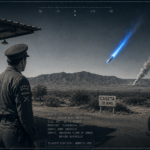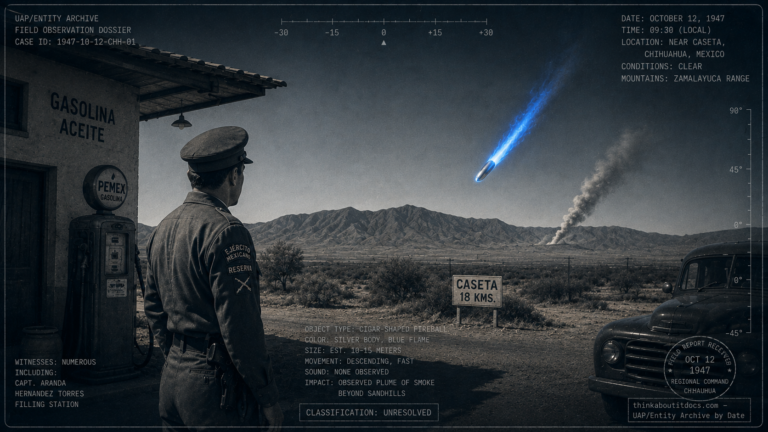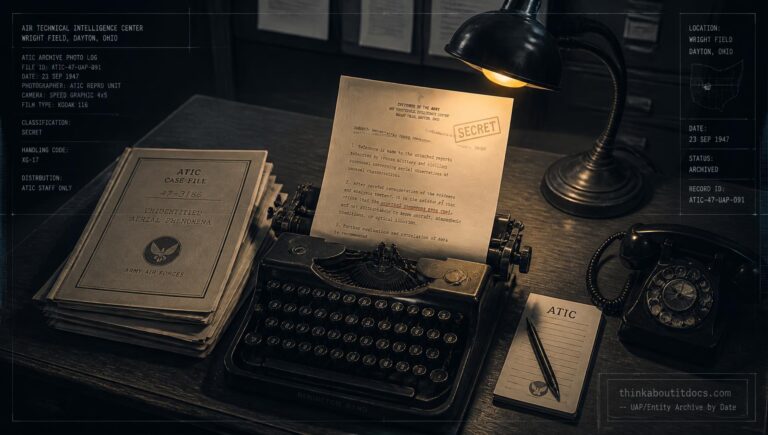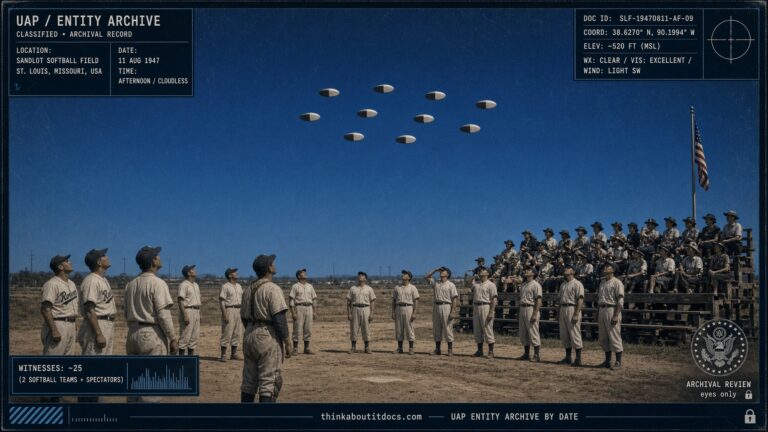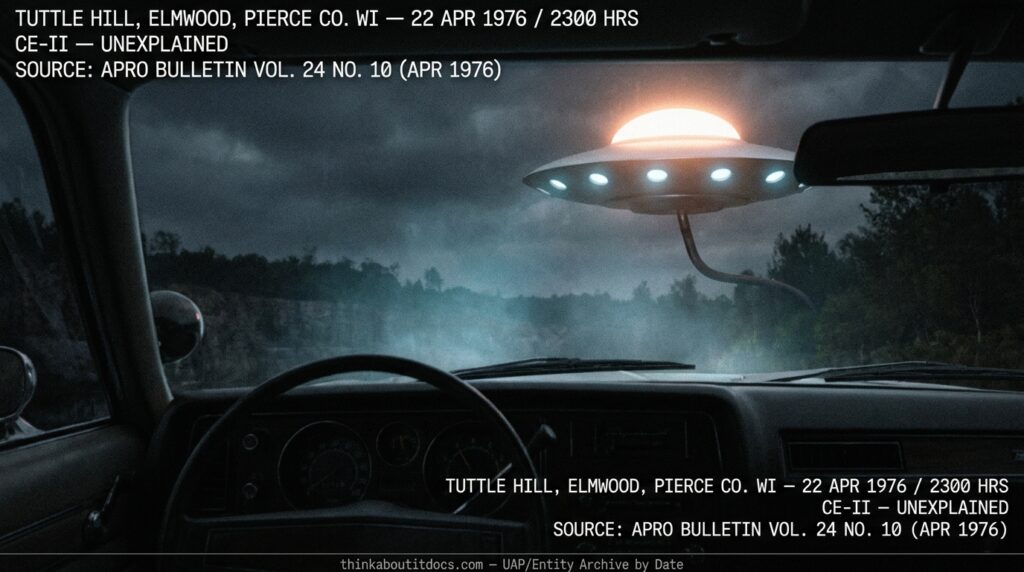
Tuttle Hill, near Elmwood, Pierce County, Wisconsin, April 22, 1976 — Reserve police officer George Wheeler's view from his disabled squad car as a silver disc with six bluish-white portholes and a blinding orangish-white dome hovers approximately 100 feet above an active limestone quarry. A bluish flash on departure knocked out the car's lights, engine, and radio. Source: APRO Bulletin, Vol. 24 No. 10 (April 1976).
THINK ABOUTIT UFO|UAP SIGHTING REPORT
1976: Police officer has repeat sighting on Tuttle Hill
At approximately 11:00 P.M. on April 22, 1976, reserve police officer George Wheeler — a veteran of thirty years of law enforcement in New York and Wisconsin and a combat pilot in World War II — drove to the top of Tuttle Hill outside Elmwood, Wisconsin, to investigate what he thought was a large fire and instead found a silver disc-shaped craft hovering approximately one hundred feet off the ground with six bluish-white portholes, shadows moving inside as if someone was walking past the windows, a slowly revolving turbine-like mechanism visible through an open panel, and a long black hose-like appendage extending downward toward the ground. When the object departed at extreme speed, a bluish flash knocked out his squad car’s lights, engine, and radio — and Wheeler himself, who was found dazed and unable to recall anything after the flash until a passing farmer asked if he needed help.
The case — investigated exhaustively by Robert Pratt and Professor Jack Bostrak of the University of Wisconsin at River Falls — involved electromechanical effects on the police vehicle, possible disruption of television reception at a neighboring farm, apparent animal behavioral reaction, multiple corroborating witnesses who saw the object’s glow from different locations, and a primary witness whose professional credentials as a thirty-year law enforcement veteran and WWII combat pilot placed him among the most qualified civilian observers in the APRO case files. Wheeler was also a repeat witness, having reported a similar object in April 1975.
Date: April 22, 1976
Sighting Time: Approximately 11:00 P.M.
Day/Night: Night
Location: Tuttle Hill, near Elmwood, Pierce County, Wisconsin, United States (approximately 60 miles east of the Mississippi River in west-central Wisconsin)
Urban or Rural: Rural — hilltop overlooking a limestone quarry and farmland outside a village of 737
No. of Entity(‘s): Not directly observed — shadows were visible moving behind the portholes “as if someone was moving inside”
Entity Type: Not directly observed — shadow movement only
Entity Description: Not directly observed; shadows moving past six bluish-white portholes or windows suggested occupant activity inside the craft
Hynek Classification: CE-II (Close Encounter II) Observation of an object in close proximity to the witness, where physical traces (impression, burn, medical effect, etc.) are left or (electrical effect, heat) are felt
Duration: Approximately 45 seconds of direct observation before the bluish flash
No. of Object(s): 1
Description of the Object(s): Disc-shaped craft with a silver main body; top glowing orangish-white so brilliantly that it was “like looking into the sun”; six bluish-white lights, windows, or portholes on the side with shadow movement visible behind them; an open panel on the side facing the witness revealing a slowly revolving mechanism with fin-like parts similar to a turbine; partially extended legs; a long black hose-like appendage extending downward from the bottom, disappearing behind tree cover before reaching the ground; positioned near an active limestone quarry
Shape of Object(s): Disc
Size of Object(s): Not precisely estimated; sufficiently large for six portholes, an open panel, extended legs, and a hose-like appendage
Color of Object(s): Silver main body; orangish-white glow on top (extremely bright); bluish-white portholes; black hose-like appendage
Distance to Object(s): Approximately 500 feet
Height & Speed: Hovering approximately 100 feet above ground level between a limestone quarry and a farmhouse; departed straight up at “extremely high speed” with a “whooshing” sound; bluish flash occurred at moment of departure
Number of Witnesses: Multiple — George Wheeler (primary, direct observation); David Moots (found Wheeler dazed in squad car immediately after); additional witnesses saw the object’s glow from other locations; O’Bryan family (neighboring farm) experienced television disruption at the same time
Special Features/Characteristics: Electromechanical effects — squad car lights, engine, and radio all went dead simultaneously upon the object’s departure; bluish flash preceded the vehicle failure; possible television reception disruption at the O’Bryan farm (set quit “for a short time” several minutes after 11:00 P.M.); possible animal reaction — dogs at a neighboring farm would not respond to their owner’s calls and barked continuously; witness experienced apparent confusion, daze, or possible brief unconsciousness after the bluish flash; open panel revealed slowly revolving turbine-like mechanism with fin-like parts; hose-like appendage extending toward the ground; primary witness was a repeat observer (April 1975 prior sighting); primary witness was a WWII combat pilot and 30-year law enforcement veteran
Case Status: Unexplained
Source: APRO Bulletin, Vol. 24 No. 10 (April 1976); Robert Pratt; Jack Bostrak (Professor of Biology, University of Wisconsin–River Falls)
Summary/Description: Reserve police officer George Wheeler, a WWII combat pilot and 30-year law enforcement veteran, observed a silver disc with six portholes, a brilliantly glowing top, and a hose-like appendage hovering over a limestone quarry near Elmwood, Wisconsin. After approximately 45 seconds of observation, the object departed vertically at extreme speed; a bluish flash simultaneously disabled his squad car’s electrical systems and left Wheeler dazed. He was found shortly afterward by a passing farmer. Television disruption and abnormal dog behavior were reported at neighboring properties. The case was exhaustively investigated by Robert Pratt and Professor Jack Bostrak.
Related Cases: 1978 Colfax Wisconsin DD (Mark Coltrane — police officer, same region) | 1975 Mellen Wisconsin CE-II (Baker Family Landing) | 1974 Frederic Wisconsin CE-III (William Bosak)
Full Report
George Wheeler had thirty years of law enforcement experience — first in New York State, then in Wisconsin — and had served as the one-man police force in Elmwood before transitioning to a reserve officer role, filling in for the town’s current chief when needed. He had also been a combat pilot in World War II. Elmwood is a village of approximately 737 people in Pierce County, west-central Wisconsin, about sixty miles east of the Mississippi River.
At approximately 11:00 P.M. on April 22, 1976, Wheeler was on patrol when he spotted an orange glow at the top of Tuttle Hill, a prominent local elevation. Thinking it was a large fire, he drove up the hill to investigate. When he arrived at the top, he found not a fire but a strange glowing object hovering approximately one hundred feet off the ground, positioned between an active limestone quarry and a nearby farmhouse. He estimated it was approximately five hundred feet from his position.
The object was disc-shaped. Its main body was silver in color, but the top glowed orangish-white with such intensity that Wheeler compared it to looking into the sun. Six bluish-white lights — which Wheeler described as windows or portholes — were visible along the side, and behind them he could see shadows moving as if someone was walking inside. In the middle of the side facing him, a panel appeared to be open. Inside the opening, Wheeler could see something that was revolving slowly and had fin-like parts, resembling a turbine.
What Wheeler interpreted as legs were partially extended from the main body of the craft, and a long black hose-like appendage hung from the bottom. He could not determine whether the hose was touching the ground because it extended down to where it was obscured by trees. The limestone quarry over which the object was hovering was an active quarry still being worked.
Wheeler recalled advice given to him by Professor Jack Bostrak of the University of Wisconsin at River Falls after Wheeler’s first UFO sighting in April 1975: if he should ever have a similar experience, he should attempt to observe as many details as possible. Wheeler followed this guidance throughout his observation.
Upon arriving at the hilltop, Wheeler had radioed the sheriff’s department headquarters in Ellsworth to describe what he was seeing. He believes he said something like “My God, it’s another one of these UFOs or spacecraft.” He estimates that he observed the object for approximately forty-five seconds.
Then the object began to rise straight up at extremely high speed. At that moment, a bluish flash occurred. Wheeler’s squad car — lights, engine, and radio — went dead simultaneously. Wheeler himself does not remember anything after the flash until someone asked if he needed help. The object made a “whooshing” sound as it departed.
The first person to encounter Wheeler after the event was David Moots, a thirty-six-year-old dairy farmer from Elmwood. Moots had been driving home after taking his babysitter home and had seen Wheeler’s squad car parked elsewhere earlier with its lights on. When he saw the same car parked at the top of Tuttle Hill with all lights out, blocking one lane of the road, he decided to stop. Wheeler was trying to get out of the car and appeared to have something wrong with him. Knowing that Wheeler had once had a heart attack, Moots thought he might be having another and asked what was wrong. Wheeler said he had been “hit.” Moots asked, “Hit by a car?” Wheeler replied, “No, one of those UFOs.”
Moots said that Wheeler appeared dazed and was not acting normally. Although Moots did not know Wheeler well, he had had sufficient contact to recognize that his behavior was atypical.
At the neighboring O’Bryan farm — the closest property to the quarry — Mr. O’Bryan reported that he had not seen anything because he was watching television. He casually noted that his television set had quit working “for a short time” several minutes after 11:00 P.M. — the approximate time of Wheeler’s observation. At another nearby farm, a nine-year-old boy mentioned that his sister had come home that evening and the family dogs had not responded to her calls as they normally would. Instead of running up to greet her and jumping up for attention, the dogs simply barked for some time.
Researcher’s Notes
The Bluish Flash on Tuttle Hill — Elmwood 1976 and the Electromechanical Evidence Pattern
- Classification Correction — CE-I to CE-II: The original page classified this case as CE-I (Close Encounter I — close-range observation without physical effects). This is incorrect. The simultaneous failure of Wheeler’s squad car lights, engine, and radio at the moment of the object’s departure constitutes an electromechanical effect — which falls explicitly under the CE-II definition: “Observation of an object in close proximity to the witness, where physical traces (impression, burn, medical effect, etc.) are left or (electrical effect, heat) are felt.” The television disruption at the O’Bryan farm and the abnormal dog behavior at the adjacent property provide additional supportive evidence. Wheeler’s dazed condition and apparent brief loss of consciousness or memory also qualify as a medical or physiological effect. The reclassification from CE-I to CE-II aligns the case with its documented evidence profile.
- The Repeat Witness Question: Wheeler reported a similar UFO sighting in April 1975 — making the 1976 observation his second encounter. The APRO Bulletin article explicitly addresses the “repeat witness” problem, noting that J. Allen Hynek in particular expressed reservations about witnesses claiming more than one sighting. APRO’s position — that during periods of heightened UFO activity in a localized area, multiple sightings by the same individual are plausible rather than disqualifying — is defensible in the Elmwood context. The Elmwood area experienced documented UFO activity across multiple years in the mid-1970s, and Wheeler’s position as a patrol officer placed him outdoors and observant at night more frequently than the average civilian. Bostrak’s advice to Wheeler after the 1975 sighting — to observe as many details as possible if a similar event recurred — indicates that qualified investigators took the possibility of a repeat encounter seriously rather than treating it as grounds for dismissal.
- Investigative Depth — Pratt and Bostrak: The Elmwood case benefited from two rigorous and complementary investigative approaches. Robert Pratt conducted exhaustive witness interviews with all individuals relevant to the case. Jack Bostrak, a Professor of Biology at the University of Wisconsin at River Falls, provided scientific methodology and had established a pre-existing relationship with Wheeler after the 1975 sighting. The combination of a trained journalist’s interviewing technique and a university professor’s analytical framework produced one of the more thoroughly documented CE-II cases in the APRO files. Bostrak’s follow-up investigation of the O’Bryan farm television disruption and the adjacent property’s dog reaction demonstrates the kind of environmental canvassing that most UFO investigations lack.
- The Hose-Like Appendage and the Quarry Context: Wheeler’s observation that the object was positioned over an active limestone quarry — and that a long black hose-like appendage extended downward from the craft toward the ground — is one of the most unusual structural details in the case and one of the few that suggests a functional interaction between the object and the terrain below it. If the appendage was in contact with the ground or the quarry surface, the case would involve a resource-acquisition behavior consistent with a small but significant subset of UFO reports in which objects appear to interact directly with geological formations, water sources, or mineral deposits. The detail that the hose was obscured by trees before reaching ground level prevents confirmation, but the quarry context is noteworthy — limestone quarries expose subsurface geological strata that are not accessible at undisturbed surface level.
George Wheeler drove up Tuttle Hill expecting a fire and found something for which thirty years of police work and a combat pilot’s wartime experience had not prepared him. He radioed what he saw, watched it for forty-five seconds with the deliberate observational attention a fellow investigator had coached him to apply, and then the bluish flash took the lights, the engine, the radio, and his memory of the next few minutes. David Moots found him dazed in a dead squad car on a dark hilltop, trying to get out. The television at the O’Bryan farm had quit. The dogs next door would not come when called. The archival record has no comfortable explanation for any of it, and the Air Force — which by 1976 had closed Project Blue Book and formally exited the UFO investigation business — was not coming to provide one.
Media

Original sketch by witness George Wheeler.

The object that George Wheeler saw. (credit: APRO Bulletin)

George Wheeler indicating the approximate position of UFO observed on Thursday evening, April 22, 1976. Picture was taken May 27, 1976. (credit: APRO Bulletin)