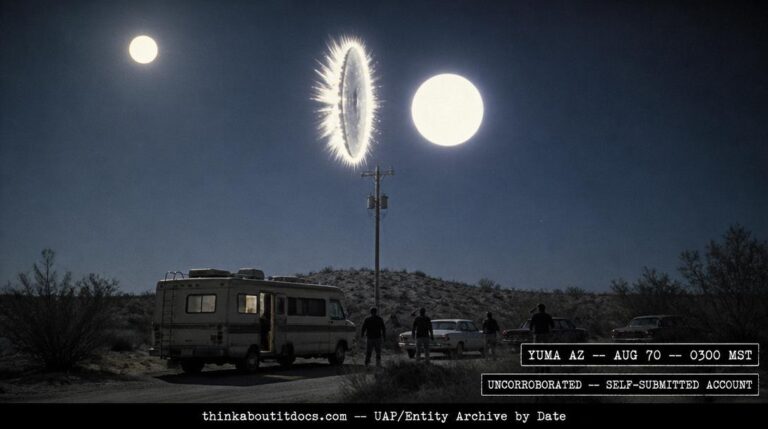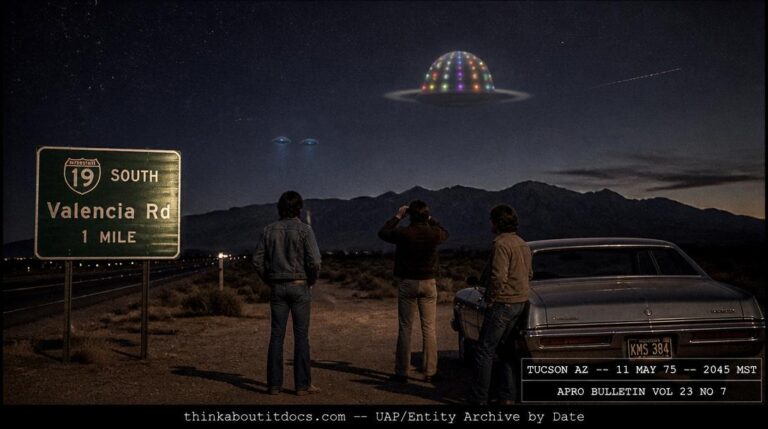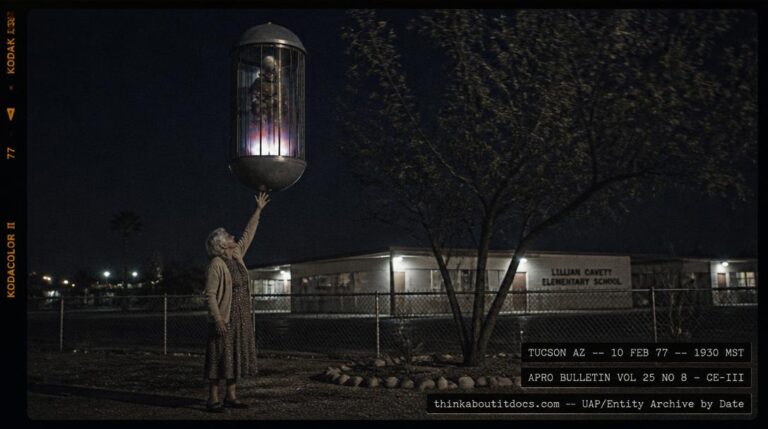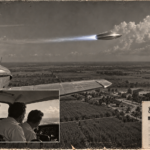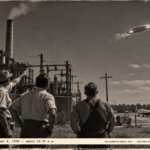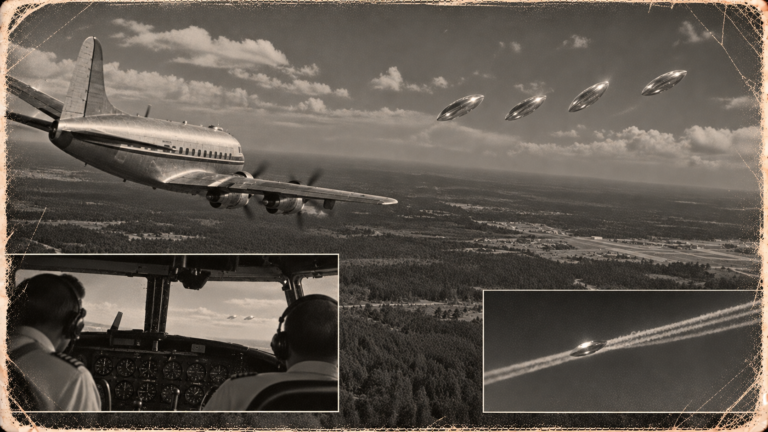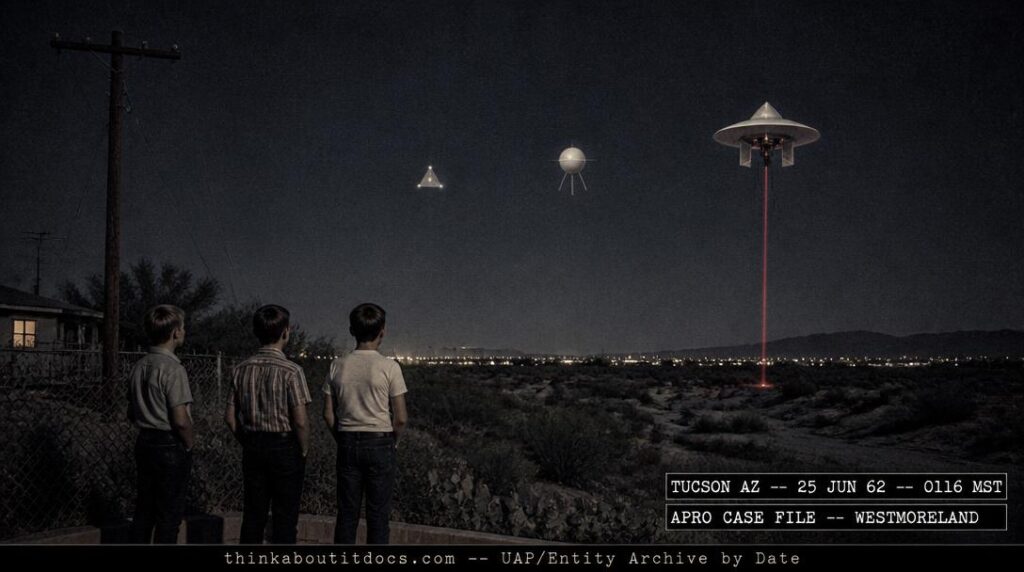
Southeast Tucson, June 25–26, 1962 — Three structured objects observed by the Westmoreland boys over Pantano Wash, with Object #3 deploying a cable under a narrow red interior light. APRO case investigated by Coral and Jim Lorenzen.
THINK ABOUTIT UFO|UAP SIGHTING REPORT
1962: Tucson, Arizona Sighting
On the night of June 25, 1962, three boys camping in a backyard tent in southeast Tucson witnessed a six-hour sequence of structured aerial objects performing coordinated maneuvers — firing smaller “rocket-like” devices, exchanging them between craft, deploying landing gear, and lowering a cable to the ground before retrieving an object and departing. APRO co-founders Coral and Jim Lorenzen personally investigated the case over three visits, conducting extensive cross-examination, and concluded the witnesses were sincere. The case was featured as the lead article in the July 1962 APRO Bulletin and remains one of the most detailed multi-object nocturnal observations in the APRO files.
Date: June 25–26, 1962
Sighting Time: Approximately 9:00 p.m. on June 25 through approximately 3:00 a.m. on June 26, 1962 (MST)
Day/Night: Night
Location: Westmoreland residence, southeast Tucson, Arizona (overlooking Pantano Wash, approximately 3–4 miles from Davis-Monthan AFB)
Urban or Rural: Suburban
No. of Entity(‘s): None observed
Entity Type: Not Applicable
Entity Description: Not Applicable
Hynek Classification: NL (Nocturnal Light) — closest object estimated over Pantano Wash at approximately one-quarter mile (~1,320 feet), beyond the 500-foot CE-I threshold, though exceptional structural detail was reported
Duration: Approximately 6 hours
No. of Object(s): 3 primary objects, plus multiple smaller “rocket-like” objects fired between them
Description of the Object(s): Object #1: bright white point source that resolved into a triangular shape as it appeared to approach; fired green “rockets” horizontally. Object #2: appeared round with two stilt-like protuberances on the underside; received small objects from #1, then fired one of its own before fading from view. Object #3: round with a cone-shaped superstructure above a circular airfoil; deployed three stilt-like legs, opened two doors on the underside revealing a red interior light, and lowered a brown rope-like cable to the ground before retrieving an object approximately six feet long
Shape of Object(s): Triangular (#1), disc/round with underside protuberances (#2), disc/round with cone-shaped superstructure (#3)
Size of Object(s): Object #3 estimated at approximately 80 feet in diameter based on angular comparison with a utility pole cross-arm at known distance, if positioned over Pantano Wash (quarter mile). Small “rocket” objects estimated at approximately 6 feet long
Color of Object(s): White (all three objects)
Distance to Object(s): Object #1 at approximately 30–40 degrees elevation to the west-southwest. Object #3 estimated over Pantano Wash, approximately one-quarter mile from witnesses
Height & Speed: Variable — objects were stationary for extended periods, then maneuvered slowly. Small “rockets” moved too fast to track visually
Number of Witnesses: 3 (John Westmoreland, age 14; James Westmoreland; Ronnie Elack [as rendered in APRO Bulletin — possibly OCR for “Black”]). Mother Pat Westmoreland (~40) corroborated the boys’ consistency under her own cross-examination the following morning
Special Features/Characteristics: Complete silence throughout all observations. Green “rocket-like” objects fired from Object #1, transferred to Object #2 through apparent absorption into its underside. Object #3 deployed retractable stilt-like landing gear, opened hinged doors on its underside revealing a perpendicular red light beam, and lowered a brown cable or rope to the ground before retrieving an object of similar size to the small “rockets.” A jet aircraft (likely from Davis-Monthan AFB flight pattern) passed over at 1:16 a.m., providing the witnesses with a direct comparison between conventional and unconventional objects
Case Status: Unexplained
Source: Coral E. Lorenzen, “Saucers Shoot Rockets over Tucson, Arizona,” APRO Bulletin, July 1962; Tucson Daily Citizen, June 26, 1962; case file compiled by Dan Wilson from APRO archives
Summary/Description: Three boys camping overnight in a backyard tent in southeast Tucson observed a sequence of unconventional aerial objects from approximately 9:00 p.m. on June 25 through the early morning hours of June 26, 1962. The primary witness, 14-year-old John Westmoreland, kept contemporaneous notes on a score pad. The objects operated in apparent coordination, firing and receiving smaller “rocket-like” devices between craft, deploying mechanical structures (landing gear, hinged doors), and lowering a cable to the ground near Pantano Wash before retrieving an object and departing to the east. All objects were completely silent. APRO co-founders Coral and Jim Lorenzen investigated the case in person within 48 hours of the event, conducting three separate visits to the Westmoreland home and walking the observation site with the boys. A separate balloon hoax by college students on June 29, three days later, was wrongly conflated with the Westmoreland sighting by local press.
Related Cases: 1952 Davis-Monthan AFB B-36 Incident
Detailed Report
On the warm, humid evening of June 25, 1962, three boys — John Westmoreland (age 14), his brother James, and next-door neighbor Ronnie Elack — had permission to spend the night in a tent in the Westmoreland backyard in southeast Tucson, Arizona. The Westmoreland home was situated approximately three to four miles from Davis-Monthan Air Force Base, a Strategic Air Command installation, and overlooked Pantano Wash to the east. Armed with playing cards, a pad, and a pencil, the boys settled in for a night outdoors. By about 9:00 p.m. they had tired of cards and gone outside to watch the stars.
John noticed an anomalous “star” at approximately five degrees south of due west, at 30–40 degrees elevation. It was very bright, white, and appeared to move slightly before dimming, drifting south, losing some altitude, and becoming stationary. The boys checked on it intermittently for the next few hours but saw little activity. Then at approximately 11:45 p.m., the object brightened dramatically and appeared to grow larger, resolving from a point of light into a triangular shape. It became stationary again. At 12:15 a.m. on June 26, Object #1 fired three green “rockets” or “flares” horizontally — moving too fast to track visually. John grabbed the score pad and began keeping written notes, timestamped against the kitchen clock visible through a window.
After the first rocket was fired, a second object (Object #2) appeared, racing from west to east across the northern sky. It executed a sharp reversal and took up a position at about 15 degrees east of north, at slightly greater elevation than Object #1. Object #2 appeared closer and larger, presenting as round-shaped with two stilt-like protuberances on its underside. One of the small “rocket” objects approached Object #2 from below and appeared to be absorbed through its bottom surface. This transfer sequence repeated twice more over approximately the next several minutes — each time Object #1 firing a small object, which then traveled to and entered Object #2. Object #2 then fired its own “rocket” into the night sky, dimmed, and faded from view.
A third object (Object #3) was then spotted at approximately 100–110 degrees azimuth and about 45 degrees elevation. It appeared the largest and closest of the three, sporting a distinctive cone-shaped superstructure above a circular airfoil. Like the others, it was white and completely silent. At 1:16 a.m. a jet aircraft passed overhead — the witnesses later determined it was likely following the Davis-Monthan AFB flight pattern — providing a direct auditory and visual contrast with the unconventional objects, which produced no sound whatsoever.
Object #3 then descended closer. Three stilt-like protuberances deployed from its underside. The object gained altitude briefly, and a dark elongated structure slid out from above the circular rim. Three small “rocket-like” objects emerged in rapid succession and then returned. Two doors swung open downward on the underside, and as they opened, the landing legs retracted. The small objects entered the opening one by one. The object elevated slightly, moved sideways, and became stationary.
The most dramatic phase followed. Something resembling a rope or cable descended from Object #3 toward the ground below — near or over Pantano Wash. When the doors had opened, a narrow red light beam had shone perpendicularly downward, illuminating the area enough for the boys to discern that the cable was brown in color. Both John and James independently identified the color. The cable remained extended for an estimated three to five minutes, then began retracting. As it cleared the ridge bordering the wash, the boys could see an object attached to its lower end — approximately the same size and general configuration as the small “rockets,” which they estimated at about six feet long based on angular comparison with John’s father (approximately six feet tall). After the object was pulled inside, the doors closed and Object #3 moved up and east until lost from view.
The boys watched for further activity but eventually retired to the tent as fatigue overcame them. In the morning they told their mother, Pat Westmoreland, who subjected them to her own interrogation using what Coral Lorenzen described as every trick she knew to trip them up, but the boys’ accounts remained consistent.
Coral Lorenzen learned of the case the evening of June 26 when she opened the Tucson Daily Citizen and saw the headline reporting the boys’ notes. She telephoned Mrs. Westmoreland immediately, and within hours she and Jim Lorenzen were at the home conducting the first of three extended interview sessions. Jim Lorenzen walked with the boys to Pantano Wash to evaluate sightlines and distances. Coral sketched the objects under the boys’ direction. Neither investigator detected rehearsed conversation, strain, or trickery. Based on angular comparison of the rim of Object #3 with a five-foot cross-arm on a utility pole at the corner of the Westmoreland lot, the Lorenzens estimated that if the object had been over Pantano Wash (quarter mile distant), it was approximately 80 feet in diameter.
On June 29, three days after the Westmoreland sighting, a group of college students launched homemade balloons filled with kitchen gas and lit by candles in fireproof crepe paper. A local atmospheric physics professor at the University of Arizona tracked one of these objects from the meteorological lab, initially considering it anomalous before determining it was a hoax device. Coral Lorenzen herself called the Tucson Citizen suggesting the June 29 object might be a prank, and the students eventually acknowledged their role while calling it a “wind velocity experiment.” The local press then implied that these balloons explained all recent sighting reports in the Tucson area — a conflation that Coral Lorenzen challenged in her APRO Bulletin report, noting that the Westmoreland sighting preceded the balloon prank by three days and described structured objects performing mechanical operations entirely unlike floating candle-lit bags.
Researcher’s Notes
The Westmoreland Sighting — Tucson 1962 and the APRO Home-Turf Advantage
- Source Chain and Investigative Quality: This case has an unusually strong provenance for a civilian sighting of its era. The primary investigators were Coral and Jim Lorenzen, co-founders of the Aerial Phenomena Research Organization, whose headquarters had been in Tucson since 1960. They responded within approximately 48 hours of the event, conducted three separate in-person visits, walked the observation site, and produced sketches under witness direction. The primary source is Coral Lorenzen’s own article in the July 1962 APRO Bulletin, titled “Saucers Shoot Rockets over Tucson, Arizona” — a first-person investigative account, not a secondhand summary. The page’s credited source, Dan Wilson, is a researcher known for transcribing APRO and Project Blue Book files, not the original investigator. The Tucson Daily Citizen published the boys’ notes on June 26, 1962, providing an independent contemporaneous record predating the Lorenzens’ investigation.
- The Date Discrepancy: The original page header listed the date as “June 25/26, 1962” (correct) while the Sighting Time field erroneously read “From 10:25 p.m. local time, June 22, until 3:00 a.m. local time, June 23.” The June 22–23 dates have no support anywhere in the APRO Bulletin text. The narrative consistently places the sighting on the night of June 25: the boys camped that night, Coral read the Tucson Daily Citizen on the evening of June 26, and the college balloon hoax occurred on June 29 — described as “three days after the Westmoreland sighting.” The June 22–23 dates appear to be a simple data-entry error, possibly a misread of handwritten notes during transcription. This rebuild corrects the Sighting Time to match the verified APRO record.
- Hynek Classification and the Distance Problem: The original page classified this as CE-I (Close Encounter of the First Kind), which requires an observation within approximately 500 feet. However, the Lorenzens’ own investigation estimated that Object #3 — the closest of the three — was positioned over Pantano Wash, approximately one-quarter mile (~1,320 feet) from the witnesses. This is well beyond the CE-I threshold. The exceptional structural detail reported (doors, legs, cable, cone superstructure, color of the cable by red interior light) is unusual for a Nocturnal Light classification, but Hynek’s taxonomy is distance-based, not detail-based. The reclassification to NL reflects the investigators’ own distance estimate. If future evidence establishes the object was substantially closer than the wash, CE-I would be appropriate.
- Mundane Candidates and the Balloon Conflation: The cleanest mundane candidate for the initial “star” observation at 9:00 p.m. is a bright planet or star exhibiting atmospheric scintillation, which can produce apparent color changes and small apparent movements. The proximity of Davis-Monthan AFB (SAC installation, 3–4 miles distant) means military air traffic was routine — the 1:16 a.m. jet overflight confirms this. However, the witnesses explicitly contrasted the jet with the silent objects, and the reported mechanical operations (doors, retractable gear, cable deployment and retrieval) are not consistent with any known aircraft or atmospheric phenomena. The June 29 balloon hoax is definitively excluded: it occurred three days later, involved crude candle-lit gas bags, and was itself identified as a prank by both the investigating professor and Coral Lorenzen. The local press’s conflation of the two events is a textbook example of premature explanatory closure — a theme Coral Lorenzen addressed directly in her APRO Bulletin article. The Westmoreland sighting itself remains unexplained by any documented conventional source.
The Westmoreland sighting endures as one of the most detailed multi-object nocturnal observations in the APRO files — investigated rapidly, documented thoroughly, and never satisfactorily explained. The boys’ contemporaneous notes, the mother’s independent interrogation, and the Lorenzens’ three-visit cross-examination collectively form a source chain that meets the standard the archive demands. The case sits in the record as reported, unexplained, and waiting.