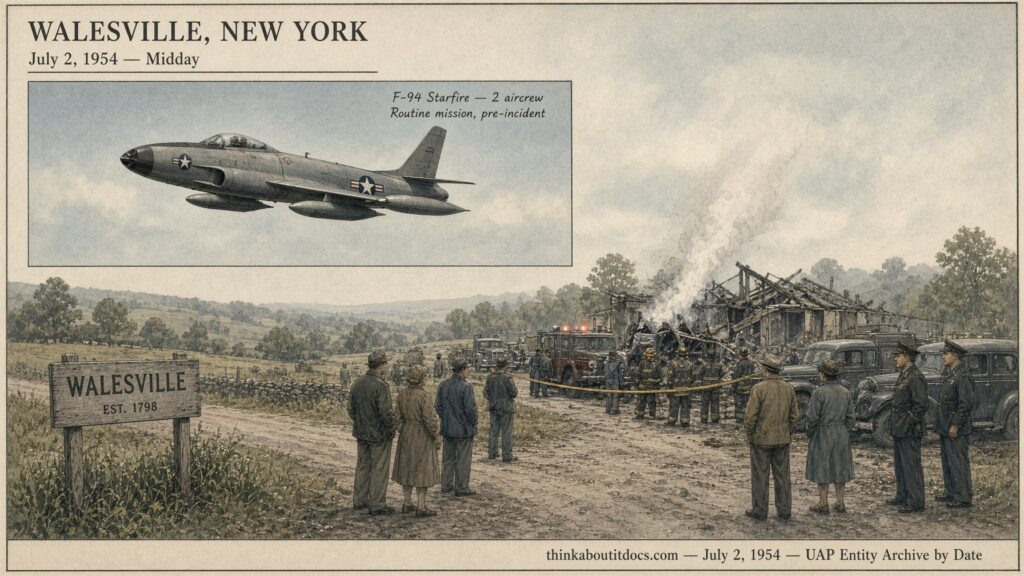
The Walesville, New York crash site, July 2, 1954 — a documented tragedy often mischaracterized in later UFO literature.
THINK ABOUTIT UFO|UAP SIGHTINGS REPORT
1954: The Walesville, New York F-94 Crash — Facts and Framing
On July 2, 1954, an Air Force F-94C Starfire jet, diverted to investigate an unidentified radar contact over upstate New York, suffered a cockpit fire warning and crashed into the small hamlet of Walesville after its two-man crew ejected. Four civilians on the ground were killed: Stanley Phillips, 38; his wife, Florence, 32; their eleven-year-old son, Gary; and Doris Monroe, 28, in her own home preparing lunch for her four children. This archive documents what is actually established about that day, and separates it clearly from what later popular UFO literature added to the story.
A NOTE ON THIS ENTRY
This case involved real civilian deaths, including a child. This archive presents it with the same care it would want applied to any account of a genuine tragedy: the documented, investigated facts first, and the popular UFO-literature framing clearly labeled as such, without either minimizing the loss of life or treating it as an exciting unsolved mystery. The two source entries this page consolidates (dated July 1 and July 2, under the place names “Wellsville” and “Walesville”) describe the same single event.
Date: July 2, 1954
Sighting Time: Approximately 12:30 p.m. (EDT)
Day/Night: Day
Location: Airspace over central New York State (intercept); crash site at Walesville, near Utica, NY (approx. 11 miles southwest of Utica)
Urban or Rural: Air (intercept); small rural hamlet (crash site)
No. of Entity(‘s): 0
Entity Type: Not Applicable
Entity Description: Not Applicable
Hynek Classification: None assigned. The intercepted object was never visually confirmed as anomalous by the flight crew with certainty, and the crash itself is officially attributed to a documented mechanical fault. Assigning a UFO-encounter classification to a case with this level of confirmed alternative explanation would overstate what is actually established.
Duration: The intercept mission and subsequent bailout occurred within a single flight beginning at approximately 11:05 a.m. EST
No. of Object(s): 1 unidentified radar/visual contact (disputed identity — see below)
Description of the Object(s): Not established with confidence. Later research (Kevin Randle) suggests the object the crew was vectored toward may have been identified during the flight as a known USAF C-47 transport, tail number 6099; a separate, unnamed Mohawk Airlines pilot was quoted in contemporary press reports describing “a light apparently shining” from an object in the area.
Shape/Size/Color of Object(s): Not established
Distance to Object(s): Not established
Height & Speed: The F-94C was vectored to 10,000 ft on a 60° heading during the intercept attempt
Number of Witnesses: 2 aircrew (pilot Lt. William E. Atkins, 24; radar observer Lt. Henry F. Coudon, 26); an unnamed Mohawk Airlines pilot; thousands of New York State residents reportedly called police that day reporting unidentified objects in the sky, per contemporary New York Times reporting
Special Features/Characteristics: The F-94C, out of Griffiss Air Force Base, Rome, New York, was diverted mid-flight to intercept an unidentified aircraft; a fire warning light illuminated in the cockpit, and following standard procedure, both crew members ejected after shutting down the engines, leaving the aircraft to crash unpiloted. The official Air Force accident investigation, completed August 17, 1954, concluded the F-94C’s fire and overheat warning circuitry was defective and prone to false warnings — a documented, known issue with the aircraft type, not evidence of an external cause. Popular UFO literature, most notably Donald Keyhoe’s later accounts, presented the case as a jet “shot down” while chasing a UFO and attributed the crew’s ejection to sudden, otherwise-unexplained heat; this framing is not supported by the completed accident report, which both authors and researchers have separately noted contains factual errors in some retellings (including the identities of those killed).
Case Status: Officially Explained (mechanical fault, per USAF accident investigation, August 17, 1954). This archive notes the case remains a fixture of popular UFO literature under a different, less supported framing, and states that framing’s actual evidentiary basis plainly.
Source: USAF accident investigation report, August 17, 1954; contemporary Associated Press and New York Times reporting, July 3, 1954; Donald Keyhoe, “Flying Saucers: Top Secret” and “Aliens from Space” (popular UFO-literature framing); Kevin Randle research and commentary
Summary/Description: On the morning of July 2, 1954, an F-94C Starfire jet took off from Griffiss Air Force Base, New York on a training mission and was diverted mid-flight to intercept an unidentified aircraft reported in the area. During the intercept attempt, a cockpit fire warning light illuminated. Following standard procedure, pilot Lt. William E. Atkins and radar observer Lt. Henry F. Coudon shut down the aircraft’s engines and ejected; both survived without serious injury. The unpiloted jet crashed into the small hamlet of Walesville, near Utica, New York, striking two houses and a car. Four civilians were killed: Stanley Phillips, his wife Florence, and their eleven-year-old son Gary, who were in their car; and Doris Monroe, in her home preparing lunch for her four children, one of whom was injured by debris. The USAF’s completed accident investigation attributed the crash to a defective fire and overheat warning circuit in the F-94C, a documented issue with the aircraft type. Popular UFO literature has since presented the case as an Air Force jet brought down while pursuing a UFO — a framing this archive notes is not supported by the completed official investigation, though the underlying diversion to intercept a genuinely unidentified object, and the widespread contemporary public reports of unusual aerial activity that day, are independently documented.
Related Cases: None known
Detailed Report
The F-94C Starfire that would crash into Walesville, New York took off from Griffiss Air Force Base at approximately 11:05 a.m. on July 2, 1954, on what began as a routine training mission. Only a few miles into the flight, Griffiss’s control tower diverted the crew to an active air defense mission: intercept an unidentified aircraft, vectored at 60 degrees and 10,000 feet.
Pilot Lt. William E. Atkins had some difficulty locating the target initially. Ground control then advised him of a second unidentified aircraft in the area — one the pilot subsequently identified, according to later research by investigator Kevin Randle, as a known USAF C-47 transport, tail number 6099. At the point of that identification, no malfunction had yet occurred, according to both the pilot’s own account and the C-47 pilot’s.
What happened next is where the documented record and the popular retelling diverge most sharply. A fire warning light illuminated in the F-94’s cockpit. Following standard emergency procedure, Atkins shut down the aircraft’s engines, and he and radar observer Lt. Henry F. Coudon ejected. Both survived. The now-unpiloted jet, still carrying 48 high-powered rockets, crashed into the small crossroads hamlet of Walesville, roughly eleven miles southwest of Utica, striking two houses and an automobile before bursting into flames intense enough to melt the surrounding roadway.
Four people on the ground died. Stanley Phillips, 38, his wife Florence, 32, and their eleven-year-old son Gary, all of neighboring Hecla, were in their car when it was struck. Doris Monroe, 28, was in her own home preparing lunch for her four children when the aircraft hit; her one-year-old daughter, Betty Lou, suffered a severe leg laceration from flying debris but survived, along with her three siblings.
The Air Force’s board of inquiry completed its investigation on August 17, 1954. Its conclusion was mechanical, not extraordinary: the F-94C’s fire and overheat warning circuitry was defective and prone to false activation, a documented deficiency in the aircraft’s design that the Air Force’s own inspection requirements had failed to catch. This is the officially established cause of the crash.
That is not, however, the version of events that became widely known. Donald Keyhoe, in his later popular UFO books, presented a considerably different account: a jet brought down while pursuing a genuine UFO, its crew forced out by sudden, otherwise unexplained heat, the plane “screaming down” into Walesville as a direct consequence of the encounter. Subsequent researchers, including Kevin Randle, have noted that Keyhoe’s retelling contains factual errors — misidentifying the civilian victims, among other details — and that the completed accident report simply does not support the causal claim that a UFO brought the aircraft down.
What is independently documented, separate from either account, is that widespread and unusual reports of aerial activity were genuinely occurring across New York State that same day — contemporary New York Times coverage described state police phone lines flooded with UFO reports in the hours around the crash, and an unnamed Mohawk Airlines pilot was quoted describing “a light apparently shining” from an object in the area. Whether any of that activity has a genuine connection to the F-94’s fire warning malfunction, or represents a separate, coincidental cluster of unrelated sightings during an active period of the broader 1954 UFO wave, is not something this archive can resolve from the available record.
RESEARCHER’S NOTES
Walesville — 1954 and the Difference Between a Documented Cause and a Popular Story
- A completed, specific official investigation exists: Unlike many cases in this archive, this one has a formal accident report with a stated mechanical cause — a defective fire warning circuit — reached through a real investigative process, not simply an unexplained disappearance or an anonymous claim.
- The popular account and the official one are not the same story: Keyhoe’s widely circulated version asserts a causal UFO encounter the accident report doesn’t support, and independent researchers have documented factual errors in his retelling. This archive treats the gap between the two as significant and worth stating explicitly, rather than blending them into one narrative.
- Real, named victims deserve accuracy, not embellishment: Given that this case involves the deaths of a child and three adults, this archive holds itself to a higher standard of factual precision here than it would for a typical unverified sighting — getting the victims’ names and the investigation’s actual conclusion right matters more than a dramatic framing.
- Genuine unresolved elements remain, short of the crash’s cause: The identity of whatever the crew was originally vectored toward, and the wave of unrelated public UFO reports the same day, remain genuinely undetermined — this archive notes that open question without using it to imply a connection to the crash itself.
- A later claim of memory loss, reported secondhand: A 1968-era secondhand account (relayed through a source who said an Air Force contact told him) claims the pilot experienced a period of memory blackout beyond what heat exposure alone would explain. This is a considerably weaker, unverified secondary claim, and this archive notes it only as such — a rumor about the case, not a documented part of the official record.
This case is preserved here because it genuinely occurred during the 1954 UFO wave and involved a real intercept of a genuinely unidentified contact — not because this archive endorses the popular claim that a UFO caused the crash. The completed accident investigation’s conclusion is the best-documented account of why the aircraft went down, and this archive presents it as such, alongside the human cost that resulted.
“State police examining the wreckage of a car which was caught in the path of a pilotless F-94 Starfire Jet.”
— Rome Daily Sentinel, July 3, 1954