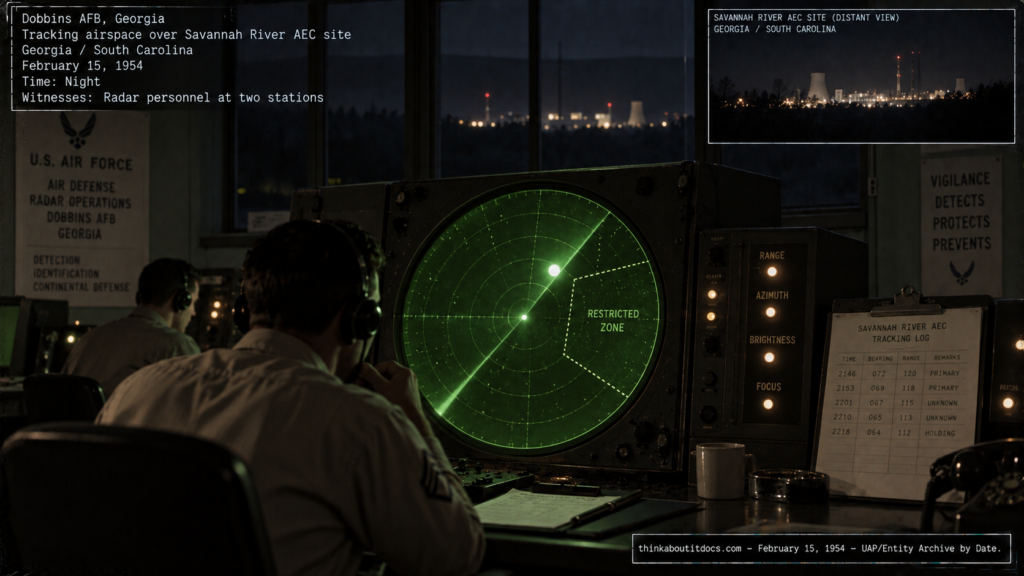
The Dobbins AFB radar scope that tracked an unidentified target violating Savannah River AEC restricted airspace, February 15, 1954.
THINK ABOUTIT UFO|UAP SIGHTINGS REPORT
1954: The Savannah River AEC Radar Case — South Carolina
An Air Defense Command radar operator in Georgia watched a target streak toward one of the most sensitive nuclear facilities in the country, accelerate to nearly a thousand miles an hour, punch straight through restricted airspace, then whip through a series of turns sharp enough to imply forces no aircraft of 1954 could survive — before a second radar station confirmed every move independently. This is one of the most precisely tracked unidentified radar cases of the entire decade.
Date: February 15, 1954 BBU
Sighting Time: 10:15-10:36 p.m. (EST)
Day/Night: Night
Location: Airspace over Georgia and South Carolina, centered on the Savannah River Atomic Energy Commission site (near Siloam, GA to New Ellenton, SC)
Urban or Rural: Air (restricted nuclear-facility airspace)
No. of Entity(‘s): 0
Entity Type: Not Applicable
Entity Description: Not Applicable
Hynek Classification: RV (Radar-Visual, per this archive’s convention for radar-only cases; no direct visual sighting of the object was recorded in this instance)
Duration: Approximately 21 minutes of continuous radar tracking
No. of Object(s): 1
Description of the Object(s): Radar return approximately the size of two normal aircraft
Shape/Size/Color of Object(s): Unknown — radar-only case, no visual description available
Distance to Object(s): First detected approximately 100 miles south of the tracking station; closed to and crossed directly into the Savannah River AEC restricted zone
Height & Speed: Altitude 20,000-22,000 ft; speed varied dramatically across the tracking period, from approximately 360 knots (400 mph) initially to a peak recalculated estimate near 1,800 mph during one sharp turn, with an estimated 1.5 g’s sustained through that maneuver
Number of Witnesses: Radar personnel at two independent stations — S/Sgt. K.A. Payne of the 728th AC&W Squadron, Dobbins AFB, and separate confirming personnel at Pope AFB
Special Features/Characteristics: The target’s course change directly toward, and violation of, the Savannah River AEC’s prohibited airspace was a specific, documented event, not an incidental flight path; the object’s velocity changed repeatedly and sharply throughout the 21-minute track, including a turn recalculated at approximately 1.5 g’s and a peak probable speed near 1,800 mph; a second radar station (Pope AFB) independently tracked the same target violating the AEC zone and confirmed the observation to the primary tracking station in real time
Case Status: Officially logged by Project Blue Book (BBU); one of the more rigorously documented radar-only cases of the era, with cross-station confirmation and detailed recalculated flight-path data
Source: Brad Sparks; Jan Aldrich
Summary/Description: Beginning at 10:15 p.m. on February 15, 1954, USAF radar operator S/Sgt. K.A. Payne of the 728th AC&W Squadron, Dobbins AFB, tracked an unidentified target on MPS-7 radar approximately 100 miles south, near Siloam, Georgia, moving east at roughly 400 mph and 20,000 ft. The target turned toward the Savannah River Atomic Energy Commission site near Augusta, accelerating to an estimated 1,000 mph average speed (probable peak near 1,000 mph) before violating the AEC’s prohibited airspace at 10:22 p.m. Pope AFB radar independently confirmed the airspace violation and alerted Dobbins. The target then executed a series of sharp turns — including one recalculated at approximately 1,800 mph peak speed and 1.5 g’s — reversing direction multiple times while alternately slowing to around 600 mph, before finally fading from radar near Kershaw, SC at 10:36 p.m., 21 minutes after first detection.
Related Cases: None known
Detailed Report
The Savannah River Site, straddling the Georgia-South Carolina border, was among the most sensitive pieces of real estate in the entire United States in February 1954 — an Atomic Energy Commission facility central to the nation’s nuclear weapons production, with restricted airspace enforced accordingly. Any unauthorized aircraft approaching it warranted serious attention. What approached it on the night of February 15 warranted more than that.
At 10:15 p.m., S/Sgt. K.A. Payne, operating MPS-7 radar for the 728th Aircraft Control and Warning Squadron at Dobbins Air Force Base, picked up an unidentified target roughly 100 miles to the south, near Siloam, Georgia. It was moving east at a fairly unremarkable 360 knots — about 400 mph — at 20,000 feet. Nothing about those initial numbers stood out.
What happened over the next several minutes did. By 10:21, now near Augusta, the target had climbed to 22,000 feet and turned onto a heading pointed directly at the Savannah River AEC plant, accelerating hard — Payne’s own estimate at the time was 900 knots (roughly 1,000 mph); later recalculation from the mapped positions suggested an average closer to 750 mph, with a probable peak speed near 1,000 mph. Whatever the precise figure, the target crossed into the AEC’s prohibited airspace at 10:22 p.m.
This wasn’t Dobbins’ discovery alone. Pope Air Force Base, tracking independently, picked up the same violation and radioed Payne to confirm it — a second, separate radar station corroborating the exact event in real time, which substantially strengthens the case against simple equipment malfunction or operator error at a single station.
The target’s behavior over the following minutes reads like a study in erratic, high-performance flight. At 10:22:30, it turned left onto roughly a 75-degree heading, slowing to about 600 mph before continuing to turn to around 55 degrees. A minute later, near New Ellenton, South Carolina, it made a sharp 75-degree turn north, accelerating again — this time to an average near 1,200 mph, with a recalculated probable peak near 1,800 mph and an estimated 1.5 g’s sustained through the maneuver — carrying it back out of the restricted zone. By 10:24, near Aiken, it had slowed again to around 600 mph before turning sharply east, then southeast, then south, passing below Columbia before finally turning north and fading from the scope near Kershaw at 10:36 p.m. — 21 minutes after Payne’s first detection.
RESEARCHER’S NOTES
Savannah River — 1954 and Radar Data Precise Enough to Argue With
- Independent cross-station confirmation: Two separate radar installations, Dobbins and Pope, tracked the same target’s restricted-airspace violation and communicated about it in real time. This substantially rules out a single operator’s misreading of a stationary echo or equipment glitch as the sole explanation.
- Recalculated, not just estimated, figures: The case’s documentation distinguishes between the operator’s real-time speed estimates and later recalculations derived from the actual mapped positions and timing — a level of analytical rigor that gives the reported peak speeds and g-forces more weight than a single witness’s on-the-spot impression would carry.
- A specific, high-value target: The object’s course change aimed directly at, and its confirmed violation of, restricted nuclear-facility airspace is a much more specific and consequential detail than a generic unexplained radar contact — this was treated, at the time, as a genuine security concern, not a curiosity.
- Extreme velocity changes across a single track: Accelerating and decelerating repeatedly between roughly 400 and 1,800 mph within a 21-minute window, while executing sharp directional turns, describes flight characteristics well outside the performance envelope of any aircraft in service in 1954 — a claim serious enough that this archive notes it plainly rather than softening it.
- No visual sighting to corroborate the radar track: This remains, ultimately, a radar-only case. No pilot or ground observer is recorded as having visually confirmed an object matching the tracked position, which leaves open real questions about signal interpretation, however carefully the underlying data was analyzed.
This is one of the most carefully documented and independently cross-confirmed radar cases in this archive’s record, distinguished by two separate stations tracking the same restricted-airspace violation and by recalculated, rather than merely estimated, flight data. It remains a radar-only case with no visual corroboration, and this archive presents its extraordinary calculated figures with that limitation stated plainly.
“Target made a sharp 75° turn to the N… having accelerated again to about 1,200 mph average speed (probable peak speed about 1,800 mph at 1.5 g’s).”
— Brad Sparks & Jan Aldrich, on the February 15, 1954 Savannah River AEC radar case