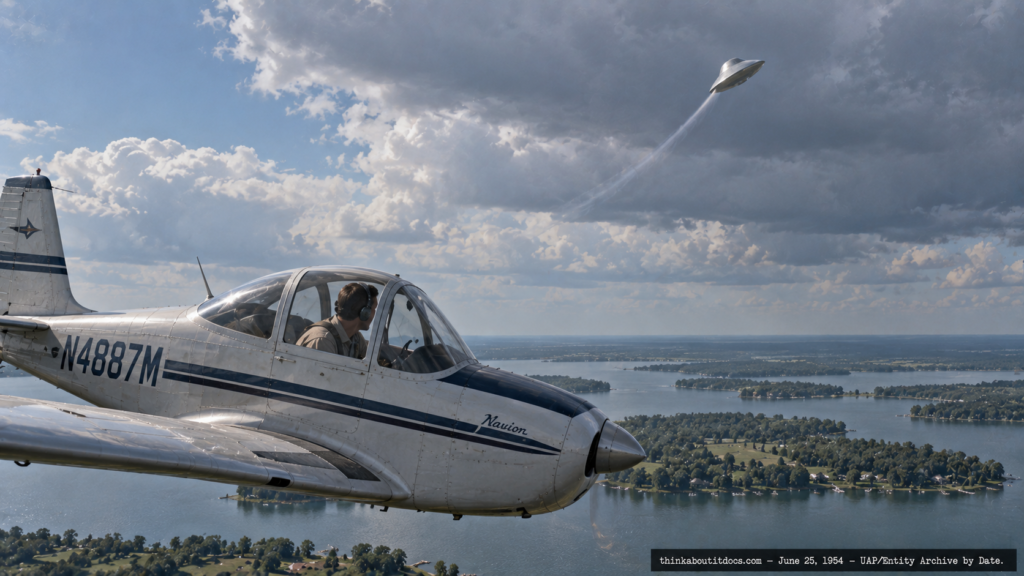
John Mark's sighting over Indian Lake, Ohio, independently confirmed by Dayton airport radar, June 25, 1954.
THINK ABOUTIT UFO|UAP SIGHTINGS REPORT
1954: The Indian Lake, Ohio Sighting — John Mark
John Mark was flying his own light plane over Indian Lake, Ohio when a silver, flat-bottomed object with a raised front edge and a cone on top blew past him going roughly ten times his own speed — then, impossibly, stopped, pulled a high-G maneuver, and shot straight up into the overcast. Dayton airport’s radar was watching the same patch of sky at the same moment, and it logged an equally impossible target: 1,980 miles an hour.
Date: June 25, 1954 BBU
Sighting Time: 5:05 p.m. (EDST)
Day/Night: Day
Location: Indian Lake, Ohio
Urban or Rural: Air
No. of Entity(‘s): 0
Entity Type: Not Applicable
Entity Description: Not Applicable
Hynek Classification: RV (Radar-Visual)
Duration: Approximately 3-5 minutes
No. of Object(s): 1
Description of the Object(s): Round, silver or aluminum-colored, with a flat bottom, a raised front edge, and an inverted cone structure on top
Shape/Size/Color of Object(s): Round with a flat bottom and raised front edge, inverted cone on top; silver/aluminum in color; approximately 40 ft in diameter
Distance to Object(s): Observed at 12,000-15,000 ft while Mark’s own aircraft flew at 6,200 ft
Height & Speed: Flew horizontally at approximately 2,000 mph before hovering, executing a high-G pull-up, and climbing steeply into cloud cover; independently tracked by ground radar at 1,980 mph in the same location
Number of Witnesses: 1 direct visual witness (John Mark, an experienced private pilot); Dayton airport radar operators independently tracking the same target
Special Features/Characteristics: The object’s visually estimated speed (approximately 2,000 mph) and the independently radar-tracked speed (1,980 mph) matched within a very small margin, despite coming from two entirely separate sources — one visual estimation from the air, one instrumented tracking from the ground; the object’s flight profile included level high-speed flight, a hovering pause, a high-G pull-up maneuver, and a steep climb into overcast cloud, a varied sequence rather than simple straight-line flight
Case Status: Officially logged by Project Blue Book (BBU); a rare case combining a credentialed visual witness with independent, closely matching ground radar confirmation of an extreme calculated speed
Source: Don Berliner
Summary/Description: At 5:05 p.m. on June 25, 1954, John Mark, an experienced private pilot flying a Navion light plane at 6,200 ft over Indian Lake, Ohio, observed a single silver or aluminum, round object with a flat bottom, raised front edge, and inverted cone on top, approximately 40 ft in diameter, at 12,000-15,000 ft. The object flew horizontally at an estimated 2,000 mph, hovered, executed a high-G pull-up, then climbed steeply into overcast cloud cover. The observation lasted approximately 3-5 minutes. Ground radar at Dayton, Ohio airport independently tracked a very fast target, 1,980 mph, at the same location during the same period.
Related Cases: None known
Detailed Report
John Mark was an experienced private pilot, flying his own Navion light plane at 6,200 feet over Indian Lake, Ohio, on the afternoon of June 25, 1954, when something appeared well above his own altitude — between 12,000 and 15,000 feet — that had no business behaving the way it did. He described a round object, silver or aluminum in color, roughly forty feet across, with a flat bottom, a raised edge along its front, and an inverted cone-shaped structure rising from its top.
What Mark watched it do next was the remarkable part. The object flew horizontally at a speed he estimated at roughly 2,000 miles per hour — a figure that, on its own, would already be extraordinary for 1954. But it didn’t simply continue in a straight line. It came to a hover, executed a maneuver Mark described as a high-G pull-up, and then climbed steeply, vanishing into overcast cloud cover. The entire sighting, from first notice to disappearance, lasted somewhere between three and five minutes.
What elevates this case above a single pilot’s extraordinary claim is what was happening on the ground at the same time: radar at Dayton, Ohio’s airport was independently tracking a very fast target in the same location. The radar-derived speed came out to 1,980 miles per hour — a figure that matches Mark’s own visual estimate of 2,000 mph closely enough to suggest both were tracking the same genuine, if unexplained, phenomenon, rather than two unrelated errors happening to land in the same rough range by chance.
RESEARCHER’S NOTES
Indian Lake — 1954 and Two Independent Numbers That Agree
- Visual and radar figures converging independently is genuinely rare: Most cases in this archive offer either a witness’s visual impression or a radar track, rarely both from separate, uncoordinated sources arriving at nearly the same number. A pilot’s on-the-spot 2,000 mph estimate landing within 1% of an independently radar-derived 1,980 mph is a strong argument against either figure being a simple guess.
- A credentialed, experienced witness: Mark’s status as an experienced private pilot means his estimate of speed and altitude comes from someone with genuine professional grounding in judging exactly those things, lending his visual estimate more weight than an untrained observer’s would carry.
- A varied flight profile, not simple straight-line motion: The object’s sequence — high-speed level flight, a hover, a high-G pull-up, a steep climb — describes controlled, deliberate maneuvering rather than a single ballistic or coasting trajectory, a detail that argues against many conventional natural or simple mechanical explanations.
- A specific, describable structure: The flat bottom, raised front edge, and inverted cone on top is a level of structural detail beyond a generic “disc” description, suggesting Mark had a clear enough view to note asymmetric features rather than a simple silhouette.
- No photograph or film despite the duration: Given the sighting’s relatively long 3-5 minute duration, the absence of any photographic documentation is a notable limitation, even accounting for the practical difficulty of photographing something from a light aircraft cockpit in real time.
This is one of the strongest speed-and-altitude cases in this archive’s record, distinguished by the close, independent agreement between a credentialed pilot’s visual estimate and separately tracked ground radar data. That convergence is the case’s real evidentiary weight — two different methods, two different observers, arriving at essentially the same extraordinary number.
“Radar at Dayton, Ohio airport, tracked a very fast target (1,980 mph) at same location.”
— Don Berliner, on John Mark’s account, June 25, 1954