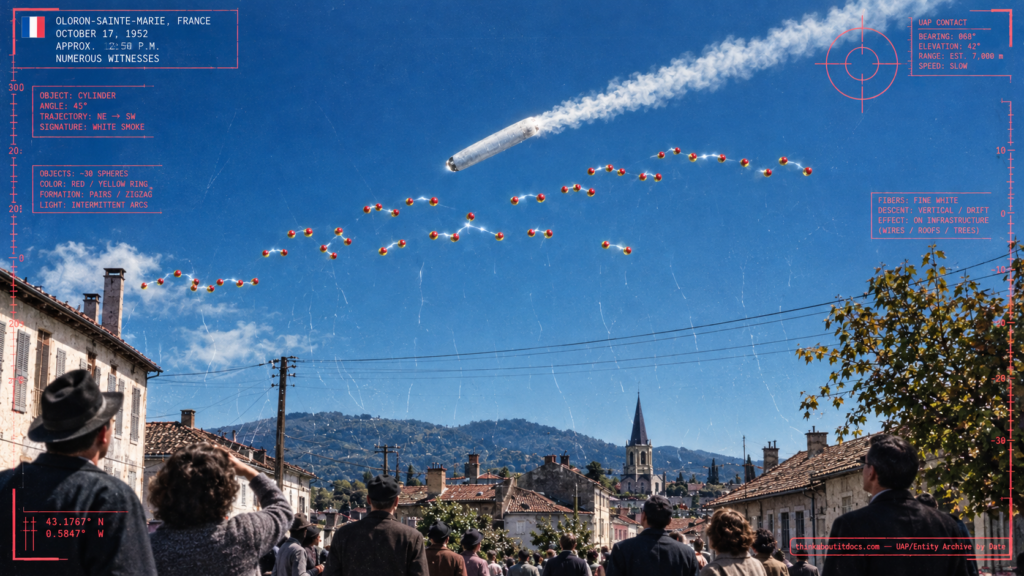
Oloron-Sainte-Marie, France, October 17, 1952 — the cylinder and spheres as described by Jean-Yves Prigent.
THINK ABOUTIT UFO|UAP ENCOUNTER REPORT
1952: The Oloron, France “Angel Hair” Case
A Cylinder, Thirty Spheres, and a Spider Explanation
Just after one o’clock on an October afternoon in Oloron-Sainte-Marie, France, school supervisor Jean-Yves Prigent watched a huge white cylinder tilt across the southwestern sky at a 45-degree angle, trailing a plume of white smoke, escorted by some thirty smaller red spheres ringed in yellow that zigzagged in pairs, crackling with a whitish arc of light whenever two of them drew apart. Behind them fell a fine, cottony, hairlike substance that draped itself over telephone wires, tree branches, and rooftops across the town.
It’s one of the most famous UFO cases to come out of the great 1952 flap, and also one of the field’s most instructive: within days, a local physician who interviewed Prigent directly offered a specific, testable natural explanation — a mass “ballooning” migration of spiders, whose windblown silk is known in French folklore by the very same name the case is remembered for: “angel hair,” or “threads of the Blessed Virgin.” That explanation doesn’t erase the sighting from the record, but it belongs at the center of how this case is told, not left out entirely.
Date: October 17, 1952 (this archive’s earlier sourcing had recorded the date as October 27, 1952 — corrected here; every independent source located confirms October 17. A related, similar phenomenon reportedly recurred in the same town around October 28, 1952.)
Sighting Time: Approximately 12:50 p.m.
Day/Night: Day
Location: Oloron-Sainte-Marie, Pyrénées-Atlantiques, France, with the same phenomenon reported across the town and in nearby villages
Urban or Rural: Mixed — the town of Oloron and surrounding rural villages
Entity Type: Not Applicable
Entity Description: Not Applicable
Hynek Classification: CE-II (Close Encounter of the Second Kind) — a physical trace (the fibrous material) was left behind and directly collected by witnesses
Duration: Over six minutes, per witness accounts
No. of Object(s): Over 30 (one large cylinder plus approximately 30 smaller spheres)
Size of Object(s): Not precisely established; Prigent himself estimated the cylinder’s altitude variously at 2,000, 3,000, or 10,000 meters across different retellings
Distance to Object(s): Not precisely established (see altitude estimate above)
Shape of Object(s): A narrow cylinder inclined at roughly 45 degrees, accompanied by numerous smaller spherical objects
Color of Object(s): The cylinder was white, trailing a plume of white smoke; the spheres were described as red, each surrounded by a yellow ring, giving them a “Saturn-like” appearance
Number of Witnesses: Numerous — Jean-Yves Prigent, his wife, and two sons, along with other residents of Oloron and nearby villages, both together and separately; at least eight witnesses are specifically documented
Special Features/Characteristics: The spheres reportedly moved in pairs along a broken, zigzagging path, with a whitish streak resembling an electric arc appearing between paired spheres as they drew apart. A fine, white, hairlike substance fell from the display and covered telephone wires, tree branches, and rooftops. When gathered into a ball, the material reportedly turned gelatinous and evaporated or vanished. One man claimed to have become briefly entangled in the material before freeing himself, after which it rose back into the air. A similar phenomenon reportedly recurred in Oloron around October 28, and a nearly identical event occurred roughly ten days later in Gaillac, France.
Case Status: Disputed. A local physician who interviewed Prigent directly, five days after the sighting, offered a specific natural explanation: a mass “ballooning” migration of spiders, a well-documented autumn phenomenon in which spiders release fine silk threads to travel on air currents. In this reading, the “zigzagging red spheres” were sunlight refracting off drifting gossamer threads, with the apparent movement partly attributable to the observer’s own motion combined with wind; the falling fiber material itself matches “angel hair” or “threads of the Blessed Virgin,” a phenomenon already named in French rural folklore before this case occurred. This explanation was debated heavily in the local and regional press through late October 1952. It does not, however, fully account for Prigent’s initial description of a large, structured cylindrical object with a smoke plume, and the collected fiber material itself dissolved before it could be subjected to full laboratory analysis — leaving the case genuinely unresolved between a natural and an anomalous reading rather than cleanly closed either way.
Source: Jean-Yves Prigent (primary witness); contemporary local physician’s letter of explanation (name not confirmed in sources located); Jean Fondin, special correspondent for a Paris children’s newspaper; France Dimanche, October 26, 1952; HowStuffWorks; Wikipedia, “Angel hair (UFO)”
Summary/Description: On the afternoon of October 17, 1952, school supervisor Jean-Yves Prigent, his family, and numerous other residents of Oloron-Sainte-Marie, France witnessed a large white cylinder tilted at roughly 45 degrees moving slowly southwest across the sky, trailing a plume of smoke, accompanied by roughly thirty smaller red spheres ringed in yellow that moved in pairs along a zigzagging path, producing an arc-like flash of light when paired spheres separated. A fine, white, cottony fiber material fell from the display over the following minutes, coating telephone wires, tree branches, and rooftops; when balled up, the material turned gelatinous and disappeared. Five days later, a local physician who interviewed Prigent proposed that the entire event was a mass migration of ballooning spiders, whose drifting silk threads — a known natural phenomenon already called “angel hair” in local folklore — could account for both the luminous, zigzagging “spheres” and the falling fiber material. The explanation was hotly debated in the regional press, and a similar event reportedly recurred in Oloron around October 28, followed by a nearly identical occurrence in Gaillac, France about ten days after the original sighting.
Related Cases: Gaillac, France (approximately ten days later, nearly identical phenomenon); Venice, Italy, October 27, 1954 (“shining spindles” trailing angel hair, witnessed by Gennaro Lucetti and Pietro Lastrucci); Évora, Portugal, November 2, 1959 (angel hair collected and microscopically analyzed by a school director and later by military and university scientists, inconclusive); a 1957 Florida fall witnessed by Craig Phillips (later director of a national aquarium), whose samples disappeared before laboratory analysis; a February 10, 1978 fiber fall near Samaru, New Zealand lasting two hours.
Detailed Report
The Oloron case is among the best-documented “angel hair” events in the UFO literature, in large part because it was investigated close to the event itself rather than reconstructed decades later. Jean Fondin’s contemporary report for a Paris children’s newspaper, based directly on Prigent’s account, preserves specific sensory detail — the cylinder’s 45-degree tilt, the smoke plume, the paired zigzagging spheres, the electric-arc-like flash between separating pairs — that gives the sighting real texture beyond a generic light-in-the-sky report.
What sets this case apart from many others in this archive, though, is that a specific, named rational explanation was offered almost immediately, by someone with direct access to the primary witness. A local physician, interviewing Prigent five days after the event, proposed that the entire display was a mass “ballooning” migration of spiders — young spiders release fine silk threads that catch the wind and carry them, sometimes over long distances, a genuine and well-studied natural behavior that occurs seasonally in autumn. Under this explanation, the “luminous, zigzagging spheres” were sunlight catching drifting gossamer threads at different angles, with apparent movement coming from a combination of wind and the observer’s own motion, and the fiber material that fell afterward was simply the spider silk itself — already known in French rural tradition, independent of this case, as “angel hair” or “fils de la Vierge” (“threads of the Virgin”).
This explanation is neither a fringe dismissal nor an obviously complete account. It fits the falling-fiber phenomenon well, and spider ballooning is real, documented, and seasonally appropriate for October in southwestern France. But it sits awkwardly with Prigent’s description of a large, structured cylindrical object with a visible smoke plume moving on a straight course — a description that doesn’t obviously reduce to drifting spider silk, however much the accompanying “spheres” might. The case’s own physical evidence never resolved the tension either way: the collected fiber material reportedly turned gelatinous and evaporated before it could undergo full laboratory analysis, a pattern that recurs across nearly every angel hair case in the historical record, including the later Venice, Évora, and Florida incidents.
RESEARCHER’S NOTES
Oloron, France — 1952 and Ufology’s Most-Cited Natural Explanation
- A date correction from this archive’s own earlier record: This page previously carried the date October 27, 1952 — likely a conflation with either the October 28 Oloron recurrence or an unrelated 1954 Venice sighting. Every independent source located confirms the primary event occurred October 17, 1952.
- A specific, near-contemporary rational explanation exists and deserves equal billing: The spider-ballooning explanation came from a physician who interviewed the primary witness directly, only five days after the event — this is a far stronger evidentiary position than most skeptical explanations offered decades after the fact, and this archive presents it as a genuine competing account, not a footnote.
- The explanation fits part of the case well and leaves another part unresolved: Spider silk plausibly explains the falling fiber material and possibly the “luminous spheres,” but does not obviously account for Prigent’s structured cylindrical object with a smoke plume — a genuine gap in the natural explanation that this archive does not paper over.
- A recurring evidentiary problem across every angel hair case: This archive’s own comparative sourcing shows the same pattern repeating in Venice (1954), Évora (1959), Florida (1957), and New Zealand (1978) — collected material that dissolves, evaporates, or vanishes before full scientific analysis, making the phenomenon as a whole difficult to settle definitively in either direction.
- A named, credentialed original witness: Prigent’s professional standing as a school supervisor, and the presence of his family and multiple independent townspeople as corroborating witnesses, sets this case apart from many single, anonymous-witness reports elsewhere in the 1952 record.
More than seventy years later, Oloron remains ufology’s textbook case for how a natural phenomenon and an anomalous one can occupy the same afternoon sky without either explanation ever fully closing the account — a physician’s spiders drifting on the autumn wind, and a school supervisor’s cylinder tilted at forty-five degrees, both still on the record, neither one erased by the other.
“A sort of plume of white smoke was escaping from its upper end.”
— Jean-Yves Prigent, describing the object over Oloron, France, October 17, 1952