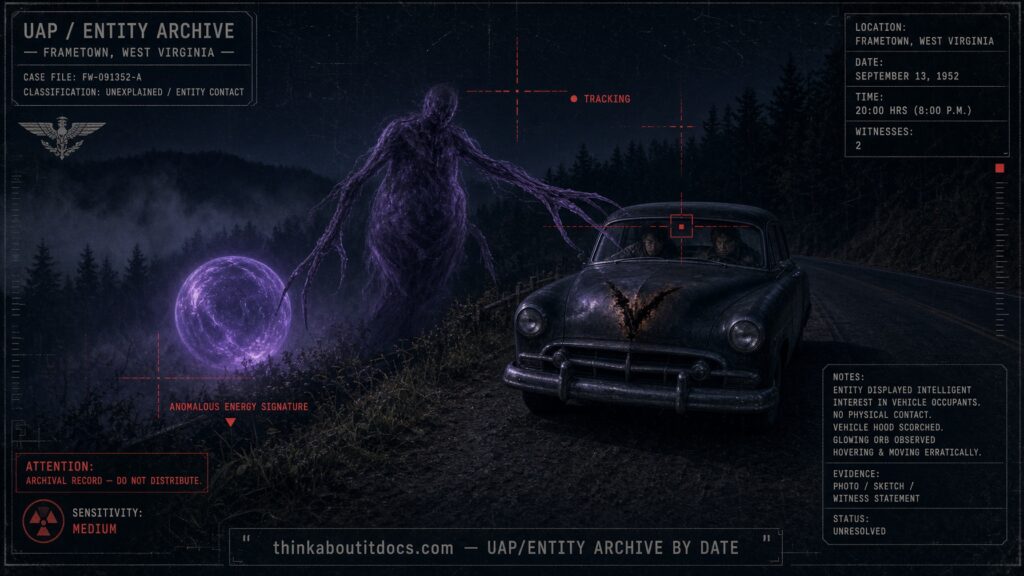
Frametown, West Virginia, September 13, 1952 — the Snitowski family's roadside encounter.
THINK ABOUTIT UFO|UAP & ENTITY ENCOUNTER REPORT
1952: The Frametown, West Virginia Encounter — The Day After Flatwoods
One night after a much stranger creature terrorized three boys in nearby Flatwoods, West Virginia, George Snitowski’s car stalled dead on a rural highway near Frametown — and as he searched the roadside for the source of a sulfurous smell, his wife’s screams turned him around to face an eight-foot figure with a bloated body and long, spindly, forked arms gliding straight toward their car.
The Frametown case has lived for decades in the shadow of its far more famous neighbor, the Flatwoods Monster, which unfolded just one county over and barely twenty-four hours earlier. But where Flatwoods is often remembered as folklore filtered through decades of retelling, Frametown carries its own distinct, tightly specific details — a soft violet glow, a stalled engine, a “sensation of thousands of needle-like vibrations,” and a V-shaped burn scorched into the hood of the family’s car, found afterward by a gas station attendant who had no reason to invent it.
Date: September 13, 1952
Sighting Time: 2000 (8:00 p.m.)
Day/Night: Night
Location: Frametown, West Virginia
Urban or Rural: Rural
No. of Entity(‘s): 1
Entity Type: Large humanoid
Entity Description: Roughly 8 to 9 feet tall, with a large head, bloated body, and long, spindly arms; one arm, stretched across the family’s windshield, ended in a forked tip
Hynek Classification: CE-III (Close Encounter of the Third Kind) — close observation with an animate being associated with the object
Duration: Not precisely recorded; the encounter unfolded over several distinct phases — the stall, George’s investigation, the entity’s approach, and the family’s wait inside the locked car until the globe’s departure
No. of Object(s): 1
Size of Object(s): A large globe; specific dimensions not recorded
Distance to Object(s): Not precisely recorded; George approached it directly on foot down the highway slope before retreating
Shape of Object(s): A large globe
Color of Object(s): A soft violet glow
Number of Witnesses: 2 (George and Edith Snitowski); their daughter was also present in the car
Special Features/Characteristics: The family’s car stalled without warning, and an unpleasant odor resembling ether mixed with sulfurous smoke filled the air. George, thinking a chemical plant might be burning, got out to investigate and saw a large globe hovering and swaying gently over the ground down the slope of the highway, glowing violet. Approaching it, he felt a “sensation of thousands of needle-like vibrations” on his skin and became ill, staggering back toward the car. As he returned, his wife Edith screamed that something was behind him; George turned to see an 8-to-9-foot figure with a bloated body and long spindly arms gliding rapidly toward him. The couple got inside and locked the car; one of the entity’s arms, ending in a forked tip, stretched across the windshield before the figure retreated and glided away. The glowing globe then rose above the trees and departed, leaving a luminous trail. A gas station attendant afterward found a V-shaped, burned brown mark on the car’s hood.
Case Status: Insufficient Data — a single-family account with a described physical trace (the burn mark) that was reportedly observed by a third-party gas station attendant, though that observation is not independently documented beyond the secondary sources citing it; no official investigation record has been located
Source: Paul Lieb; Jacques Vallée and Mark A. Hall
Summary/Description: On the evening of September 13, 1952 — the day after the famous Flatwoods Monster encounter in a neighboring West Virginia county — Mr. and Mrs. George Snitowski were driving with their young daughter near Frametown when their car suddenly stalled and an unpleasant sulfurous, ether-like smell filled the air. Thinking a nearby chemical plant might be on fire, George got out and, looking down the highway slope, saw a large globe hovering and swaying, glowing soft violet. Approaching it, he felt a strange vibrating sensation across his skin and became nauseated, turning back toward the car. His wife Edith then screamed that something was behind him; George turned to see an 8-to-9-foot humanoid figure with a bloated body and long, spindly, forked-tipped arms gliding rapidly toward him. The family scrambled into the car and locked the doors as one of the entity’s arms stretched across the windshield. The figure then retreated and glided away, and shortly after, the glowing violet globe lifted above the treeline and departed, leaving a luminous trail behind it. A gas station attendant later discovered a V-shaped, burned brown spot on the hood of the family’s car.
Related Cases: The Flatwoods Monster (Braxton County, West Virginia, September 12, 1952) — occurring one day earlier in a neighboring county, sharing several structural elements (a strange smell, a glowing object, a tall entity, physical after-effects on witnesses) though the entity descriptions differ significantly between the two cases.
Detailed Report
The Frametown case unfolds in the immediate wake of one of American ufology’s most famous entity encounters, and the timing invites an obvious question this archive does not attempt to resolve: whether the two cases are genuinely independent, whether one influenced how the other was told, or whether both simply reflect a regional flap already underway in West Virginia that September. What can be said is that the two accounts, despite their proximity in time and place, describe meaningfully different entities — the Flatwoods being is generally described with a distinctive spade-shaped or heart-shaped head and a floating, skirted lower body, while the Frametown figure is described in simpler terms: tall, bloated, spindly-armed, with a forked hand, and no equivalent head or clothing detail preserved.
The Snitowski account carries a level of physical progression — stall, smell, investigation, illness, entity approach, retreat to the car, windshield contact, departure — that gives it real narrative structure rather than reading as a single frozen image. The “needle-like vibrations” sensation George reported upon nearing the glowing globe is a specific and somewhat unusual physiological detail, distinct from the more commonly reported heat, static electricity, or simple fear found in other close-encounter accounts of the era.
The case’s clearest piece of potential physical evidence — the V-shaped burn mark on the car’s hood — is reported through a third party, a gas station attendant, rather than documented directly by an investigator at the time. This archive has not located an independent account from the attendant himself, nor any photograph or physical retention of the marked hood panel; the detail survives only as it was passed down through the Lieb, Vallée, and Hall sourcing.
RESEARCHER’S NOTES
Frametown, West Virginia — 1952, and Life in Flatwoods’ Shadow
- Genuinely distinct entity descriptions: Despite occurring a day apart and one county over from Flatwoods, the Frametown entity is described in different, non-overlapping terms — this argues against the two cases simply being garbled retellings of the same event, though it doesn’t rule out a shared regional atmosphere of heightened reporting.
- A specific, unusual physiological detail: The “thousands of needle-like vibrations” sensation is precise enough to stand out from more generic fear-and-heat descriptions common to the genre, and is worth weighing as a potentially genuine idiosyncratic memory rather than a borrowed narrative element.
- Third-party physical evidence, not independently verified: The burned hood mark is the case’s strongest potential physical corroboration, but it reaches this archive only through secondhand sourcing, with no independent confirmation from the attendant or any surviving photograph located.
- A case that lives in a bigger case’s shadow: Frametown’s proximity to Flatwoods, both in time and in the literature, means it is rarely examined on its own terms — this archive treats it as a distinct case worth its own record rather than a footnote to its more famous neighbor.
More than seventy years after that September night, Frametown remains what it has mostly been treated as ever since: the case that happened the day after the famous one, in the next county over — worth remembering, on its own specific and oddly precise terms, rather than only as an echo.
“A figure about eight or nine feet tall, with a big head, bloated body, and long, spindly arms, gliding rapidly.”
— George Snitowski’s account, Frametown, West Virginia, September 13, 1952