Osceola, Wisconsin, July 29, 1952: an hour of unidentified radar targets.
THINK ABOUTIT UFO|UAP SIGHTINGS REPORT
Osceola, Wisconsin Radar-Visual Targets:
One Hour of Unidentified Returns and an F-51 Scramble, July 29, 1952
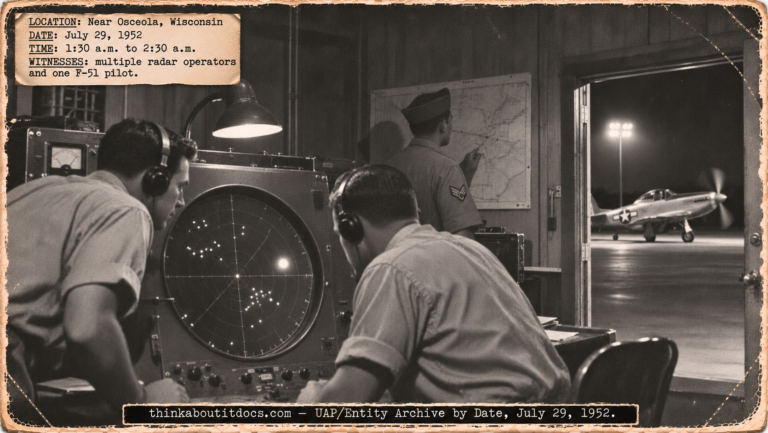
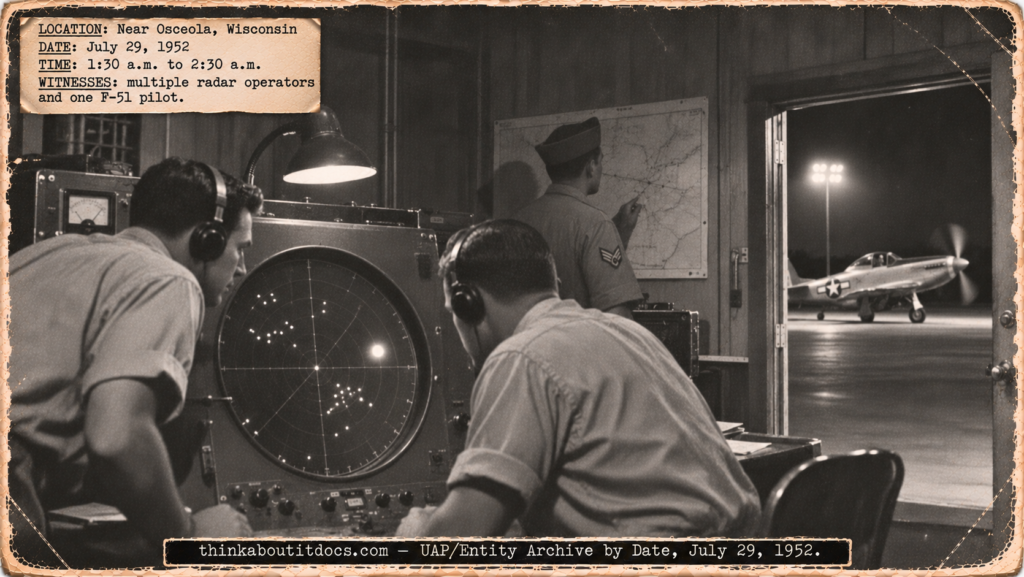
At 1:30 a.m. on July 29, 1952, a radar unit near Osceola, Wisconsin began painting targets that appeared out of nowhere southwest of the station, crossed the scope at 50 to 60 knots in loose clusters of up to ten, and vanished 30 to 70 nautical miles later. Among them ran one large, sharply defined target clocked at 600 knots. A Ground Observer Corps report of unidentified flying objects sent an F-51 Mustang up to investigate, and the pilot reported seeing unidentified objects he could not intercept. For an hour the radar room watched what the Air Force logged as a UFO sighting.
The Osceola radar-visual case landed in the middle of the Washington flap, two days after the capital’s second radar weekend and on the day of the Air Force’s largest press conference since World War II. Project Blue Book carries its conclusion as Unknown, with an Air Technical Intelligence Center comment that anomalous propagation was affecting the radar and that “a firm analysis cannot be made.” The file also holds a later ATIC comment arguing the returns were ground clutter. Both positions are laid out below.
Date: July 29, 1952
Sighting Time: 1:30 a.m. to 2:30 a.m. local time (0130 to 0230 hours)
Day/Night: Night
Location: Near Osceola, Wisconsin, United States
Urban or Rural: Rural
No. of Entity(‘s): Not Applicable
Entity Type: Not Applicable
Entity Description: Not Applicable
Hynek Classification: Radar-Visual (RV)
Duration: About 1 hour (radar tracking); the F-51 pilot’s visual observation took place within the same hour
No. of Object(s): Numerous radar targets: individual sightings of multiple targets, up to ten in a loose cluster, plus one large target; the pilot saw unidentified objects visually (number not recorded)
Description of the Object(s): Radar returns of normal size, with one large, well-defined target. All targets appeared suddenly on the scope southwest of the station, traveled across it and disappeared just as suddenly. They did not show on the height indicator. The pilot reported visually sighting unidentified flying objects.
Shape/Size/Color of Object(s): Undetermined; the report describes the objects as “of undetermined size or shape”
Distance to Object(s): Targets traveled 30 to 70 nautical miles across the scope (50-nautical-mile range setting) before disappearing; the F-51 operated 50 to 70 nautical miles south and south-southwest of a reference point in the case file
Height & Speed: Large target: 600 knots (about 700 mph) as computed on the scope. Small-target clusters: 50 to 60 knots (60 to 70 mph). Height: not shown on the height indicator; the pilot estimated the objects he saw at 125,000 feet
Number of Witnesses: Multiple radar operators on duty, one F-51 pilot and a Ground Observer Corps report; exact number not stated
Special Features/Characteristics: Simultaneous radar and airborne visual observation in the same area; scope photographs reviewed by an electronic expert; targets appeared and vanished without crossing a fixed track; anomalous propagation noted by ATIC
Case Status: Project Blue Book: Unknown. ATIC comments (see Researcher’s Notes) favor ground clutter and anomalous propagation but state that a firm analysis cannot be made.
Source: Project Blue Book case file and record card (Osceola, Wisconsin, July 29, 1952); ATIC comments; photograph file 1731 (11 photographs, July 29, 1952); Berliner (BBU 1731)
Summary/Description: Radar operators near Osceola tracked numerous unidentified targets for one hour. An F-51 scrambled on a Ground Observer Corps report. The pilot saw unidentified objects but could not intercept them. Blue Book conclusion: Unknown.
Related Cases: Osceola, Wisconsin radar cases of July 13, July 25 and July 28, 1952; the Washington National Airport radar weekends of July 19-20 and July 26-27, 1952; the Langley AFB radar-visual case of July 29, 1952
Detailed Report
The Air Force case summary dated July 29, 1952 opens with a plain statement: numerous unidentified flying objects of undetermined size or shape were sighted by ground electronic means between 0130 and 0230 hours by members of a radar unit located near Osceola, Wisconsin, who were on duty. The returns were of normal size, with one exception, a large, well-defined target whose speed was computed on the scope, set to the 50-nautical-mile range, at 600 knots.
The remaining sightings were individual, each consisting of multiple targets, up to ten, in a loose cluster. Those targets moved at 50 to 60 knots by the same scope calculation. The summary records that the only possible formation seen during the whole hour came during one or two of the multi-target sightings, when two or three targets might have been moving in a loose formation.
The targets followed a consistent pattern. All of them suddenly appeared on the scope southwest of the station, crossed it and, after traveling between thirty and seventy nautical miles, just as suddenly disappeared. Patterns overlapped continually. Within the multi-target sightings, the targets progressed independently of each other in track and heading, with some making a turn. None showed on the height indicator. The summary attributes that to anomalous propagation.
A visual sighting ran alongside the radar. A Ground Observer Corps report of unidentified flying objects led the unit to send up one F-51 aircraft to intercept or identify the unknown targets. The pilot reported seeing unidentified flying objects, but interception and identification were not possible. The case file states there was some correlation between the electronic and visual sightings, which placed both in the same area at the same time. The pilot’s estimate of the height of the objects he saw was 125,000 feet. The case file places an F-51 in an area 50 to 70 nautical miles south and south-southwest of the reference point at altitudes between 6,000 and 10,000 feet during the sighting period. The record card carries a separate line saying the objects were observed from 25,000 feet.
The card notes that scope photographs were reviewed by an electronic expert. A photograph file for the date (file 1731, 11 photographs) is part of the Blue Book holdings. The conclusion on the case summary reads Unknown.
RESEARCHER’S NOTES
What the Air Force Said About the Osceola Returns
- Anomalous propagation: The first ATIC comment says the radar was affected by anomalous propagation, a condition that lets the set detect ground targets it normally would not. It adds that this would not explain the movement of the targets unless weather conditions made every ground target fail to paint on each antenna sweep, producing apparent motion in stationary returns.
- The ground-clutter argument: A later ATIC comment, written on a routing sheet in the case file, argues that the returns were most likely individual stationary ground targets painting at a random rate under temperature inversion or moisture lapse conditions, and that such paints can produce apparent speeds from zero to several thousand miles per hour. The same comment states it believes no connection exists between the visual and radar sightings.
- The open question: ATIC wrote that “a firm analysis cannot be made” and that temperature-versus-height and moisture-lapse-versus-height data would help. The Blue Book conclusion stayed Unknown. The file does not contain that weather data.
- The visual sighting: The F-51 pilot reported seeing unidentified objects and could not close with them. The case summary records some correlation between the visual and radar positions. ATIC’s later comment disputes that link. The file does not give the pilot’s name.
- Altitude figures do not agree: The pilot’s 125,000-foot estimate, the card’s “observed from 25,000 feet” line and the F-51’s recorded 6,000 to 10,000 feet cannot all describe the same geometry. The scan quality of the card leaves the 25,000-foot line open to a second reading.
- Cluster behavior: Targets that appear suddenly, travel 30 to 70 nautical miles on independent headings and vanish are the pattern ATIC attributes to ground-return fading.
The Osceola case shows both sides of the 1952 radar record in one file. The unit saw an hour of moving returns, an interceptor went up, and a pilot reported objects he could not catch. The Air Force’s own analysts then said the radar was misbehaving and, later, that the returns were probably ground clutter, while leaving the conclusion Unknown because the data to settle it was never collected. It stands as an unresolved radar-visual report rather than a proven anomaly.
“All targets suddenly appeared on the radar scope and after having traveled between thirty and seventy nautical miles would just as suddenly disappear.”
— Air Force case summary, Osceola, Wisconsin, July 29, 1952