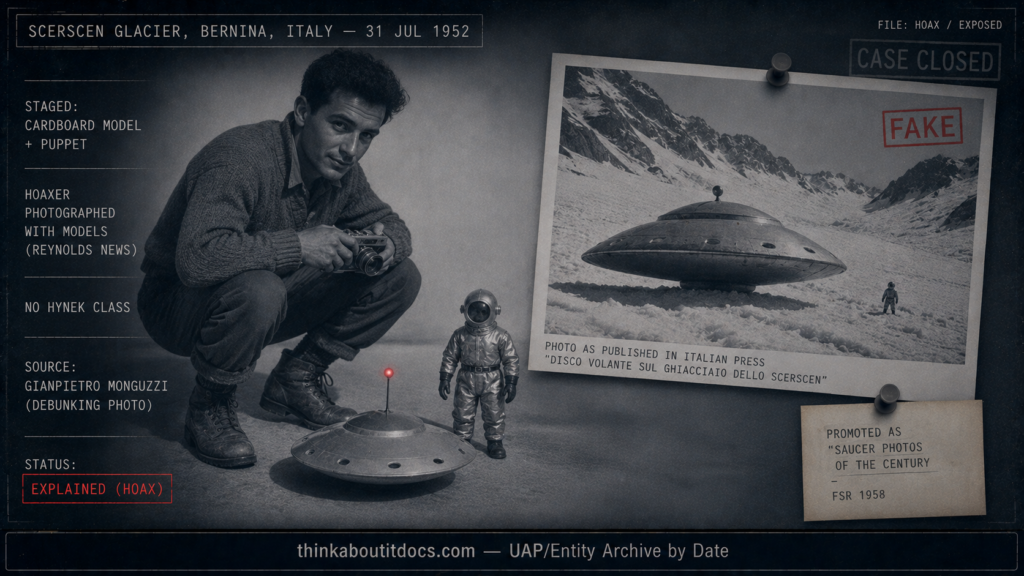
The 1952 Bernina "saucer photos of the century" by Gianpietro Monguzzi — exposed as a hoax made with a cardboard model and a puppet, with press photos showing him posing alongside the models. Logged Explained (hoax). (thinkaboutitdocs.com — UAP/Entity Archive by Date)
THINK ABOUTIT UFO|UAP|ENTITY SIGHTINGS REPORT
1952: The Monguzzi “Saucer” Photographs, Bernina / Scerscen Glacier, Italy
DOCUMENTED HOAX.
The photographs were staged with a tabletop model and a puppet; press photos later showed the hoaxer, Gianpietro Monguzzi, posing with his camera and the models.
No Hynek classification applies.
Case Status: Explained (hoax).
For a few years in the 1950s these were promoted as “the saucer photos of the century”: a series of crisp images, taken on a glacier high in the Bernina Alps, showing a lens-shaped disc resting on the snow and a figure in a shiny diving suit walking around it. The photographer, a young Italian engineer named Gianpietro Monguzzi, said he and his wife had stumbled on a landed craft and its occupant on July 31, 1952. The pictures circulated through the European press and were still being championed in Flying Saucer Review as late as 1958. They are fakes. Italian investigators established that the “saucer” was a small cardboard model and the “spaceman” a puppet, staged on the snow and photographed close-up to look full-size; press photographs later surfaced showing Monguzzi himself holding his camera alongside the little models. The archive keeps the entry as a documented hoax, describes the famous images for the record, and labels it plainly so it can never again be passed off as evidence.
Date: July 31, 1952 (photos withheld and published roughly two months later)
Sighting Time: About 0925 (as claimed)
Day/Night: Day
Location: Scerscen glacier, Bernina massif, province of Sondrio, Lombardy, Italy (the Bernina range straddles the Italy–Switzerland border)
Urban or Rural: Rural (high alpine glacier)
No. of Entity(‘s): 1 as claimed (a figure in a “diving suit”) — in fact a puppet/model
Entity Type: Staged prop — a small figure made to look like a suited humanoid
Entity Description: As claimed: a human-shaped figure in a metallic “diver’s suit” that “almost looked hairy,” carrying something like a flashlight, walking around and circling the craft. Actually a puppet photographed close-up
Hynek Classification: None — documented hoaxes carry no Hynek classification (the prior “CE-III” has been removed)
Duration: Not applicable (a staged photo series)
No. of Object(s): 1 as claimed (a “gigantic” lens-shaped disc) — in fact a cardboard/tabletop model
Description of the Object(s): As claimed: a gigantic lens- or saucer-shaped craft on the ice, with a red antenna on top, portholes around the upper half, and a section of the surface that rotated as it rose “like an elevator.” Actually a small model saucer staged on the snow
Shape of Object(s): Lens / saucer-shaped, with a top antenna (as modeled)
Size of Object(s): Claimed “gigantic”; in reality a tabletop-scale model
Color of Object(s): Metallic (as modeled)
Distance to Object(s): Claimed about 200 meters; in reality a few feet from the camera
Height & Speed: Claimed to rise silently “like an elevator” and depart at great speed — staged in the photos
Number of Witnesses: 2 claimed (Monguzzi and his wife, Pinuccia Radaelli); the hoax also implicated accomplices (see Researcher’s Notes)
Special Features/Characteristics: Claimed “absolute silence” in which the couple’s voices became inaudible before the object appeared; a red antenna; rotating surface; portholes; no trace left on the ice. All features of a staged photo story; the absence of any ground trace is consistent with there having been no full-size craft
Case Status: Explained (hoax)
Source: Photographs by Gianpietro (Giampiero) Monguzzi, an engineer at the Edison company, Monza; promoted in the Italian/European press (La Tribuna Illustrata, Nov 1952) and later in Flying Saucer Review (Sept–Oct 1958, Lou Zinsstag). Exposed via press photographs of Monguzzi with his camera and the models, published in Reynolds News (UK), preserved by Murray Bott and passed to researcher Loren Gross; Italian investigation identified the model-and-puppet method and the accomplices
Summary/Description: On July 31, 1952, Italian engineer Gianpietro Monguzzi claimed that he and his wife, on the Scerscen glacier in the Bernina Alps, experienced a sudden total silence and saw a gigantic lens-shaped craft land on the ice, from which a figure in a metallic “diving suit” emerged and circled it before the craft rose silently and departed, leaving no trace. He produced seven photographs. The images were later shown to be a hoax made with a small cardboard model saucer and a puppet, with press photos surfacing of Monguzzi posing with his camera and the models. The case is logged as Explained (hoax), and carries no Hynek classification.
Related Cases: the broader corpus of 1950s faked “saucer” photographs (e.g., the model-and-string hoaxes of the era) | 1950: McMinnville, Oregon UFO Photographs (a still-debated photographic case, for contrast) | other documented photographic hoaxes in the archive
DETAILED REPORT
The story Monguzzi told is, as a narrative, a complete close encounter. He was an engineer for the Edison company, twenty-nine years old, living near Milan. On the morning of July 31, 1952, he said, he and his wife, Pinuccia Radaelli, were on the Scerscen glacier in the Bernina massif when a freezing breeze rose with a sound like a ship’s rigging, and then an “absolute silence” fell — so complete that when he shouted to his wife she could not hear him, and he could see her mouth move with no voice coming out. Then, about 200 meters off, a gigantic lens-shaped object settled onto the ice. It had a red antenna on top. A figure in a metallic “diving suit,” which “almost looked hairy” and carried something like a flashlight, climbed out and walked around the craft as if inspecting it. Monguzzi photographed the object and the figure. The being went back behind the disc; part of the surface began to rotate; the craft rose “like an elevator,” showing a row of portholes around its upper half, and departed. The silence lifted. No trace was left on the ice. He came away with seven photographs.
The pictures are genuinely striking, which is why they traveled. They were published in the Italian and European illustrated press from late 1952, and as late as 1958 the Flying Saucer Review ran them under the headline “Monguzzi Takes Saucer Photos of the Century,” written by the credulous saucer enthusiast Lou Zinsstag. For a time they were among the more famous occupant photographs in circulation.
They are fakes, and the demonstration is clean. Italian investigators established that the “saucer” was a small cardboard model and the figure a puppet, staged on the snow and shot close-up so that the tabletop scene read as a full-size craft at distance — a standard model-photography hoax of the period. The decisive material is photographic in its own right: pictures surfaced, published in the British paper Reynolds News, showing Monguzzi himself holding his camera together with the small models used to make the “saucer photos.” Those debunking images were preserved by the researcher Murray Bott and passed to the UFO historian Loren Gross, through whom they entered the documentary record. When the hoaxer is photographed posing with his props, the case does not require further argument.
The internal details, read back through the hoax, line up with a staged shoot rather than an event. A “gigantic” craft that leaves no trace on a glacier is exactly what a tabletop model produces. The cinematic touches — the rigging-like sound, the total silence, the elevator-smooth ascent, the conveniently photogenic “spaceman” circling the disc — are the embellishments of a story built around pictures, not the fragmentary, awkward details typical of real surprise sightings. Even the claimed two-month delay before publication, which Monguzzi attributed to fear, fits the time needed to develop, select, and shop a photo set; he reportedly showed the images to friends and his manager and sought to sell them, and they were placed with the press for payment.
One romantic counter-story deserves a brief, firm answer, because it still circulates. A minority of Italian writers have suggested that Monguzzi might really have photographed a secret military prototype and then been pressured to pose as a hoaxer to discredit himself — the Cold War “forced to recant” theory. There is no need for it and no evidence for it. The Reynolds News photographs show him with the actual models; a man does not need to be coerced into faking pictures he is documented making. The cover-up version is itself a small illustration of how the record gets muddied in both directions: just as fabricated cases can be dressed up as real, an exposed fabrication can be re-spun as a suppressed truth. The archive resists both. The models are in the frame; the case is closed.
RESEARCHER’S NOTES
The Monguzzi Photos — Bernina 1952 and a Hoax Caught in the Act
- Classification, why none applies: Under the archive’s standard, a documented hoax carries no Hynek classification, and the prior “CE-III” has been removed. CE-III denotes a real close observation of beings associated with a craft; here there were no beings and no craft, only a model and a puppet. Assigning a close-encounter class to a known fabrication would lend it exactly the apparent legitimacy the rebuild is meant to strip away. The case is filed by status — Explained (hoax) — not by encounter type.
- The evidence chain that closes it: Two independent strands converge. First, Italian investigation identified the method (a cardboard model saucer and a puppet figure) and, in the Italian-language record, named accomplices — Monguzzi’s cousins Mario and Alfredo Gaiani, with help from a Scerscen mountain guide — indicating a planned production rather than a lone impulse. Second, and decisively, the Reynolds News photographs show Monguzzi posing with his camera and the models themselves; those images were preserved by Murray Bott and conveyed to Loren Gross. Method plus a picture of the hoaxer with his props is as conclusive as photographic-hoax debunking gets.
- Why it traveled, and why that matters: The Monguzzi set spread because the images were technically good and the story was vivid, and because at least one influential outlet — Flying Saucer Review in 1958, via Lou Zinsstag — promoted them uncritically as historic proof. This is the mechanism by which a single fabrication can do lasting damage: presented well and endorsed by a recognized venue, it gets recopied for decades and lends false weight to “occupant photograph” claims generally. Labeling it plainly as a hoax is not hostility to the subject; it is what protects the genuinely unresolved photographic cases from being lumped in with a known fake.
- The “forced to recant” cover-up theory, dismissed: The competing claim that Monguzzi photographed a real secret craft and was made to pose as a faker is unsupported and unnecessary. The debunking photographs show him with the models he used; no coercion is required to explain a man holding the props of his own hoax. The cover-up reading is a cautionary example of the opposite failure mode to the one the archive usually guards against — not laundering a fake into a sighting, but laundering an exposed fake back into a “suppressed truth.” Both are forms of poisoning the record, and the discipline is the same: follow the physical evidence, which here is unambiguous.
 The Monguzzi photographs earn their place in the archive precisely as a documented hoax — one of the cleaner ones, because the hoaxer was himself photographed with his models.
They are kept and described so the record is complete and so the images, which still surface in documentaries and online, are anchored to the truth about them.
Stripped of any Hynek classification, labeled Explained (hoax), and walled off from both credulous promotion and the romantic cover-up myth, the Bernina “saucer photos of the century” stand as what they are: a tabletop model, a puppet, and a young engineer caught holding the evidence.