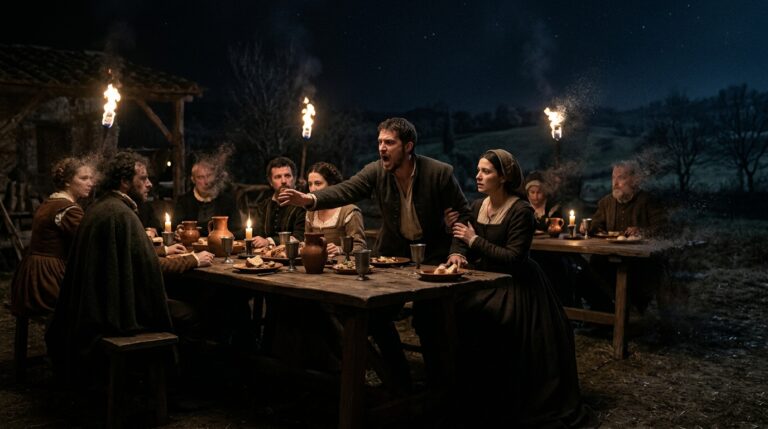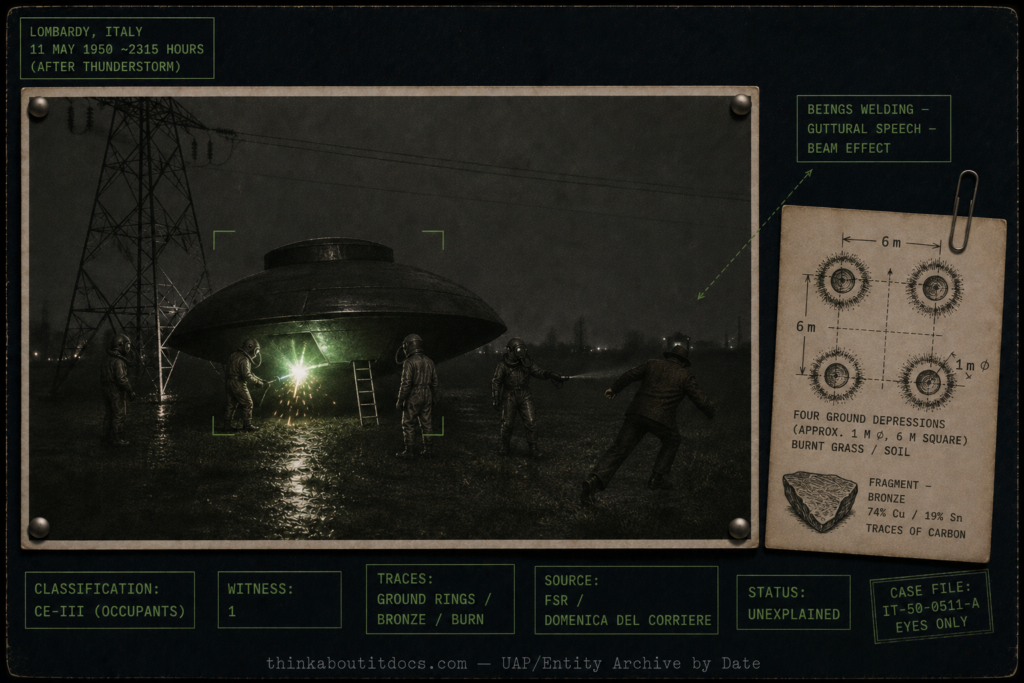
The Bruno Facchini encounter, Abbiate Guazzone near Varese, Italy, April 24, 1950 — a landed craft, helmeted occupants welding under a green light, and a beam that knocked the witness down; classified CE-III, status Unexplained.
THINK ABOUTIT UFO | UAP | ENTITY ENCOUNTER REPORT
1950: The Bruno Facchini Encounter — Abbiate Guazzone (Varese), Italy
A violent thunderstorm had just rolled off the Lombardy plain on the night of April 24, 1950, when a metalworker named Bruno Facchini stepped out of his house near the village of Abbiate Guazzone and saw flashes pulsing in a field by a power-line pole. He went to investigate, afraid a downed cable might endanger his children — and instead found a large dark craft, shaped like a ball flattened on top, resting beside the pylon with a ladder down and a green welding-light flaring as helmeted, heavily suited figures worked on it. He thought, at first, that they were American pilots repairing a downed experimental plane, and walked up to offer help. Only when they answered him in guttural sounds and the machine began to come alive did he understand what he was looking at. He ran. One of the figures raised a tube and a beam knocked him flat. By morning there were four scorched rings pressed into the field, burnt grass, and scattered fragments of metal — and Facchini had a mark on his back that would spread and ache for a month. He never recanted, never profited, and told the same story without variation for the rest of his life. It remains one of the classic unexplained close encounters in the European record.
Date: April 24, 1950
Sighting Time: Approximately 22:00 (10:00 p.m.)
Day/Night: Night (immediately following a violent thunderstorm)
Location: Abbiate Guazzone (frazione of Tradate), Province of Varese, Lombardy, Italy
Urban or Rural: Rural — an open field beside a high-voltage power-line pole, on the edge of the village
No. of Entity(‘s): 4
Entity Type: Humanoid
Entity Description: Human-sized, about 1.70 m tall, in heavy one-piece coveralls resembling diving suits, with helmets and masks; from each mask a flexible tube of roughly 30 cm hung like a breathing hose. Their faces were concealed. They moved slowly and stiffly, as though the suits were heavy, and communicated among themselves and toward the witness in guttural, unintelligible sounds (“gurr… gurr…”). One directed a hand-held tube or apparatus at the fleeing witness, emitting a beam that knocked him to the ground.
Hynek Classification: CE-III (occupants observed) — with CE-II physical traces (ground rings, burnt grass, recovered fragments) and a documented physiological effect on the witness
Duration: Several minutes
No. of Object(s): 1
Description of Object(s): A large dark craft “like a ball flattened from above,” resting beside the pylon. A ladder descended from beneath it, lit by a greenish glow; an open door/vent revealed an interior with a second internal ladder leading to an upper level and walls lined with connected bottles or cylinders, gauges, and tubes. A constant buzzing “like a giant beehive” or a large power generator accompanied it. The air nearby was unusually warm. It departed by moving off sideways, then climbing and accelerating out of sight.
Shape: Round / domed disc — a flattened sphere
Size: Estimated ~10 m wide and ~7 m high
Color: Dark body, with a greenish welding/interior glow; metallic reflections caught in the welding light
Distance: First seen ~180–200 m away; the witness approached to within about 4–5 m
Height & Speed: Landed (on the ground); departed sideways then climbed and accelerated away
No. of Witnesses: 1 for the encounter — Bruno Facchini, metalworker, early 40s (the ground traces and fragments were later observed by police)
Special Features/Characteristics: Beings apparently welding/repairing the craft; greenish welding light; guttural language; an apparent gestured “invitation” aboard; a beam from a hand-held device that knocked the witness down and left a spreading burn; four circular ground depressions ~1 m across in a square pattern ~6 m on a side; burnt grass; recovered metal fragments later analyzed as ordinary bronze
Case Status: Unexplained
Source: Contemporaneous Italian press (La Domenica del Corriere, 1952); Antonio Giudici, Flying Saucer Review vol. 20 no. 6 (1974); Ezio Bernardini, Flying Saucer Review vol. 32 no. 4 (1987); Jacques Vallée, Magonia catalogue entry #78; metallurgical analyses by the Istituto di Ricerche per lo Studio dei Metalli, Novara, and by Renato Vesco (1951); later treatment in Timothy Good, Alien Base (1998)
Summary/Description: After a severe thunderstorm on the night of April 24, 1950, Bruno Facchini left his house in Abbiate Guazzone, near Varese, and noticed flashing lights in an adjacent field by a power-line pole. Believing a cable might have fallen, he went to investigate and found a large dark, flattened-spherical craft on the ground, a ladder beneath it, and helmeted figures in heavy suits working on it under a greenish welding light. Taking them for pilots repairing a downed aircraft, he approached within a few meters and offered help. They answered in guttural sounds and gestured at him; as the craft powered up he realized they were not human and fled. One being aimed a tube that emitted a beam, striking him in the back and throwing him to the ground, where he struck his head on a stone. He remained conscious and watched the craft withdraw its ladder, close, and depart with a heavy buzzing. The next day he found four circular depressions, burnt grass, and metal fragments; police viewed the traces, and the fragments were submitted for analysis. A physician later documented a burn on his back that spread and pained him for a month.
Related Cases: 1954 — Quarouble, France (Marius Dewilde — lone blue-collar witness, landed object, beam/paralysis, ground traces) | 1954 — the European humanoid wave and its “occupants working beside a grounded craft” motif | 1961 — Eagle River, Wisconsin (Joe Simonton — lone witness, beings inside a landed craft)
Detailed Report
The Facchini encounter is unusual in the early record for combining a detailed occupant sighting with a physical aftermath that other people examined, and for a witness whose account survived more than three decades of re-interviewing without drift.
The setting was mundane. A thunderstorm had just passed; Facchini, a metalworker living in a colonial-style house on the edge of Abbiate Guazzone, went outside and saw flashes in the field near a high-voltage pylon. His first thought was practical and protective — a fallen cable that might electrocute one of his children at play the next day — so he walked a path along the edge of a nearby furnace yard toward the light. At a distance he made out a huge dark shape “like a ball with a flattened top,” which he put at roughly ten meters across and seven high, standing beside the pole.
A ladder hung beneath it, lit green, and a standing figure with what looked like a lamp appeared to be welding. The figure wore something like a diver’s suit and a mask. Drawing closer, Facchini saw two more similarly dressed figures moving slowly around the craft, their movements hampered, he assumed, by the weight of their suits. Through an open vent he could see into the craft: a second internal ladder, rows of connected cylinders or bottles, gauges, and tubes. The air was warm and a constant buzz, like an enormous beehive, hung over the scene. Reasonably, he concluded this was a downed experimental aircraft — perhaps American, given the U.S. air presence then in the region — and he approached within four or five meters and called out an offer to help.
The answer changed everything. The beings replied only in guttural, meaningless sounds and made gestures he read as an invitation to come aboard. As the craft began to power up, the realization that these were not pilots and not human broke over him, and he turned and ran. Glancing back, he saw one figure raise a hand-held device; a beam struck him in the back with enough force to throw him down, and his head hit a stone. Conscious but hurt, he stayed on the ground and watched the beings finish, draw up the ladder, close the craft, and depart — moving off sideways before climbing and accelerating away with the buzzing rising to a roar.
The morning brought the physical residue. Returning for a lost cigarette tin, Facchini found four circular depressions about a meter wide each, set in a square some six meters on a side, the grass within them burnt, and pieces of melted metal scattered about. He took the fragments to the police at Varese, who came to the site and saw the ground traces; the metal was sent to the Istituto di Ricerche per lo Studio dei Metalli in Novara. Days later a physician examined Facchini and found a blackened mark where the beam had hit; it spread to cover much of his back and caused him pain for about a month, alongside ordinary bruising from the fall.
The fragments are the hinge of the case, and honesty requires stating where they led. The Novara institute described the material as a heat-resistant, anti-friction metal; figures later cited were on the order of 74% copper and 19% tin with trace elements — in other words, an ordinary bronze alloy. A separate 1951 examination by the early Italian investigator Renato Vesco reached essentially the same conclusion: bronze, with elevated tin and traces of lead. Under magnification the substance was yellow-white, and it contained no element unknown on Earth. The one piece of hard physical evidence, in short, proved to be terrestrial.
What it did not do was explain the rest. The rings, the burnt grass, the documented burn that spread across a man’s back, and a coherent, unwavering account from a witness who gained nothing and suffered ridicule — none of that is dissolved by the fragments being bronze. Facchini became “the disc guy,” lost patience with the endless visitors, and eventually stopped speaking of it, but when researchers did reach him — Sergio Conti in 1973, Antonio Giudici for Flying Saucer Review in 1974, Ezio Bernardini in 1981 — the story held. He added only one reflection over the years: when he watched the Apollo astronauts on television, he was struck that their suits looked like the heavy suits of his visitors.
RESEARCHER’S NOTES
The Facchini Landing — Abbiate Guazzone 1950 and the Limits of Hard Evidence
- Classification. This is a full CE-III: multiple occupants observed at close range, in clear association with a landed craft. It carries strong CE-II support — four ground depressions, burnt vegetation, and recovered fragments, all observed by parties beyond the witness — and a documented physiological effect, the spreading back burn. The witness was not abducted; he declined the apparent gestured invitation and fled, which keeps the case at CE-III rather than pushing it into the abduction category. The live page’s “CE3” is therefore correct, and it is sharpened here by noting the physical-trace and injury components explicitly.
- Source chain. The provenance is unusually deep for a single-witness occupant case. It runs from contemporaneous Italian press in 1952 (La Domenica del Corriere, which photographed Facchini with his jacket, shoes, and a fragment), through serious investigative write-ups by Antonio Giudici and Ezio Bernardini in Flying Saucer Review, into Vallée’s Magonia catalogue as entry #78, and on into later survey works including Timothy Good’s Alien Base. Two independent metallurgical analyses — the Novara institute and Renato Vesco — anchor the physical side. This is primary-tier sourcing across press, field investigation, and laboratory, not a story relayed through enthusiast bulletins.
- Pattern context. Facchini sits at the head of a recognizable European subgenre: the lone, working-class night witness who stumbles upon occupants servicing a grounded craft and is repelled by a beam or paralysis, leaving ground traces behind. Its closest cousin is Marius Dewilde at Quarouble, France, in 1954 — another solitary blue-collar witness, another beam that immobilized him, another set of marks on the ground taken seriously by authorities. The “beings repairing the craft” element also prefigures occupant cases like Eagle River in 1961. The motif’s recurrence across countries and decades, by witnesses with no contact with one another, is part of what has kept the case in serious catalogs.
- Physical / evidentiary weight. High for the period, but pointedly mixed. In its favor: a credible, consistent witness; police-observed ground traces; a medically documented injury; and contemporaneous press coverage. Against a straightforward extraterrestrial reading: the encounter itself had only one witness, and the single piece of recoverable hard evidence turned out to be ordinary bronze. The fair conclusion is that the case is genuinely unexplained — it resists conventional reduction to a hoax (none was ever exposed, and the witness profited nothing) or to simple misperception (which does not produce burn-marked rings or a spreading skin injury) — while the one physical sample available offers no support for an off-world origin. Unexplained is the disposition that holds both facts honestly.
Seventy-five years on, the Facchini case endures precisely because it refuses to resolve cleanly in either direction. It offers more than most early occupant reports — ground traces others saw, fragments a laboratory tested, an injury a doctor recorded — and a witness whose character and consistency impressed nearly everyone who met him. Yet the hard evidence, when examined, was earthly bronze, and the heart of the event rests on one man’s word. Stripped of the press exaggerations and mistranslations that accreted over the decades, what remains is a coherent, sober, and unwavering account of a landed craft and its occupants that has never been satisfactorily explained. It belongs in the record as one of the strongest unexplained close encounters of its era — neither inflated into proof nor dismissed into invention.
Full Report
On the 24th day of April 1950, 42 year old factory worker Bruno Facchini was working the late shift, and stepped outside to get some fresh air on his break. His home city of Varese in Italy had just had a severe thunderstorm.
The last distant streaks of lightning were still visible as Bruno decided to see if the electrical system had popped a circuit breaker. He was taken completely aback at what he saw not far from the factory doors.
Investigating a bright glowing light which he thought was part of a factory transformer problem, he was shocked to see a circular shaped, glowing object with a ladder descended from its bottom.
At the top of the UFO was a greenish glow which partially obscured a light-skinned being. The unusual being appeared to be welding something on the craft. Bruno’s first impression of the craft was that it was a type of experimental craft from a nearby air base.
His impression was quickly altered by the sight of several other small alien creatures which emerged from the craft. In a moment or two, the ladder began to be drawn up into the mysterious craft, and the beings began to reenter the craft through an invisible door of some kind.
The full realization of what he was witnessing sent Bruno into a full run away from the frightening encounter. As he fled, he heard a sound like that of a large beehive. One of the remaining creatures pointed a type of weapon at the scared worker, and a beam of force knocked him to the ground.
Although in pain, he was able to watch the last activities of the strange aliens as they prepared the craft to take off. The beehive like sound increased as the object made its way into the skies and vanished from view.
The next day, Bruno made a full report of his encounter to the police force. There were signs still visible of the activities of the night before. Police found burned patches on the ground, and indentation marks of an extremely heavy object.
Also found were some odd, green pieces of a metal-like substance. Bruno recounted the welding operation, and suggested that the green pieces of debris were refuse of the process.
The fragments were analyzed. The results of this test concluded that the fragments were an “anti-friction” material, containing several types of metal along with a lubricant. In September 1953, UFO investigators had their own tests conducted on the green substance.
A scientific institute specializing in metallurgy assessed that the fragments were 74% copper, 19% tin, and other trace elements. The substance, under heavy magnification was a yellow-white color, but did not contain any metals which could not be found on Earth.
These conclusions did not entirely rule out the possibility of an extraterrestrial connection in the case of Bruno Facchini. There is no way to conclude that the metal composition could not be made on another planet.
Facchini accept was taken very seriously by all who knew him. He was a respectable man, well liked, and considered to be reliable and trustworthy. He gained nothing from his tale of the strange object and occupants he described on the night of April 24, 1950.
source: Eye witness statements, UFO Italy.
Abbiate Guazzone, Italy, April 24, 1950:
Jacques Vallée’s “Magonia database,” a listing of UFO landings, has the following entry:
78 – Apr. 24, 1950 – 2200
Abbiate Guazzone (Italy).
Bruno Facchini heard and saw sparks coming from a dark, hovering object, near which a man dressed in tight-fitting clothes and wearing a helmet seemed to be making repairs. Three other men were seen near the craft. When the work was finished, a trap through which light had been shining was closed and the thing took off. The witness had the time to note many details of the machine and its occupants. (FSR 63, 2; Magonia)
The province of Varese already had its share of UFO sightings, yet this case is in fact one of the most well-known “early” close encounters of the third kind in Italy. Here is the full and correct story:
Bruno Facchini, 40, is a mechanic, married, father of a young boy, lives in a colonial house in Abbiate Guazzone, Varese, Italy, a few miles from the motorway to Milan.
On 24th April 1950, at 10:00pm, the rain had just stopped after a violent thunderstorm, and he went outside his home to go to the toilet seat in a shack, and when he was about to return home after smoking a cigarette, he saw several strange flashing lights which at the time he thought were being generated by the storm, in a field adjacent to his home.
He decided to investigate anyway, because the lights were in the direction of a power line pole. The high voltage power line goes right over the village, and another of its poles is right in front of his home. He thought that a power cable may have fallen to the ground, which may explain the flashes, and he became afraid that his kid might get hurt if he grabbed it when playing outside the next day. He took a pathway that delimited the ground of a furnace and walked toward the place where he saw the flashing light, but saw nothing anymore. As he was about to go back to his home, he saw the lights again, and went in their direction again.
He told Antonio Giudici:
“It was still a little farther. I decided to go there. Then I saw there a huge dark shape, like a ball, with a flattened top.”
He saw that the dark object some 200 yards away, next to the power line pole. He estimated it to be 10 meters large and 7 meters high.
He told Antonio Giudici:
“In the middle [of the shape] there was a small ladder, lightened by a green light. Almost immediately, I understood that the light came from some sort of lamp handled by a standing man who seemed to be engaged in welding. He wore something like a diving suit and a mask.”
Later he summarized for the press:
“Next to a power line pole and to a [gelso, ?] I saw a huge, round shape. From the illuminated disc, a ladder came down. A door opened. I could see inside the UFO, because a light diffused inside, there was another ladder leading to a higher level of the craft; on the walls, there were bottles connected together in rows and between them I could notice that there were gauges and tubes.”
He told Antonio Giudici:
“Driven by curiosity, at went closer, and I saw two other people, with the same clothing, moving slowly around the craft – I guessed that their diving suit was heavy and slowed down their movements. The craft, lighted by the welding tool, cast metallic reflections back.”
The sparks Facchini had seen were pouring out of pipes; which one of the figure was working on with some type of device. The inside of the craft could be partially seen through an open vent. Inside were lots of dials and cylinders. The air around the craft was unusually warm and a buzzing sound like a giant beehive was heard constantly.
All the figures were similarly dressed in grayish one-piece tight fitting clothes and were wearing helmets but their faces were concealed behind masks from the front of which emerged one flexible pipe which reminded him of a breathing tube. Facchini later said he found them to be of the same size than human beings, about 1 meter 70.
At that time he thought that an aircraft in trouble because of the storm had landed and that the people were trying to do some repair, or maybe be some American pilots, repairing some new aircraft that failed and he did not know of. After watching for a while, he approached within four to five meters of the craft and offered his help:
He then started to realize they might not be American pilots, as the beings started to converse with each other and call him in “a guttural language,” and also because they moved with difficulties and made “strange gestures” at him, which he felt may be an offer to come aboard. The invitation and the realization that they were not human threw him in a state of panic.
He told Antonio Giudici:
“I offered to help, but the only answer I received were some guttural sounds that were not understandable. I wondered what their intentions were. I had the feeling they were inviting me aboard. Suddenly I heard an uproar, like the amplified buzz of a bee, or a huge power generator. I saw another ladder in the interior of the craft, and all around, tubes, cylinders, and gauges. I understood that this was not a plane, and I was seized by panic, I started to run away.”
“I was not so close anymore when I turned my head back. I saw one of the men raise some sort of apparatus he carried at his side and beam a ray of light in my direction. I started to run again, but immediately, I felt as if I was cut in two parts by some cutting tool or by a jet of compressed air and I fell flat.”
Later he told to the press:
“After a while I saw four beings around the disc. Two were beside the ladder. A third one seemed to attempt to weld together a group of tubes. Exactly this operation produced the strange flashing that had attracted my attention. Thinking that this was some test of a secret prototype, I approached them asking if they had need for help. The beings started to make strange gestures and emitted guttural sounds, something like “gurr… gurr…” At that moment the craft was started and it was only then that I understood that they were not human beings. Seized by panic, I started to run away. While I ran, I had a glimpse at them and I saw that one of those individuals was directing something at me.”
He felt pushed to the ground for several yards and knocked down. Later he said it was like feeling a strong discharge and a burning sensation on the skin of his abdomen. He stayed on the ground but looked what was going on.
 Right: Bruno Facchini showing his jacket and shoes
he wore on the night of the encounter.
Source: Italian newspaper Domenica del Corriere.
Shortly afterwards, when the repairs has apparently been completed, the “American pilots” then returned to their craft, a trap through which light had been shining was closed and the craft took off sideways, making a heavy buzzing sound.
He told Antonio Giudici:
“They seemed not to be interested in my anymore. I am convinced they only wanted to scare me and had no intention to do anything wrong to me.” “They were busy in removing the scaffold and withdrawing the ladder. Then the door closed. All the lights went out. And the buzzing sound continued. Suddenly the sound became louder. The craft took off, gained speed and disappeared.”
Later he told to the press:
“I was hit at the back by a light beam, and it had such a force that I felt pushed. I lost my equilibrium and I hit the ground, knocking my head against a stone. Hurt, scared and [intontito. ?], I stayed on the ground without moving. In the meantime those beings were finishing their welding job. Then they all entered in the disc, it closed and went away.”
He stayed on the ground for a while, looking at the sky. Everything was silent again. Finally he went back home, and unsurprisingly he could not sleep very well that night.
The following day Facchini returned to the site, because he had lost his cigarette box there when he fell. He noticed that there were some traces and four circular depressions of one-meter diameter each, arranged in a square pattern of 6 meters side length. The grass around it is burnt and lots of pieces of melted metal are on the ground.
“The next morning, after a sleepless night, I went back to the location and I found four wide circular traces, a meter wide each. The grass in it was burnt. on various places on the ground, there were pieces of metal.”
 Left: Bruno Facchini showing one of the fragments
he picked up on the site on the next day.
Source: Italian newspaper “Domenica del Corriere.”
Facchini then went to the police headquarters of Varese and an investigation was carried out by unmotivated policemen there and also allegedly by military technicians (the presence of military technician may well be an exaggeration of the Press.)
The police went on location and saw the ground traces, and Facchini or the police handled the debris who were sent to the research institute for the studies of metals in Novara. The institute examined the samples and merely said they were heat-resistant, antifriction metal, which were commented as “would be ideal in space flight to face the burn-up as the craft entered the Earth’s atmosphere,” although it is not clear who made that comment.
Several days after the encounter, Facchini estimated he was hurt enough to justify a visit to an MD. The MD found that Facchini had a blackened mark where the beam hit him, and this mark grew until it covered his entire back, causing him pains for a whole month. Because he was thrown to the ground when hit by the beam, he also had several normal wounds.
The next year, some of the debris are examined again by Renato Vesco, from Genova, one of the very first Italian private UFO investigator, and Vesco concluded the samples are essentially bronze with an elevated percentage of pond and some traces of lead.
Facchini said he never really recovered psychologically. Many ufologists visited him time and time again, to check if he really told the story they read in ufological publications, and he always did, with no changes in the account.
In 1981, Italian ufologist Ezio Bernardini met him, and re-interviewed him. Nothing in the story had changed. Facchini told him that when he saw the moon landings on TV, he was stunned that the astronauts’ suits reminded him to the suits of his visitors. He described their clothing as “diving suits” in 1950, but now he understood that they were “space suits” or earth-landing suits if you will.
A Navy officer reported a conversation with Facchini:
“You are really a luck one! I would have given a lot to be able to admire shat you saw, this technological marvel!”
Facchini answer was bitter.
“Lucky, Me? If I had known how much trouble I would get from this experience, I would not have said one word about it, guaranteed!”
AN ARTICLE BY VARESE NEWS, ITALY:
I translated the following recent article by Varese News:
The most important ufology case in the Varese area happened on April 24. 1950 at Abbiate Guazzone, neighborhood Tradate. Bruno Facchini, mechanical worker, aged 40, married, father of two sons, claimed to have had an encounter with humanoid beings, attempting the repair of a flying disc. The case quickly became famous, in our region as well as in the whole of Italy. In the September 1973 issue of “Giornale dei Misteri” (“Mysteries Journal”), Sergio Conti, a ufology fan, cleared some aspects of this event, criticizing the exaggerations due to the clamor of the press of that time. Conti met Facchini at his home, in Bainsizza street, Abbiate Guazzone. The man had moved to this new home, but at the time he lived in front of the shack where the event occurred. Here the reconstruction that could be done.That April 24, 1950, there was a violent storm in the area. At about 10:00 P.M. Facchini opened the door of his colonial house in order to go to the toilets located outside of the house in a shack.
It was a rural area then, slightly distant from the center of the small village. There was a violent flash. He thought that the thunderstorm had damaged the power lines.
He approached cautiously the light source, thinking that a possible fallen power cable may be a danger for his still young sons. He advanced in a path that limited the grounds of a nearby furnace. After some meter he saw a figure, bent on a platform, who held some sort of tool in the hand. With this, he seemed to be repairing a small disc-shaped craft. Close to this figure he saw other figures moving, wearing heavy coveralls. He approached them, asking him if they needed help. The figure doing the repair seemed to be dressed like a diver; from the top of a helmet to the mouth, he had a thirty centimeters tube. The beings emitted guttural sounds and seemed to make gestures inviting him to come ahead. Facchini, frightened, did this, but he hardly had the time to see the “humanoid” point some sort of camera at him, from which light beam was emitted that hit Facchini on the back, and made him fall to the ground. He struck his head against a stone on the ground. It bled, but he remained conscious.
He was sufficiently conscious to see a ladder that retired in the disc, and to see the disc take off towards the sky with a buzzing sound.The case created a huge fuss. Facchini became famous but this brought him a lot of troubles in return. In a country where peasant and workers are used to talk as much as they breathe, to claim that he saw humanoids could not bring him great fortune. All in all the mechanic became “the disc guy” and after some year, to calm down the passion around the story and him, he stopped speaking about it. Bruno Facchini died eighteen years ago. And his sons by now have nearly forgotten. The wife of one of his sons explained: “No, my husband’s not here, he is at work. Yes, I remember that story, but it is damn old.”
The story of Facchini sums up a lot to the ideas of the directors of the first American science fiction movies. But if we want to give credit to the mystery, these aspects can help us: Facchini recovered metal pieces on the ground at the location of the encounter. He handed them all at the Istituto di Ricerche per lo Studio dei Metalli (The research institute for the studies of metals) in Novara, but he never received the full response on the nature of the material. He was only told that it was some anti friction material.
Discussion:
Many aspects of the testimony were silenced, changed, distorted and exaggerated. In the above presentation, I have gathered the own words of Facchini and the details that were given back in 1950, or later by himself, and put aside the additions, changes, exaggerations that I could find out simply because they were introduced in several very short summaries much later. Here are some of these alterations.
One account found on the Internet says that Facchini left his house “to take the air,” another one said “to smoke a cigarette,” while he primarily left his house for the more prosaic reason that the toilets were not inside the house but in a small wooden shack outside the house and he had to use them. This is very common in country houses of that time in the whole Europe, and it may have created opportunities for strange encounters in the night that do not exist anymore nowadays.
The same summary altered his motivation to investigate. He was not “moved by curiosity,” he thought that the light may be due to a fallen power cable and thought of the dangers it creates for his young kids.
The “tight fitting clothes” sometimes mentioned in recent summaries of the case are not an accurate description; actually, the error comes from translation difficulties there is a difference between a heavy diving suit designed to walk at the bottom of a sea or lake, and the tight fitting diving suit designed to swim underwater.” The heavy diving suit can of course functionally qualify as a diving suit, but the vocabulary lapse has created the mental image of a rubber diving suit designed to swim, then, it was assumed that the suit was not actually a diving suit, but that diving suits refers to some tight fitting suit. Essential information is lost. Facchini clearly said that the suit was heavy in his opinion, because the moves of the figures were slow. This excludes the tight fitting suit, as it would not have allowed Facchini to explain slow moves as effect of wearing heavy suits. The other interesting feature is that Facchini saw similar suits when he watched the Apollo astronauts on the moon much later, on TV. The only aspect that had to be modified is the purpose of the heavy suits: not to walk on sea floors, but to be used in space or foreign atmosphere. Facchini’s thinking is logical here, whereas late summaries of the case have altered an important feature of the case.
Probably the most annoying alteration is that many late summaries present that Facchini saw humans, or “figures of human aspects.” Actually, he clearly said that he first thought they might be human pilots, American, repairing some sort of craft unknown to him, but quickly understood that this was not the case. This is of great importance, debunkers use such distortions a lot. Many UFO sightings reports start by “I first thought it may be a plane” or “What I first thought to be a balloon,” but continue with the reasons why the witness rejected the first idea he had. In a similar manner, the fact that Facchini first thought that the figures may be pilots repairing their craft does not allow to infer that he actually saw human pilots repairing an aircraft. The same applies to the diving suits and tubes, it should not be taken literally just because the witness compared the clothing of the beings with divers clothing, and it does not authorize to infer that they were divers. Of course, in such an extreme situation, admitting for the purpose of the discussion that the report is true, anyone would be so puzzled that the realization of what is occurring is absolutely not a simple process, fear, bewilderment, the impossibility to interpret the figures and the craft in comparison with already experienced events must play a key role in the time it needs to interpret the events and in the interpretation itself. If the figures were pilots and if the craft was a conventional craft, Facchini would have first be frightened (it is 22:00 and probably a little dark or very dark, there is a thunderstorm) and then, by approaching, he would have realized more and more that there is nothing to be frightened after all. Instead, his fright grows when he gets closer and sees more and better, and he is thrown into a panic when he hears the voices of the being and the loud buzzing sound of the craft.
His first idea that they may be American sounds as no surprise, since at the end of the war, the US Air Force was present in that area and used some hangars of the Marchetti aviation plant in that area. Moreover, the Milan airport and the Air Force bases of Vergiate and Venegono are only a few miles away.
Here we have one of many early stories of a landing of a craft and occupants not from our planet. As time went by, it was distorted. The fragments may have been a proof, but who can tell, now? Probably, in another 50 years, the case will be reduced and altered even more and will allow many to utter explanations and interpretations of all sorts, included that the old story “has no basis” or is “a newspaper invention.”
Additional sources and references:
- Article in the newspaper La Domenica del Corriere, Roma, July 7, 1952.
- Article in the newspaper La Domenica del Corriere, Roma, July 17, 1952.
- Article in Phénomènes Spatiaux, French early ufology magazine, GEPA ufology group, issue #47.
- “The case of Bruno Facchini“, article by Antonio Giudicci, in the ufology magazine Flying Saucer Review (FSR), U-K., volume 20, number 6, pp 30-31, November/December 1974.
- “A Classic Case from 1950“, article by Ezio Bernardini, in the ufology magazine Flying Saucer Review (FSR), U-K., vol 32, number 4, pp 12-13, June 1987.
- “Alien Base“, book by Tim Goode, Century publisher, U-K., 1998.
- Article by Alfredo Lissoni, in the ufology magazine UFO Notiziario, Italy, November 2000.
- “Scrutati i Cieli“, (“watch the sky”), book by Giuseppe Stilto, Italy, pp 186-199, 2000.
- “Humanoids in Italy“, article by Roberto Pinotti in UFO sightings in Italy, number 1, February 2002.