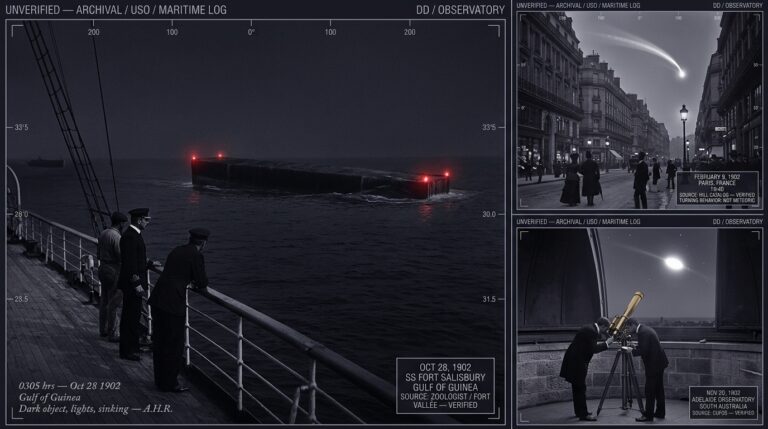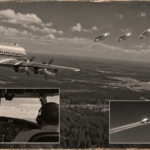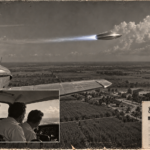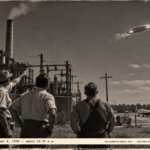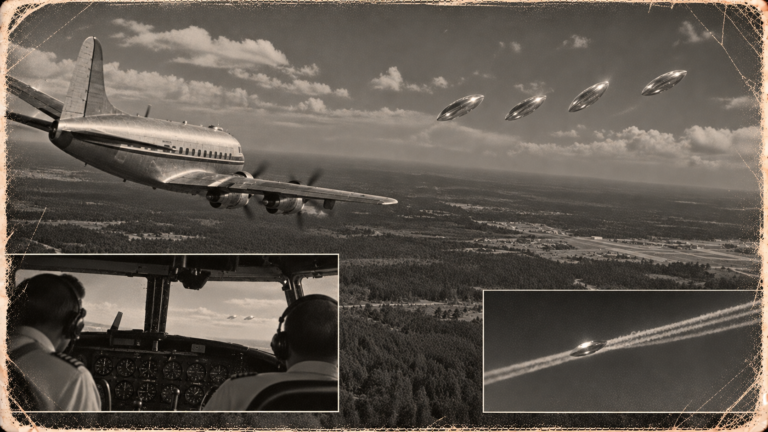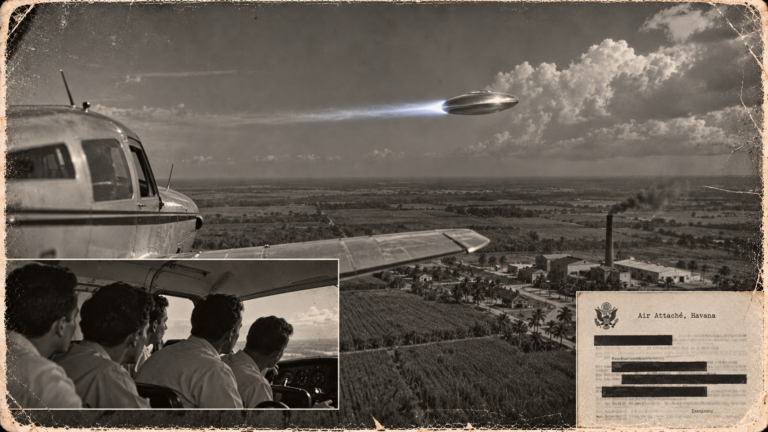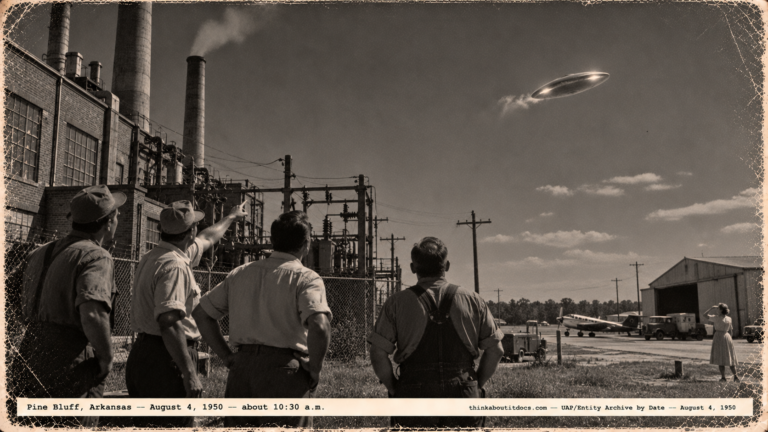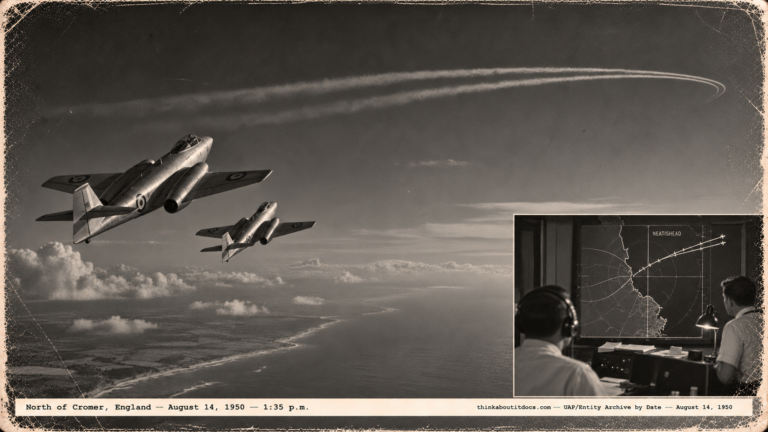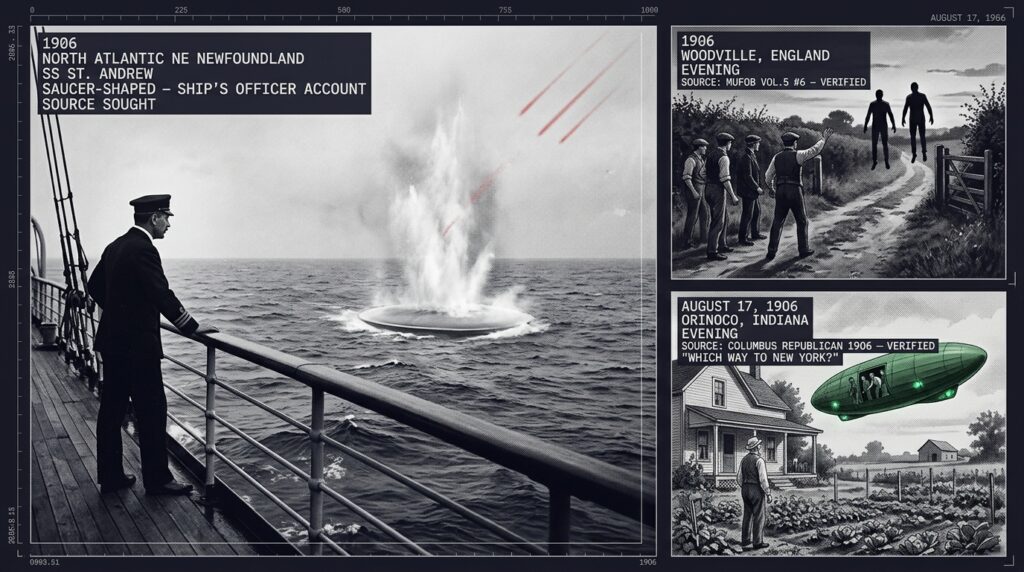
Three 1906 cases: the SS St. Andrew North Atlantic encounter — a ship's officer watches a saucer-shaped rocking metallic object strike the sea throwing steam 40 feet, describing its flat profile as explaining the rocking motion (1906, source sought); George Fowler watches two silhouetted figures rise above the trees in Woodville, England (MUFOB Vol. 5 #6); and John Warner's green cigar airship whose occupants asked directions to New York (Columbus Republican, August 18, 1906).
1906: UFO|UAP & Entity Sightings Archive
1906‘s anchor case is the SS St. Andrew North Atlantic encounter — a ship’s officer northeast of Newfoundland watched a saucer-shaped metallic object fall with a rocking motion, strike the water with a hiss, and throw spray and steam forty feet into the air, estimating that at night it would have illuminated the sea for fifty to sixty miles. The witness’s own account repeatedly calls the objects “meteors,” and that framing is preserved here rather than silently overridden — but the explicit saucer-shape description and functional use of that shape to explain the object’s motion make this one of the more analytically interesting maritime reports of the decade.
The rest of the year is a mix of solid, ambiguous, and outright-excluded material: continuing luminous-wheel reports from the China Sea; a rising-and-vanishing “silhouettes” encounter at Woodville, England; two independent 1906 newspaper accounts of a green airship over Orinoco, Indiana whose crew asked a farmer for directions to New York; a vanishing-men account from Bertha, Nebraska with an uncertain evidentiary chain; and a boy’s 1906 airship-boarding claim that only surfaced in a 1973 newspaper, sixty-seven years after the fact. One entry on the live page — a man’s claimed psychic astral trip to Mars — is not an aerial sighting at all and has been moved out of the case list below; see the Researcher’s Notes for why.
Date: 1906
Location: North Atlantic, northeast of Newfoundland (deck of the SS St. Andrew)
Time: Unknown
Hynek Classification: DD
Case Status: Insufficient Data
Summary: “I saw three meteors fall into the water dead ahead of the ship one after another at a distance of about five miles. Although it was daylight, they left a red streak in the air from zenith to the horizon. I then saw a huge meteor on the port beam falling in a zigzag manner less than a mile away. We could distinctly hear the hissing of water as it touched. It fell with a rocking motion leaving a broad red streak in its wake. The meteor must have weighed several tons, and appeared to be 10 to 15 feet in diameter. It was saucer shaped, which probably accounted for the peculiar rocking motion. When the mass of metal struck the water the spray and steam rose to a height of at least 40 feet. If it had been night, the meteor would have illuminated the sea for 50 or 60 miles.” Note: the witness’s own account describes these objects as meteors throughout; that framing is preserved rather than overridden. The saucer-shape and rocking-motion detail is what makes this entry analytically notable, not a claim that the witness believed he saw a craft.
Source: Unlisted — the specific detail (saucer shape, rocking motion, light-range estimate) reads as genuine maritime log language; primary source not yet identified
Date: 1906
Location: China Sea
Time: Unknown
Hynek Classification: NL
Case Status: Insufficient Data
Summary: Giant luminous wheels were seen by a British steamer.
Source: Unlisted — part of a documented Persian Gulf/China Sea spinning-wheel observation series (1879, 1880, 1906); primary source not yet identified
Date: 1906
Location: Woodville, England
Time: Evening
Hynek Classification: Unclassified — ambiguous entity/craft nature
Case Status: Insufficient Data
Summary: Walking between Great Navy Pit and Woodville, Mr. George Fowler and two companions noticed two silhouettes on a nearby path. When Fowler called out and approached, the two silhouettes rose into the air and disappeared above the trees, panicking the witnesses.
Source: MUFOB (Merseyside UFO Bulletin), Vol. 5, #6 — confirmed pre-war UFO research publication
Date: 1906
Location: Mitchell, South Dakota
Time: Unknown
Hynek Classification: CE-III
Case Status: Insufficient Data — 67-year gap between claimed event and first publication
Summary: A boy named Herbert DeMott, of Mitchell, South Dakota, claimed to have boarded an airship that landed near his family’s well. “As I approached it, a door rolled back and I was welcomed inside. Its two occupants sat inside on camp stools.” The occupants looked ordinary and spoke fluent English but would not say where they were from. DeMott claimed the craft’s shell was filled with helium, that a lever cut off “the magnetism from the Earth” to allow ascent, and that the occupants drew water from the family’s horse trough “for use in manufacturing electricity.”
Source: The Democrat-Herald (Albany, Oregon), August 27, 1973 — the source is a 1973 newspaper reporting a 1906 claim; this temporal gap means the account cannot be treated as contemporaneous documentation, though it is preserved here as a documented claim
Date: June 1906
Location: Bertha, Burt County, Nebraska
Time: Evening (before sunset)
Hynek Classification: N/A — ambiguous entity encounter, no craft observed
Case Status: Insufficient Data
Summary: Carlson, a 17-year-old Swedish immigrant, was riding by horse-drawn carriage toward a dance in flat, open farmland when he saw two young men walking ahead of him at a distance of roughly half a mile. As he approached to offer them a ride, his horse became agitated and nearly uncontrollable; by the time he regained control, both figures had vanished from open, unobstructable ground. Carlson later failed to recognize either man among the dance’s attendees. The account reached researchers via Albert Rosales, through a communication from the witness’s son, Bill Carlson.
Source: Sider, Jean, citing Rosales, Albert, via communication from Bill Carlson (witness’s son) — a family-transmission source, standard for the Rosales compilation chain; the horse’s reaction is the case’s most evidentially notable detail
Date: August 17, 1906
Location: Orinoco, Indiana
Time: Night
Hynek Classification: CE-III
Case Status: Insufficient Data
Summary: John Warner, a resident of Orinoco, reported that an airship dropped low over his garden while he sat on his back porch. Two independent newspaper accounts differ on detail: the Columbus Republican describes the ship as green with green lights, its unnamed occupants asking Warner for directions to New York and departing after he pointed them toward Jonesville. The Rockport Journal, describing “that night,” has Warner drawn outside by a noise in his barn, then seeing a cigar-shaped green craft descend into his garden with four men aboard, who said they were traveling from Chicago to New York and left after Warner directed them toward Seymour.
Source: Columbus Republican (Columbus, Indiana), August 18, 1906; Rockport Journal (Rockport, Indiana), August 31, 1906 — two independent contemporaneous newspaper accounts of the same claimed event; whether the underlying event was genuine or a rural Indiana tall tale remains undetermined
Date: September 1906
Location: Syracuse, New York
Time: Unknown
Hynek Classification: N/A — claimed psychic/astral experience, no aerial observation
Case Status: Insufficient Data
Summary: Sackville G. Leyson, described as president of the Society for Psychical Research, told a Utah newspaper that he had traveled to Mars via psychic astral projection while his body remained at home. He described two distinct tribes of Martians — one very tall with large ears, a lion-like nose, and a single central eye; the other small, web-footed, and eyeless-nosed, living in holes in rock or ground — along with rock houses, rubber-like trees, and workers using light-guiding machines in a deep ravine. He said he would repeat the journey with scientific witnesses present.
Source: Emery County Progress (Emery County, Utah), September 15, 1906 — a real period newspaper account of a claimed psychic experience; whatever its nature, it is preserved here as part of the documented record rather than set apart from it
RESEARCHER’S NOTES
The 1906 Archive — A Meteor Witness Who Said “Saucer-Shaped,” and One Entry That Was Never a Sighting
- The Leyson Mars account is kept as a standard entry, labeled honestly: an earlier version of this correction had moved it to a separate archive note on the reasoning that it wasn’t a UFO sighting. Per this site’s broader standing practice, weird and anomalous claims of all kinds — psychic, cryptid, entity, apparition — belong in the record as regular entries rather than being set apart. It is presented here as what it is: a claimed psychic experience, not an aerial observation, but no less part of the documented record for that.
- The Pleasantville, New York balloon is referenced but has no case data: The live page’s introductory prose mentions “an identified conventional balloon flight with named occupants” at Pleasantville, but no Date/Location/Time/Summary/Source block for it exists anywhere in the source material reviewed. Rather than invent details to fill that gap, it has been omitted here and flagged for a future session with the actual source in hand.
- The St. Andrew case is presented on the witness’s own terms: The account calls the objects “meteors” throughout. This page treats the saucer-shape and rocking-motion description as analytically interesting rather than reframing the witness’s own meteor identification as a UFO claim he didn’t make.
- Two entries carry real evidentiary caveats that are stated plainly rather than smoothed over: Mitchell, South Dakota is a sixty-seven-year publication gap; Bertha, Nebraska reaches the archive through a witness’s son rather than the witness directly. Both are kept as documented claims, not elevated to confirmed cases.
1906 is a year where the archive’s editorial judgment matters as much as its sourcing. The St. Andrew case gives the year real analytical weight — a witness’s own “meteor” framing paired with a saucer-shaped, functionally-described object is worth preserving honestly rather than either dismissed or oversold. The Leyson Mars piece never belonged in this list to begin with, and it no longer is one.
“It fell with a rocking motion leaving a broad red streak in its wake. The meteor must have weighed several tons, and appeared to be 10 to 15 feet in diameter. It was saucer shaped, which probably accounted for the peculiar rocking motion.”
— Ship’s officer, SS St. Andrew, North Atlantic northeast of Newfoundland, 1906