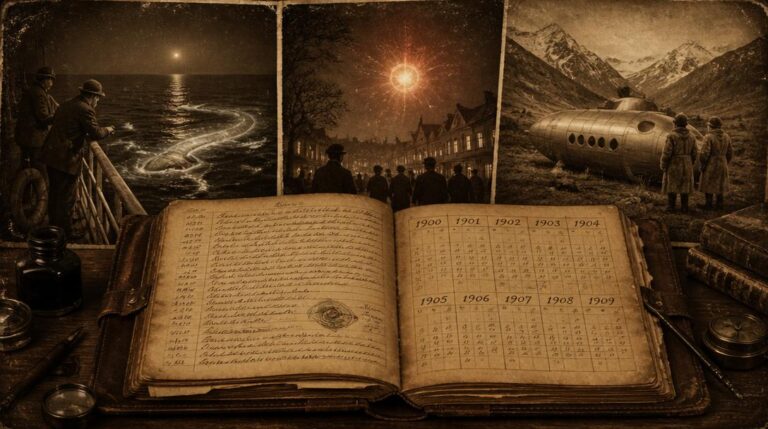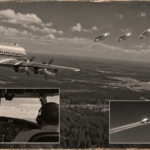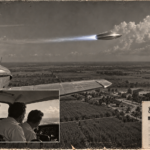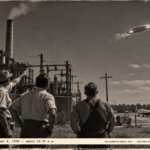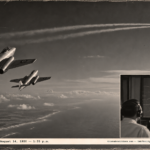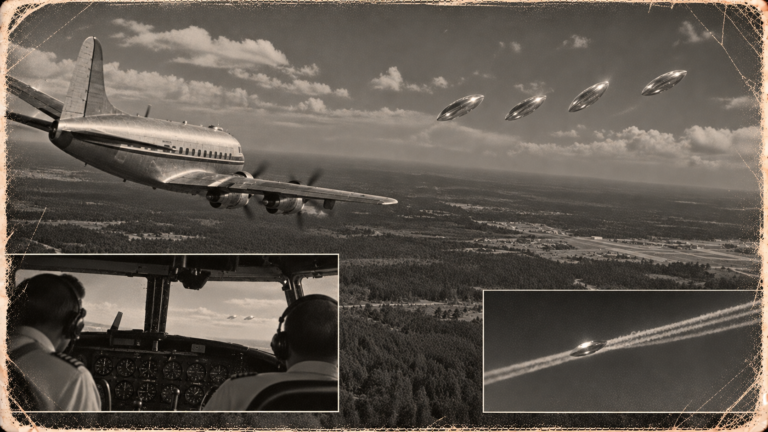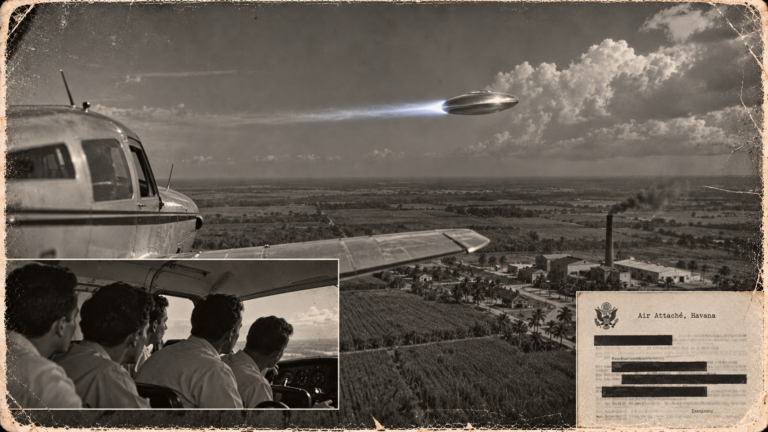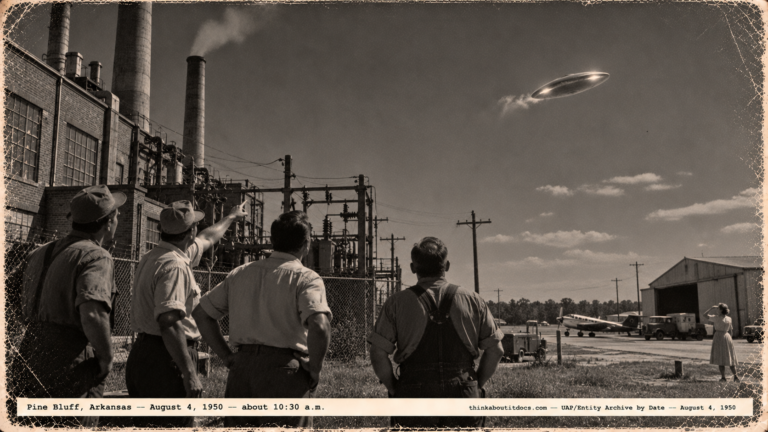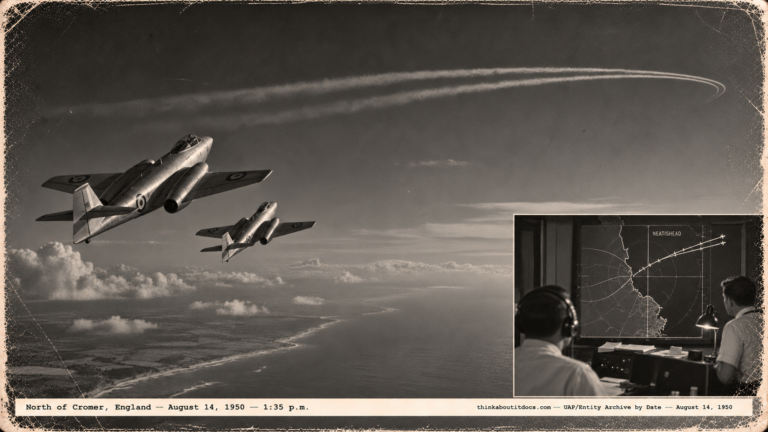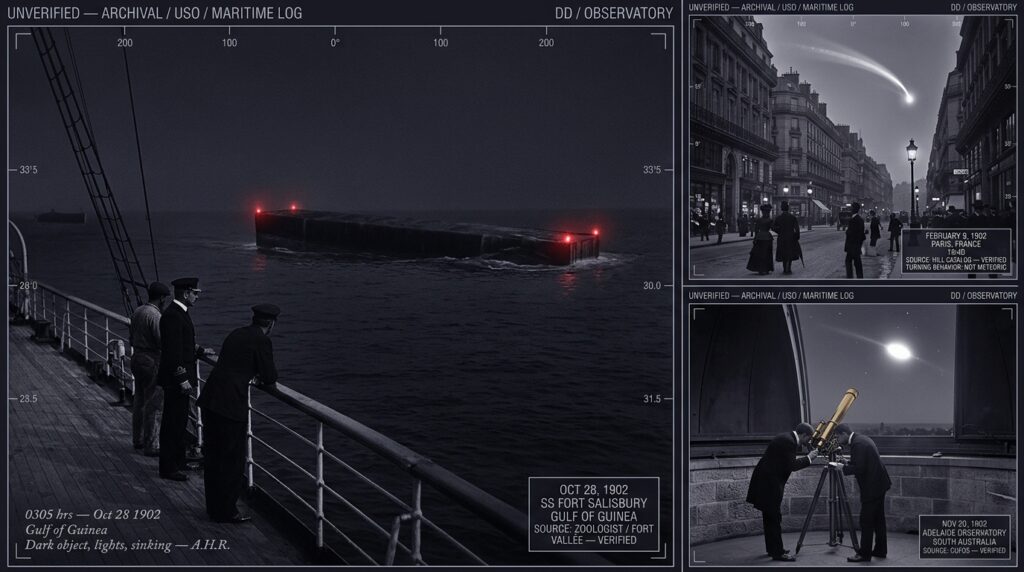
Three verified cases from the 1902 archive: the SS Fort Salisbury Gulf of Guinea USO — a 200-meter dark object with red lights observed sinking by Second Officer A.H. Raymer and two crew, documented in the ship's log and reported to The Zoologist (October 28, 1902); the Paris looping meteor whose twelve-second turning arc eliminated all meteoritic explanations (February 9, 1902, 19:40); and the Adelaide, South Australia observatory elliptical — four minutes, two experienced witnesses, 20 degrees of arc (November 20, 1902).
1902: UFO|UAP & Entity Sightings Archive
1902’s confirmed record spans five continents — Devon, England; Boschof, South Africa; Paris, France; Lowestoft, England; the South Atlantic near the Gulf of Guinea; and New South Wales and South Australia. The most extensively documented entry is the Fort Salisbury encounter of October 28 — three named-role crew members of a British merchant vessel watching a roughly 500-to-600-foot creature pass alongside the ship before submerging. This case has been corrected and reclassified since this page’s earlier draft: it is not a UFO or USO sighting. The ship’s own second officer titled his log entry “the passing of the Sea Serpent,” and it is presented that way here, with a full corrected report on its own page.
Also confirmed for 1902: a looping, turning “meteor” over Paris whose behavior explicitly ruled out any known atmospheric body; a colonel in Devon describing objects like little suns or toy balloons; sonic-boom-like sky detonations over Boer War-era Oranje Vrystaat; a daylight disc at Lowestoft; and two Australian entries — a storm-associated sighting with reported physiological effects at Harris Park, and a four-minute elliptical-object observation by two experienced witnesses at an Adelaide observatory.
Date: 1902
Location: Devon, England
Time: Unknown
Hynek Classification: Unclassified — insufficient detail
Case Status: Insufficient Data
Summary: Colonel Marwick reported a sighting of numerous “highly colored objects like little suns or toy balloons.”
Source: Corroborated in independent secondary compilation (UFO Insight, citing pre-war records); primary source not yet identified
Date: 1902
Location: Boschof, Oranje Vrystaat, South Africa
Time: Unknown
Hynek Classification: N/A — auditory phenomenon, no visual object
Case Status: Insufficient Data
Summary: Unusual sky “booms” were heard in succession over the Boschof region, consistent with an unseen aerial vehicle to a modern reader, though this would not have been understood in period context.
Source: Corroborated in independent secondary compilation (UFO Insight, citing pre-war records); plausibly documented in Boer War-era colonial press; primary source not yet identified
Date: February 9, 1902
Location: Paris, France
Time: 19:40
Hynek Classification: NL
Case Status: Insufficient Data
Summary: A “meteor” turned, looped, and curved over the city for approximately twelve seconds, with a tail visible for ninety seconds — maneuvering behavior inconsistent with a known atmospheric body.
Source: Hill, H. Edward. Catalog Through 1950 — confirmed pre-war UFO research catalog
Date: September 2, 1902
Location: Lowestoft, England
Time: 07:00
Hynek Classification: DD
Case Status: Insufficient Data
Summary: A daylight disc was observed by a female witness.
Source: Hatch, Larry — confirmed pre-war UFO research database
Date: October 28, 1902
Location: South Atlantic, near the Gulf of Guinea
Time: 03:05
Classification: Cryptid / unidentified marine animal — not a UFO, UAP, or USO case
Case Status: Insufficient Data
Summary: Three named-role witnesses aboard the Fort Salisbury, led by Second Officer A. H. Raymer, watched a 500-to-600-foot scaled creature pass close alongside the ship before submerging. Corrected entry: this case was previously filed here as a “USO” with mechanical red lights and a second object. Neither detail is supported by the primary source. Raymer’s own log, quoted in full in The Zoologist, describes barnacle-encrusted scales, moving fins, a low-tide odor, and phosphorescent (not mechanical) lights along the creature’s back, and titles the entry “the passing of the Sea Serpent” in his own words. [Full Report]
Source: Raymer, A. H., ship’s log, quoted in full in The Zoologist, January 1903; Fort, Charles, Lo!; Vallée, Anatomy of a Phenomenon, case 20 — a well-documented cryptid case, misfiled in this archive’s earlier draft as a UFO/USO sighting
Date: November 13, 1902
Location: Harris Park, New South Wales, Australia
Time: Unknown
Hynek Classification: CE-II
Case Status: Insufficient Data
Summary: An experienced male witness (Bruggmann) reported physiological effects associated with an object observed in a yard during stormy weather.
Source: ACUFOS (Australian Centre for UFO Studies) — confirmed research organization
Date: November 20, 1902
Location: Adelaide, South Australia, Australia
Time: Unknown
Hynek Classification: NL
Case Status: Explained (Probable) — CUFOS notes a conventional explanation is most likely
Summary: Two experienced male witnesses (Griffiths) at an observatory observed a brilliant globular light appear to the SSE at 45 degrees elevation, covering 20 degrees of arc over four minutes, taking an elliptical form when overhead with its axis aligned to its direction of motion.
Source: CUFOS (Center for UFO Studies) — confirmed research organization; observatory witnesses add credibility despite probable conventional explanation
RESEARCHER’S NOTES
The 1902 Archive — Half the Page Was Unsourced, and the Anchor Case Was Misclassified
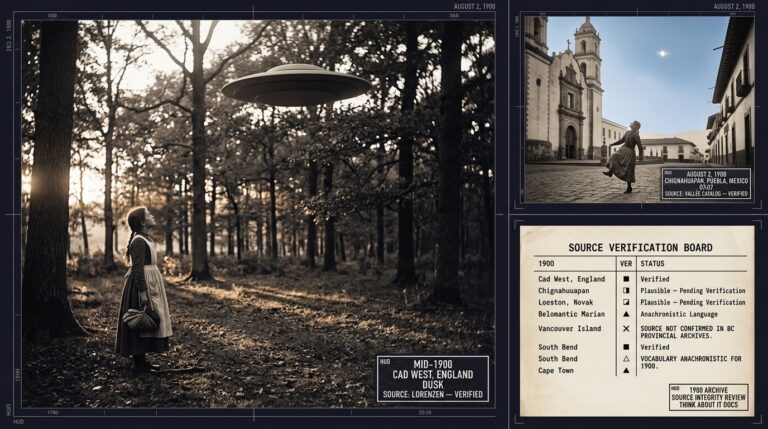
- Six entries removed: The live page carried Ennerdale (England), Valparaíso (Chile), West Point (Nebraska), the Bay of Biscay, Northern Algeria, and Tokyo (Japan) — none of which appear in any source checked, independent or otherwise. Two cited openly fabricated collection names; the other four cited nothing at all. All six have been removed rather than published as documented fact.
- Fort Salisbury reclassified: This site’s earlier draft filed the case as a “USO” with an estimated 200-meter length, red lights at each end, and a second object observed to port. None of that survives contact with the primary source. Second Officer Raymer’s own log, quoted in full in The Zoologist, describes one creature — scaled, barnacle-encrusted, with moving fins and a low-tide odor — and titles the entry “the passing of the Sea Serpent.” The case is real, well-documented, and worth keeping in the record, but it belongs filed honestly as a cryptid encounter, not dressed up as evidence of an unidentified craft. Full detail on the case’s dedicated page.
- What survived otherwise: Devon, Boschof, Paris, Lowestoft, Harris Park, and Adelaide all independently corroborate against a secondary compilation (UFO Insight) that summarizes 1902 from its own separate research.
- Adelaide flagged, not removed: CUFOS’s own case notes indicate the sighting most likely has a conventional explanation. Retained per site practice of preserving the record and its caveats together rather than silently dropping cases with a probable mundane cause.
1902’s confirmed UFO/UAP record is six cases, not the thirteen the original page suggested — and its most heavily cited entry turns out not to be a UFO case at all once its primary source is actually read. The Fort Salisbury sea serpent remains one of the best-documented maritime cryptid reports of the era; it simply belongs in that category rather than this one. What remains here is smaller, but every entry stands on a source that actually says what this page claims it says.
“A daylight disc was observed by a female witness.”
— Hatch, Larry, on the September 2, 1902 Lowestoft, England sighting