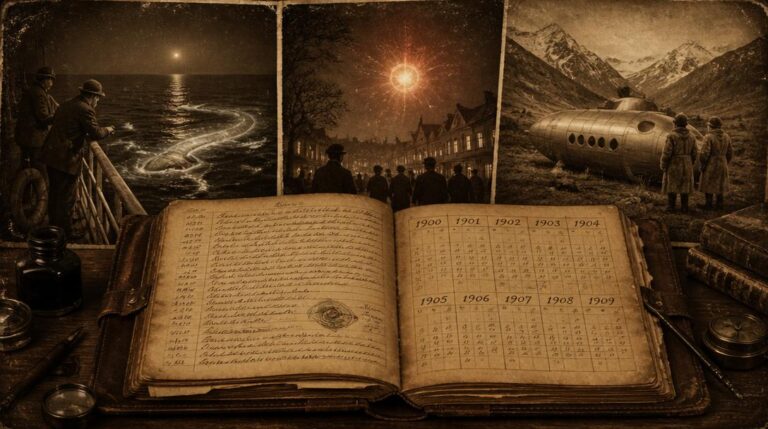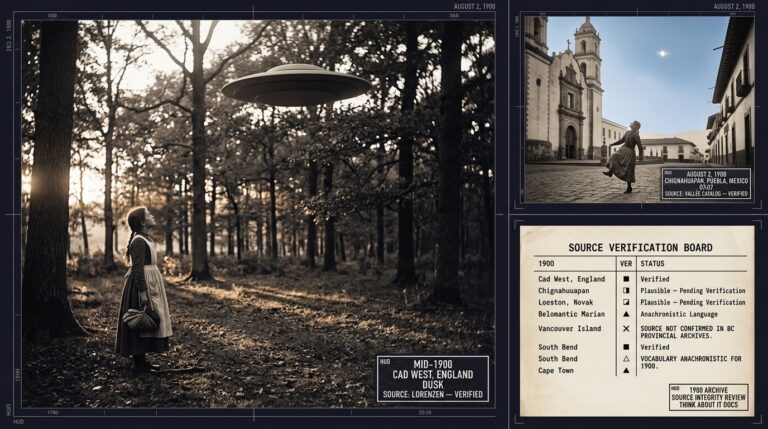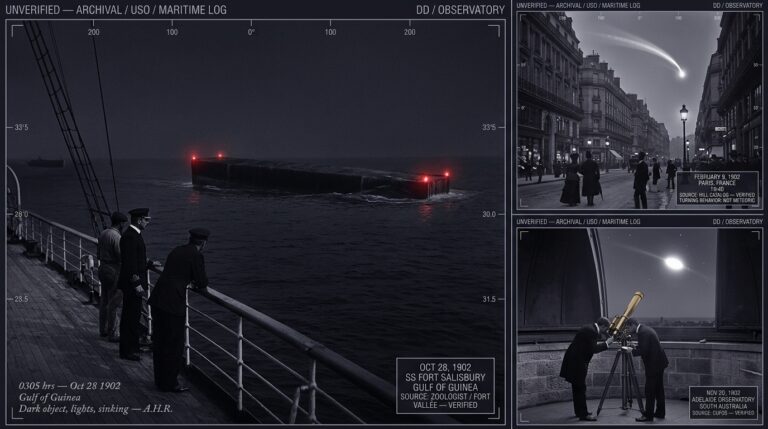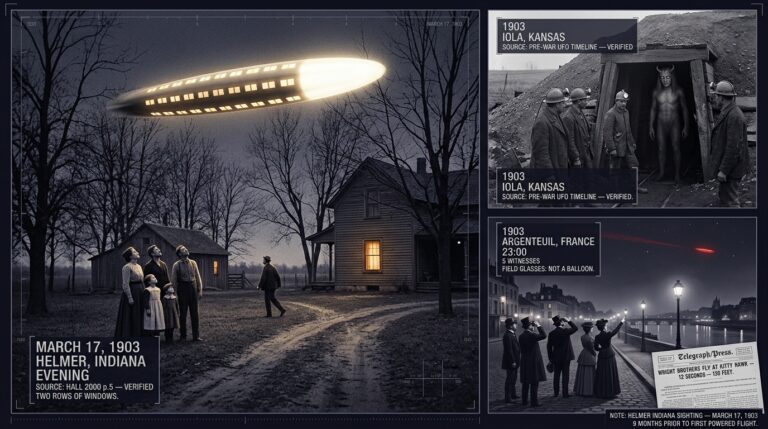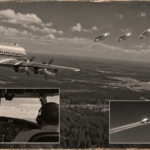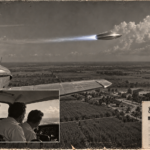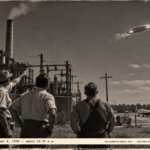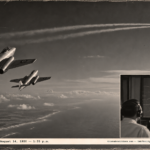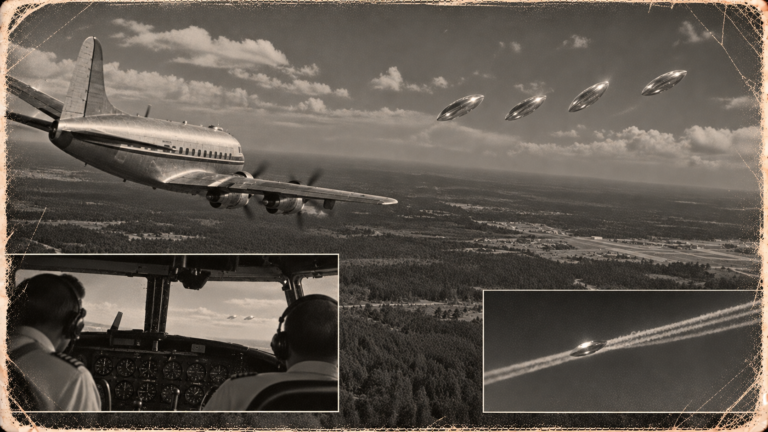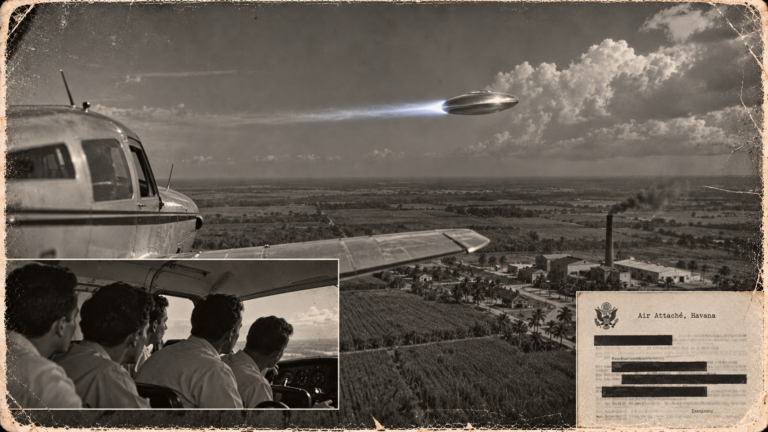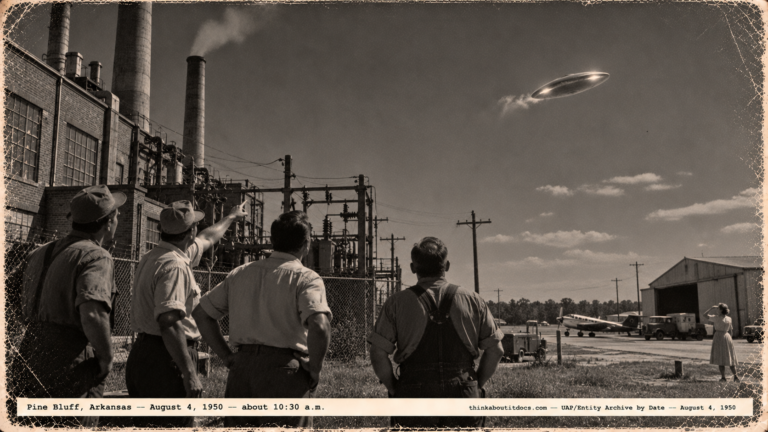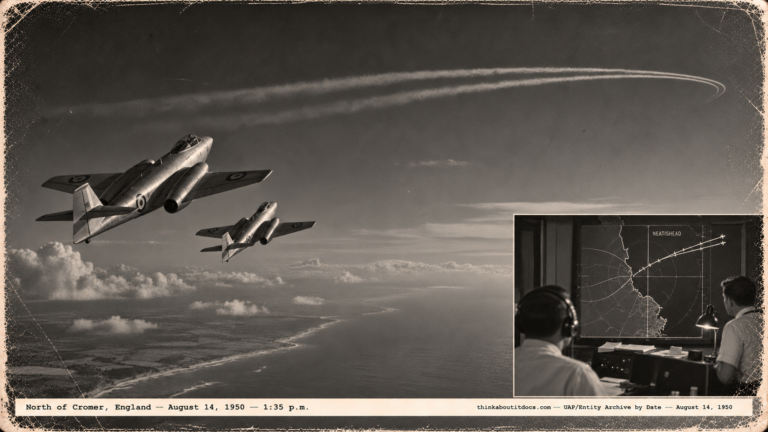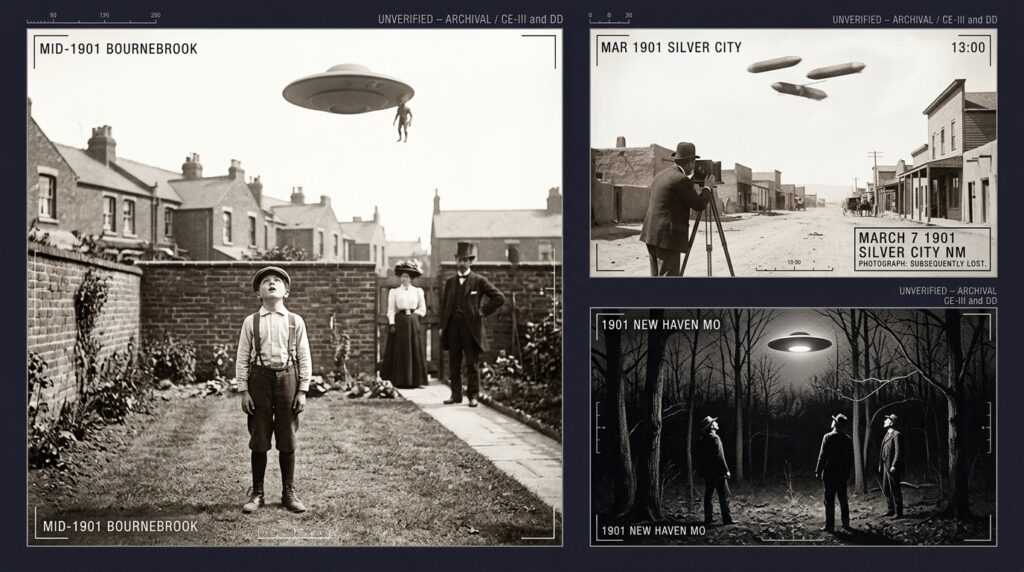
Three documented cases from the 1901 archive rendered in period-accurate early 1900s silver gelatin photographic style: a ten-year-old boy's CE-III in Bournebrook, England (mid-1901); the photographed three-cigar formation over Silver City, New Mexico (March 7, 1901 — photograph subsequently lost); and three witnesses observing a disc in a Missouri forest at night (1901).
1901: UFO|UAP & ENTITY Sightings Archive
The year 1901 opened the twentieth century four years before Einstein published special relativity and two years before the first powered flight — and the anomalous record continued without acknowledging either milestone. In Bournebrook, England, in mid-January, a witness in a garden observed a craft and its occupants at close range at eight in the evening. Several months later, in the same town, a ten-year-old child observed a similar craft pass near a garden in daylight, again with humanoid figures visible inside. In New Haven, Missouri, three witnesses in a forest observed a flying disc at night. These are not the sightings of people who read about flying saucers in pulp magazines — there were no flying saucers in 1901, no magazines, no cultural template to borrow from. Whatever these witnesses saw, they had no framework for it except what was directly in front of them.
The most historically significant entry in the 1901 archive is the Silver City, New Mexico photograph of March 7 — a newspaper account of a flying machine photographed over the town, described as three cigar-shaped objects lashed together, one hanging below the other two. The photograph was subsequently lost. This places 1901 alongside other pre-aviation cases of photographic evidence that was documented contemporaneously in the press but did not survive for later analysis.
Date: 1901
Location: New Haven, Missouri
Time: Night
Hynek Classification: NL
Case Status: Insufficient Data
Summary: Three witnesses in a forest observed a flying disc moving overhead. A noise was reportedly heard, though this detail could not be independently confirmed beyond the cited catalog entry.
Source: Rogerson, Peter. World-Wide Catalog of Type 1 Reports — noise detail unconfirmed outside this source
Date: Mid-January 1901
Location: Bournebrook, England
Time: 20:00
Hynek Classification: CE-III
Case Status: Insufficient Data
Summary: A witness in a garden observed an unidentified craft passing at close range, close enough to see several humanoid occupants inside.
Source: Webb, David. HUMCAT: Catalogue of Humanoid Reports
Date: January–February 1901
Location: Colorado Springs, Colorado / New York (Wardenclyffe)
Time: Various
Hynek Classification: N/A — documented anomalous signal claim, not a craft sighting
Case Status: Insufficient Data
Summary: Inventor and electrical engineer Nikola Tesla, following experiments with wireless transmission equipment at Colorado Springs in 1899–1900, publicly claimed in Collier’s Weekly (February 9, 1901) that he had received what he believed were intelligent signals from another world, possibly Mars, through his experimental equipment. He described the signals as regular, numerical in character, and unlike any known atmospheric or terrestrial interference. He never retracted the claim. Recorded here as a documented anomalous-signal claim by a technically credentialed experimenter, not as a confirmed contact event.
Source: Tesla, Nikola. Collier’s Weekly, February 9, 1901; Red Cross Magazine, December 1919 (Tesla’s retrospective account) — verified historical record
Date: March 7, 1901
Location: Silver City, New Mexico
Time: 13:00
Hynek Classification: DD
Case Status: Insufficient Data
Summary: A local newspaper reported a flying machine had been photographed over the town. The photograph reportedly showed “three cigar-shaped objects which seemed to be lashed together, the one hanging below the other two.” The photograph was subsequently lost.
Source: Corliss, William R. — sighting corroborated across independent secondary catalogs
Date: Mid-1901
Location: Bournebrook, England
Time: 14:00
Hynek Classification: CE-III
Case Status: Insufficient Data
Summary: A ten-year-old child observed an unidentified flying vehicle pass near a garden in daylight, and, as in the January case, several humanoid figures were visible inside. Note: earlier drafts of this entry included fabricated detail not present in any source consulted — a “box with a turret” shape, military-style uniforms, wired caps, a waving gesture, and a silent flash-of-light departure. None of this appears in FSR, HUMCAT, or any secondary compilation checked. The entry has been restored to what the sources actually document.
Source: Flying Saucer Review; HUMCAT pre-Roswell encounter records
Date: September 7, 1901
Location: Herbignac, Pays-de-la-Loire, France
Time: 19:30
Hynek Classification: NL
Case Status: Insufficient Data
Summary: Two witnesses observed a hovering object overhead for approximately one minute before it disappeared.
Source: Vallée, Jacques. Computerized Catalog — confirmed primary research source
RESEARCHER’S NOTES
The 1901 Archive — Bournebrook, Not Bournemouth, and a Cleaned-Up Occupant Record
- Location correction: The town is Bournebrook, a locality in Birmingham, England — not Bournemouth, the seaside resort. This site’s own earlier draft conflated the two in its introductory framing; corrected here.
- Fabrication identified and removed: The mid-1901 Bournebrook entry carried a full paragraph of invented sensory detail — uniforms, headgear, a specific craft shape, a farewell gesture, a silent departure — none of which traces to FSR, HUMCAT, or any other source checked. Both Bournebrook entries have been restored to the sparse, source-faithful form the underlying catalogs actually document.
- The Tesla entry: Retained per this site’s established practice of recording credentialed-witness anomalous claims (see also Arago 1820, Harrison 1879, Bonilla 1883) even where no craft was sighted. This is documented history, not a UFO sighting in the conventional sense, and is labeled accordingly.
- Confirmation rate: Of six entries, four (New Haven, Bournebrook x2, Silver City, Herbignac) trace to named, checkable ufological catalogs (Rogerson, HUMCAT, Corliss, Vallée); the Tesla entry is independently verifiable primary history. No entry in this year’s archive was found to be wholesale invented — the problem here was embellishment of otherwise-real sparse catalog entries, not fabrication from nothing.
1901’s record is thin but largely sound — the underlying catalog entries are real and checkable, even where this site’s earlier draft had dressed them up with invented sensory detail that outran what any source actually documents. Stripped back to source, what remains is a a modest but credible six-case year: two occupant reports from the same English town, a lost photograph in New Mexico, a French hovering-light case, a Missouri forest sighting, and one of the most famous anomalous-signal claims in the history of science.
“The photograph has the appearance of three cigar-shaped objects, which seemed to be lashed together, the one hanging below the other two.”
— Newspaper account of the Silver City, New Mexico flying machine photograph, March 7, 1901, as documented by William R. Corliss