THINK ABOUTIT CLOSE ENCOUNTER REPORT
1768: Close Encounter near Leipzig, Germany
In September 1768, Johann Wolfgang von Goethe — nineteen years old, traveling by stagecoach from Frankfurt to Leipzig to begin his university studies, already the most intellectually gifted young man in 18th century Germany — was forced off the stagecoach by a treacherous muddy uphill track and was walking behind the vehicle when he looked down into a ravine to his right. What he saw he described in his own words in his autobiography Dichtung und Wahrheit — Poetry and Truth — the memoir that would become one of the foundational documents of German Romantic literature. In a funnel-shaped space there were innumerable little lights shining, ranged step-fashion over one another, shining so brilliantly the eye was dazzled. But they did not keep still. They jumped about here and there — upward from below and downward from above — as if they were animated luminous creatures. Goethe used the word animated deliberately. He was nineteen, he was one of the sharpest observers of natural phenomena in Europe, and he had no framework for what he was looking at in that ravine except that it was alive and it was luminous and it was moving with the intelligence of living things. He called it a sort of amphitheater — a structural comparison that speaks to an organized spatial arrangement of the lights rather than random scatter. Whatever Johann Wolfgang von Goethe saw in a ravine near Leipzig in September 1768 remained with him well into adulthood — he considered it significant enough to preserve in the autobiography he published fifty years later.
Date: September 1768
Sighting Time: Evening — the stagecoach had been traveling in difficult weather; exact time not recorded
Day/Night: Evening
Location: Near Leipzig, Saxony, Germany — in a ravine beside a muddy uphill track on the Frankfurt to Leipzig road
Urban or Rural: Rural — rough country road with a ravine
No. of Entity(s): Many — innumerable animated luminous creatures
Entity Type: Small luminous animate beings — described as jumping about with the behavior of living things; Goethe explicitly used the word animated
Entity Description: Innumerable little lights arranged in step-fashion in a funnel-shaped space in the ravine. Shining brilliantly enough to dazzle the eye. Moving upward from below and downward from above with the animated behavior of living creatures. The funnel-shaped arrangement of the space they occupied suggests either a physical feature of the ravine or a structural configuration generated by the beings themselves.
Hynek Classification: CE-III — Close Encounter of the Third Kind; close observation of multiple animate luminous beings in an organized spatial arrangement. The existing CE-III classification is correct.
Duration: Not recorded — sufficient for sustained observation and Goethe’s detailed description
No. of Object(s): Multiple — innumerable; arranged in a funnel-shaped space
Description of Object(s): Innumerable little lights in a funnel-shaped arrangement, stepped one above another, brilliantly luminous, moving with animate intelligence upward and downward within the funnel space
Shape of Object(s): Individual lights — small; arranged collectively in a funnel-shaped configuration
Size of Object(s): Small — individual lights; the funnel formation was large enough to fill the ravine’s visual field
Color of Object(s): Brilliantly luminous — specific color not recorded beyond their intensity
Distance to Object(s): Ravine below the road — visible from the road edge above; close enough for dazzling brightness to reach the observer’s eyes
Height & Speed: In the ravine — below road level; moving rapidly upward and downward within the funnel space
Number of Witnesses: Multiple — Goethe and fellow stagecoach passengers walking behind the vehicle; Goethe is the primary documented witness
Special Features / Characteristics: Animate behavioral intelligence — the key analytical feature preserved in Goethe’s own description is the explicit attribution of animate behavior to the lights; they jumped about as if they were animated luminous creatures — not random atmospheric scatter but organized directed movement consistent with living organisms; funnel-shaped spatial arrangement — the amphitheatre comparison suggests a structured contained space rather than open atmospheric dispersion; step-fashion stacking — the arrangement of lights in ascending tiers suggests organized spatial positioning rather than random distribution; brilliant dazzling luminosity — intense enough to dazzle the eye of a trained observer at ravine distance; the encounter is preserved in Goethe’s autobiography Dichtung und Wahrheit — one of the foundational texts of German literature — giving it one of the most prestigious literary preservation chains of any historical UAP account; Goethe was nineteen at the time and would later become the author of Faust and the greatest figure of German Romantic literature; the word amphetamine in the page summary is a mistranslation or OCR error — the original German word was Amphitheater, meaning amphitheatre; note the stagecoach passengers being forced to walk by the muddy uphill track placed them at ground level on the road edge, enabling the downward view into the ravine that would not have been possible from inside the moving vehicle
Case Status: Unexplained
Source: Johann Wolfgang von Goethe, Dichtung und Wahrheit (Poetry and Truth), Part One, Book Three; The Bible UFO Connection — UFOs in History
Summary/Description: In September 1768, nineteen-year-old Johann Wolfgang von Goethe, walking behind his stagecoach on the muddy Frankfurt-Leipzig road, looked into a ravine to his right and observed innumerable brilliantly luminous lights arranged step-fashion in a funnel-shaped space — jumping about upward and downward as if animated living creatures. He compared the arrangement to an amphitheatre. He preserved the account in his autobiography Dichtung und Wahrheit, published fifty years later. One of the most literarily prestigious and intellectually credentialed historical CE-III accounts in the European record.
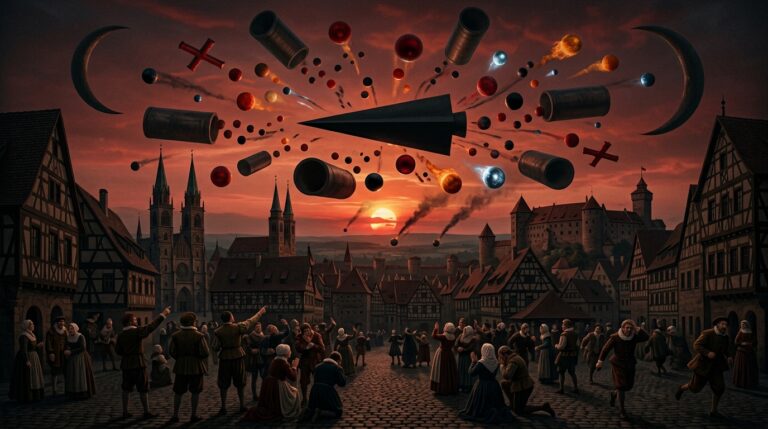
Related Cases: July 9, 1686 CE Leipzig Germany — Gottfried Kirch Hovering Object | 1561 CE Nuremberg Germany Aerial Battle | German UAP Archive
DETAILED REPORT:
September 1768. Johann Wolfgang von Goethe is nineteen years old. He has left Frankfurt for Leipzig to begin his university studies — a journey of approximately 300 kilometers through the varied terrain of central Germany. The road is rough. It has been raining. On a particularly steep and muddy uphill section, the stagecoach becomes too treacherous for the passengers to remain inside — the track is so bad that the vehicle risks overturning if the passengers remain in their seats.
Goethe and his fellow passengers alight and walk behind the stagecoach.
This is the circumstance that makes the encounter possible. From inside a moving stagecoach on a difficult track, the passengers’ attention would be on the road ahead and on maintaining their seats. Walking on the road edge, moving slowly uphill through mud and rain, passengers have time to look at the landscape around them. Goethe looked to his right.
There was a ravine.
And in the ravine there was something.
The description Goethe preserved in Dichtung und Wahrheit — his autobiography, written decades after the event and published in stages between 1811 and 1833 — is the primary text. He writes of a sort of amphitheatre — his comparison for the funnel-shaped space that the lights occupied. An amphitheatre is a structured, tiered space with seats arranged in ascending rows around a central focus. The funnel-shaped space in the ravine had a similar organizational logic: lights arranged step-fashion, one above another, in a containing form that resembled an architectural structure.
The lights were innumerable. The count is not possible — there were simply too many to count. They were arranged in the funnel-shaped space in steps — each rank of lights at a different elevation than the ones above and below it. The brightness was sufficient to dazzle Goethe’s eyes at the distance from the road edge to the ravine floor — the brilliance was not a gentle glow but an intense luminosity that overwhelmed normal vision.
And they moved.
This is the word Goethe chose and it is the word the archive holds above all others in this account: animated. The lights did not drift with the movement of the air or bob with the motion of a stream or pulse with the rhythms of atmospheric luminescence. They jumped. Upward from below. Downward from above. They moved with the directional intelligence of living things — not randomly, not passively, but with the purposeful movement that Goethe as a trained observer of natural phenomena could only describe as the behavior of animated creatures.
Goethe recorded this encounter fifty years later as sufficiently significant to include in his autobiography. Dichtung und Wahrheit — Poetry and Truth — is not a journal of daily events. It is a carefully constructed literary and intellectual autobiography in which Goethe selected from his life experiences those that had meaning and preserved them with literary craft. His decision to include the Leipzig ravine encounter in this work means that half a century after the event, the memory of innumerable animated luminous creatures in a funnel-shaped space had not faded or been rationalized away.
The page’s source text contains a mistranslation of the original German. The word rendered as amphetamine in the source is Amphitheater — amphitheatre. Goethe was comparing the funnel-shaped spatial arrangement of the lights to an amphitheatre — a tiered theatrical space. This comparison makes his description precisely coherent: step-fashion, tiered, arranged in ascending order around a central funnel-shaped space, like the seats of an outdoor theatre. The mistranslation should be corrected on the page.
Goethe went on to write Faust, The Sorrows of Young Werther, Iphigenie auf Tauris, Egmont, and the Theory of Colors — his scientific work on light and optics that engaged him throughout his life. His lifelong interest in the behavior of light, begun formally in his later scientific work, was perhaps already engaged by what he saw in that ravine near Leipzig in September 1768: innumerable little lights jumping about as if they were animated luminous creatures.
RESEARCHER’S NOTES:
Goethe’s Leipzig Encounter — Animate Behavior, Funnel Architecture, and the Most Literarily Preserved CE-III Account
- The Word Animated as Analytical Anchor: Goethe’s explicit use of the concept of animation — living, directed movement — to describe the lights’ behavior is the most analytically significant element of his account. He was a trained observer of natural phenomena who would later produce serious scientific work on optics and color. His decision to use the word animated rather than flickering, drifting, or reflecting reflects a deliberate observational judgment that what he was seeing exhibited the behavioral characteristics of living beings. This is not a metaphor — it is an observation.
- The Funnel-Shaped Amphitheatre Architecture: The funnel-shaped space with lights arranged step-fashion — Goethe’s amphitheatre comparison — describes a spatially organized structure that has no conventional natural explanation. A natural geological feature — a pit, a hollow, a cave entrance — does not produce step-fashion illuminated tiers of animate lights. The architectural organization of the lights in the ravine argues for a structured space, either physical or generated by the beings within it.
- Literary Preservation Chain: The preservation of Goethe’s Leipzig ravine encounter in Dichtung und Wahrheit — one of the foundational texts of German literature, in continuous scholarly publication and study for two centuries — gives this account the most prestigious literary preservation chain of any historical CE-III account in the European record. Researchers who would dismiss a rural peasant’s account of animated lights in a ravine cannot dismiss the same account when it is preserved in the autobiography of the greatest figure in German literary history.
- Source Correction: The word amphetamine in the page source summary is a mistranslation or OCR corruption of the original German Amphitheater — amphitheatre. The correct translation of Goethe’s comparison is amphitheatre, not amphetamine. This correction should be applied to the page to preserve the accuracy of Goethe’s original description and the analytical value of his architectural comparison.
Johann Wolfgang von Goethe was nineteen years old and walking in mud behind a stagecoach on the Frankfurt-Leipzig road when he looked into a ravine and saw innumerable animated luminous creatures jumping step-fashion up and down in a funnel-shaped space bright enough to dazzle his eyes. He called it an amphitheatre. He wrote it in his autobiography fifty years later. Dichtung und Wahrheit has been in print since 1811. The account of the Leipzig ravine is still in it. Whatever Goethe saw in that ravine in September 1768 made enough of an impression on one of the finest minds in European history to survive five decades and find its place in the literary monument he built of his life’s experiences. The archive holds what Goethe held: innumerable little lights, jumping about, animated, in a funnel-shaped space in a German ravine on a muddy evening in September 1768. The word he used was animated. He meant it.