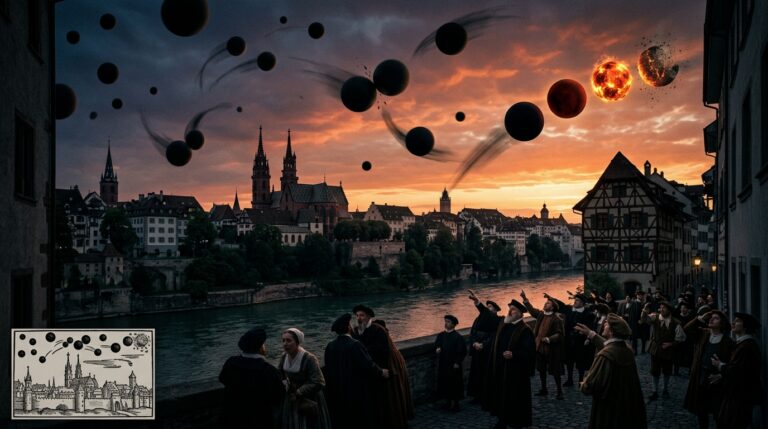
The first attempted UFO photograph — Lausanne, Switzerland, August 1762
THINK ABOUTIT UFO|UAP SIGHTINGS REPORT
1762: The Lausanne Fusiform Object | The First Attempted UFO Photograph
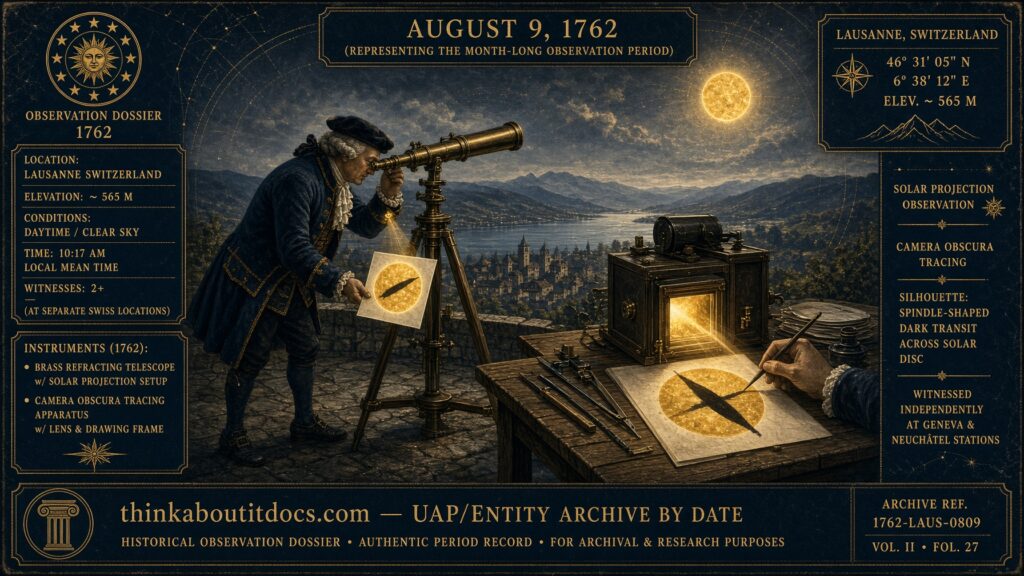
For nearly a month, an amateur Swiss astronomer trains his telescope on the sun almost every day and watches a spindle-shaped object cross and eclipse it. He doesn’t just describe it — he traces its outline with a camera obscura and sends the resulting image to the Royal Academy of Sciences in Paris. A second observer, independently, sees the same shape from a different location. A third astronomer, watching the sun from Paris at the same time, sees nothing at all.
Date: August 9, 1762 (with near-daily observation continuing for nearly a month afterward)
Sighting Time: Daytime, while observing the sun
Day/Night: Day
Location: Lausanne, Switzerland, with a corroborating observation from Sole, near Basel
Urban or Rural: Urban — observed from a fixed telescope station
No. of Entity(‘s): Not Applicable
Entity Type: Not Applicable
Entity Description: Not Applicable
Hynek Classification: DD (Daylight Disc/Object), observed via solar transit
Duration: Observed almost daily for nearly a month
No. of Object(s): One
Description of the Object(s): A fusiform (spindle-shaped) object observed crossing and eclipsing the sun’s disc through telescopic observation
Shape of Object(s): Fusiform/spindle-shaped; the Basel observer’s version presented more of an edge and was narrower
Size of Object(s): Not recorded in absolute terms; visible in silhouette against the solar disc
Color of Object(s): Dark/silhouetted against the bright solar disc
Distance to Object(s): Not calculable from a solar transit observation of this kind
Height & Speed: Not recorded
Number of Witnesses: At least two independent named observers (de Rostan at Lausanne, an unnamed friend at Sole near Basel); notably NOT observed by a third astronomer, Monsieur Messier, watching the sun from Paris at the same time
Special Features/Characteristics: De Rostan traced the object’s outline using a camera obscura and submitted the resulting image to the Royal Academy of Sciences in Paris — described by later compilers as likely the first attempted scientific image of a UAP in history; the original image no longer survives; the object’s non-visibility from Paris at the same time is cited as evidence against a sunspot explanation, since sunspots would be visible from any location observing the same solar face
Case Status: Unexplained
Source: Harold T. Wilkins, Flying Saucers on the Attack, pp. 211–212
Summary/Description: Monsieur de Rostan, an amateur astronomer and member of the Medico-Physical Society of Basel, observed through telescope a fusiform object crossing and eclipsing the sun beginning August 9, 1762, at Lausanne, Switzerland. He was able to observe the object almost daily for nearly a month, and traced its outline with a camera obscura, sending the resulting image to the Royal Academy of Sciences in Paris — an image that, per later compilers, no longer survives. A friend of de Rostan’s, living at Sole near Basel, independently observed a similar spindle-shaped object against the sun, though it appeared to present more of an edge and was somewhat narrower than de Rostan’s observation. A third astronomer, Monsieur Messier, studying the sun from Paris during the same period, did not observe the object at all — cited by period sources as an indication the object was not a sunspot, since a sunspot would have been visible from any location observing the same solar face at the same time.
Related Cases: Not Applicable
Detailed Report
Unlike most 18th-century sightings in this archive, the Lausanne case is preserved not through a chronicle, pamphlet, or oral tradition, but through the description of an actual attempted scientific documentation process. De Rostan’s membership in the Medico-Physical Society of Basel places him within a genuine period scientific institution, and his method — sustained, near-daily telescopic observation over nearly a month, combined with an attempt to mechanically trace the object’s outline using a camera obscura for submission to the Royal Academy of Sciences — represents a level of methodological rigor unusual even among this archive’s better-documented astronomical entries. The unfortunate loss of the original traced image means the case’s most valuable piece of potential physical evidence cannot be independently examined today.
The account’s most analytically interesting feature is the geographic discrepancy in visibility: two observers in Switzerland, at different locations, both saw a fusiform object crossing the sun with slightly different apparent shapes (suggesting genuine parallax or a genuinely three-dimensional object viewed from different angles), while a third astronomer in Paris observing the sun during the same general period saw nothing. If accurately reported, this pattern is inconsistent with a sunspot (which would be visible identically from any location viewing the same face of the sun) and more consistent with either a relatively low-altitude object passing between specific observers and the sun, or with independent observational error at one or more locations. The available secondary source does not allow this to be resolved with confidence.
RESEARCHER’S NOTES
The Lausanne Fusiform Object — Switzerland 1762 and the First Attempted UAP Photograph
- Source chain assessment: This account reaches the archive through Harold T. Wilkins’s 20th-century compilation rather than a directly cited 18th-century primary document; while de Rostan’s Medico-Physical Society membership and the Royal Academy of Sciences submission are asserted, the original submission and image have not been independently located or verified by this archive.
- Physical evidence / evidentiary weight: The camera-obscura-traced image, described as likely the first attempted scientific image of a UAP in history, no longer survives — a significant loss, since its existence (or absence) would substantially affect this case’s evidentiary weight one way or the other.
- Classification issues / corrections: The differing apparent shape reported by the two Swiss observers, combined with the object’s non-visibility from Paris, argues against a simple sunspot misidentification, but the available secondary sourcing does not permit a confident alternative classification, leaving the case Unexplained.
- Pattern context / comparative cases: This sighting belongs to the broader cluster of credentialed 18th-century astronomical anomaly observations in this archive, including the multiply-observed “Venus satellite” Neith reports spanning Fontana (1645), Short (1740), Lagrange (1761), and Horrebow (1768) — a separate but comparably persistent astronomical puzzle of the same general period.
The Lausanne fusiform object stands as the archive’s clearest example of a genuine period attempt at rigorous scientific documentation of an anomalous aerial phenomenon — sustained observation, mechanical tracing, and formal submission to a national scientific academy — undermined only by the loss of the one piece of physical evidence that might have settled the question definitively.
“I was able to observe this object almost daily for nearly a month. I also managed to trace its outline with a camera obscura and sent the image to the Royal Academy of Sciences in Paris.”