THINK ABOUTIT ABDUCTION REPORT
1753: Alberto Gordoni’s disappearance in Catania, Sicily, Italy
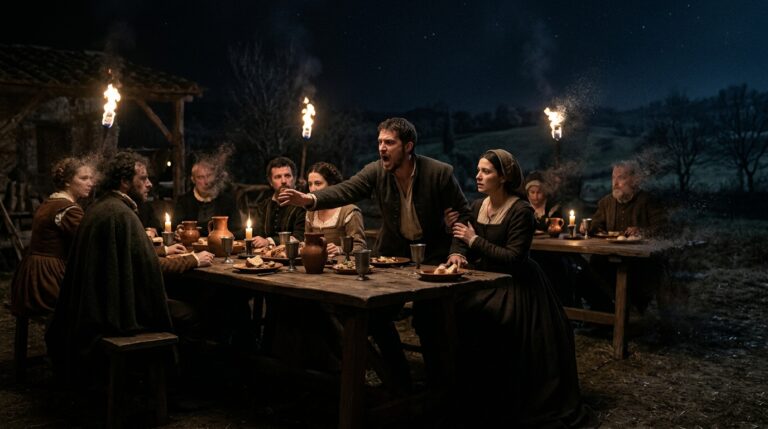
On May 3, 1753, in the castle yard at Catania, Sicily, Alberto Gordoni — a respected local artisan — vanished in plain sight before his wife, the Duke of Zenini, and several other witnesses. They dug up the ground immediately. They found nothing. No pit, no hollow, no trace of the man who had been standing there a moment before. Twenty-two years passed. Then, on the same spot in the castle yard, Alberto Gordoni reappeared. He claimed he had not disappeared at all — that only moments had passed from his perspective. He was committed to a rest home for the feeble-minded. Seven years later, a physician named Father Mario spoke with him there and became convinced he was telling the truth. Alberto described what had happened to him: a tunnel with a vague white light at its end, weird mechanisms he could not recognize, a large canvas covered with stars and pulsating dots, and a tall thin female entity who explained that he had fallen into a cleft of time and space and that it would be very difficult to send him back. She told him about holes opening in darkness, white drops, thoughts moving at the speed of light, souls without bodies and bodies without souls, and flying cities where eternally young entities dwell. Father Mario brought him back to the location. Alberto took one step and disappeared again — this time forever. Father Mario fenced the location and named it: The Trap of the Devil.
Date: May 3, 1753 — first disappearance; 1775 — reappearance; 1782 — second disappearance
Sighting Time: Daytime
Day/Night: Day
Location: Castle yard, Catania, Sicily, Italy
Urban or Rural: Urban — castle grounds, Catania
No. of Entity(s): 1 — tall thin human-like figure with long hair, probably female
Entity Type: Tall thin humanoid — probable female; encountered inside the dimensional space Alberto entered
Entity Description: A tall thin human-like figure with long hair, probably female. She communicated directly with Alberto about the nature of the space he had entered — explaining dimensional fissures, temporal differentials, flying cities, and the difficulty of returning him. She was apparently capable of initiating or facilitating dimensional transit but described the return as extremely difficult.
Hynek Classification: CE-IV — Close Encounter of the Fourth Kind; witnessed daytime physical disappearance of the witness; 22 years of missing time experienced as moments; entity contact inside the dimensional space; second disappearance permanent; location permanently anomalous — fenced and named The Trap of the Devil
Duration: First disappearance: 22 years Earth time / moments subjective time. Second disappearance: permanent — never returned
No. of Object(s): None described — no craft; the dimensional aperture itself is the associated phenomenon
Description of Object(s): N/A — the dimensional cleft or fissure is the access mechanism; described internally as a tunnel leading to a white light
Shape of Object(s): N/A
Size of Object(s): N/A
Color of Object(s): White light at tunnel end; star canvas described as dark with pulsating points
Distance to Object(s): N/A — Alberto was inside the dimensional space
Height & Speed: N/A — inside dimensional space
Number of Witnesses: Multiple — Alberto’s wife, the Duke of Zenini, and other countrymen witnessed the first disappearance; Father Mario witnessed the second disappearance
Special Features / Characteristics: Witnessed daytime vanishing — multiple high-credibility witnesses including the Duke of Zenini; immediate ground investigation found no physical explanation; 22 years Earth time experienced as moments by the witness — extreme temporal differential; tunnel with white light as dimensional transit mechanism; weird mechanisms — unknown technology inside the dimensional space; star canvas with pulsating dots — possibly a navigational display or astronomical view from inside the space; tall thin female entity with explicit dimensional and cosmological knowledge; entity described flying cities of eternally young entities — immortal civilizations; second disappearance witnessed by Father Mario at exactly the same location; the location permanently anomalous — Father Mario fenced it and named it The Trap of the Devil; the location has remained associated with anomalous disappearances in Sicilian tradition; the 22-year temporal differential is the longest documented in the pre-modern Italian abduction record; the case was documented in Planet X monthly newspaper, Kiev Ukraine, July 2005 from Italian regional historical sources
Case Status: Unexplained — permanent disappearance; location documented as anomalous
Source: Planet X monthly newspaper, Kiev, Ukraine, July 2005 — “The Trap of the Devil”
Summary/Description: On May 3, 1753, Alberto Gordoni vanished from the castle yard in Catania, Sicily in plain sight of his wife, the Duke of Zenini, and other witnesses. He reappeared 22 years later at the same spot claiming only moments had passed. Committed as feeble-minded, he was interviewed 7 years later by Father Mario who believed him. Alberto described a dimensional tunnel, unknown mechanisms, a star canvas with pulsating dots, and a tall thin female entity who explained he had fallen into a cleft of time and space. Father Mario brought him back to the site; Alberto stepped onto it and vanished permanently. Father Mario fenced the location and named it The Trap of the Devil.
Related Cases: 1572 CE Romerswil Switzerland Hans Buchmann 2.5-Month Abduction | 1593 CE Manila Philippines Gil Pérez Teleportation | Italian CE-IV Archive | Dimensional Anomaly Archive
DETAILED REPORT:
May 3, 1753. Catania, Sicily. The castle yard of a Sicilian noble estate — a specific, bounded, identifiable geographic location with defined walls, a known layout, and witnesses of social standing who are present when Alberto Gordoni simply ceases to exist.
Gordoni was a respected local artisan — a craftsman with an established reputation in the community, a man whose social position gave him something to lose by unusual behavior and nothing to gain by fabricating an extraordinary disappearance. He was walking in the yard. His wife was there. The Duke of Zenini was there. Other countrymen — the account’s word — were present. Multiple witnesses of varying social status from a working artisan’s wife to a duke.
He disappeared.
Not fainted, not fell, not ran — disappeared. In plain sight. The witnesses dug up the ground immediately, in the location where he had been standing. They found no pit, no hollow space, no physical explanation for where a man could have gone in the seconds since he was visible. The search was immediate and thorough enough to be recorded as part of the account. Nothing.
Twenty-two years passed.
Then Alberto Gordoni reappeared in the castle yard — at the same location — in 1775.
He claimed he had not disappeared at all. From his subjective perspective, nothing unusual had happened. No time had passed. He was there and then he was there. The community’s response to a man who had been absent for 22 years insisting that he had not been absent was entirely rational: he was committed to a rest home for the feeble-minded. A man who returns after 22 years claiming continuity of experience has produced the only account available to him, and 18th century Sicily had one institutional response to it.
Seven years later — in 1782 — Father Mario, a physician, came to speak with Alberto.
Father Mario listened carefully. He assessed Alberto not as a deluded man but as a credible witness to something he could not explain. His professional judgment was that Alberto was not lying. He was telling the truth as he experienced it. The account Alberto gave Father Mario in that rest home in 1782 is the most extraordinary element of the entire case.
Alberto described a tunnel. He had walked into something like a tunnel — a passage of some kind — toward a vague white light at its far end. Inside he encountered objects and mechanisms — weird mechanisms, totally unknown and unrecognizable to him. Not furniture, not tools, not anything in the visual vocabulary of an 18th century Sicilian craftsman. Unknown technology.
Then he saw what he could only describe as a large canvas covered with stars and dots that pulsated independently. Not a painting. Not a sky — pulsating dots on a canvas is not the description of any sky Alberto had ever seen. Something else entirely. Possibly a navigation display. Possibly a dimensional map. Possibly a view of a reality orthogonal to the one he had left. He described what he saw as accurately as his available vocabulary permitted. The archive holds the description without translating it into certainty.
The entity appeared.
A tall thin human-like figure with long hair, probably female. She told Alberto what had happened to him with specificity that 18th century Sicilian theology and natural philosophy could not have generated independently: he had fallen into a cleft of time and space. A fissure in the dimensional fabric. It would be very difficult to deliver him back. The temporal differential he was experiencing — moments of subjective time for each year of Earth time — was a function of where he was rather than anything that had been done to him intentionally.
She told him about holes opening in darkness. White drops — perhaps energy events, perhaps dimensional access points. Thoughts moving at the speed of light. Souls without flesh and body, and bodies without souls — suggesting a civilization or a class of beings operating at a different relationship between consciousness and physical form than the human baseline. Flying cities. Entities dwelling in them who are eternally young.
Alberto begged her to send him back. She told him it would be very difficult. He kept asking. Eventually the mechanism worked — he was returned to the castle yard in 1775, 22 years after he left, having experienced the transit as moments.
Father Mario became convinced. He took Alberto back to Catania, to the castle yard, to the exact location. Whether this was a therapeutic attempt to help Alberto reconnect with his experience or a scientific attempt to document the anomalous location, the outcome was the same.
Alberto took one step onto the location and disappeared again.
Father Mario watched. He crossed himself. He ordered the location fenced. He named it — in the theological vocabulary available to an 18th century Sicilian physician-priest — The Trap of the Devil. The location remained fenced and remained associated with anomalous disappearances in Sicilian regional tradition.
Alberto Gordoni was never found.
RESEARCHER’S NOTES:
The Catania Trap — Dimensional Fissure, 22-Year Temporal Differential, and the Most Extraordinary Entity Briefing in the Pre-Modern Archive
- The Temporal Differential as Classification Feature: The 22-year Earth time experienced as moments by Alberto Gordoni is the largest documented temporal differential in the pre-modern CE-IV record. Hans Buchmann in 1572 experienced 2.5 months as an unrecalled interval. Jacob Jacobsson in 1759 experienced 4 days as hours. Alberto experienced 22 years as moments. The extreme compression of subjective time relative to Earth time is consistent with modern theoretical physics frameworks for time dilation in regions of different spacetime curvature — frameworks that did not exist in 1753 and that an 18th century Sicilian artisan could not have accessed as a source for fabricating his account.
- The Entity’s Cosmological Briefing: The tall thin female entity’s description of holes in darkness, white drops, thoughts at light speed, souls without bodies, bodies without souls, and flying cities of eternally young beings is one of the most informationally dense entity communications in the pre-modern record. It anticipates by two centuries the cosmological vocabulary of modern contact research — dimensional access points, consciousness-body dissociation, advanced civilizations of apparent immortals. The specificity and coherence of the information argues for genuine communication rather than psychotic confabulation.
- The Second Disappearance as Location Verification: Father Mario’s witness of Alberto’s second disappearance at exactly the same location as the first is the most analytically significant physical evidence in the case. The location is the anomaly — not Alberto, not the entity, not the dimensional space Alberto entered. The location functions as a stable access point that produces the same result when stepped on by the same person. Father Mario’s response — fencing and naming the location — was an institutional acknowledgment that the location itself was the source of the phenomenon.
- Father Mario’s Professional Assessment: Father Mario was a physician-priest — combining the medical and theological professional training of 18th century educated Italy. His professional assessment that Alberto was not lying and his decision to return Alberto to the location represent the most methodologically rigorous engagement with an anomalous abduction case in the pre-modern Italian record. His subsequent naming and fencing of the location constitutes the earliest documented anomalous zone designation in the Sicilian UAP record.
Alberto Gordoni stepped into a dimensional cleft in a castle yard in Catania on May 3, 1753 and spent 22 years of Earth time experiencing moments, talked to a tall thin female entity about flying cities and souls without bodies, and was returned to the same yard in 1775 to be committed as feeble-minded. Seven years later Father Mario listened to him, believed him, and brought him back to the location. Alberto stepped on it and was gone forever. Father Mario fenced the spot and called it The Trap of the Devil. The archive holds every element of this case — the witnesses, the duke, the digging, the 22 years, the tunnel, the unknown mechanisms, the star canvas, the entity, the briefing, the second disappearance, the fence. Whatever opened in that Sicilian castle yard in 1753 opened again in 1782. Alberto Gordoni entered it twice. He only came back once.