THINK ABOUTIT CLOSE ENCOUNTER REPORT
1620: Demon in Quimper-Corentin, France
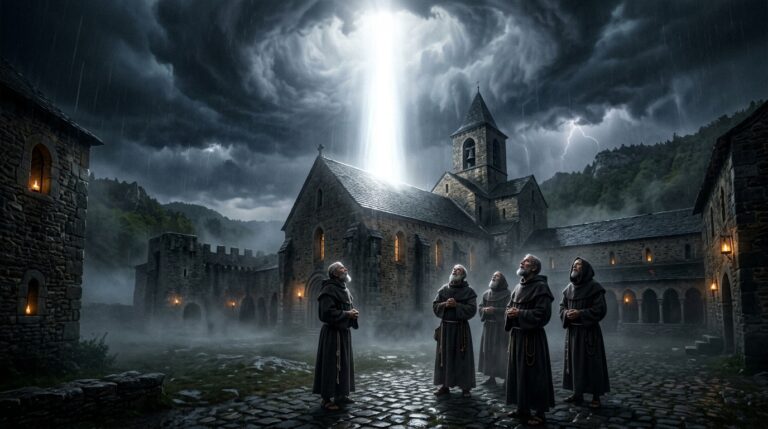
On the evening of February 1, 1620, at 7:30 PM, lightning struck the lead-covered pyramid on the roof of the cathedral of Quimper-Corentin in Brittany, France. The pyramid caught fire, exploded, and collapsed with a stupendous noise. Citizens rushed from every part of the city to the cathedral. What they found in the fire was not explainable by lightning. Inside the flames, clearly visible to everyone present, was a being — described as a demon — green in color, with a long green tail, actively working to keep the fire burning. The authorities threw consecrated objects into the fire. They threw 150 buckets of water at it. They threw forty to fifty cartloads of manure at it. None of it stopped the fire and none of it drove away the entity, which continued its work inside the flames shifting color from green to blue to yellow. It was not until a consecrated host mixed into bread was thrown into the fire, and blessed water mixed with bile from a morally unimpeachable nurse was spread over both the entity and the burning pyramid, that the being responded. It whistled in a most horrible fashion and flew away. The event was published simultaneously in Paris and Rennes in two versions — the Rennes version more complete — and was preserved by Jacques Vallée in Passport to Magonia as one of the most precisely documented early 17th century CE-III cases in the French record.
Date: February 1, 1620
Sighting Time: 19:30 — between 19:30 and 20:00
Day/Night: Night
Location: Quimper-Corentin, Brittany, France — cathedral roof and immediate surroundings
Urban or Rural: Urban — city center, cathedral
No. of Entity(s): 1
Entity Type: Non-human entity — described as a demon; early reports describe a green humanoid
Entity Description: A being inside the fire on the cathedral roof, clearly visible to all witnesses. Color-shifting — sometimes green, sometimes blue and yellow. Body and long tail described specifically. Active behavior — observed working to maintain and increase the fire rather than simply being present within it. Responded to specific ritual compounds by whistling horribly and departing by flight. Did not respond to water, consecrated objects thrown at distance, or manure.
Hynek Classification: CE-III — Close Encounter of the Third Kind; close observation of an animate being by multiple witnesses in a public location; the being responded to specific physical stimuli confirming its physical reality
Duration: Approximately 30 minutes to more than one hour — from arrival of citizens after the explosion through the entity’s eventual departure
No. of Object(s): 1 — the fire itself may be considered the associated phenomenon; no separate craft described
Description of Object(s): N/A — fire on cathedral roof pyramid following lightning strike
Shape of Object(s): N/A
Size of Object(s): N/A — entity visible inside flames at a scale distinguishable to multiple witnesses
Color of Object(s): Green primarily; shifting to blue and yellow — the entity itself was the colored element within the fire
Distance to Object(s): On the cathedral roof — close enough for the entire city population to observe color detail and behavioral activity
Height & Speed: Elevated — on cathedral roof pyramid; departed by flight
Number of Witnesses: Multiple — the entire population of Quimper who rushed to the cathedral; published accounts in both Paris and Rennes confirm community-wide observation
Special Features / Characteristics: Color-shifting entity — documented changing between green, blue, and yellow; deliberate behavioral intent — entity observed actively maintaining the fire rather than passively existing within it; systematic failure of suppression — 150 buckets of water, 40–50 cartloads of manure, and consecrated objects thrown at distance all failed to affect the entity or extinguish the fire; specific trigger for departure — consecrated host in bread plus blessed water mixed with bile from a morally credible nurse caused the entity to respond; departure method — whistled horribly and flew away; dual publication record — Paris and Rennes versions of the account; documented by Jacques Vallée in Passport to Magonia
Case Status: Unexplained
Source: Jacques Vallée, Passport to Magonia (1969); contemporary publications in Paris and Rennes, 1620
Summary/Description: On February 1, 1620, lightning struck the lead pyramid on the roof of Quimper-Corentin cathedral in Brittany, France, at 7:30 PM. Citizens rushing to the scene found a green color-shifting entity with a long tail inside the fire, actively working to maintain it. All conventional and ritual suppression attempts — 150 buckets of water, 40–50 cartloads of manure, consecrated objects — failed. Only a combination of consecrated host in bread and blessed water mixed with nurse’s bile caused the entity to whistle horribly and fly away. Published in Paris and Rennes in 1620 and preserved by Jacques Vallée.
Related Cases: 1608 CE Nice France Baie des Anges Scaly Entities | 1390 CE Bologna Italy Rotating Ball with Faces | Pre-Modern Entity in Fire Archive
DETAILED REPORT:
February 1, 1620. Quimper-Corentin — the cathedral city of Brittany, at the confluence of the Odet and Steir rivers in the far west of France. The cathedral of Saint-Corentin, one of the great Gothic cathedrals of Brittany, dominates the city skyline. On its roof sits a lead-covered pyramid — an architectural feature of the period that rises above the main structure.
At 7:30 in the evening, lightning strikes it.
The pyramid catches fire. Then it explodes. Then it collapses with what the accounts describe as a stupendous noise — a sound loud enough and violent enough to send the citizens of Quimper-Corentin running from every direction toward the cathedral to find out what has happened.
What they find is not what lightning does to a building.
Inside the fire on the ruined roof, clearly visible to everyone who has gathered, is a being. The early accounts describe it as green — a green entity with a long green tail. The more complete Rennes version of the account adds that it was seen clearly by all witnesses inside the fire, and that its color was not fixed: sometimes green, sometimes blue and yellow. Not the colors of fire. The colors of the entity itself, shifting within the flames that should have been consuming everything on the cathedral roof.
And it is not simply present in the fire. It is working. The witnesses describe it as doing its best to keep the fire going — an entity not incidentally caught in a burning building but actively engaged in maintaining and extending the combustion that has brought the entire population of the city to the cathedral steps.
The authorities respond with what is available to them.
They throw consecrated objects — Agni Dei, small wax discs stamped with the image of the Lamb of God and blessed by the Pope, considered among the most potent protective items in the Catholic arsenal — into the roaring fire. Nothing happens. The entity continues its work.
They bring water. Not a bucket or two — 150 buckets of water are thrown at the fire and the entity inside it. The fire keeps burning. The entity keeps working.
They bring manure. Forty to fifty cartloads of manure are piled onto the burning cathedral pyramid. This is not a small quantity — it represents a massive physical intervention by a large portion of the city’s population, a coordinated effort to smother the fire with organic material. Nothing. The entity is still there. The fire is still burning.
Everything available to a 17th century French cathedral city has been tried and has failed.
Someone proposes something more specific. A consecrated host — the Eucharistic bread at the center of Catholic sacramental theology, considered the most sacred physical object in the Catholic tradition — is placed inside a loaf of ordinary bread and thrown into the flames. Simultaneously, blessed water is mixed with bile obtained from a nurse described in the account with careful specificity as a woman of above reproach conduct — the moral integrity of the nurse being apparently relevant to the efficacy of her bile as a ritual component — and this mixture is spread over both the entity and the burning pyramid.
The entity responds.
It whistles in what the account describes as a most horrible fashion. And it flies away.
The fire — presumably — went with it or was brought under control in its absence. The account’s focus on the entity’s departure rather than the fire’s subsequent behavior suggests that the resolution of the entity was the resolution of the event.
The account was published in Paris. A more complete version was published in Rennes. Both are cited by Jacques Vallée in Passport to Magonia as a significant pre-modern CE-III case — notable for its multiple witnesses, its precise documentation of failed suppression methods, the specificity of the successful intervention, and the entity’s behavioral response to the final compound that drove it away.
RESEARCHER’S NOTES:
The Quimper Entity — Color-Shifting Behavior, Suppression Failure, and a Very Specific Exit Trigger
- Color-Shifting as Behavioral Indicator: The entity’s documented color shifts — from green to blue to yellow — observed clearly by multiple witnesses inside the fire are analytically significant because they suggest active state changes in the entity rather than passive appearance. Color-shifting behavior in non-human entities appears across the pre-modern and modern record often in association with energetic or reactive states. The Quimper entity was shifting colors in the context of active fire-maintenance work — suggesting the color changes reflected functional states rather than mere visual variation.
- Systematic Suppression Failure: The failure of 150 buckets of water, 40–50 cartloads of manure, and thrown consecrated objects to affect either the fire or the entity is analytically significant because it documents the systematic exhaustion of every available intervention before the specific successful compound was identified. This is not a folklore account in which the hero immediately knows the remedy. It is a trial-and-error sequence that failed repeatedly before succeeding — the hallmark of genuine problem-solving under observation rather than narrative construction.
- The Specific Exit Trigger: The combination of consecrated host in bread plus blessed water mixed with a morally credible nurse’s bile is one of the most analytically specific entity-exit triggers in the pre-modern record. The specificity — including the moral character qualification for the nurse — suggests either a genuine observed response to a particular compound, or a post-hoc rationalization of a coincidental departure. The account’s precision in describing both components and their application argues for the former. Whatever drove the entity away required something more targeted than water, manure, or standard consecrated objects.
- Dual Publication Record: The simultaneous publication of this event in both Paris and Rennes in 1620 — with the Rennes version being more complete — establishes an independent documentation chain that argues against fabrication by a single source. Two separate publishers in two different cities chose to print this account, which means it circulated through independent channels with sufficient credibility to warrant publication in both the capital and in the regional city closest to the event.
A green color-shifting entity worked to maintain a cathedral fire in Quimper-Corentin for over half an hour on February 1, 1620, while the entire population of the city watched and every intervention they attempted failed. It did not leave when they threw holy objects at it. It did not leave when they poured 150 buckets of water on it. It did not leave when they buried it in cartloads of manure. It left when something specific was prepared and applied to both it and the pyramid it was working on — and when it left, it whistled horribly and flew. Published in Paris and Rennes in the same year. Preserved by Jacques Vallée four centuries later. The archive holds it now. The entity that kept the Quimper fire burning knew what it was doing and knew exactly what it could not tolerate. That specificity is the most unsettling detail in a case full of unsettling details.