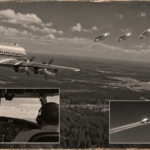
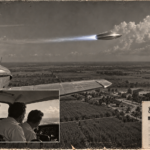
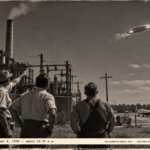
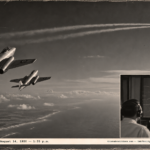
Dossier reconstruction of the three orange lights reported over Tunis, Tunisia, July 17, 1988.
THINK ABOUTIT UFO|UAP ENCOUNTER REPORT
1988: Tunis, Tunisia UFO Sighting | Three Orange Lights Case Archive
On the night of July 17, 1988, three siblings and cousins lying on a terrace in Tunis, Tunisia, watching the stars, noticed what looked at first like an approaching plane — until it resolved into three orange lights, arranged in a triangle, drifting toward them at what they judged to be about 30 km/h. Only later, they say, did they come to understand these as three lights belonging to a single, much larger, saucer-shaped craft. Spooked as the lights grew larger, the three got up and hid, still watching, until the lights suddenly shot away like a falling star.
There’s a real problem with the account’s own timeline worth addressing directly rather than smoothing over: the witness recalls seeing footage the very next day of the Belgian Air Force scrambling two F-16s after a UFO, matching “the three lights” they’d seen. That Belgian intercept is a real, thoroughly documented event — but it took place on the night of March 30–31, 1990, not in July 1988. This entry keeps that discrepancy front and center rather than quietly resolving it.
Date: July 17, 1988, as given in the source — though see Researcher’s Notes regarding a significant unresolved chronological inconsistency
Sighting Time: Undocumented — described only as nighttime, while stargazing
Day/Night: Night
Location: Tunis, Tunisia (on a residential terrace)
Urban or Rural: Urban — corrected from “Rural.” Tunis is Tunisia’s capital and largest city; absent any indication the terrace was in a genuinely rural outlying area, “Rural” appears to be a mislabeling
Hynek Classification: NL (Nocturnal Light) — point or extended luminous source observed at night, retained despite the described structure, consistent with this archive’s treatment of similarly distant sightings
Duration: Undocumented — no total time given, though the account describes an extended approach, a period of hiding, and a sudden departure
No. of Object(s): 1 — a single large craft, initially perceived by the witnesses as three separate lights, later understood by them to be part of one saucer-shaped object
Description of the Object(s): Three orange lights, arranged in a triangular pattern, initially mistaken for approaching aircraft lights; grew larger as they approached, then departed suddenly “like a shooting star.” The witnesses came to believe these lights belonged to a single, huge, saucer-shaped craft, though they never saw the craft itself as a whole
Shape of Object(s): Disks (three light-emitting sections in a triangular arrangement, understood by the witnesses to be part of a single larger saucer-shaped craft)
Size of Object(s): Described only as “huge”; no numeric estimate given
Color of Object(s): Orange
Distance to Object(s): Undocumented — corrected from a speed figure mistakenly placed in this field; see Height & Speed and Researcher’s Notes
Height & Speed: Witness estimated the lights’ speed at approximately 30 km/h as they approached (this figure was misplaced under Distance to Object(s) in the original field data); no altitude given
Number of Witnesses: 3 — the witness, their brother, and a cousin, together on the terrace
Special Features/Characteristics: Initially mistaken for an approaching plane, distinguished by the absence of the flashing lights the witnesses associated with aircraft; witnesses fled and hid as the lights grew larger while continuing to watch; departure was sudden and very fast, described as “like a shooting star”; witness reports (with an important chronological caveat — see Researcher’s Notes) having seen news coverage the following day of a Belgian Air Force F-16 intercept of a UFO, with amateur video the witness felt matched what they had seen
Case Status: Insufficient Data — see Researcher’s Notes for rationale
Source: Undocumented — appears to be a directly submitted first-person account; original submission venue not specified
Summary/Description: On the night given as July 17, 1988, three witnesses on a terrace in Tunis, Tunisia watched three orange lights, arranged in a triangle, approach at an estimated 30 km/h before suddenly accelerating away. The witnesses came to interpret the lights as belonging to a single large saucer-shaped craft. The account also describes seeing news coverage the next day of a Belgian Air Force F-16 UFO intercept — an event that, per the historical record, actually occurred in March 1990, creating a significant unresolved discrepancy in the account’s timeline.
Related Cases: The witness’s own account connects this sighting to the Belgian UFO wave of 1989–1990, but the connection is chronologically inconsistent with the stated 1988 date of this sighting; see Researcher’s Notes. Not separately indexed in this archive.
Detailed Report
The witness recalls lying on a terrace in Tunis with a brother and cousin on the night of July 17, 1988, watching the stars and talking. The brother pointed out what looked like plane lights approaching from a distance — except they didn’t flash the way aircraft lights normally did, which caught the group’s attention. As they kept watching, the lights resolved into three distinct orange disks arranged in a triangular pattern, moving together, which the witnesses later came to interpret as three lights belonging to one very large, saucer-shaped craft, though they never saw a solid object connecting them.
The lights continued to approach, growing larger, at a pace the witness estimated at around 30 km/h. Unsettled, the three got up, moved back, and hid, all while continuing to watch the lights rather than looking away. Then, just as suddenly as they’d appeared, the lights shot off and away, vanishing like a falling star. The witnesses, by their own account, were left looking at one another, trying to make sense of what they’d just seen — a reaction the witness underscores by noting they had generally been skeptical of UFOs and the paranormal beforehand, and had no ready explanation to offer.
The account then adds a striking detail: the witness recalls that, the following day, an Italian television channel reported that the Belgian military had detected a UFO and scrambled two F-16 jets to intercept it, airing amateur video the witness felt showed the same three lights they had seen the night before.
This detail creates a substantial problem for the account’s own timeline, addressed directly in Researcher’s Notes rather than smoothed over: the Belgian Air Force’s F-16 intercept is a specific, extensively documented historical event that took place on the night of March 30–31, 1990 — not in July 1988, and not the day after this sighting is said to have occurred.
RESEARCHER’S NOTES
Three Lights Over Tunis — 1988 and a Timeline That Doesn’t Add Up
- Major Chronological Inconsistency: The witness states that “the next day” after the July 17, 1988 sighting, Italian television reported the Belgian military had detected a UFO and scrambled two F-16 jets, with amateur video showing “the three lights” they had seen. The Belgian UFO wave’s F-16 intercept, however, is a well-documented historical event that took place on the night of March 30–31, 1990 — almost two years after the date given for this sighting. This is a substantial, unresolved discrepancy in the witness’s own account, not a minor detail.
- Possible Explanations, Left Open: This archive does not attempt to resolve the discrepancy. Plausible explanations include a simple misremembering of the year of the Tunis sighting itself (with the true date closer to 1990), a later conflation of two separate memories — the original sighting and, at some unrelated point afterward, seeing Belgian wave coverage — or some other cause. Each would change how the case should be read, and none can be confirmed from the material available.
- Possible Memory Contamination: The witness’s own retrospective interpretation — that three separate lights were “part of one huge saucer-like shape” — closely echoes the iconic description of the Belgian wave’s “black triangle” craft, a single large object with three corner lights, the case’s most famous and widely reproduced description. Given the chronological questions above, it is worth considering whether the witness’s memory of their own sighting was reshaped by later exposure to that far more famous case — a well-documented phenomenon in eyewitness psychology, not a claim about the witness’s honesty.
- Even a Corrected Date Wouldn’t Fully Resolve It: Even if the sighting date is adjusted to 1990, the witness’s description of “an amateur video” showing the three lights doesn’t cleanly match the documented Belgian wave record, whose most famous visual evidence was a single still photograph (taken at Petit-Rechain, released in April 1990 and later admitted to be a hoax in 2011), not video of the F-16 intercept night itself.
- Field Correction: The original data placed “moved at a speed of 30 km/h” under Distance to Object(s); this is a speed figure, not a distance, and has been relocated to Height & Speed. No actual distance to the object is given anywhere in the source.
- Urban or Rural: The original field lists “Rural” for a sighting in Tunis, Tunisia’s capital and largest city; absent any indication the specific terrace was in a genuinely rural outlying area, this is corrected to Urban.
Three orange lights over a Tunis terrace, growing larger, then gone in an instant — that much of the account is simple and consistent. What isn’t simple is the date attached to it, tangled up as it is with a famous Belgian case that happened almost two years after this sighting is said to have taken place. This entry is filed as Insufficient Data because that tangle genuinely can’t be undone with what’s available, not because the core experience described seems implausible on its own terms.
“We could not believe our eyes.”