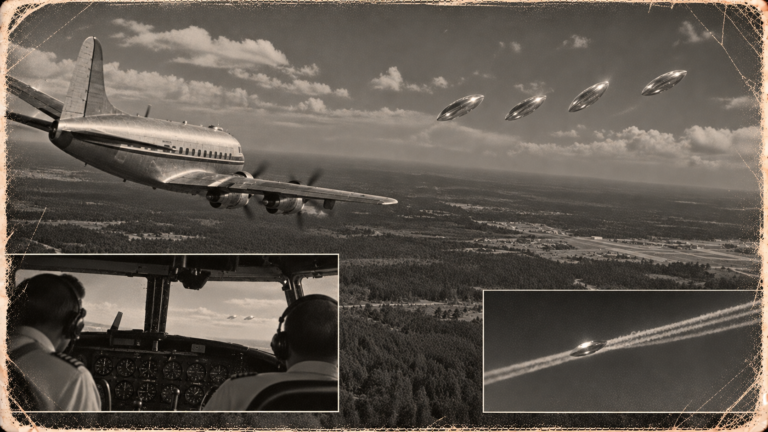
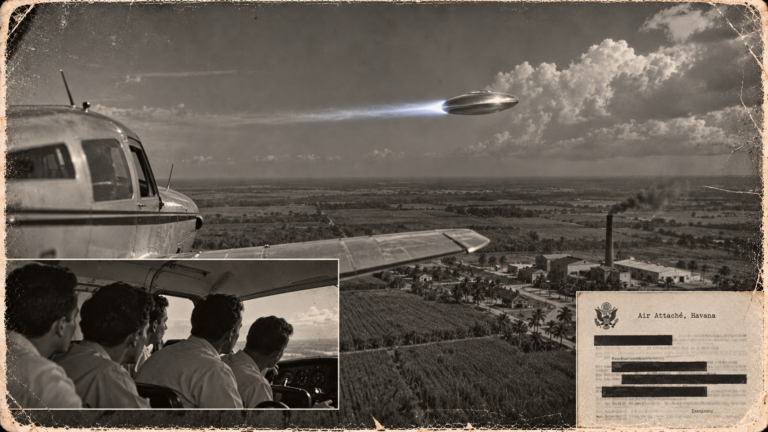
Dossier reconstruction of the object tracked over Haneda US Air Force Base, Japan, August 5–6, 1952.
THINK ABOUTIT UFO|UAP ENCOUNTER REPORT
1952: Haneda AFB, Japan UFO Case | RV Radar-Visual Case Archive
Just before midnight on August 5, 1952, control tower operators at Haneda US Air Force Base near Tokyo spotted a brilliant light hovering nearby — and behind it, through 7×50 binoculars, a dark circular shape roughly four times the light’s own diameter. Ground radar picked up the object at the same time. An F-94 interceptor was scrambled and vectored onto it; its radar operator got a solid lock, even though neither he nor his pilot ever managed to see the thing with their own eyes. At one point the target suddenly accelerated to a clocked 300 knots and split into three separate radar returns, holding quarter-mile spacing between them. Contact, by radar or by eye, continued for the better part of an hour.
Project Blue Book’s own contemporaneous verdict was “Unknown.” Sixteen years later, the Condon Report reclassified it as explained — the star Capella plus an atmospheric optical trick. Meteorologist James McDonald called that explanation “almost wholly unacceptable” and laid out why in detail. This entry gives Condon’s actual argument its full due rather than a critic’s paraphrase of it, and leaves the dispute exactly where the record leaves it: unresolved.
Date: August 5–6, 1952 (Project Blue Book file BBU 1827)
Sighting Time: Visual sighting began shortly before midnight on August 5; F-94 airborne at 00:03 on August 6; radar/visual contact continued for roughly 30 minutes to about an hour, depending on source. See Researcher’s Notes.
Day/Night: Night
Location: Haneda US Air Force Base, near Tokyo, Japan; also observed from Tachikawa AFB (approximately 30 miles west), involving the Shiroi GCI (Ground-Controlled Intercept) radar station
Urban or Rural: Haneda US Air Force Base (military installation)
No. of Entity(‘s): 0 — none reported
Entity Type: Not applicable
Entity Description: Not applicable
Hynek Classification: RV (Radar/Visual) — observation supplemented with radar, correctly applied
Duration: At least 30 minutes of radar/visual contact (per Gross’s summary); the Condon Report’s own account describes the visual object persisting for close to an hour before disappearing, possibly obscured by clouds
No. of Object(s): 1 primary object, which at one point split into three separate radar targets maintaining quarter-mile intervals
Description of the Object(s): An intensely brilliant light with a dark, circular body visible behind it, roughly four times the light’s own diameter; a secondary light was visible on the underside at one point; the object hovered, flew in curves, and performed a variety of maneuvers before accelerating sharply away
Shape of Object(s): Disc
Size of Object(s): The dark circular body was described as roughly four times the diameter of the brilliant light itself; no absolute size given
Color/Description of Object(s): An intensely brilliant light with a dark circular shape behind/around it
Distance to Object(s): Not given precisely; at one point the object came within about 10 miles of the AC&W radar station
Height & Speed: Speed varied from hovering to a clocked 300 knots (approximately 345 mph); no specific altitude figure given, though the object was visible from the control tower and to an inbound civilian aircraft
Number of Witnesses: Multiple — at least two Air Force control tower operators who first spotted the object, joined by additional personnel; ground radar (GCI) operators at Shiroi; the crew of the scrambled F-94 (pilot 1st Lt. W.R. Holder, radar operator 1st Lt. A.M. Jones); “scattered witnesses” during the extended encounter; and the pilot of an inbound civilian C-54 airliner, asked to observe the object, who reported it looked to him like a brilliant star
Case Status: Unexplained — Project Blue Book’s own original classification; the later Condon Report’s “explained” conclusion remains seriously disputed. See Researcher’s Notes.
Source: UFOs at Close Sight (Patrick Gross), ufologie.net; cross-referenced with the official Condon Report (Section III, Chapter 5) and a detailed rebuttal by Professor James E. McDonald
Summary/Description: On the night of August 5–6, 1952, Air Force personnel at Haneda AFB near Tokyo observed a brilliant, maneuvering light with a dark disc-shaped body, tracked simultaneously by ground and airborne radar over roughly half an hour to an hour. Project Blue Book classified the case “Unknown.” The 1968 Condon Report later proposed the star Capella and an atmospheric optical effect as an explanation, a conclusion directly disputed by atmospheric physicist James McDonald, who called it “almost wholly unacceptable.”
Related Cases: Frequently cited alongside other major Blue Book “Unknown” cases from the early 1950s radar-visual wave. Not separately indexed in this archive.
Detailed Report
Just before midnight on August 5, 1952, two Air Force control tower operators at Haneda US Air Force Base, near Tokyo, noticed a brilliant light in the sky. Other personnel joined them, and the group watched it through 7×50 binoculars as it approached the base slowly and came to a hover, plainly visible from the tower. Behind the light, observers could make out a dark, circular body roughly four times the light’s own diameter, with a second light visible on its underside at one point. The object hovered, flew in curves, and ran through a series of maneuvers.
Ground radar picked up the object at around the same time, and shortly after midnight an F-94 interceptor, piloted by 1st Lt. W.R. Holder with radar operator 1st Lt. A.M. Jones aboard, was scrambled and vectored onto it by Shiroi GCI (Ground-Controlled Intercept) radar. Jones obtained a solid airborne radar lock as the jet closed in, though the crew reported excellent visibility yet never achieved visual contact with the object itself. The target went through repeated circular maneuvers before suddenly accelerating to a clocked 300 knots and splitting into three separate radar returns, each holding a roughly quarter-mile interval from the others. Contact — by ground radar, airborne radar, or direct visual observation from Haneda — was maintained across a window that Gross’s summary places at “over 30 minutes,” though the Condon Report’s own reconstruction of the event describes the visual object persisting for closer to an hour before it disappeared, possibly obscured by cloud cover moving in over the base. During the encounter, an inbound civilian C-54 airliner was asked to look for the object; its pilot reported that it appeared to him like a brilliant star, and dismissed it as such.
Project Blue Book — the U.S. Air Force’s official, contemporaneous UFO investigation — classified the case “Unknown.” Major Dewey Fournet, Blue Book’s own liaison at the Pentagon at the time, considered the object’s maneuvers so clearly deliberate that he cited this case as evidence supporting the hypothesis that UFOs were craft of extraterrestrial origin — a line of internal analysis that reportedly went nowhere afterward.
Sixteen years later, in 1968, the University of Colorado’s UFO study — the “Colorado Project,” whose findings became the Condon Report — revisited the case and reached a different conclusion. Rather than the vague “star” dismissal sometimes attributed to it, the Condon Report’s actual proposal was specific: the star Capella (magnitude 0.2, roughly 8° above the horizon), its light distorted by a hypothesized atmospheric effect — possibly a sharp temperature inversion producing a corona-like diffraction through a layer of moist air over Tokyo Bay. The report treated the radar detections as likely unrelated to the visual sighting altogether, pointing out, among other inconsistencies, that the fast radar target’s plotted path passed close to the Shiroi GCI site without any of the personnel there — who went outside and looked — seeing a corresponding light.
That conclusion did not go unchallenged. Professor James E. McDonald, a specialist in meteorology and atmospheric physics who separately reviewed and disputed numerous Condon Report cases, concluded that the Capella hypothesis could not adequately account for the reported details and called the Condon Report’s explanation “almost wholly unacceptable.” On the specific point about Shiroi personnel failing to see a light, McDonald countered that a highly directional or semi-directional light source — of a kind not unusual even in ordinary technology — could easily go undetected from one particular vantage point without that failure meaningfully strengthening the case for Capella as the source of what Haneda and Tachikawa observers saw.
RESEARCHER’S NOTES
The Haneda AFB Case — Japan 1952 and a Reclassification Under Dispute
- Blue Book’s Original Classification vs. the Later Condon “Explanation”: Project Blue Book’s own contemporaneous investigation, conducted while the case was fresh, classified it as “Unknown.” It was only sixteen years later, in the 1968 Condon Report — a study whose stated purpose included winding down official Air Force involvement in UFO investigation — that the case was reclassified as “explained.” This entry retains the original Unknown/Unexplained designation, given the significant, credentialed challenge to the later reclassification described below.
- The Condon Report’s Actual Explanation: Rather than simply “a light that looked like a star,” the Condon Report’s specific proposed explanation was the star Capella, combined with a hypothesized atmospheric optical effect — possibly a temperature inversion producing a corona-like diffraction around the star’s light — while treating the radar detections as likely unrelated to the visual sighting. This is a considerably more specific and substantive argument than a bare dismissal, and is presented here in its own terms rather than only through a critic’s paraphrase.
- McDonald’s Rebuttal: Professor James E. McDonald argued the Capella hypothesis did not adequately explain the reported details and that the Condon Report’s own account contained internal timing inconsistencies. He specifically challenged the Condon Report’s argument that Shiroi GCI personnel saw no corresponding light where radar showed a target, countering that a highly directional light source could explain non-detection from certain angles without disproving a physical object.
- A Skeptical Data Point Worth Weighing Fairly: The pilot of an inbound civilian C-54 aircraft, asked to observe the object, reported that it looked to him like a brilliant star and dismissed it as such — a contemporaneous, professionally trained observer’s assessment that lends some genuine support to the Condon Report’s star-based explanation, even as the broader radar and maneuver data remain harder to reconcile with it.
- Radar-Visual Correlation Disputed: The Condon Report argued the visual sighting and the radar detections may not have been the same phenomenon at all, noting that the fast-moving radar target’s path passed close to Shiroi GCI without a corresponding light being seen there. Gross’s account treats the radar and visual observations as clearly describing a single object. This entry does not resolve that dispute.
- Duration Discrepancy: Gross’s summary states contact was maintained “for over 30 minutes,” while the Condon Report’s own account describes the visual object persisting for close to an hour before disappearing, possibly obscured by cloud cover. Both figures are presented here rather than reconciled into one.
The Haneda case is a rare instance where both sides of a UFO dispute are backed by credentialed, careful analysis — a Pentagon Blue Book officer who saw evidence of deliberate control, and a government-commissioned study that named a specific star and a specific atmospheric mechanism, only to be challenged point by point by an atmospheric physicist who found that explanation wanting. This archive doesn’t referee that fight. It restores the Condon Report’s actual argument to its full weight and lets it stand next to McDonald’s rebuttal, filed as Unexplained on the strength of Blue Book’s own original word for it.
“Almost wholly unacceptable.” — James E. McDonald, on the Condon Report’s explanation