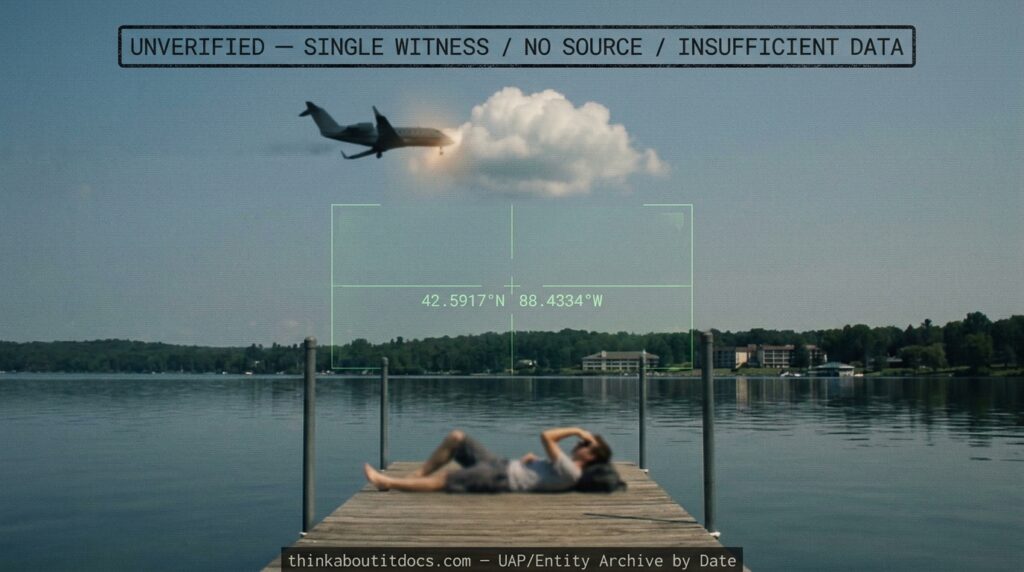
Summer 2002 — A small jet entered a cloud over Lake Geneva, Wisconsin and never emerged. Single anonymous witness, no corroboration, no investigation conducted.
THINK ABOUTIT UFO|UAP SIGHTING REPORT
2002: Aircraft Fly’s Into A Cloud & Disappears
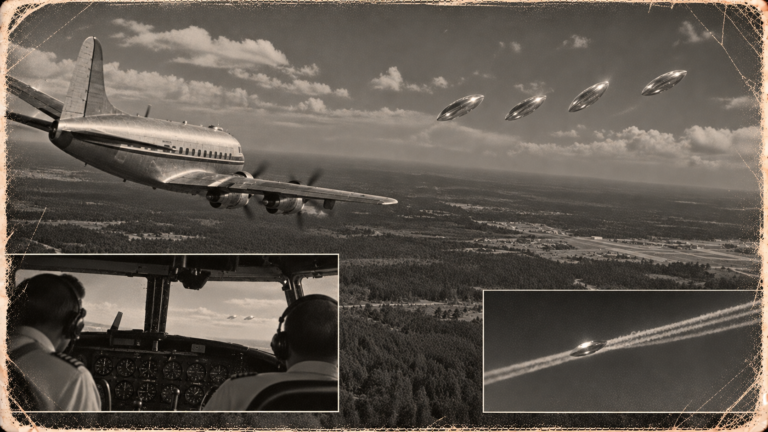
On a clear summer afternoon in 2002, a lone observer lying on a private pier on Lake Geneva, Wisconsin watched a small twin-engine jet fly directly overhead at approximately 5,000 feet and enter a mid-sized cloud. The aircraft never emerged. The engine noise — audible and continuous up to the moment of entry — ceased instantaneously. The witness watched the cloud for an estimated 15–20 minutes. Nothing came out. No aircraft was reported missing in the Lake Geneva area that summer. The event has no corroboration, no named source, and no investigative follow-up of any kind.
Date: Summer 2002 (exact date not specified)
Sighting Time: Afternoon
Day/Night: Daytime
Location: Lake Geneva, Walworth County, Wisconsin (private pier on the lake)
Urban or Rural: Rural (lakefront residential, resort area)
No. of Entity(‘s): 0
Entity Type: N/A
Entity Description: N/A
Hynek Classification: DD (Daylight Disc) — applied with significant reservations. The witness observed what appeared to be a conventional small twin-engine jet, not a disc or anomalous shape. The DD classification rests solely on the object’s anomalous disappearance behavior, not on its morphology. See Researcher’s Notes for discussion.
Duration: Approximately 15–20 minutes of post-entry observation (the witness watched the cloud for that period after the object failed to emerge)
No. of Object(s): 1
Description of the Object(s): Appeared to be a conventional small twin-engine jet aircraft. No anomalous shape, surface features, or lighting described prior to entering the cloud. The anomaly is behavioral — the aircraft entered the cloud and did not exit, and its engine noise ceased simultaneously.
Shape of Object(s): Conventional jet aircraft appearance
Size of Object(s): Consistent with a small twin-engine jet
Color of Object(s): Not described
Distance to Object(s): Approximately 5,000 feet (directly overhead)
Height & Speed: Approximately 5,000 feet altitude; speed consistent with a small twin-engine jet in level flight
Number of Witnesses: 1
Special Features/Characteristics: Instantaneous cessation of engine noise upon entering the cloud. Object did not emerge from the opposite side of the cloud within the expected transit time (a few seconds). Cloud eventually dissipated normally without revealing anything inside. Witness speculated the object may have been a UAP capable of mimicking a conventional aircraft.
Case Status: Insufficient Data
Source: Self-submitted anonymous report; no investigating organization or publication cited
Summary/Description: An anonymous witness sunbathing on a private pier on Lake Geneva observed a small twin-engine jet enter a mid-sized cloud at approximately 5,000 feet and never emerge. The engine noise ceased instantaneously upon entry. The witness watched the cloud for 15–20 minutes; nothing exited. No aircraft was reported missing. The witness speculated the object may have been a UAP capable of mimicking conventional aircraft. No corroboration, no named source, no investigation conducted.
Related Cases: Not applicable — no comparable “aircraft-into-cloud disappearance” cases with sufficient documentation exist in the archive for meaningful cross-reference
Detailed Report
The setting was unremarkable: a clear summer afternoon on Lake Geneva, Wisconsin, a resort area served by several local airports that generate regular private and charter jet traffic throughout the warm months. The anonymous witness was lying on a private pier, sunbathing and looking up at a mostly clear sky with scattered clouds. The sound of a small jet overhead was familiar — routine background noise for anyone spending time on the lake during summer.
The witness visually acquired a small twin-engine jet flying directly overhead at an estimated altitude of 5,000 feet. The aircraft appeared entirely conventional in shape, sound, and flight profile. It entered a mid-sized cumulus cloud. What happened next — or rather, what did not happen — is the entirety of the report. The jet did not emerge from the other side of the cloud. The transit should have taken a few seconds at most; the cloud was not large enough to conceal a jet for any appreciable duration. Simultaneously, the engine noise cut off — not a gradual fade with distance, but an abrupt and complete cessation.
The witness continued watching the cloud for an estimated 15–20 minutes, expecting the aircraft or something else to appear. Nothing did. The cloud itself eventually dissipated naturally without revealing anything inside it. The witness offered a speculative interpretation: that what appeared to be a conventional aircraft may have been a UAP with the capacity to mimic familiar forms and then alter its state or become undetectable.
No follow-up was conducted. No FAA or NTSB records indicate a missing aircraft in the Lake Geneva area during the summer of 2002. The witness did not contact aviation authorities, local law enforcement, or any UFO reporting organization. The account exists as a standalone, unsourced, first-person narrative.
Researcher’s Notes
The Cloud Entry — Lake Geneva 2002 and the Limits of Single-Witness Observation
- The Classification Problem: The existing DD (Daylight Disc) classification is applied loosely and arguably incorrectly. The witness never described a disc — the object looked like a conventional small twin-engine jet in every observable respect. The anomaly is behavioral (disappearance, instantaneous noise cessation) rather than morphological. Strictly applied, the Hynek taxonomy does not have a clean category for “conventional-looking object that behaves anomalously.” DD is the least inappropriate option if one accepts that the object was ultimately unidentified, but it functions as a placeholder rather than a confident classification. The original page also listed “DD” in the Duration field, which is a data entry error — DD is a Hynek classification, not a time measurement. Case Status has been set to Insufficient Data rather than Unexplained, reflecting the absence of any investigation.
- Mundane Candidates: Several conventional explanations deserve honest consideration before any anomalous hypothesis is entertained. The aircraft could have changed course inside the cloud — banking away from the observer’s line of sight — causing both visual loss and a reduction in perceived engine noise, which is highly directional for jet aircraft. The witness’s estimated 15–20 minutes of watching may reflect subjective time distortion; studies of unexpected-event perception consistently show that observers overestimate elapsed time during periods of anticipatory attention. The cloud could have been larger or denser than it appeared from directly below, particularly if it had vertical development not visible from the pier. The aircraft could have descended to a lower altitude inside the cloud, dropping below the observer’s effective visual horizon behind trees or terrain. None of these explanations require anything anomalous, and none can be ruled out without additional data that does not exist.
- The Morphing Hypothesis: The witness’s own speculation — that the jet may have been a UAP capable of shape-shifting or cloaking — enters territory that is largely unfalsifiable with the available evidence. UAP mimicry of conventional aircraft is a recurring theme in certain corners of UAP literature but has not produced verified instrumental evidence in any documented case. Without radar data, multiple independent observers, or any form of recorded evidence beyond memory, the morphing hypothesis remains pure speculation. It is included here because the witness offered it, but the archive does not endorse unfalsifiable hypotheses as analytical conclusions.
- Evidentiary Assessment: This case sits at the lowest tier of the archive’s evidentiary scale. It consists of an anonymous submission to no identified platform, with no investigating organization, no corroborating witnesses, no instrumental data, and no follow-up of any kind. The witness’s own framing — “my third sighting may have been a UFO, or it may have not been” — reflects appropriate uncertainty. The account is included for archival completeness and as an example of the inherent limitations of single-witness, uninvestigated reports. It cannot support analytical conclusions about the nature of what was observed.
The Lake Geneva cloud-entry account is a minimal-evidence report built on a single, admittedly ambiguous observation by an anonymous witness. The experience — a jet enters a cloud and never comes out, engine noise vanishing instantly — is genuinely odd if taken at face value, but the report provides no mechanism for ruling out directional noise attenuation, course change inside the cloud, or subjective time distortion. No aircraft was reported missing. No other witness came forward. No investigation was conducted. The case occupies the far edge of the archive’s evidentiary threshold, included for completeness and transparency rather than as a meaningful data point. It illustrates the honest difficulty of distinguishing a genuinely anomalous event from an unusual perception of an ordinary one when only a single unverified account exists.