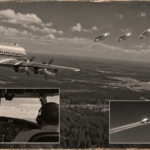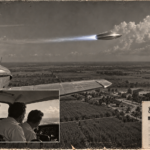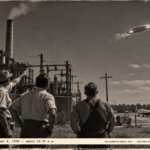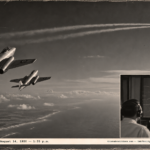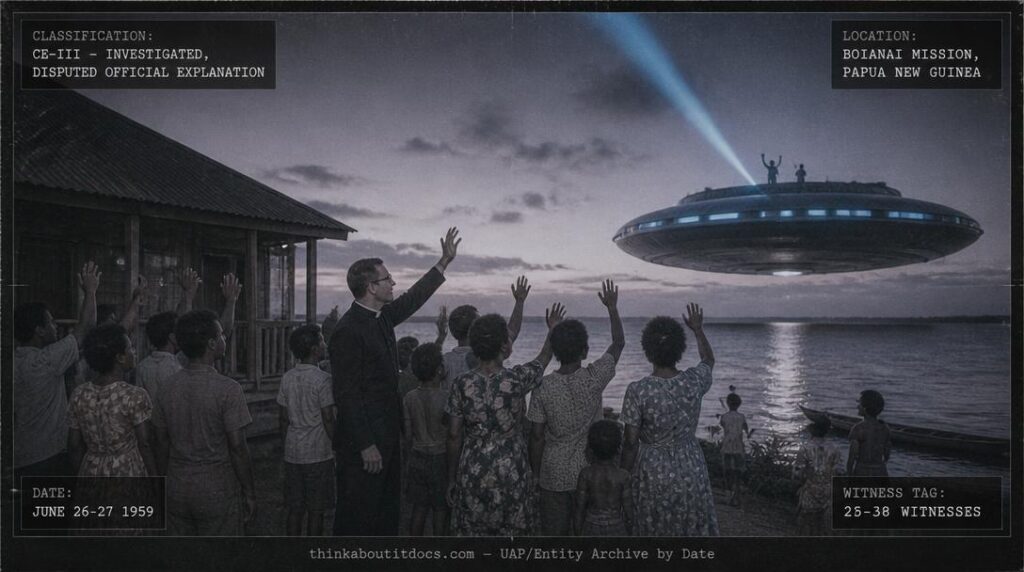
Recreation of the June 1959 Boianai, Papua New Guinea sighting, in which Father William Gill and dozens of witnesses watched a disc-shaped craft with human-like figures on its deck, who appeared to wave back when signaled.
THINK ABOUTIT UFO|UAP|ENTITY ENCOUNTER REPORT
1959: Father Gill and the Boianai, Papua New Guinea Encounter
On the evenings of June 26 and 27, 1959, Anglican missionary Father William Booth Gill and dozens of witnesses at the Boianai mission in Papua New Guinea watched a large, disc-shaped craft hover for hours over the coast, four human-like figures visible on an open deck — and on the second night, when Gill raised his arm and waved, the figures reportedly waved back.
Date: June 26 and 27, 1959
Sighting Time: Beginning around 6:00-6:02 PM each evening, continuing for several hours into the night
Day/Night: Evening, extending into night
Location: Boianai Anglican Mission, on the Papua coast, Papua New Guinea (then an Australian territory)
Urban or Rural: Rural — a coastal mission station
No. of Entity(‘s): Four, seen together on the deck of the main craft; individually, witnesses at times saw only one, two, or three visible at once as they moved about
Entity Type: Humanoid
Entity Description: Gill and the other witnesses described the figures as looking entirely human in form and proportion — so ordinary in appearance that Gill initially assumed that, given the chance to approach, they would turn out to be earthly pilots in military uniform. No further physical detail (clothing, facial features) beyond their human silhouette is recorded. On the second night, two of the figures appeared to be occupied with some task near the center of the deck, periodically bending and raising their arms as if adjusting equipment not visible to the observers below; a third figure appeared to look down directly at the watching crowd.
Hynek Classification: CE-III (Close Encounter III) — close observation with animate beings associated with the object. This is one of the most frequently cited textbook examples of this category in ufology literature.
Duration: Approximately four hours of UFO activity on the night of June 26; renewed activity beginning around 6:00 PM on June 27 and continuing, with breaks, into the evening, including roughly 20-25 minutes of sustained close observation and apparent mutual signaling with the figures on the deck
No. of Object(s): 1 primary/main object (the large disc-shaped craft with the visible figures), plus 2 additional smaller UFOs reported stationary in the sky at the same time on June 27 — one over nearby hills to the west, one directly overhead
Description of the Object(s): A large, solid, circular craft with a wide base and a narrower upper deck, appearing to rest on four leg-like structures underneath. Around its side were roughly four panel- or porthole-like features that glowed slightly brighter than the rest of the hull. At intervals, the object emitted a shaft of blue light projected upward into the sky at roughly a 45-degree angle. The object was described by Gill as looking like an entirely ordinary, earth-made craft — he compared its unremarkable appearance to that of a Ford car — rather than anything overtly alien in styling.
Shape of Object(s): Disc-shaped, with a wide lower base and a narrower upper deck
Size of Object(s): Described only as large; no numeric diameter is recorded in this source
Color of Object(s): The hull itself is not given a specific color beyond its brighter glowing panels/portholes; the craft’s projected light beam was blue
Distance to Object(s): On the first sighting over the sea, the object was estimated at roughly 150 meters above the water throughout the observation
Height & Speed: Gill separately estimated the cloud base that evening at approximately 600 meters, distinct from the object’s own altitude, which was judged at roughly 150 meters above the water during the initial sighting. The main object was largely stationary throughout the observation periods, with only slight apparent changes in size interpreted by some later analysts as minor changes in distance or altitude.
Number of Witnesses: 38 people on the main occasion, including Gill, mission teachers Stephen (Steven) Gill Moi and Ananias Rarata, and Mrs. Nessie Moi, among others; reports describe roughly 25-38 witnesses depending on the specific moment and night in question
Special Features/Characteristics: On the second night, Gill and the assembled witnesses waved at the figures on the deck; the figures appeared to wave back, and this exchange was repeated by other witnesses with the same apparent response. Gill also had a torch signal directed at the object, which was followed by what appeared to be an answering wavering motion from the object and a brief apparent movement toward the observers before it stopped. At 10:40 PM that night, an unexplained, sharp, loud explosion was heard near the mission, though nothing was visually observed at the time due to overcast skies. This sighting occurred amid a wider wave of reported UFO activity in the New Guinea region, with roughly 60 separate sightings reported in the surrounding weeks.
Case Status: Unexplained (Investigated) — this case was formally investigated by the Royal Australian Air Force and, independently, by astronomer J. Allen Hynek and the Center for UFO Studies. The RAAF’s official explanation attributed the sightings to a combination of visible planets (Jupiter, Saturn, Mars), cloud movement, and light refraction; Hynek’s own investigation concluded this explanation could account for some secondary lights but not the primary object, given its size and its lack of movement over an extended, multi-hour observation period.
Source: Bill Chalker, “The Oz Files: The Australian UFO Story” (Duffy & Snellgrove, Sydney, 1996), drawing on Chalker’s own interviews with Rev. Gill and Gill’s original 1959 written statements; Rev. Norman E.G. Crutwell, FSR Special Issue #4; official Royal Australian Air Force investigation records; and the Center for UFO Studies (Dr. J. Allen Hynek and Allen Hendry)
Summary/Description: William B. Gill, an Anglican priest at the Boianai mission in Papua New Guinea, observed a disc-shaped craft with human-like figures visible on its deck on two consecutive evenings, June 26-27, 1959. Roughly 25 to 38 local residents, including mission teachers and medical technicians, also witnessed the phenomena. On the second night, witnesses signaled to the figures by waving and using a torch, and appeared to receive a response in kind. The sighting was one of roughly 60 UFO reports across the New Guinea region within a few weeks and became one of the most widely cited multi-witness UFO encounters on record, drawing formal investigation from both the Australian government and independent ufologists including Dr. J. Allen Hynek.
Detailed Report
The day before his own sighting, Gill had already written to a colleague, the Reverend David Durie, forwarding a UFO report from one of his mission’s assistant teachers and noting a pattern of recent sightings in the area, particularly around nearby Mount Pudi. In that letter, Gill described himself as skeptical of an extraterrestrial explanation, favoring instead the possibility of some form of electrical phenomenon or an unusual side effect of nuclear testing, and closed the letter signing himself “Doubting William.” Less than 24 hours later, his position had changed entirely.
On the evening of June 26, Gill first noticed a bright white light in the northwestern sky, which appeared to approach and then hover. Over the course of the evening, 38 people gathered to watch what became the main object: a large, solid, disc-shaped craft with a wide base and a narrower upper deck, resting on what appeared to be four leg-like supports, with roughly four brighter panel- or porthole-like features around its side. At intervals it projected a shaft of blue light upward at roughly a 45-degree angle. Witnesses saw what appeared to be human figures appear on an open deck atop the craft — sometimes one, sometimes as many as four at once — before the light beam and the figures disappeared and the object moved off through clouds. Gill estimated the object’s altitude at roughly 150 meters above the water and the evening’s cloud base at about 600 meters, and judged the main observation period at around 25 minutes.
The object, or one very similar to it, returned the following evening, first spotted around 6:00 PM by another mission resident and confirmed by Gill two minutes later. As dusk settled, Gill, Ananias Rarata, and a small group of onlookers watched figures reappear on the deck, again numbering up to four. Two of the figures seemed occupied with a task near the center of the deck, periodically bending and raising their arms; a third appeared to look down at the group below. Gill raised his arm and waved — and, to the group’s evident surprise, the figure appeared to wave back. When Ananias waved with both arms, two more of the figures did the same. The gathered onlookers, described as gasping in a mix of joy and surprise, repeated the gesture and again seemed to receive a response. As darkness closed in, Gill had a mission member fetch a torch and signaled the object with a series of long flashes; after a short pause, the object appeared to respond with a wavering back-and-forth motion, seemed to grow slightly larger as if approaching, then stopped and came no closer. The figures eventually withdrew from view, reappeared briefly a short while later, and the blue light beam activated twice more before the group, after roughly four hours total that evening, went in to dinner and later to evensong. Gill would later address the frequent criticism that this decision seems strange, explaining that after an extended and ultimately inconclusive encounter the previous night, the group’s sense of urgency had understandably diminished, and that nothing about the object’s appearance or behavior felt otherworldly to him in the moment — he described it as looking as ordinary as a car, and initially expected that if the pilots could be reached, they would prove to be ordinary men in uniform. Two smaller, stationary UFOs were also reported elsewhere in the sky that same evening. Later that night, at 10:40 PM, a sharp, loud explosion was heard near the mission house under an overcast sky, with nothing visually observed to explain it.
Gill was already due to return to Australia when the case became public that August, drawing significant media attention and prompting civilian UFO research groups to distribute his report to members of the Australian federal parliament. A parliamentary question that November to the Minister for Air went largely unanswered on the specific point of whether Air Force Intelligence had investigated the case; the RAAF did not formally interview Gill until six months after the sighting, in a session Gill later recalled as brief and focused mainly on general discussion of stars and planets. The RAAF’s official conclusion, delivered by Squadron Leader F.A. Lang, held that the June-July sightings were most likely natural phenomena — potentially the planets Jupiter, Saturn, and Mars — misperceived under unsettled, cloudy weather conditions, with light refraction and shifting cloud density potentially accounting for the perceived size, movement, and humanoid shapes. Independent investigation reached a different conclusion on the central object: Dr. J. Allen Hynek and Center for UFO Studies chief investigator Allen Hendry agreed that some of the secondary lights that night were likely bright stars or planets, but concluded the primary craft’s size and its lack of movement over several hours ruled out a straightforward astronomical explanation. A later proposal that the group had mistaken a lit fishing boat, seen against a false horizon, for a hovering craft has also been challenged on the grounds that Gill was specific and consistent that the object sat at roughly 30 degrees of elevation in the sky, not near the horizon. In 1973, Hynek traveled to Australia and Papua New Guinea and located six of the original witnesses, all of whom independently supported Gill’s account of what had happened. The case later inspired Australian novelist Randolph Stow’s 1979 novel “Visitants,” which used the Boianai sightings as a fictionalized backdrop. Gill himself, interviewed again years later, maintained that the sightings remained unexplained to him, while pushing back gently on the idea that conventional explanations offered for the case should be dismissed as unserious, viewing them instead as good-faith attempts at understanding.
RESEARCHER’S NOTES
The Boianai Visitants — 1959 and Ufology’s Best-Known Multi-Witness Case
- Classification Assessment: CE-III fits precisely and unambiguously — this is among the cases most frequently used to illustrate the category in ufology literature: a landed or hovering craft with clearly observed animate beings directly associated with it, witnessed at length by dozens of people.
- Source Chain Assessment: Few cases in this archive have a source chain this strong. The primary witness was a credentialed Anglican missionary with no evident motive to fabricate a story, corroborated in writing the same week by his own contemporaneous letters (written, notably, expressing skepticism before his own sighting). Dozens of named local witnesses were present, several were separately interviewed, and the case drew formal investigation from both a national air force and an independent team led by a professional astronomer. When Hynek returned to the region 14 years later, he was able to locate and re-interview six original witnesses, all of whom held to their original account without prompting or reward.
- Evidentiary Weight: No photograph exists. The case’s evidentiary weight instead rests on witness count, duration, consistency across multiple interviews and years, and the specific, repeatable nature of the reported signaling exchange. The RAAF’s own official explanation (misidentified planets under unsettled weather) was directly examined and disputed by Hynek’s team on specific technical grounds — the primary object’s size and total lack of movement over several hours are not properties planets exhibit — making this one of relatively few cases in this archive where a named official explanation was formally offered and then specifically, technically contested by independent investigators, rather than simply asserted either way.
- Pattern and Comparative Context: The Boianai sightings occurred within a broader flap of roughly 60 reported UFO sightings across the New Guinea region within a few weeks, a genuine cluster pattern rather than an isolated event. The case is widely regarded within ufology as one of the strongest documented instances of apparent two-way signaling between witnesses and an unidentified craft’s occupants, and it directly influenced fictional treatment in Australian literature via Randolph Stow’s 1979 novel “Visitants.”
- Geographic and Historical Context: Papua New Guinea was an Australian territory in 1959, which is why the case was investigated by the RAAF and drew the attention of the Australian federal parliament rather than any other national body. The mission setting, with a resident community of trained teachers and medical staff serving as much of the witness pool, is part of why this case has been treated as unusually credible within the broader ufology literature.
Few UFO cases anywhere have the combination this one has: a credentialed, reluctant witness who wrote himself into skepticism the day before his own sighting, three dozen corroborating observers, a specific and repeated signaling exchange, and two separate, serious formal investigations that reached different conclusions about the very same object. The RAAF’s planetary explanation remains on record; so does Hynek’s specific, technical rejection of it for the primary craft. Six witnesses still stood by the story 14 years later. The case remains Unexplained.
“It was all so ordinary, as ordinary as a Ford car.”