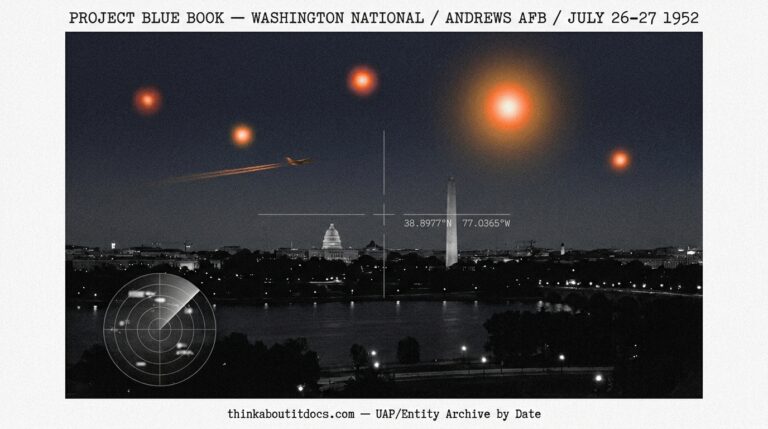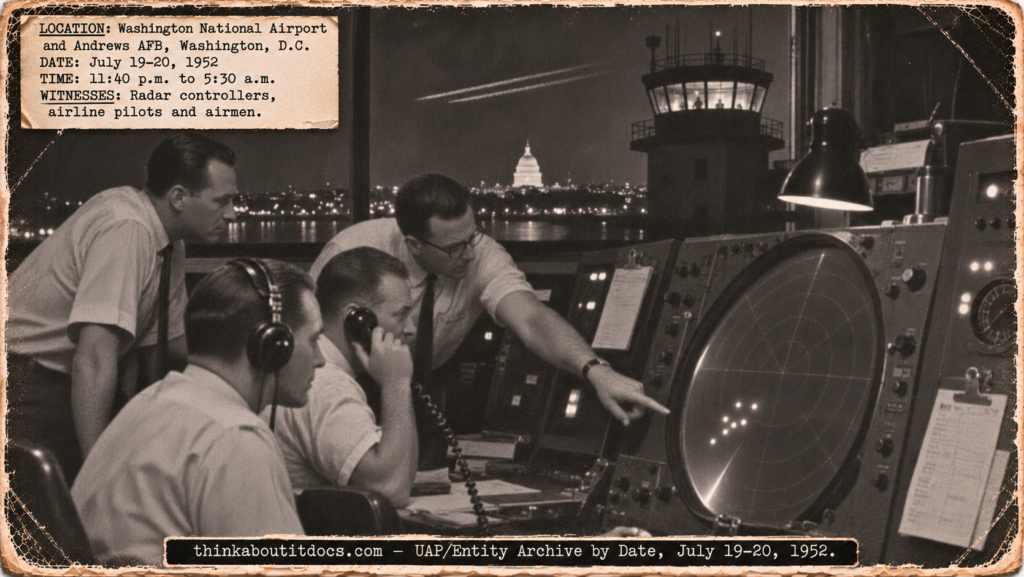
Washington, July 19-20, 1952: the scopes fill up.
THINK ABOUTIT UFO|UAP SIGHTINGS REPORT
Washington National Airport, First Weekend:
Radar Targets, F-94s and a Night the Capital’s Scopes Filled, July 19-20, 1952
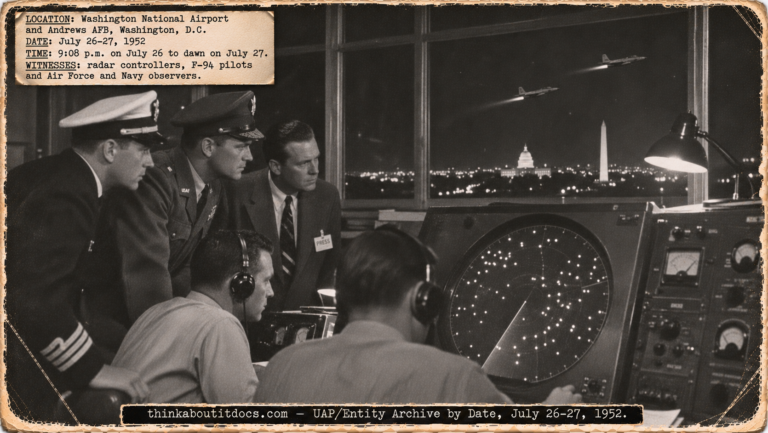
At 11:40 on the night of July 19, 1952, air traffic controller Edward Nugent at Washington National Airport spotted seven objects on his radar about 15 miles south-southwest of the city. No known aircraft were in the area, and the objects followed no established flight path. His supervisor, Harry Barnes, had two controllers check the set. It was working normally. Before the night was over, targets had been tracked at National Airport and Andrews Air Force Base, an airline pilot had counted six fast white lights from his cockpit, and an object hovering over a radio beacon had vanished from all three radar centers at the same moment.
The Washington National Airport UFO sightings of July 19-20, 1952 ran for over six hours. When two F-94 Starfire jets arrived from New Castle Air Force Base around 3 a.m., the objects disappeared from the scopes. When the jets, low on fuel, left, the objects returned. Newspapers across the country ran the story the next day. Project Blue Book carries it as an Unknown.
Date: July 19-20, 1952
Sighting Time: 11:40 p.m. to 5:30 a.m. (radar); visual sightings through the night
Day/Night: Night
Location: Washington National Airport and Andrews AFB, Washington, D.C., United States
Urban or Rural: Urban
No. of Entity(‘s): Not Applicable
Entity Type: Not Applicable
Entity Description: Not Applicable
Hynek Classification: Radar-Visual (RV)
Duration: Over 6 hours of radar tracking; the last radar detection was at 5:30 a.m.
No. of Object(s): Seven objects on radar at 11:40 p.m.; additional targets in every radar sector through the night
Description of the Object(s): Radar targets that appeared to hover, move slowly, reverse direction and accelerate; white, tailless, fast-moving lights seen from the air; an orange ball of fire with a tail seen from the ground at Andrews; an orange-red light that stood still, then changed direction and altitude abruptly
Shape/Size/Color of Object(s): Lights: white; orange-red; an orange ball with a tail. Size not recorded
Distance to Object(s): The first seven targets were about 15 miles south-southwest of the city
Height & Speed: Targets moved slowly at times and at other times reversed direction at speeds calculated up to 7,000 mph (sources attach this figure to both weekends)
Number of Witnesses: At least 7 named or identified: controllers Edward Nugent, Harry Barnes, Howard Cocklin and Joe Zacko; Capital Airlines pilot S. C. Pierman; airman William Brady; Staff Sgt. Charles Davenport; plus radar operators at three centers
Special Features/Characteristics: Radar targets confirmed by two airports; visual sightings by pilots and Andrews personnel; objects vanished when F-94s arrived and returned when they left; a hovering object vanished from all three radar centers at once
Case Status: Project Blue Book: Unknown (BBU)
Source: Berliner; Sparks; Project 1947 (AFOSI, UFOE and CAA entries); Wikipedia (1952 Washington, D.C. UFO incident); History.com; CCL Item #23
Summary/Description: Controllers at National Airport tracked seven unidentified targets at 11:40 p.m. Andrews confirmed visually and by radar. Targets vanished when F-94s arrived at about 3 a.m. and returned when the jets left. Blue Book: Unknown.
Related Cases: The Second Washington National Airport Weekend, July 26-27, 1952; the Samford press conference of July 29, 1952; Fort Monmouth radar case of July 1, 1952
Detailed Report
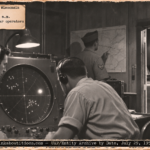
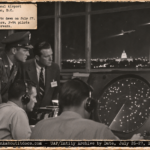
At 11:40 p.m. on July 19, 1952, controller Edward Nugent at Washington National Airport saw seven objects on radar, about 15 miles south-southwest of the city. No known aircraft were there, and the objects did not follow an established flight path. Nugent’s superior, Harry Barnes, had two controllers check the radar. They found it working normally. Controllers Howard Cocklin and Joe Zacko in the tower reported their own blips and a hovering bright light that left at incredible speed. Project 1947 lists the first radar pickups at about 2340 EDT.
Barnes called Andrews Air Force Base, ten miles away. Andrews radar showed nothing unusual at first, but airman William Brady in the tower saw an orange ball of fire trailing a tail, which “took off at an unbelievable speed.” Capital Airlines pilot S. C. Pierman, waiting in a DC-4 on a runway, observed six white, tailless, fast-moving lights over 14 minutes. Barnes said each sighting matched a radar blip near the plane. Staff Sgt. Charles Davenport at Andrews saw an orange-red light that seemed to stand still, then changed direction and altitude abruptly. An object hovering over a radio beacon vanished from all three radar centers at the same moment.
Around 1 a.m., a Capital Airlines crew saw three objects “like falling stars without tails,” and three more between Herndon, Virginia and Martinsburg, West Virginia. At about 3 a.m., a Capital Airlines flight inbound to National reported a light following it from Herndon to about four miles west of the airport, and radar confirmed it.
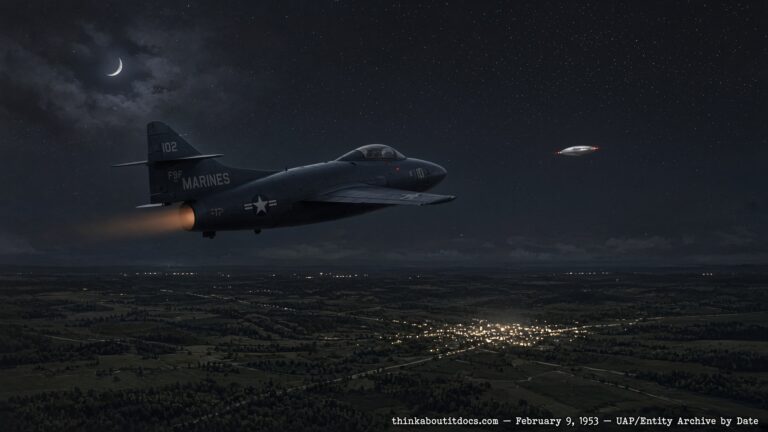
At about 3 a.m., two F-94 Starfire jets from New Castle AFB, Delaware, arrived over the city. The objects disappeared from National’s radar. When the jets left to refuel, the objects returned. Barnes concluded that “the UFOs were monitoring radio traffic and behaving accordingly.” The last radar detection was at 5:30 a.m. Numerous other visual, radar and radar-visual reports followed through the six-hour period.
Newspapers carried the story on their front pages the next day, including the headline “SAUCERS SWARM OVER CAPITAL.” Project Blue Book’s Capt. Edward Ruppelt learned of the sightings on July 21. Back in Dayton, Capt. Roy James suggested unusual weather could have caused the radar targets.
RESEARCHER’S NOTES
What the First Weekend Establishes
- Two radar sets: National Airport and Andrews each had a radar. The two sets did not always agree, and the sources note that Andrews showed nothing at first. Targets on the second set came later.
- Time of the F-94 arrival: Your date page said 11:30 p.m. for the jets’ arrival, which conflicts with the 11:40 p.m. first sighting. The accounts I used place the F-94s over the city at about 3 a.m.
- The 7,000 mph figure: Controllers calculated a top speed of 7,000 mph on some targets. Wikipedia attaches the figure to the second weekend; your archive and other summaries attach it to the first. Calculated speeds of radar blips are only as good as the assumption that the blips are one object.
- The weather explanation: Capt. Roy James at Dayton suggested unusual weather. Temperature inversions can bend radar beams and produce false returns, which is the explanation the Air Force later gave. The pilots’ visual sightings are the part inversion does not explain.
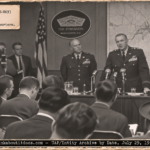
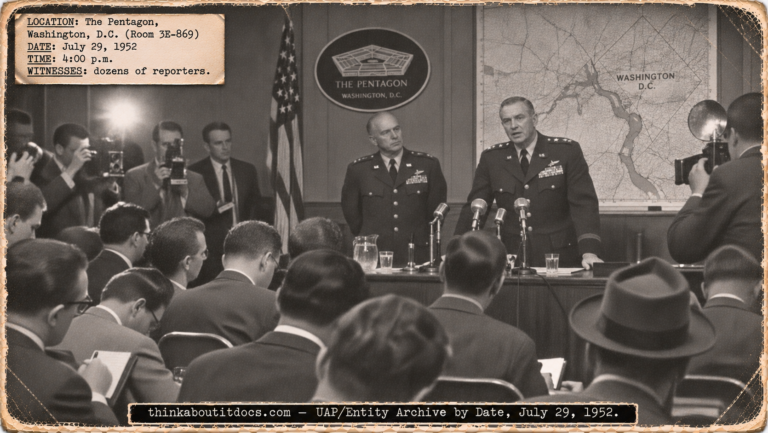
- Press and public: The story reached front pages nationwide within a day, which pushed the Air Force to hold its July 29 press conference.
The first Washington National Airport weekend is the best-documented event of the 1952 wave: named controllers, two radar sites, airline and military pilots, and a press response that changed Air Force policy. It does not prove what the targets were. It shows that the Air Force had no ready explanation for a night when trained operators believed their own radar.
“The UFOs were monitoring radio traffic and behaving accordingly.”
— Harry Barnes, senior controller, Washington National Airport, on the night of July 19-20, 1952