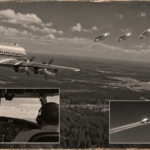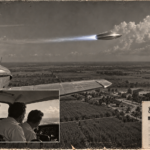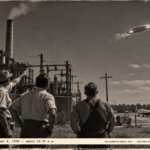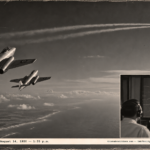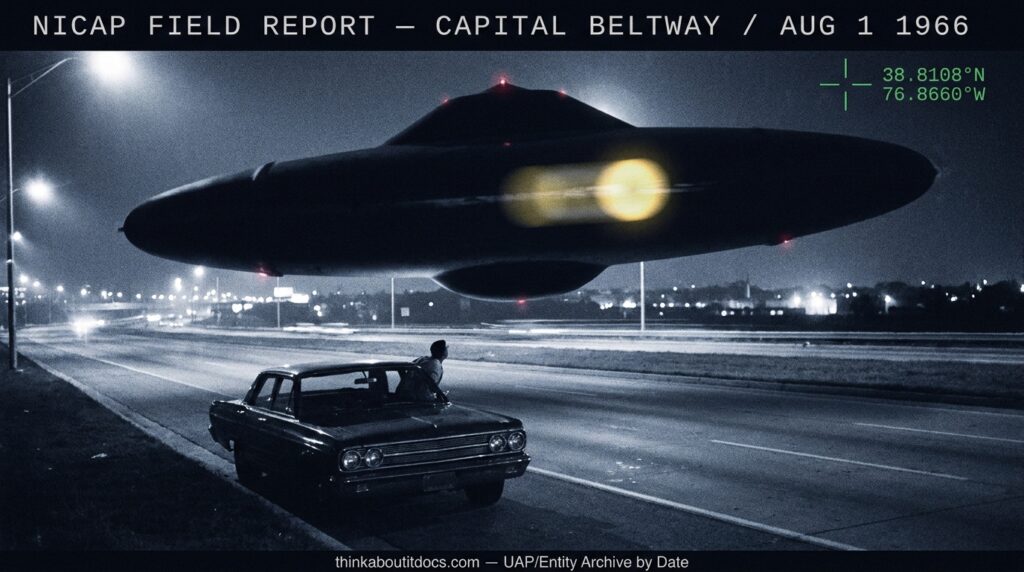
August 1, 1966 — Physicist Dr. Vasil Uzunoglu observed a house-sized submarine-shaped craft with a revolving yellow "eye" at 200 feet from the Capital Beltway near Andrews AFB. Reported to NICAP.
THINK ABOUTIT UFO|UAP SIGHTING REPORT
1966: Oblong Object Descends over the Capital Beltway near Andrews AFB
On the night of August 1, 1966, physicist and micro-electronics consultant Dr. Vasil Uzunoglu was driving the Capital Beltway past Andrews Air Force Base when a large oblong craft — described as resembling a submarine and as large as a house — descended to an estimated 200 feet from his position. At that range, Uzunoglu observed structural details for approximately ten seconds: a peaked top with a red light, a rounded undersurface with red lights, and a large off-center yellow revolving “eye” that appeared to be scanning. The body was dark, non-reflective, with no sharp edges. The object then departed south at very high speed. Uzunoglu reported the sighting to NICAP, providing the kind of precise structural observation that only a trained scientific observer at close range can produce.
The sighting occurred during a two-day flurry of activity across the Washington-Baltimore corridor on July 31 and August 1, 1966, during which Prince George’s County police watched luminous objects maneuvering erratically and Baltimore residents were awakened by an egg-shaped craft with a loud whirring noise.
Date: August 1, 1966 (part of a July 31–August 1 flap)
Sighting Time: Approximately 10:55 p.m. EDT
Day/Night: Night
Location: Capital Beltway (I-495), east of Andrews Air Force Base, Prince George’s County, Maryland (Washington, D.C. metropolitan area)
Urban or Rural: Suburban / highway
No. of Entity(‘s): 0
Entity Type: N/A
Entity Description: N/A
Hynek Classification: CE-I (Close Encounter I) — Object observed at close range (estimated 200 feet) with structural detail visible. The existing NL (Nocturnal Light) classification on the original page is incorrect; at 200 feet with a ten-second structural observation by a trained physicist, this case meets CE-I criteria.
Duration: Approximately 10 seconds of close-range structural observation; preceded by an initial sighting of a descending light minutes earlier
No. of Object(s): 1 (primary close-range observation); additional objects observed by other witnesses during the same flap
Description of the Object(s): Large oblong craft resembling a submarine, as large as a house. Dark, non-shining body material with no sharp edges. Peaked top with a red light. Rounded undersurface with red lights. A large, off-center yellow revolving or scanning “eye” — the most striking feature — with two distinct yellow regions, the lower of which appeared to revolve, blink, or scan. No wings or conventional airframe features.
Shape of Object(s): Oblong / submarine-shaped
Size of Object(s): As large as a house
Color of Object(s): Dark, non-reflective body; red lights on top and bottom; large yellow revolving light off-center
Distance to Object(s): Estimated 200 feet
Height & Speed: Descended to approximately house-rooftop level beside the Beltway; departed south at very high speed, disappearing in seconds
Number of Witnesses: 1 for the primary CE-I observation (Dr. Uzunoglu). Multiple additional witnesses during the same July 31–August 1 flap: Prince George’s County police (erratically maneuvering lights), Baltimore Country Ridge residents (egg-shaped craft with whirring noise and flashing lights)
Special Features/Characteristics: Revolving yellow “eye” with apparent scanning function. Submarine-like oblong morphology. Dark, non-reflective hull material. No conventional airframe features (no wings, no tail assembly). High-speed departure south at low elevation. Observed by a physicist and micro-electronics consultant — a trained scientific observer. Part of a multi-night, multi-location flap involving police witnesses and Baltimore residential sightings.
Case Status: Unexplained
Source: NICAP (National Investigations Committee on Aerial Phenomena) — nicap.org, Section IV | Baltimore News-American, August 1, 1966
Summary/Description: Physicist Dr. Vasil Uzunoglu observed a house-sized oblong craft at 200 feet from the Capital Beltway near Andrews AFB on August 1, 1966. He described a dark submarine-shaped body with red lights and a large yellow revolving “eye.” The object departed at very high speed. The sighting occurred during a two-day DC-Baltimore flap involving police and civilian witnesses. Reported to NICAP.
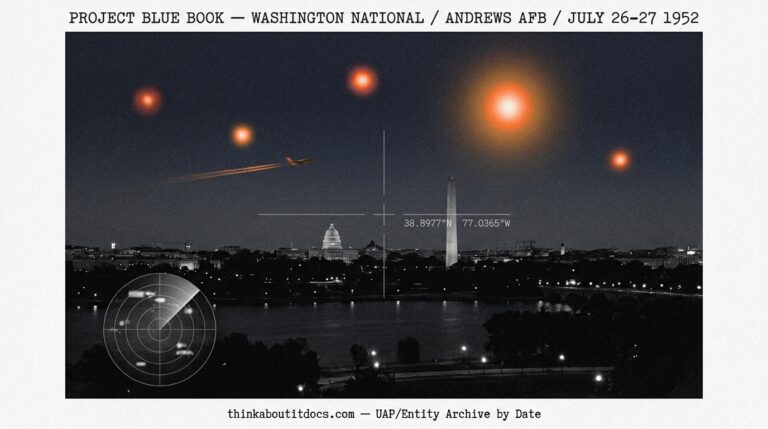
Related Cases: 1952: Washington, D.C. UFO overflights (radar-visual, jet intercepts, same airspace) | 1966 Baltimore Country Ridge egg-shaped craft (same flap, July 31–August 1)
Detailed Report
On the evenings of July 31 and August 1, 1966, the Washington-Baltimore metropolitan corridor experienced a concentrated flurry of UAP activity. Prince George’s County police observed luminous objects maneuvering erratically across the sky. In Baltimore, residents of the Country Ridge housing development were awakened in the early morning hours of August 1 by barking dogs; at least two families observed a hovering egg-shaped object with flashing lights on top and bottom that produced a loud whirring or whining noise, as reported by the Baltimore News-American.
Against this backdrop, the most detailed individual observation came from Dr. Vasil Uzunoglu, a physicist who served as a consultant on micro-electronics — a professional background that gave him both observational discipline and credibility as a technical witness. On the night of August 1, Uzunoglu was driving north and east on the Capital Beltway at approximately 10:55 p.m. EDT. He had passed Andrews Air Force Base when, through his open left window, he saw a light descend and appear to hover briefly before moving rapidly to the east.
Minutes later, a second event occurred — and this one was close. An oblong object descended over a house to Uzunoglu’s left. It was massive — its apparent size as large as the house itself. Uzunoglu slowed his car and observed the object, now an estimated 200 feet away, for approximately ten seconds. At that range, the craft revealed structural details that a physicist would be uniquely equipped to describe with precision.
The body was oblong, resembling a submarine. The material was dark and non-reflective, with no sharp edges — a smooth, continuous surface. The top was peaked and bore a red light. The underside appeared rounded, also carrying red lights. The most striking feature was an off-center element Uzunoglu described as an “eye-like object” — a large yellow structure with two distinct regions, the lower of which appeared to revolve, blink, or scan. Uzunoglu told NICAP: “The most striking part was the eye-like object off-center to the right, with two distinct yellow regions… the lower region was revolving, blinking or scanning.”
Uzunoglu turned his attention back to the highway, noting that no other vehicles were in sight. When he looked back, the object was moving south at very high speed and comparatively low elevation. It disappeared in seconds.
Researcher’s Notes
The Beltway Submarine — Washington 1966 and the Physicist’s Ten Seconds
- Classification Correction — NL to CE-I: The existing NL (Nocturnal Light) classification on the original page is incorrect and should be upgraded to CE-I (Close Encounter I). The Hynek system defines NL as a “point or extended luminous source observed at night” — a category for distant lights without discernible structure. Uzunoglu observed the object at an estimated 200 feet for ten seconds and described detailed structural features: hull shape, surface material characteristics, multiple light configurations, and an apparently functional revolving “eye.” This is a close-range structural observation that clearly exceeds NL parameters. CE-I — observation of an object with discernible structure in close proximity (within 500 feet) — is the correct classification.
- Witness Caliber: Dr. Vasil Uzunoglu’s professional background as a physicist and micro-electronics consultant places him among the highest-caliber witnesses in the UAP literature for this type of observation. A physicist working in micro-electronics brings three analytical advantages to a sighting: comfort with precise physical description, familiarity with the difference between known and unknown technology, and professional credibility that discourages casual dismissal. Uzunoglu’s description — the dark non-reflective hull, the peaked top, the revolving scanning element — reads like a technical observation report, not a startled civilian’s impression. His account was filed directly with NICAP, the most rigorous civilian UAP investigation organization of the era.
- The Revolving “Eye”: The off-center yellow element that Uzunoglu described as revolving, blinking, or scanning is the case’s most distinctive detail. A revolving or scanning light on a craft suggests a functional sensor or illumination system — purposeful technology rather than passive luminescence. The description does not match any standard navigation, anti-collision, or landing light configuration on conventional aircraft of the 1960s. The element’s off-center placement and its apparent scanning motion distinguish it from rotating beacons on helicopters or lighthouses. If accurately described, it implies a craft with active environmental sensing capability.
- The DC-Baltimore Flap Context: Uzunoglu’s sighting did not occur in isolation. The July 31–August 1 flap involved law enforcement witnesses (Prince George’s County police), residential witnesses (Baltimore Country Ridge), and a physicist — a cross-section of observer types that adds collective weight. The Baltimore egg-shaped craft with its whirring noise and the Beltway submarine with its silent revolving eye represent different morphologies, which either indicates multiple types of craft operating in the same corridor simultaneously or demonstrates the range of perceptual variation across independent witnesses. The proximity to Andrews Air Force Base — the same installation that featured in the 1952 Washington overflights — is notable and invites questions about whether the DC restricted airspace attracts or merely detects aerial anomalies that exist elsewhere unobserved.
Dr. Vasil Uzunoglu’s ten seconds on the Capital Beltway produced one of the most technically detailed nocturnal UAP observations in the Washington, D.C. archive. A physicist at 200 feet, describing a submarine-shaped hull with a revolving scanning eye, constitutes a witness-evidence combination that resists casual dismissal. The object’s morphology does not match any known aircraft of 1966, and its departure speed exceeded anything Uzunoglu — who was driving on the Beltway and therefore had a velocity reference — could account for. The sighting belongs within the broader DC-Baltimore flap of that weekend but stands on its own merits as a close-range structural observation by a trained scientist. The NL classification was an error; this is a CE-I, and a strong one.
Media