Los Alamos, June 24, 1952.
THINK ABOUTIT UFO|UAP SIGHTINGS REPORT
Los Alamos, New Mexico:
Protective Force Officers Watch a Green Ball With a Red Flame Tail
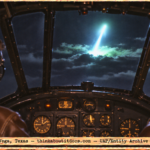
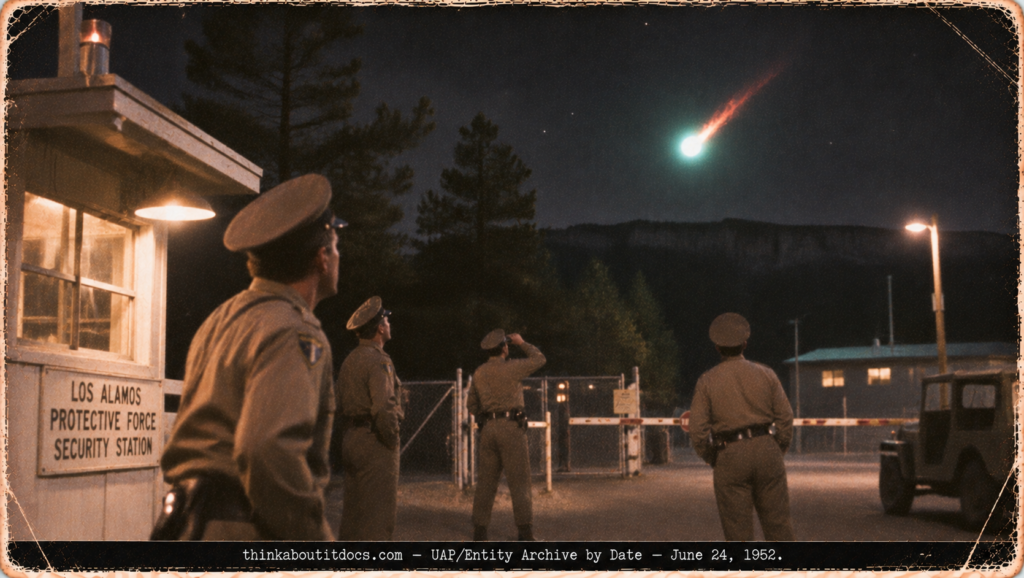
On the night of June 24, 1952, several members of the Los Alamos Protective Force looked up to see a slow, bluish-green ball of fire with a protruding red flame tail, crossing from east to west for about ten seconds. It left a trail of light that faded behind it, and though one witness thought it might be a meteor, he added that it was neither the color nor the speed of one.
The Los Alamos, New Mexico green fireball sighting of June 24, 1952 was reported through Kirtland AFB’s 34th Air Division, which scrambled “Idaho 15” without result. Blue Book evaluated the group Astro (meteor).
Date: June 24, 1952
Sighting Time: About 9:00 p.m. MST (one statement gives 2206)
Day/Night: Night
Location: Los Alamos, New Mexico
Urban or Rural: Rural (laboratory community)
No. of Entity(‘s): Not Applicable
Entity Type: Not Applicable
Entity Description: Not Applicable
Hynek Classification: Nocturnal Light (NL)
Duration: About 10 seconds
No. of Object(s): 1
Description of the Object(s): A bluish-green ball of fire with a protruding red flame tail and a trail of light that faded; one witness saw a green ball with an orange tint
Shape/Size/Color of Object(s): Round / “size of bowling balls” per one witness / bluish-green with a red-orange tail
Distance to Object(s): About two miles per one witness
Height & Speed: Slow (one witness: 250–300 mph); descending at 30–45°
Number of Witnesses: Several Los Alamos Protective Force personnel and civilians
Special Features/Characteristics: No sound; moved east to west; “Idaho 15” was scrambled and sighted nothing; witnesses doubted it was a conventional aircraft and thought it might be a meteor
Case Status: Astro (meteor) per Blue Book
Source: Air Intelligence Information Reports, 34th Air Division (Defense), Kirtland AFB, June 30, 1952, with witness statements
Summary/Description: Several Los Alamos guards and officers saw a slow bluish-green fireball with a red flame tail cross the sky for about ten seconds.
Related Cases: Spokane, Washington, June 23, 1952
Detailed Report
The Air Intelligence Information Report states that the object’s shape was circular with a tail, its color bluish-green with a protruding red flame tail, with a trail of light that seemed to fade out. Its speed was “rather slow.” Observation was visual at about 2100 MST for about ten seconds, from Los Alamos, the object appearing to come from the east and disappear in the west. The observer was considered reliable, weather was unlimited with wind 10–15 mph from the south, and a fighter, Idaho 15, was scrambled but sighted nothing. The report adds that it might have been a meteor but that it was not the color of one and was traveling much slower.
Statements from several Protective Force personnel were attached. One described a green ball with a red flame tail coming from the east, seen for a second or two, before it disappeared. Another, seen from his apartment doorway, thought of an electrical short and described a green ball with an orange tint. A third inspector wrote that at about 2200 hours he observed round green balls the size of bowling balls with 15–20 foot red-orange tails descending at 30 to 45 degrees about two miles away at 250–300 mph, fading as they neared the ground, and judged it possibly astronomical.
Blue Book’s June 23–30 table lists “Los Alamos, New Mexico” on June 24 with multiple observers and the evaluation Astro (meteor), so no BBU tag is carried.
RESEARCHER’S NOTES
Fireballs Over the Lab
- Time conflict: The AIIR says 2100 MST; one witness statement says 2206. Both are shown.
- Witnesses: Several Protective Force personnel wrote independent statements, and most said it was not an aircraft but possibly a meteor.
- Speed and color: The reporting officer noted that it was slower than a meteor and the wrong color for one.
- Context: Green fireballs over New Mexico were a recurring subject of Air Force interest from 1948 on; this is a modest June 1952 example.
A tidy case with multiple trained observers, a quick scramble and an astronomical evaluation: the Los Alamos report is included for completeness and because its witnesses, like Spokane’s the night before, describe something slower than a meteor.
“It might have been a meteor; however, it was not the color of a meteor.”
— Air Intelligence Information Report, 34th Air Division, Kirtland AFB, June 30, 1952