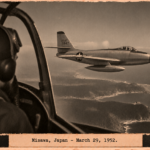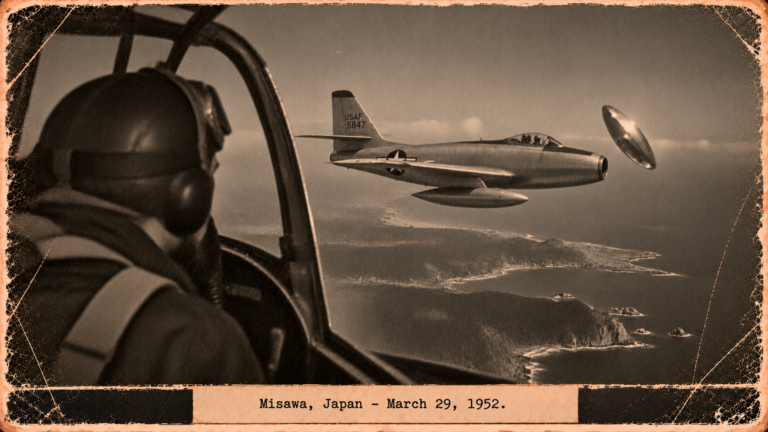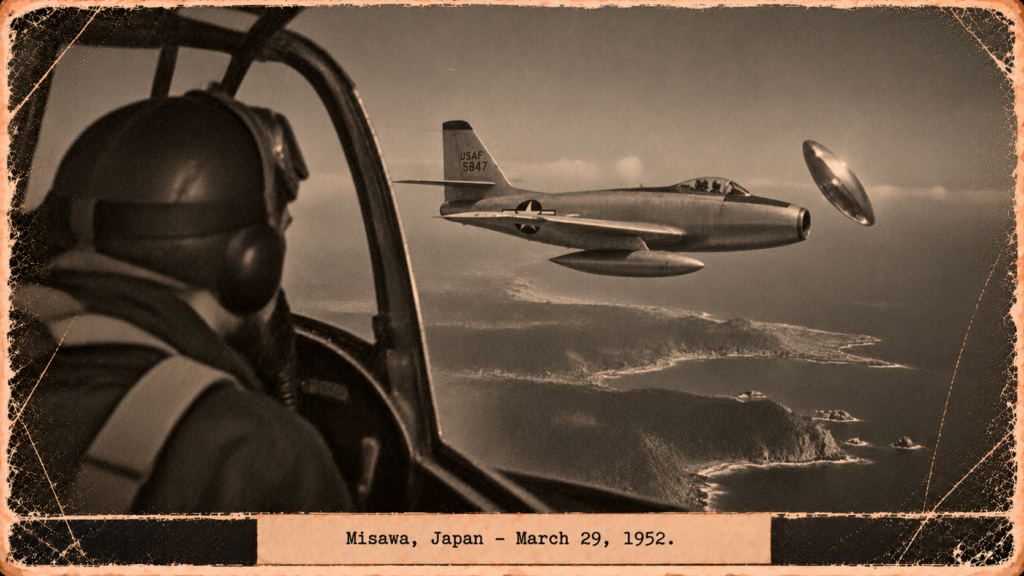
A small chrome disc flutters beside an F-84 near Misawa AFB, March 29, 1952.
THINK ABOUTIT UFO|UAP SIGHTINGS REPORT
1952: A T-6 Pilot Over Northern Japan Watches an Eight-Inch Chrome Disc Overtake an F-84 and Flutter Beside Its Fuselage
At 11:20 a.m. on March 29, 1952, an Air Force pilot flying a T-6 trainer at 6,000 feet about 20 miles north of Misawa AFB, Japan, was serving as the target for a ground-controlled intercept by two F-84s when a flash of reflected sunlight caught his eye. A small, shiny, disc-shaped object was making a pass on the nearest F-84, closing at an estimated 30 to 50 mph faster than the jet.
Just before it would have struck the fuselage the disc slowed almost instantly to the F-84’s speed, flipped up on its edge, and fluttered within two feet of the aircraft for two or three seconds. It then swung around the starboard wingtip tank, crossed in front, and shot away in a steep, almost vertical climb. The Far East Air Forces file on this Misawa, Japan UFO case ends with one word: “UNSOLVED.” Project Blue Book lists it as Unidentified.
Date: March 29, 1952
Sighting Time: 11:20 a.m. local (1120 hours)
Day/Night: Day; weather very good, no clouds remembered
Location: About 20 miles north of Misawa AFB, Honshu, Japan, over the coast
Urban or Rural: Airborne, over coastal waters and land
No. of Entity’s: Not Applicable
Entity Type: Not Applicable
Entity Description: Not Applicable
Hynek Classification: DD (Daylight Disc)
Duration: About 10 seconds
No. of Object(s): 1
Description of the Object(s): A small, thin, round, polished-chrome disc with no apparent projections that left no exhaust or vapor trail
Shape/Size/Color of Object(s): Round and very thin, about 8 inches in diameter, “as shiny as polished chromium”; the pilot compared it to a round piece of shiny sheet metal
Distance to Object(s): Within about 20 feet of the F-84’s fuselage at closest (the Keyhoe version of the statement says two feet); the F-84 was about 100 feet from the T-6
Height & Speed: About 6,000 feet; the T-6 flew at about 130 mph; the F-84 at about 150–160 mph; the disc closed at an estimated 30 to 50 mph above the F-84, slowed almost instantly to its speed, then accelerated away in a near-vertical climb
Number of Witnesses: 1 (the T-6 pilot, a young Air Force pilot from Rockford, Illinois according to Keyhoe); the F-84 pilot did not see it
Special Features/Characteristics: Slow fluttering, rocking back and forth in about 40-degree banks at roughly one-second intervals; flipped on edge at about 90 degrees; no sound, exhaust or trail reported
Case Status: Blue Book: Unidentified (BBU 1082). The FEAF Air Intelligence report concludes “UNSOLVED”
Source: Air Intelligence Information Report TR-23-52 (FEAF, ATIC office); pilot statement of April 19, 1952; Fifth Air Force/Air Defense Force forwarding letter (APO 710, April 19, 1952); Keyhoe, Flying Saucers from Outer Space (1953), p. 192; Berliner; FUFOR Index
Summary/Description: A T-6 pilot being intercepted by two F-84s saw a small chrome disc overtake one jet, flip on edge, flutter beside its fuselage and zoom away. The Air Force could offer only a canopy reflection as a possible explanation and left the case unsolved.
Related Cases: Point Conception B-29 radar target (March 24, 1952); Yakima F-94 fireball (March 22, 1952); March 1952 archive
Detailed Report
The report from the Far East Air Forces intelligence office records that at 1120 hours on March 29, 1952 an unidentified object was observed about 20 miles north of Misawa AFB by an Air Force pilot flying a T-6 type aircraft at 6,000 feet on a northerly heading at about 130 knots. Two F-84s were making practice runs on the T-6 under ground-controlled intercept.
In his statement the pilot says the GCI controller ran the intercept on him with a flight of two F-84s using the call signs “Frosty Mike 3 and 4.” He watched them close from his 7:00 position around to 5:30, and Mike 3 overtook him on the starboard side about 100 feet away and 10 feet below, “taking my number.” As the F-84 pulled abreast at his 4:00 position, a flash of reflected sunshine caught his eye at his 1:00 position.
The object that had reflected the sunshine was a small, shiny, disc-shaped thing making a pass on Mike 3. It closed from slightly above the F-84, from about its 1:00 position, on an approximate pursuit curve, overtaking it at an estimated 30 to 40 mph above the F-84’s speed (the Air Force report says 40 to 50 mph). Just before it would have flown into the fuselage it decelerated to the F-84’s airspeed almost instantaneously, flipped up on its edge at roughly a 90-degree bank, and fluttered within a very short distance of the fuselage for two or three seconds.
It then pulled away around the starboard wing, appearing to flip once as it hit the slipstream behind the wingtip fuel tank, passed the F-84, crossed in front of it, pulled up abruptly and, appearing to accelerate, shot out of sight in a steep, almost vertical climb. The pilot describes it as about eight inches in diameter, very thin, round and as shiny as polished chromium, with no apparent projections and no exhaust or vapor trails. Its unusual flight characteristic was a slow fluttering motion: it rocked back and forth in about 40-degree banks at about one-second intervals throughout its course. The whole sighting lasted about ten seconds.
The report comment says no further information was forthcoming and no explanation could be proposed other than possible reflection and refraction of light through haze, exhaust gases, air currents or the canopy of the observer’s aircraft. The F-84 pilot did not see the object. The conclusion line reads “UNSOLVED.”
RESEARCHER’S NOTES
A Close Pass, a Canopy Theory and One Witness
- One Witness, Reported Three Ways. The statement, the Air Force summary and Keyhoe’s printed version agree on the sequence and on the 6,000-foot altitude. They differ on how close it came (20 feet in the typed summary, two feet in the statement and in Keyhoe) and on how much faster than the jet it closed (30–40 versus 40–50 mph).
- The Official Explanation. ATIC’s office offered only that light might have been reflected or refracted through the canopy, haze, exhaust gases or air currents. The report does not explain how that would produce an object that appeared to overtake a jet, flip on edge and climb away.
- The Other Pilot. The F-84 pilot the object was approaching did not see it, which the report records without comment.
- Blue Book Listing. The Blue Book March list shows Misawa as Unidentified and marks its record cards as missing; the statement and the FEAF report survive in the file labeled San Diego.
- Published Account. Keyhoe printed the pilot’s statement in 1953 (p. 192), which gives the pilot’s home town; the name is blacked out in the file.
Misawa is a one-witness, ten-second case, but it is a daylight sighting by a trained pilot positioned to watch a jet at close range, written down within three weeks and left unsolved by the Air Force’s own intelligence office. That is as good as a single-witness case gets in the 1952 record.
“It was about eight inches in diameter, very thin, round, and as shiny as polished chromium.”
— Pilot statement, T-6 north of Misawa AFB, Japan, March 29, 1952